Options Trading Terms: A Complete Beginner’s Glossary

📚 Beginner’s Guide to Options — Part 49 of 51
- Part 1: What Is an Option? The Absolute Basics Explained
- Part 2: Calls vs. Puts: The Two Types of Options You Need to Know
- Part 3: Strike Price Explained: What It Actually Means for Your Trade
- Part 4: Expiration Date Explained: Why It Changes Everything
- Part 5: Premium Explained: What You’re Really Paying For
- Part 6: In the Money vs. Out of the Money: A Beginner’s Breakdown
- Part 7: Intrinsic Value vs. Extrinsic Value: What Makes Up an Option’s Price
- Part 8: How Buying a Call Option Works, Step by Step
- Part 9: How Buying a Put Option Works, Step by Step
- Part 10: What Happens When an Option Expires? Every Outcome Explained
- Part 11: Options Contracts 101: What One Contract Actually Represents
- Part 12: How to Read an Options Chain Without Getting Overwhelmed
- Part 13: Bid, Ask, and Spread: What They Mean When You’re Trading Options
- Part 14: What Is Implied Volatility? A Beginner’s Plain-English Guide
- Part 15: Why Options Lose Value Over Time: Theta Explained Simply
- Part 16: Delta Explained: What It Really Tells You About Your Option
- Part 17: Gamma Explained: Why Delta Doesn’t Stay the Same
- Part 18: Vega Explained: How Volatility Changes Your Option’s Price
- Part 19: The Greeks Cheat Sheet: Delta, Gamma, Theta, Vega in Plain English
- Part 20: What Is Assignment? What Happens If Your Option Gets Exercised
- Part 21: American vs. European Options: What’s the Difference?
- Part 22: How Much Money Do You Need to Start Trading Options?
- Part 23: Paper Trading Options: How to Practice Before Risking Real Money
- Part 24: The Biggest Mistake Beginners Make Buying Options
- Part 25: Why Most Beginners Lose Money Buying Options (and How to Avoid It)
- Part 26: Covered Calls Explained: The First Options Strategy Every Trader Should Learn
- Part 27: Cash-Secured Puts Explained: A Beginner-Friendly Way to Get Paid to Wait
- Part 28: Vertical Spreads Explained: Reducing Risk on Your First Options Trade
- Part 29: Credit Spreads vs. Debit Spreads: What’s the Real Difference?
- Part 30: The Protective Put Explained: Insurance for Your Stock Position
- Part 31: The Collar Strategy Explained: Protecting Gains Without Selling
- Part 32: Straddles Explained: Betting on a Big Move (In Either Direction)
- Part 33: Strangles Explained: A Cheaper Way to Bet on a Big Move
- Part 34: The Iron Condor Explained for Complete Beginners
- Part 35: The Wheel Strategy Explained: Getting Paid on Stocks You Want to Own
- Part 36: How Earnings Season Changes Options Pricing (and What to Watch For)
- Part 37: Why Options Get More Expensive Before Earnings: IV Crush Explained
- Part 38: Choosing the Right Strike Price for Your First Options Trade
- Part 39: Choosing the Right Expiration Date: Weekly vs. Monthly Options
- Part 40: How to Size an Options Position So One Bad Trade Doesn’t Wreck You
- Part 41: When to Take Profits on an Options Trade (Before It’s Too Late)
- Part 42: When to Cut a Losing Options Trade (Before It Goes to Zero)
- Part 43: Rolling an Options Position: What It Means and When to Do It
- Part 44: Liquidity in Options: Why It Matters More Than Beginners Think
- Part 45: Open Interest vs. Volume: What Each One Actually Tells You
- Part 46: How to Use Options to Hedge a Stock Position You Already Own
- Part 47: LEAPS Explained: Trading Options That Last a Year or More
- Part 48: The Poor Man’s Covered Call: A Cheaper Way to Run the Covered Call Strategy
- Part 49: Common Options Trading Terms Every Beginner Should Know (Glossary) (you are here)
⚡ Key Takeaways
- Options have their own distinct language, and mastering the core vocabulary protects you from costly order-entry mistakes.
- Most trading terms naturally group into contract mechanics, moneyness, pricing components, and order types.
- Bookmark this glossary as a quick-reference translation sheet whenever you encounter unfamiliar trading terms.
— Ben, Find Better Trades
When I first started trading options, I felt like everyone else was speaking a secret dialect designed to confuse newcomers. You will hear traders throw around terms like delta, assignment, extrinsic value, and credit spreads as if they are everyday small talk.
Welcome to Part 49 of our 51-part beginner series. In this guide, we are compiling the essential terms you need to know into one definitive, plain-English reference you can keep handy whenever you look at an options chain.
Contract Foundation and Core Mechanics Terms
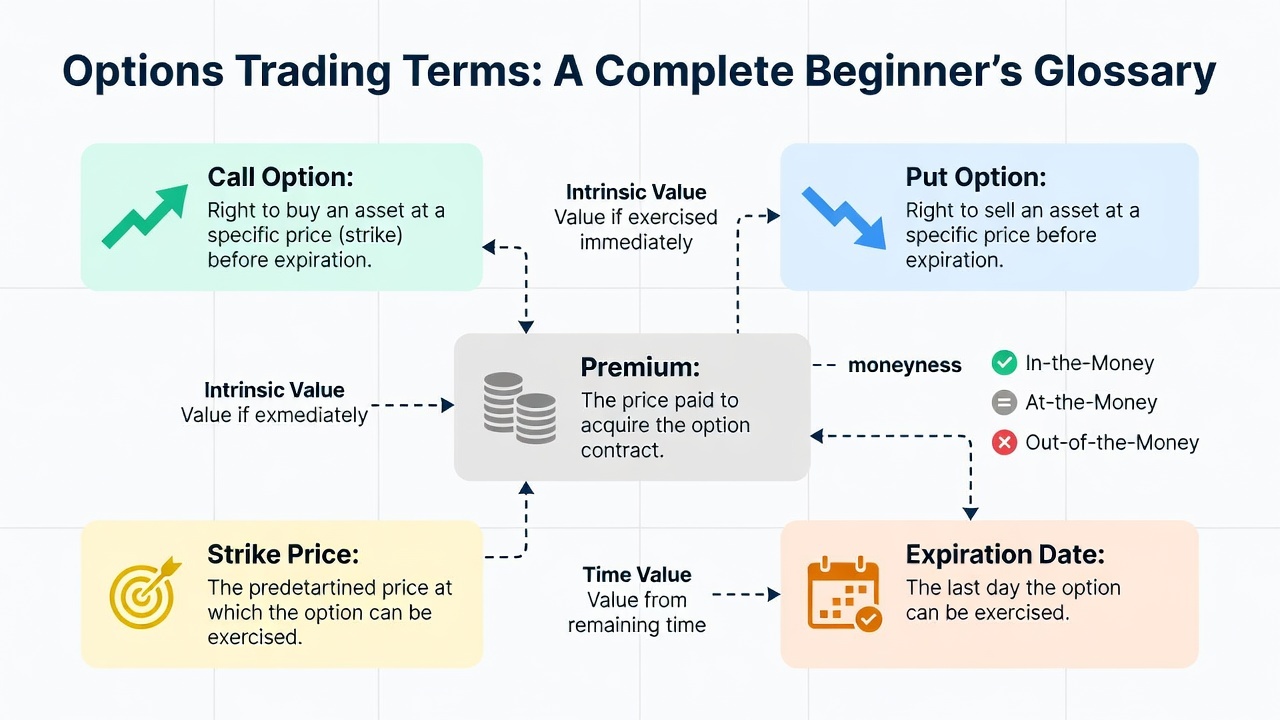
Every options trade starts with a contract, which is a legally binding agreement between two parties. Think of an options contract like a customized reservation ticket that locks in a specific price for a set period.
The underlying asset is the actual stock, exchange-traded fund, or index that the option contract is linked to. If you are trading an option on Apple, Apple stock is your underlying.
The strike price is the predetermined, fixed price at which the contract owner can buy or sell the underlying stock. It acts like an agreed-upon line in the sand that never moves, regardless of where the stock price goes later.
The expiration date is the final date and time that the option contract is valid. Once that deadline passes, the contract ceases to exist and either settles or expires worthless.
The contract multiplier represents the number of underlying shares governed by one standard contract. In the US equity markets, one standard options contract always controls exactly 100 shares of stock.
The premium is the cash price per share paid by the buyer to the seller for the rights granted in the contract. Because of the contract multiplier, you must always multiply the quoted premium by 100 to get your total dollar outlay.
Let us look at a quick numeric example of how these basic terms connect. Suppose XYZ stock is trading at $50 per share, and you buy one XYZ $55 Call expiring in 30 days for a quoted premium of $2.00.
Your strike price is $55, your expiration date is 30 days out, and your cash cost is $200 calculated as $2.00 times the 100-share multiplier. If XYZ never climbs above $55 before the expiration date arrives, the contract expires with zero value.
Directional Terms and Contract Types
Trading options involves taking specific stances on price movement, time, and volatility. Understanding directional language ensures you never press the wrong button when placing an order.
A call option gives the buyer the right, but not the obligation, to buy 100 shares of stock at the strike price before expiration. You buy calls when you are bullish and expect the underlying stock price to climb.
A put option gives the buyer the right, but not the obligation, to sell 100 shares of stock at the strike price before expiration. You buy puts when you are bearish and expect the underlying stock price to decline.
Going long means you are the buyer who opened a position by purchasing contracts. Long positions have defined, capped risk because you can never lose more than the initial premium paid.
Going short means you are the seller or writer who created the contract and collected cash upfront. Short positions carry obligations to fulfill the contract terms if the buyer chooses to act.
The term bullish describes an outlook expecting asset prices to rise over time. Conversely, the term bearish describes an outlook expecting asset prices to fall.
The term neutral describes a market outlook where you expect the stock price to stay relatively flat within a tight trading range. Options allow you to design trades that profit specifically from neutral price action.
Free For Traders
One Clear Arrow. Every High-Probability Setup. Free.
The Fusion Indicator combines multiple signals into a single buy/sell arrow on TradingView so you never miss a move.
 → Get The Free Fusion Indicator
Moneyness and Pricing Component Terms
Moneyness describes the relationship between the underlying stock price and the option contract strike price. It tells you whether exercising the option right now would produce immediate financial value.
An option is In the Money (ITM) when it possesses real, tangible cash value based on current market prices. For a call, this means the stock price is above the strike price; for a put, it means the stock price is below the strike price.
An option is Out of the Money (OTM) when it has no intrinsic value and consists entirely of hope and time. For a call, the stock price sits below the strike; for a put, the stock price sits above the strike.
An option is At the Money (ATM) when the underlying stock price is identical or virtually identical to the strike price. ATM contracts are the most sensitive to immediate shifts in stock price direction.
Intrinsic value is the exact amount of money built into the contract if it were exercised immediately. It can never be negative; an option either has positive intrinsic value or zero intrinsic value.
Extrinsic value, often called time value, is any portion of the premium that exceeds the intrinsic value. It represents what traders are willing to pay for time remaining and potential future price movement.
Here is a second worked example to show how intrinsic and extrinsic value break down. Suppose ABC stock is trading at $105 per share, and an ABC $100 Call is quoted on the options chain at $7.20.
Because the stock price of $105 is $5 above the $100 strike price, this call has exactly $5.00 of intrinsic value. The remaining $2.20 of the premium is extrinsic value, representing the time left until expiration.
| Moneyness State | Call Option Condition | Put Option Condition | Intrinsic Value |
|---|---|---|---|
| In the Money (ITM) | Stock Price > Strike Price | Stock Price < Strike Price | Greater than $0.00 |
| At the Money (ATM) | Stock Price = Strike Price | Stock Price = Strike Price | Exactly $0.00 |
| Out of the Money (OTM) | Stock Price < Strike Price | Stock Price > Strike Price | Exactly $0.00 |

The Greeks: Risk and Sensitivity Terms
The Greeks are mathematical risk metrics that quantify how an option contract price will change when market variables move. You do not need to calculate them by hand, but you must know what each Greek measures.
Delta measures the expected dollar change in an option premium for every $1.00 move in the underlying stock price. It also doubles as a rough rule-of-thumb estimate for the probability that the contract will expire in the money.
Gamma measures the rate of change in delta for every $1.00 move in the underlying stock. Think of delta as your car speed and gamma as the gas pedal accelerating your speed.
Theta represents the daily loss in an option premium caused by the passage of time, known as time decay. Theta is always a negative number for long options buyers because time is eroding your position every single night.
Vega measures how much an option premium changes for every 1% shift in the underlying stock implied volatility. When implied volatility spikes, vega adds value to both calls and puts simultaneously.
Rho measures an option price sensitivity to changes in baseline risk-free interest rates. For most short-term and medium-term retail traders, rho is the least critical Greek to monitor on a daily basis.
Execution, Liquidity, and Settlement Terms
When you enter the marketplace to buy or sell contracts, you encounter specialized terms related to trade execution and settlement. Knowing these terms keeps you from getting bad fills on your orders.
The bid price is the highest price a prospective buyer in the open market is currently willing to pay for the contract. If you want to sell an option instantly with a market order, you sell at the bid.
The ask price, sometimes called the offer, is the lowest price a seller is currently willing to accept. If you want to buy an option instantly with a market order, you buy at the ask.
The bid-ask spread is the mathematical difference between the ask price and the bid price. Tight spreads indicate healthy trading activity, while wide spreads act like an immediate hidden tax on your trade.
Volume counts the total number of option contracts traded during the current trading session. It resets back to zero at the start of every single market day.
Open interest measures the total number of active, outstanding contracts that exist in the market that have not been closed or settled. Unlike daily volume, open interest updates only once per day before the market open.
Exercise is the action taken by an option buyer to invoke their contractual right to buy or sell the underlying shares. Most retail options traders prefer selling their contracts to close rather than exercising them.
Assignment occurs when an option seller is required to fulfill their obligation because a buyer exercised the contract. If you sold a call that gets assigned, you must deliver 100 shares of stock at the strike price.
From Find Better Trades
Stop Scanning Charts. Let The Alerts Come To You.
Real-time Telegram alerts when stocks approach critical S&R levels across the whole market.
 → Get The Scanner

Volatility and Pricing Environment Terms
Options pricing depends heavily on the market expectations of future turbulence. Understanding volatility terms prevents you from overpaying for contracts right before prices collapse.
Historical volatility (HV) measures how much the underlying stock price actually fluctuated in the real world over a past lookback window, such as 30 or 90 days. It tells you what already happened in the past.
Implied volatility (IV) represents the market forward-looking forecast of how much the stock will move between today and expiration. High IV directly inflates option premiums, making both calls and puts more expensive across the board.
IV Rank is a comparative metric that shows where current implied volatility sits relative to its highest and lowest readings over the past 52 weeks. An IV Rank of 80 means volatility is higher than 80% of the past year readings.
IV Crush describes the rapid, sharp collapse in implied volatility that happens immediately after a major catalyst event passes, such as an earnings report. When IV drops like a rock, extrinsic value vanishes from your contracts almost instantly.
Strategy and Order Construction Terms
Once you move beyond buying single calls and puts, you will combine multiple contracts into structured strategies. Here are the core terms used to describe multi-leg trades and order management.
A debit trade is any options position where cash is deducted from your brokerage account to open the trade. Your maximum loss on a basic debit trade is strictly capped at the total cash debit paid upfront.
A credit trade is any options position where you receive cash into your account upfront upon opening the trade. Your goal as a credit seller is to let the contracts expire worthless so you keep the entire initial credit.
A vertical spread is a multi-leg strategy combining a long option and a short option of the same type and expiration date, but at different strike prices. Vertical spreads reduce your trade cost and cap your maximum downside risk.
A leg refers to one individual component or contract within a multi-contract options strategy. For example, a standard iron condor consists of four separate legs working together as a single trade.
Rolling is a management maneuver where you close an existing options position and simultaneously open a new position with a different strike price, expiration date, or both. It allows you to defend a position or give your trade idea more time to work.
Common Mistakes Beginners Make With Options Terminology
The first mistake is confusing volume with open interest when checking liquidity. A contract might show huge daily volume because one institution made a trade, but have tiny open interest, leaving you stranded with wide bid-ask spreads tomorrow.
Another frequent mistake is treating quoted premium as the total trade cost. Beginners often see an option priced at $1.50 and forget the 100-share multiplier, getting surprised when their account is billed $150.00 per contract.
Many new traders also confuse being short an option with taking a bearish stance on a stock. Selling a put option is a short options position, but it is actually a bullish strategy that profits when the stock price stays flat or rises.
Finally, beginners routinely ignore the difference between intrinsic value and extrinsic value. Buying high-priced OTM options loaded entirely with extrinsic value leaves you completely vulnerable to time decay and volatility crush.
Frequently Asked Questions About Options Trading Terms
What is the difference between an options premium and a strike price?
The strike price is the fixed, agreed-upon price at which you can buy or sell the underlying shares. The premium is the cash cost you pay or collect per share to own or sell that contractual right.
What does it mean when someone says an option has zero intrinsic value?
It means the contract is currently out of the money or at the money, so exercising it right now would generate zero cash profit. Any price the contract currently commands on the market consists strictly of extrinsic time value.
Is buying to open the same thing as going long an option?
Yes, executing a buy-to-open order creates a brand-new long options position in your trading account. You pay a cash debit upfront and become the owner of the contract rights.
What is the difference between exercise and assignment?
Exercise is the voluntary decision made by an option buyer to use their contractual right to trade stock. Assignment is the mandatory fulfillment required of the option seller when a buyer chooses to exercise.
Next up in Part 50, we will break down exactly what features, fee structures, and execution tools you should look for when choosing your first options trading platform.
📈 Want More? Join Our Free Trading Community
- Trading Strategy Guides Telegram — daily strategy tips and market insights
- Find Better Trades Telegram — free trade signals delivered to your phone
- Find Better Trades on YouTube — live trade breakdowns and tutorials
Lesson 49 of 55 in the free Options Trading Course.
← Previous: Poor Man’s Covered Call: Strategy Guide for Beginners
Next: Options Trading Platforms: What to Look for as a Beginner →