Options Delta Explained: Beginner’s Guide to What Delta Means

📚 Beginner’s Guide to Options — Part 16 of 51
- Part 1: What Is an Option? The Absolute Basics Explained
- Part 2: Calls vs. Puts: The Two Types of Options You Need to Know
- Part 3: Strike Price Explained: What It Actually Means for Your Trade
- Part 4: Expiration Date Explained: Why It Changes Everything
- Part 5: Premium Explained: What You’re Really Paying For
- Part 6: In the Money vs. Out of the Money: A Beginner’s Breakdown
- Part 7: Intrinsic Value vs. Extrinsic Value: What Makes Up an Option’s Price
- Part 8: How Buying a Call Option Works, Step by Step
- Part 9: How Buying a Put Option Works, Step by Step
- Part 10: What Happens When an Option Expires? Every Outcome Explained
- Part 11: Options Contracts 101: What One Contract Actually Represents
- Part 12: How to Read an Options Chain Without Getting Overwhelmed
- Part 13: Bid, Ask, and Spread: What They Mean When You’re Trading Options
- Part 14: What Is Implied Volatility? A Beginner’s Plain-English Guide
- Part 15: Why Options Lose Value Over Time: Theta Explained Simply
- Part 16: Delta Explained: What It Really Tells You About Your Option (you are here)
⚡ Key Takeaways
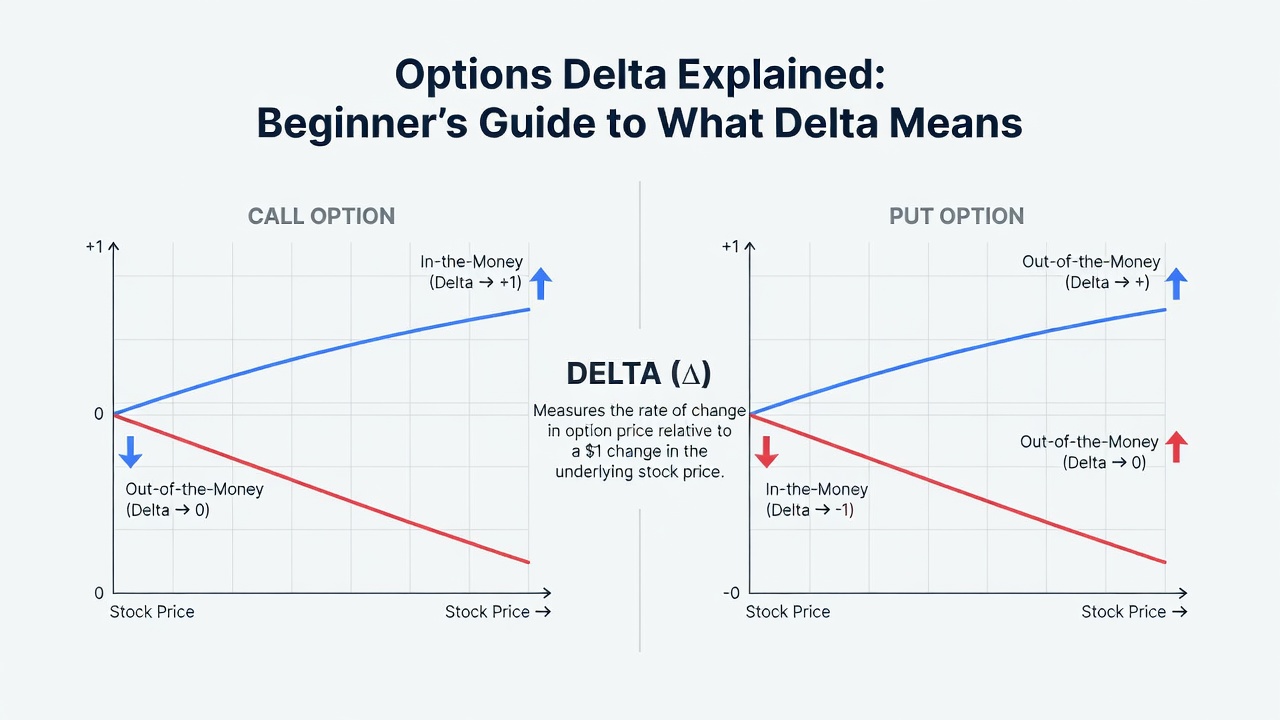
- Delta estimates how much an option’s price changes for every $1.00 move in the underlying stock.
- Traders also use Delta as a rough probability gauge for whether an option expires In The Money.
- Call options feature positive deltas from 0.00 to 1.00, while put options feature negative deltas from -1.00 to 0.00.
— Ben, Find Better Trades
Welcome back to Part 16 of my 51-part beginner options trading series.
When beginners first look at an options chain, they usually get overwhelmed by the mysterious Greek symbols attached to every contract.
Delta is the very first Greek you need to master because it directly connects stock price movement to your trade profits.
What Is Delta? The Simple Price Movement Metric
At its core, Delta measures sensitivity.
Specifically, it shows you how many dollars an option contract’s price is expected to move when the underlying stock moves by exactly $1.00.
Think of Delta like the gas pedal response in a sports car versus a heavy truck.
When you step on the gas in a sports car, the vehicle jumps forward instantly with high sensitivity.
When you step on the gas in a loaded truck, it responds much slower and takes time to build momentum.
Delta gives you that exact measurement of sensitivity before you open a trade.
We covered option premiums back in Part 5, but Delta is the primary motor driving that premium up or down when the stock moves.
If you purchase a call option with a Delta of 0.50 and the underlying stock climbs $1.00, your option premium increases by roughly $0.50.
If that same stock drops by $1.00, your option premium decreases by roughly $0.50.
It is a straight ratio showing price sensitivity between the underlying stock and the derivative contract.
Call Deltas vs. Put Deltas: Positive vs. Negative Numbers
When inspecting an option matrix, you will notice that calls and puts handle Delta with opposite signs.
Call option deltas always range from 0.00 to 1.00.
Some broker platforms display this scale as 0 to 100 by multiplying the number by 100.
Because buying a call is a bullish trade that profits when stock prices rise, call deltas carry a positive sign.
Put options work in the opposite direction because they represent bearish positions that gain value when stock prices drop.
Therefore, put deltas always range from -1.00 to 0.00, or -100 to 0 on some brokerage platforms.
If you own a put option with a Delta of -0.40 and the underlying stock falls by $1.00, your put option gains $0.40 in value.
If the underlying stock rises by $1.00 instead, your put option loses $0.40 in value.
We established the fundamental difference between calls and puts back in Part 2, and their positive or negative deltas simply reflect those directional bets.
Free For Traders
One Clear Arrow. Every High-Probability Setup. Free.
The Fusion Indicator combines multiple signals into a single buy/sell arrow on TradingView so you never miss a move.

Delta as a Probability Estimator: The Secret Cheat Code
Beyond measuring dollar sensitivity, Delta has a brilliant second application that every trader uses daily.
Traders treat Delta as an approximate shortcut for the probability that an option will expire In The Money.
In Part 6, we learned that an option expiring In The Money holds real intrinsic value at expiration.
If you look at a call option with a Delta of 0.30, the market is pricing in roughly a 30% chance that the stock finishes above your strike price on expiration day.
Conversely, that same option carries an estimated 70% chance of expiring Out of The Money and worthless.
If you evaluate a deep In The Money call with a Delta of 0.85, the market implies an 85% probability of that option staying In The Money.
While Delta is not a flawless statistical model, it serves as an excellent benchmark for gauging trade risk.
I check Delta on every single trade setup to quickly determine if my profit expectations match real market odds.
If I am buying a 0.15 Delta option, I instantly know I am taking a speculative, low-probability lottery ticket setup.

Delta as Share Equivalent: Thinking Like a Stock Trader
Another helpful mental framework is thinking of Delta as a share replacement metric.
In Part 11 of this guide, we learned that one single options contract represents 100 underlying shares of stock.
Delta tells you exactly how many actual shares of stock your single option contract is behaving like right now.
If you buy one call option contract with a 0.50 Delta, your trade behaves almost identically to holding 50 shares of stock.
If the underlying stock advances by $2.00, your 50-share stock position would make $100.
Your single 0.50 Delta call contract will also gain roughly $1.00 per share, yielding $100 in contract profit.
If you hold a call option with a 0.90 Delta, that contract moves in tandem with owning 90 shares of physical stock.
If you hold a put option with a -0.25 Delta, that trade moves like being short 25 shares of stock.
This share-equivalent mental math allows traditional stock traders to evaluate portfolio exposure instantly.
Deep In The Money vs. Deep Out of The Money Delta Behavior
An option contract’s Delta is highly dependent on where its strike price sits relative to the current stock price.
We discussed how strike prices define your target price line in Part 3 of our series.
At The Money options—where the strike price equals the stock price—almost always feature a Delta around 0.50 for calls and -0.50 for puts.
As stock prices push an option deeper In The Money, its Delta crawls steadily closer to 1.00 for calls or -1.00 for puts.
As stock prices drag an option deeper Out of The Money, its Delta shrinks down toward 0.00.
The table below summarizes how Delta behaves across different moneyness levels for both calls and puts:
| Moneyness Level | Call Option Delta | Put Option Delta | Approx. Probability ITM |
|---|---|---|---|
| Deep In The Money (ITM) | +0.80 to +0.99 | -0.80 to -0.99 | 80% – 99% |
| At The Money (ATM) | +0.45 to +0.55 | -0.45 to -0.55 | 45% – 55% |
| Out of The Money (OTM) | +0.15 to +0.40 | -0.15 to -0.40 | 15% – 40% |
| Deep Out of The Money (DOTM) | +0.01 to +0.10 | -0.01 to -0.10 | 1% – 10% |
Understanding this distribution helps you avoid paying high prices for low-probability options.
Deep ITM options cost more money upfront, but their high Delta means they move rapidly when the stock swings in your favor.
From Find Better Trades
Consistent Income. Any Market Direction.
The Income Project’s low-risk debit spread system generates steady returns whether the market runs up, down, or sideways.

Worked Example: Calculating Delta in Action Across Two Real-World Scenarios
Let’s run through two practical numeric examples so you can see Delta at work in real dollars.
Assume stock ABC is currently trading at $100 per share.
Scenario A: Buying a Call Option
You decide to buy an At The Money $100 strike Call option for a total premium price of $3.50 per share ($350 total cost).
This call option currently carries a Delta of +0.50.
During the trading day, company ABC releases good news and the stock rallies $3.00, pushing the stock price up to $103.00.
To calculate your option’s expected gain, multiply the $3.00 stock increase by your +0.50 Delta.
$3.00 stock move multiplied by 0.50 Delta equals a $1.50 gain in option premium per share.
Your contract premium climbs from $3.50 up to $5.00 per share.
Because one contract represents 100 shares, your initial $350 investment is now worth $500, netting you a $150 profit.
Scenario B: Buying a Put Option
Now let’s look at buying a Put option on the same stock ABC at $100.
You purchase a $95 strike Out of The Money Put option priced at $1.50 per share ($150 total cost).
This put option currently carries a Delta of -0.30.
Later that week, stock ABC stumbles and falls by $4.00, lowering the share price down to $96.00.
To calculate your gain, multiply the -$4.00 stock move by the -$0.30 Delta.
Multiplying two negative numbers produces a positive gain of +$1.20 in contract premium per share.
Your put option premium grows from $1.50 up to $2.70 per share.
Your original $150 trade value rises to $270 total, generating a clean $120 profit on a declining stock.
How Option Buying vs. Selling Flips Your Delta Direction
Up to this point, we have looked at Delta purely through the eyes of an option buyer.
However, when you act as an option seller, your directional exposure flips upside down.
Buying a call gives you positive Delta direction, meaning you want the underlying stock to go up.
Selling a call gives you negative Delta direction, meaning you want the stock to drop or stay flat.
Similarly, buying a put gives you negative Delta direction because you profit when stock prices sink.
Selling a put gives you positive Delta direction because you benefit when stock prices rise or remain stable.
If you sell a put contract that carries a -0.30 buyer Delta, your account actually takes on a net +0.30 positive Delta position.
Always double-check your total portfolio Delta so you know whether stock rallies or stock drops will help your overall balance.
Common Mistakes Beginners Make With This
Assuming Delta remains static throughout the trade. Many beginners assume an option with a 0.50 Delta will move 50 cents per dollar stock move forever. In reality, Delta updates dynamically with every single price tick and tick of the clock, which means your price sensitivity changes as the trade progresses.
Treating Delta as a guaranteed win rate percentage. A 0.30 Delta option indicates approximately a 30% probability of expiring In The Money, but it does not guarantee trade profitability. You still need the stock to move far enough to cover the premium you paid before you break even.
Forgetting the 100-share contract multiplier. New traders frequently look at a 0.40 Delta and think they will only make 40 cents total when the stock rises a dollar. Remember that options contracts control 100 shares, so a 0.40 Delta yields $40 per contract on a $1.00 stock move.
Buying extreme low-Delta options because they look cheap. Purchasing 0.05 Delta calls for $0.10 looks like an easy bargain to beginners. However, that low Delta tells you the market estimates a 95% likelihood that the option expires entirely worthless.
Frequently Asked Questions About Options Delta
Does Delta stay the exact same as the stock moves? No, Delta changes continuously as the stock price shifts closer to or further away from your option’s strike price. The rate at which Delta changes for every dollar move in the stock is tracked by another Greek called Gamma.
Is buying a higher Delta option always better? Not necessarily, because higher Delta options carry much higher upfront premium costs. While a 0.80 Delta call follows stock movement closely, it requires significantly more risk capital than buying an option with a 0.40 Delta.
Can Delta ever rise above 1.00 or fall below -1.00? No, an option contract can never move faster dollar-for-dollar than holding the actual underlying stock shares. The absolute maximum boundaries for Delta are +1.00 for call options and -1.00 for put options.
Why does my broker show my option Delta as 50 instead of 0.50? Many trading platforms multiply the standard decimal Delta by 100 to show your full share-equivalent exposure. A listed Delta of 50 simply indicates that your single option contract moves like 50 shares of stock.
Now that you understand how Delta measures sensitivity today, you are ready to explore why that number shifts on every tick of the market, which brings us directly to Gamma in Part 17.
📈 Want More? Join Our Free Trading Community
- Trading Strategy Guides Telegram — daily strategy tips and market insights
- Find Better Trades Telegram — free trade signals delivered to your phone
- Find Better Trades on YouTube — live trade breakdowns and tutorials