How Buying a Put Option Works Step by Step for Beginners

📚 Beginner’s Guide to Options — Part 9 of 51
- Part 1: What Is an Option? The Absolute Basics Explained
- Part 2: Calls vs. Puts: The Two Types of Options You Need to Know
- Part 3: Strike Price Explained: What It Actually Means for Your Trade
- Part 4: Expiration Date Explained: Why It Changes Everything
- Part 5: Premium Explained: What You’re Really Paying For
- Part 6: In the Money vs. Out of the Money: A Beginner’s Breakdown
- Part 7: Intrinsic Value vs. Extrinsic Value: What Makes Up an Option’s Price
- Part 8: How Buying a Call Option Works, Step by Step
- Part 9: How Buying a Put Option Works, Step by Step (you are here)
☑ Key Takeaways
- Buying a put option gives you the right, but not the obligation, to sell a stock at a set strike price before a specific deadline.
- This trade is a bearish strategy that allows you to profit when a stock’s price drops significantly below your strike price.
- Your risk is strictly limited to the premium you pay upfront to buy the contract.
— Ben, Find Better Trades
When I first started trading, the idea of making money when a stock crashes felt completely backward. Most of us are conditioned to buy low and sell high, so wrapping your head around a bearish trade can feel like learning a foreign language. Today, in Part 9 of our beginner series, I want to demystify this process and show you exactly how buying a put option works step by step.
1. What Is a Put Option and Why Do We Buy It?
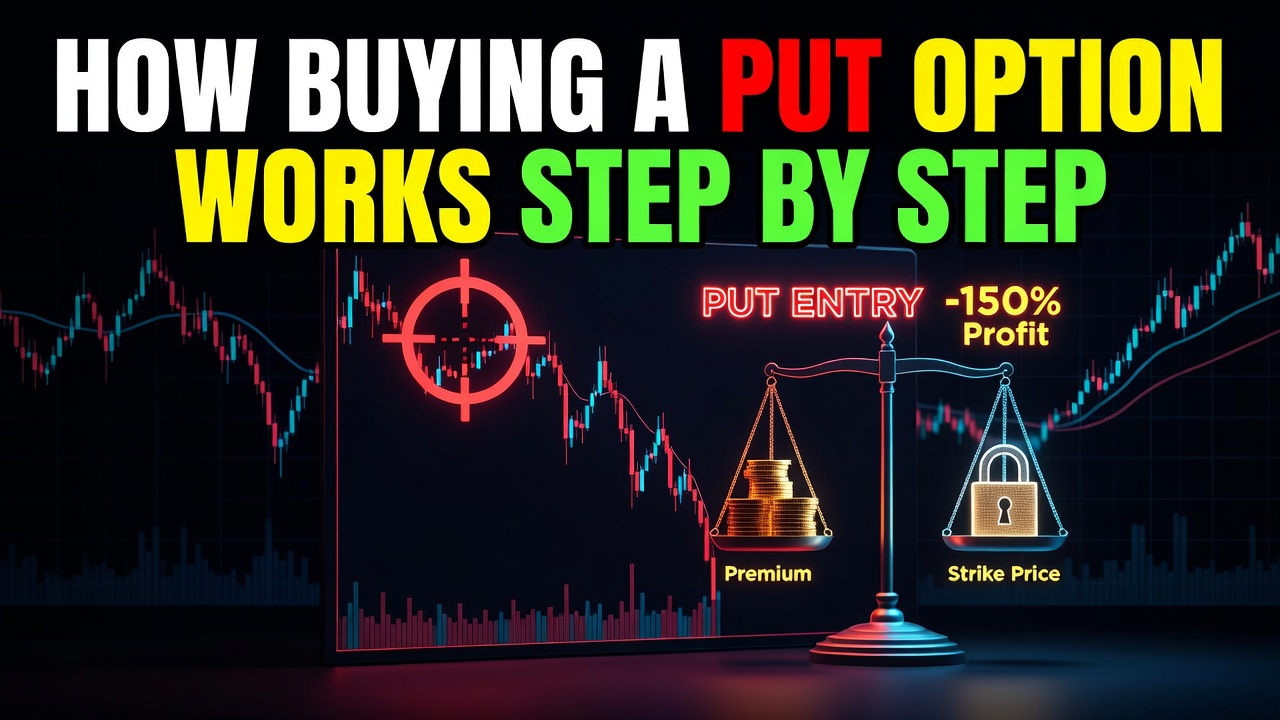
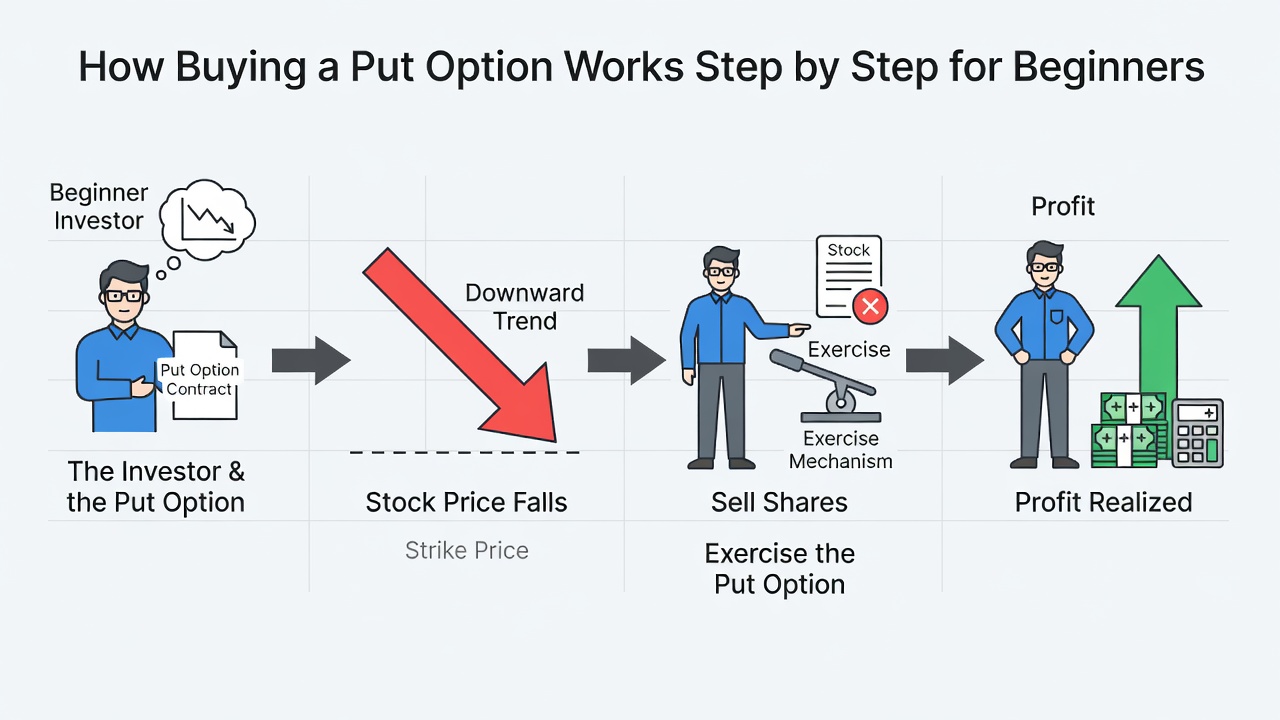
Buying a put option is a strategy you use when you think a stock is going to drop in value. When you buy a put, you are paying for the contract right to sell a specific stock at a set price, which we call the strike price, before a specific date.
We covered the basic definitions of calls and puts earlier in this series, but it helps to look at this through a simple real-world lens. Think of a put option as an insurance policy for a house or a car. If you buy car insurance and get into a wreck, the insurance company pays you for the damage based on your policy’s locked-in value.
Similarly, if you buy a put option on a stock and that stock crashes, your put option becomes highly valuable because it allows you to sell the stock at the older, higher price. You do not have to own the underlying stock to buy a put option; most retail traders simply buy puts to profit from the rising value of the contract itself as the stock drops.
The person selling you the put option is taking on the obligation to buy those shares from you at that set strike price if you choose to exercise your right. For taking on that risk, they demand an upfront fee, which is the premium we discussed in Part 5.
2. The Insurance Analogy: How Puts Protect Value
To really cement this concept, let us look at a real-world insurance analogy that has nothing to do with Wall Street. Imagine you own a vintage motorcycle worth $10,000, and you are worried the market for vintage bikes is about to collapse over the next three months.
You go to a specialty broker who offers you a contract: for a fee of $500, he guarantees that he will buy your motorcycle for $10,000 at any point during the next ninety days. That contract is exactly like a put option, where the motorcycle is the stock, the $10,000 guarantee is the strike price, and the $500 fee is the premium.
If the vintage bike market crashes next month and your motorcycle’s actual market value plunges to $4,000, you are thrilled you bought that contract. You can hand the broker the keys, and he is legally obligated to hand you $10,000, saving you from a massive financial loss.
If the market does not crash and vintage bikes actually go up in value, you simply choose not to use the contract, let it expire, and you are only out the $500 fee you paid upfront. In the stock market, we use this exact same mechanic to either protect our stock portfolios or simply make speculative bets on a stock’s decline.
🎯 Get High-Probability Trade Setups — Free
The Big Dipper Dashboard delivers curated trade ideas straight to your screen every morning. Know what to watch before the opening bell.

3. Understanding the Key Components of Your Put Trade
Before you place a put trade in your brokerage account, you must select three critical components that will determine your cost and your potential profit. First, you choose the underlying stock that you expect to fall in value over a specific timeframe.
Next, you must select your strike price, which we established in Part 3 is the line in the sand where your selling rights are locked in. For example, if stock XYZ is trading at $100, you might choose a strike price of $95, meaning you want the right to sell XYZ at $95.
Then, you must select your expiration date, which is the absolute deadline for your contract to perform, as we learned in Part 4. If the expiration date passes and the stock has not dropped below your strike price, the contract expires worthless, and your trade is over.
Finally, these factors combine to give you the premium, which is the market price you pay to purchase the option contract. Remember that each standard option contract represents 100 shares of the underlying stock, so you must multiply the quoted premium by 100 to find your true cost.

4. A Step-by-Step Numeric Example of a Winning Put Trade
Let us walk through a detailed, step-by-step example of a winning trade so you can see exactly how the math works. Imagine stock ABC is currently trading at $50 per share, and you believe bad earnings news is going to send the stock downward over the next few weeks.
You decide to buy one put option contract with a strike price of $48 expiring in one month, and the quoted premium for this contract is $2.00. Because one contract represents 100 shares, you pay an upfront premium of $200 to enter this trade, which represents your maximum possible risk.
Two weeks later, ABC releases terrible earnings, and the stock price quickly drops down to $40 per share, which is well below your strike price of $48. Because the stock is now at $40, your right to sell that stock at $48 is incredibly valuable to other market participants.
The intrinsic value of your option is now $8.00 per share, meaning your $2.00 contract is now worth at least $8.00 on the open market. You can sell your put option back to the market for $800, which nets you a clean profit of $600 after subtracting your initial $200 cost.
| Trade Stage | Stock Price | Option Premium (Per Share) | Total Contract Value / Cost |
|---|---|---|---|
| Entry (Buy Put) | $50.00 | $2.00 | -$200.00 (Cost) |
| Exit (Sell Put) | $40.00 | $8.00 | +$800.00 (Value) |
| Net Result | -$10.00 (-20%) | +$6.00 (+300%) | +$600.00 (Net Profit) |
5. A Step-by-Step Numeric Example of a Losing Put Trade
Now, we must look at the opposite scenario so you fully understand the risks involved when a bearish trade goes against you. Let us use the same setup: stock ABC is trading at $50, and you buy a $48 strike put option contract for a premium of $2.00, costing you $200.
This time, instead of falling, ABC releases surprisingly positive news, and the stock price climbs up to $55 per share over the next month. Because the stock is trading at $55, your right to sell shares at $48 is completely worthless; nobody would pay to sell a stock at $48 when they can sell it on the open market for $55.
As the expiration date approaches, your option loses its time value, which we described as extrinsic value back in Part 7 of this series. On the day of expiration, because the stock remains above $48, your put option expires at a value of exactly $0.00.
You lose the entire $200 premium you paid to enter the trade, but your loss is strictly capped at that amount, no matter how high ABC stock climbs. This limited risk is one of the main reasons traders prefer buying puts over shorting actual shares of stock, where the risk of loss is theoretically infinite.

6. How to Manage and Exit Your Put Option Trade
Many beginners believe that when they buy an option, they are locked into holding it until the expiration date, but this is a major misconception. You can sell your put option back to the market at any second the stock market is open, allowing you to cut losses or lock in profits early.
If you buy a put for $1.50 and the stock drops quickly, the premium might rise to $2.50 within a couple of days. You do not need to wait for expiration; you can simply sell the contract right then and pocket your $100 profit per contract.
Conversely, if you buy a put for $1.50 and the stock starts moving higher, you might watch your premium drop to $0.75. If you realize your original thesis was wrong, you can sell the contract immediately to salvage the remaining $75 of your capital rather than letting it go to zero.
You also have the choice to exercise the option, which means actually selling 100 shares of the stock at the strike price, though this requires you to either own the shares or short them. For ninety-nine percent of retail traders, simply selling the contract back to the market to close the trade is the cleanest and most common path.
7. Comparing Buying Puts to Shorting Stock
To understand why puts are such a popular tool, it helps to compare them to the traditional method of making money on a falling stock, which is short selling. Short selling involves borrowing shares of stock from a broker and selling them, with the hope of buying them back cheaper later.
Shorting stock carries unlimited risk because there is no limit to how high a stock price can rise, meaning you could theoretically lose an infinite amount of money. When you buy a put option, your maximum possible loss is strictly limited to the premium you paid to buy the contract, giving you complete peace of mind.
Additionally, short selling requires a margin account and can incur expensive borrow fees, whereas buying puts can be done in standard cash accounts without those extra fees. Put options also provide leverage, meaning a small move in the stock can produce a massive percentage gain in your option contract value.
However, the downside of buying puts is that you have a ticking clock working against you every single day due to time decay. If you short a stock, you can hold that short position as long as you want, but a put option has a hard expiration date that will eventually render it worthless if the stock does not move.
Common Mistakes Beginners Make With This
One of the biggest mistakes beginners make is buying put options that are way too far out of the money because they look cheap. A $30 strike put on a $50 stock might only cost $0.05, but the odds of that stock dropping over thirty percent before expiration are incredibly low, making it a statistical waste of money.
Another common trap is holding onto a losing put option all the way to expiration, hoping for a last-minute miracle crash. Because of time decay, your option loses value faster every day, so holding a dead trade usually results in losing your entire premium when you could have cut losses early.
Lastly, beginners often fail to account for implied volatility when buying puts, which can crush your profits even if the stock drops. If you buy a put right before an earnings announcement when option prices are highly inflated, the premium can plunge immediately after the announcement even if the stock moves in your direction.
Put Option Trading FAQ
Can I lose more money than I invest when buying a put option?
No, your maximum loss when buying a put option is strictly limited to the premium you paid to purchase the contract. You can never go into debt or owe your broker money from this specific trade, unlike shorting stock or selling options.
Do I need to own the underlying stock to buy a put option?
No, you do not need to own any shares of the stock to buy a put option contract. You can trade the option contract purely on its own, buying it to open the trade and selling it to close the trade for a profit or loss.
What happens if my put option is in the money at expiration?
If your put option is in the money by even one cent at expiration, your brokerage will typically exercise it automatically on your behalf. This means they will short 100 shares of the stock for you, so it is highly recommended to sell your contract closed before expiration to avoid this.
Why is my put option losing value even though the stock is flat?
This is caused by time decay, which slowly erodes the extrinsic value of your option contract every single day as expiration approaches. If the stock does not fall quickly enough to offset this decay, your option will lose value even if the stock price remains unchanged.
Now that you know how to trade market drops, we need to talk about what actually happens at the finish line, which is why next time we are tackling exactly what happens when an option expires.
📈 Want More? Join Our Free Trading Community
- Trading Strategy Guides Telegram — daily strategy tips and market insights
- Find Better Trades Telegram — free trade signals delivered to your phone
- Find Better Trades on YouTube — live trade breakdowns and tutorials