How Buying a Call Option Works: Step-by-Step Guide

📚 Beginner’s Guide to Options — Part 8 of 51
- Part 1: What Is an Option? The Absolute Basics Explained
- Part 2: Calls vs. Puts: The Two Types of Options You Need to Know
- Part 3: Strike Price Explained: What It Actually Means for Your Trade
- Part 4: Expiration Date Explained: Why It Changes Everything
- Part 5: Premium Explained: What You’re Really Paying For
- Part 6: In the Money vs. Out of the Money: A Beginner’s Breakdown
- Part 7: Intrinsic Value vs. Extrinsic Value: What Makes Up an Option’s Price
- Part 8: How Buying a Call Option Works, Step by Step (you are here)
☑ Key Takeaways
- Buying a call option gives you the right, but not the obligation, to purchase 100 shares of a stock at a fixed strike price before a specific deadline.
- Your maximum financial risk is strictly limited to the upfront premium you pay to buy the contract.
- You profit when the underlying stock price rises significantly above your strike price plus the premium you paid.
— Ben, Find Better Trades
Welcome back to my beginner series. If you have been following along, you know this is Part 8 of our 51-part masterclass, and today we are finally putting the pieces together to look at a real, active trade.
Up until now, we have talked about the individual gears inside the machine, like strikes, expirations, and premiums. Now, I want to show you exactly what happens when you press the buy button on your first call option.
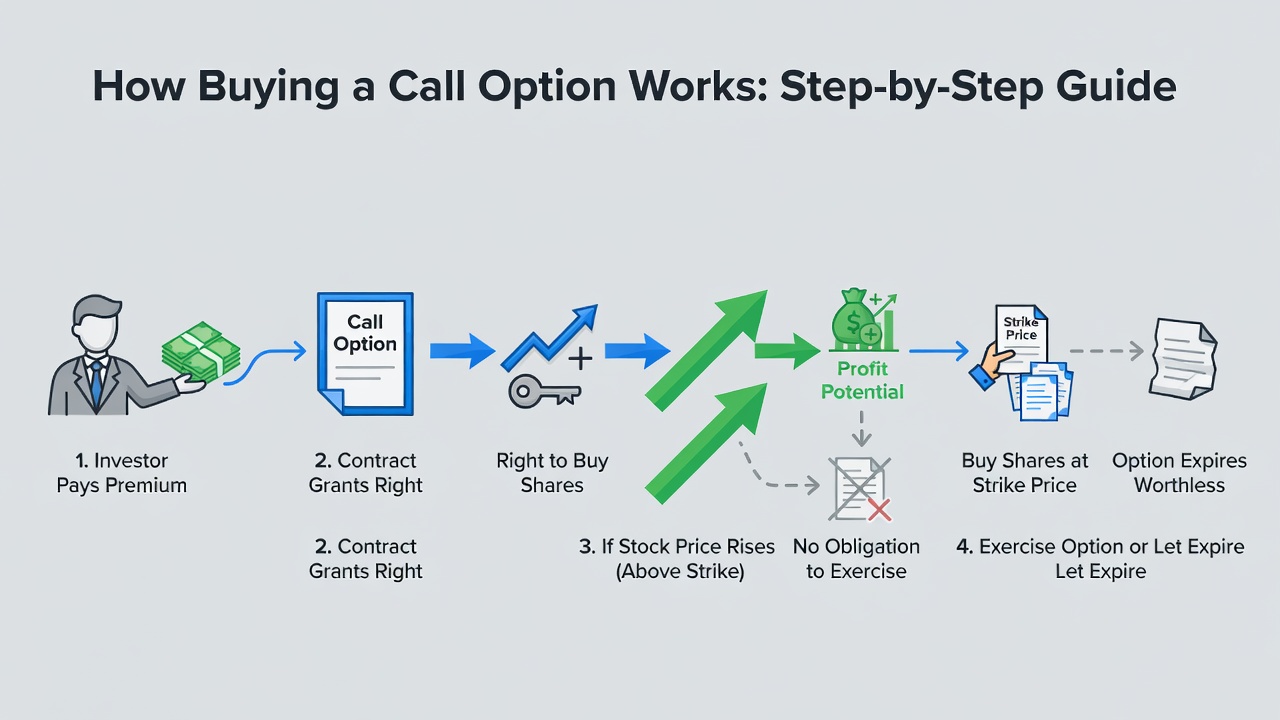
1. The Core Concept of Buying a Call Option
When you buy a call option, you are purchasing a contract that gives you a very specific legal right. This contract grants you the right to buy 100 shares of a specific stock at a set price, which we call the strike price, before a set deadline.
You do not own the actual shares of stock yet when you buy this contract. Instead, you own a piece of paper, or a digital contract, that controls those shares from a distance.
Think of it like putting a non-refundable deposit down on a rare house. You pay a small fee today to lock in a purchase price of $500,000 for the next three months.
If the neighborhood suddenly becomes incredibly popular and the house value jumps to $700,000, you still have the right to buy it for $500,000. If the neighborhood goes downhill, you can simply walk away and lose nothing but your small deposit.
This ability to walk away is why we call it an option. You have the choice to buy the stock, but you are never forced to do so if the trade goes against you.
2. Understanding Your Upfront Cost: The Premium
To acquire this contract, you must pay an upfront fee to the seller. We covered this fee, called the premium, earlier in the series, but let us look at how it functions in a real transaction.
Option premiums are always quoted on a per-share basis, which is the most common point of confusion for new traders. Because every standard stock option contract controls exactly 100 shares of stock, you must always multiply the quoted price by 100 to find your actual cash cost.
If you see a call option quoted at a premium of $2.50, you are not paying $2.50 to enter the trade. You will actually pay $250.00 out of your account, which is calculated as $2.50 multiplied by the 100 shares in the contract.
This cash outlay is paid immediately to the seller of the option when your order is filled. It represents your maximum risk on the trade, meaning you can never lose a single penny more than this initial amount, no matter how low the stock price drops.
🎯 Get High-Probability Trade Setups — Free
The Big Dipper Dashboard delivers curated trade ideas straight to your screen every morning. Know what to watch before the opening bell.

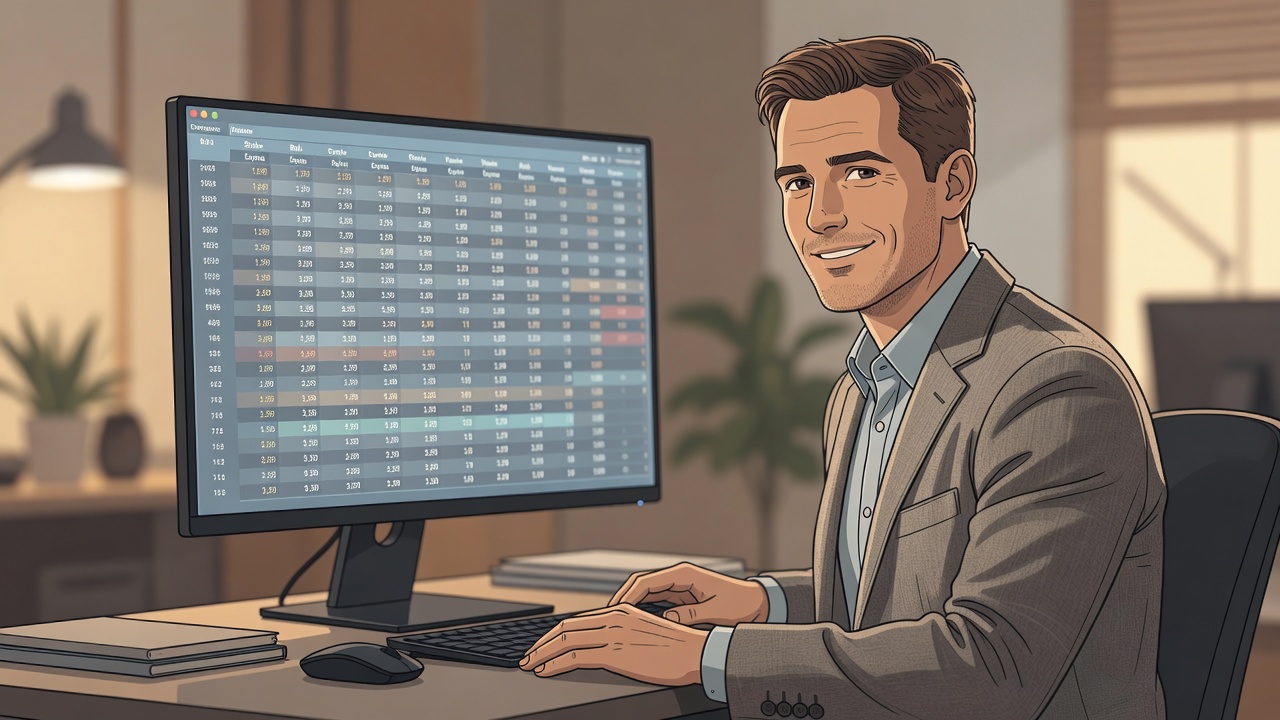
3. Choosing Your Strike Price: Setting Your Target
Before you enter the trade, you must select your strike price, which is the price you want the right to buy the stock at. Your choice here determines how much your option costs and how easy it will be to make a profit.
Let us look at a concrete example using a hypothetical stock we will call XYZ, which is currently trading at $100 per share. You can choose a strike price that is below $100, exactly at $100, or above $100.
If you choose a strike price of $105, you are buying the right to buy XYZ at $105. Because this is higher than the current stock price of $100, this option is out of the money and will have a relatively cheap premium.
If you choose a strike price of $95, you are buying the right to buy XYZ at $95. Because you can already buy the stock cheaper than its current market value, this option is in the money and will be much more expensive.
I always tell my students that your strike price is your line in the sand. It is the exact price level your stock needs to target and surpass for your contract to hold value at expiration.
4. Calculating Your Break-Even Point
Many beginners think that if they buy a $100 strike call option, they will start making money the moment the stock ticks up to $101. This is a major misconception because you have to account for the premium you paid to enter the trade.
To find your true break-even point at expiration, you must use a very simple mathematical formula. You take your strike price and add the premium per share you paid.
Let us look at our first fully worked example. Suppose XYZ stock is trading at $100, and you buy a call option with a strike price of $100 for a premium of $3.00, which costs you $300 total.
Your break-even point is exactly $103.00, which is the $100 strike price plus the $3.00 premium. If the stock ends up at exactly $103.00 at expiration, your option is worth exactly what you paid for it, and you walk away with zero profit and zero loss.
If the stock ends up at $102.00, your option is worth $2.00 at expiration, but because you paid $3.00 for it, you actually lose $1.00 per share, or $100 total. You must beat the break-even number to see a net positive return.
5. What Happens If the Stock Skyrockets?
The primary reason traders buy call options is for the leverage they provide when a stock moves up rapidly. When the stock climbs far past your break-even point, your potential profits are theoretically unlimited.
Let us use our second worked example to show how this math plays out. You bought that same $100 strike call option for a $3.00 premium, and the stock suddenly surges to $115.00 by expiration.
At expiration, your right to buy the stock at $100 when it is trading in the open market at $115 is worth exactly $15.00 per share. Since you paid $3.00 for this right, your net profit is $12.00 per share, which translates to a cash profit of $1,200 on your $300 investment.
To put this in perspective, look at the comparison table below to see how a call option performs compared to buying the actual shares of stock with the same starting move.
| Scenario (XYZ Stock at $115) | Buying 100 Shares of Stock | Buying 1 Call Option ($100 Strike) |
|---|---|---|
| Upfront Capital Required | $10,000 ($100 per share) | $300 ($3.00 premium) |
| Value at Expiration | $11,500 | $1,500 ($15.00 value) |
| Net Dollar Profit | +$1,500 | +$1,200 |
| Percentage Return | +15% | +400% |
As you can see, the stock investor made more absolute dollars, but they had to risk $10,000 of their hard-earned cash to do it. You only risked $300 and walked away with a massive percentage return on your capital.
6. What Happens If the Stock Drops or Stays Flat?
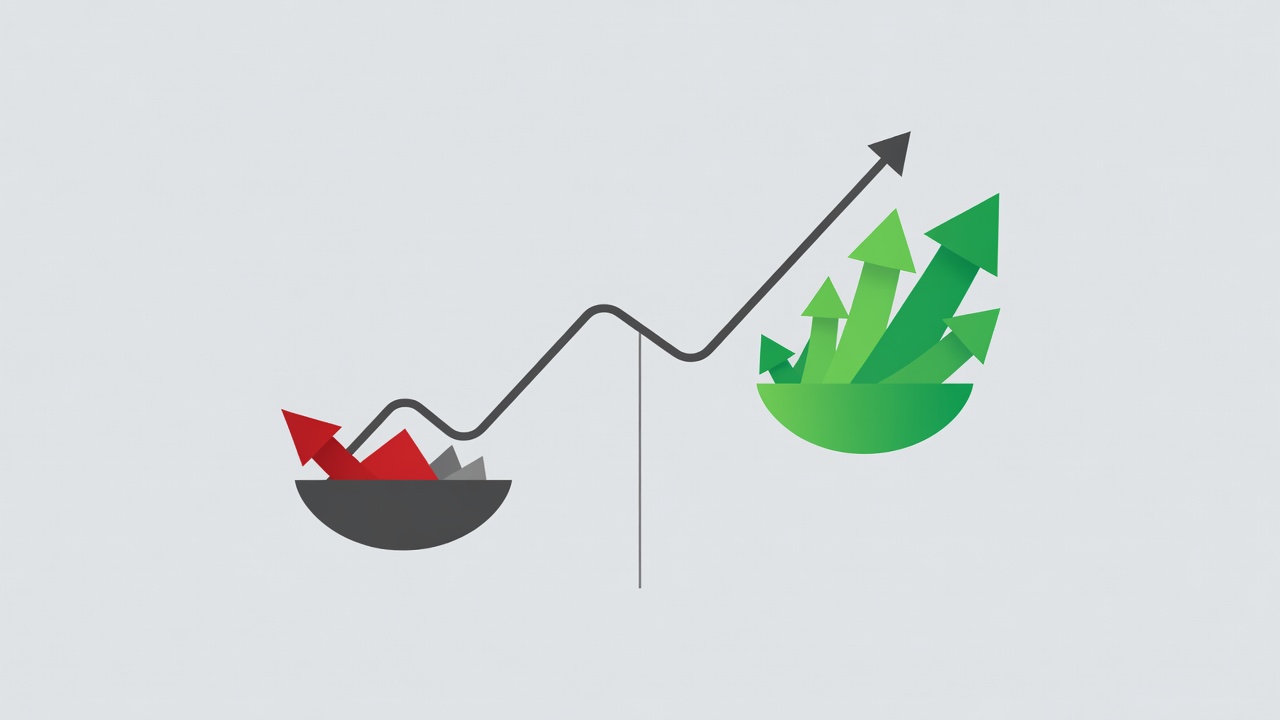
Now we need to look at the other side of the coin. If the stock does not move up as you expected, or if it outright drops, your call option will begin to lose its value rapidly.
If XYZ stock stays flat at $100, or drops down to $80 by the time expiration day arrives, your call option becomes completely worthless. No one wants the right to buy a stock at $100 when they can walk into the open market and buy it for $80.
When this happens, your option expires with zero value, and the $300 premium you paid is completely gone. The seller of the option keeps your $300, and your trade is officially closed.
However, notice that even if the stock crashed all the way down to $20 per share, you still only lost $300. The stock investor who bought 100 shares at $100 would be sitting on an absolute disaster loss of $8,000.
This defined risk is the main benefit of buying calls. You gain exposure to the upside of the stock market while knowing your exact worst-case scenario down to the penny before you ever place the trade.
7. How You Actually Close the Trade: Selling vs. Exercising
Many beginners think that if they buy a call option, they are eventually going to have to buy the 100 shares of stock. This is simply not true, and in fact, most retail traders almost never actually buy the underlying shares.
You have two main ways to exit your trade. The first option is to exercise your contract, which means you tell your broker you want to use your right to buy the 100 shares at the strike price.
Exercising requires you to have the full amount of cash in your account to buy those shares. If you exercise a $100 strike call, your broker will deduct $10,000 from your account to deliver those 100 shares of stock to you.
The second, and far more common, way to exit is to simply sell your option contract back to the market before it expires. If you bought the option for $3.00 and it is now worth $8.00, you can sell it to close your position and immediately pocket the $500 profit without ever owning a single share of stock.
Common Mistakes Beginners Make With This
The most frequent mistake I see new traders make is buying call options that are too far out of the money because they look incredibly cheap. They buy a $120 strike call on a $100 stock for $0.10, not realizing that the stock has to move up over 20% in a few weeks just for the contract to avoid expiring completely worthless.
Another massive error is holding onto a losing call option all the way to expiration day hoping for a miracle save. If your trade is clearly failing, it is often better to sell the option back to the market for a small remaining value, like $0.50, to salvage some of your initial capital rather than letting it go to absolute zero.
Finally, beginners often ignore the impact of time decay on their options. Options are decaying assets, meaning they lose value every single day the stock does not move, so buying a call when a stock is consolidation-bound is a recipe for slow, painful losses.
Buying Call Options FAQ
Do I have to buy the 100 shares of stock if I buy a call option?
No, you are never required to purchase the underlying shares. You can simply sell your call option contract back to the market at any point before expiration to lock in your profits or cut your losses.
What is the maximum amount of money I can lose when buying a call?
Your risk is strictly capped at the premium you paid to enter the trade. If you paid $150 for a call option, you can never lose more than $150, regardless of how far the stock price crashes.
How long can I hold a call option before I have to close it?
You can hold your call option for as long as you want, up until the exact expiration date and time listed on the contract. Once that expiration deadline passes, the contract ceases to exist and holds no value.
Why is my call option losing value even though the stock price went up slightly?
This happens because of time decay, which reduces the value of your option daily. If the stock price does not rise fast enough to offset this daily decay, your option value will decrease even with a small positive move in the stock.
In the next part of this series, we are going to flip the script and look at how buying a put option works, step by step, so you can profit when markets fall.
📈 Want More? Join Our Free Trading Community
- Trading Strategy Guides Telegram — daily strategy tips and market insights
- Find Better Trades Telegram — free trade signals delivered to your phone
- Find Better Trades on YouTube — live trade breakdowns and tutorials