Options Trading Platforms: What to Look for as a Beginner

📚 Beginner’s Guide to Options — Part 50 of 51
- Part 1: What Is an Option? The Absolute Basics Explained
- Part 2: Calls vs. Puts: The Two Types of Options You Need to Know
- Part 3: Strike Price Explained: What It Actually Means for Your Trade
- Part 4: Expiration Date Explained: Why It Changes Everything
- Part 5: Premium Explained: What You’re Really Paying For
- Part 6: In the Money vs. Out of the Money: A Beginner’s Breakdown
- Part 7: Intrinsic Value vs. Extrinsic Value: What Makes Up an Option’s Price
- Part 8: How Buying a Call Option Works, Step by Step
- Part 9: How Buying a Put Option Works, Step by Step
- Part 10: What Happens When an Option Expires? Every Outcome Explained
- Part 11: Options Contracts 101: What One Contract Actually Represents
- Part 12: How to Read an Options Chain Without Getting Overwhelmed
- Part 13: Bid, Ask, and Spread: What They Mean When You’re Trading Options
- Part 14: What Is Implied Volatility? A Beginner’s Plain-English Guide
- Part 15: Why Options Lose Value Over Time: Theta Explained Simply
- Part 16: Delta Explained: What It Really Tells You About Your Option
- Part 17: Gamma Explained: Why Delta Doesn’t Stay the Same
- Part 18: Vega Explained: How Volatility Changes Your Option’s Price
- Part 19: The Greeks Cheat Sheet: Delta, Gamma, Theta, Vega in Plain English
- Part 20: What Is Assignment? What Happens If Your Option Gets Exercised
- Part 21: American vs. European Options: What’s the Difference?
- Part 22: How Much Money Do You Need to Start Trading Options?
- Part 23: Paper Trading Options: How to Practice Before Risking Real Money
- Part 24: The Biggest Mistake Beginners Make Buying Options
- Part 25: Why Most Beginners Lose Money Buying Options (and How to Avoid It)
- Part 26: Covered Calls Explained: The First Options Strategy Every Trader Should Learn
- Part 27: Cash-Secured Puts Explained: A Beginner-Friendly Way to Get Paid to Wait
- Part 28: Vertical Spreads Explained: Reducing Risk on Your First Options Trade
- Part 29: Credit Spreads vs. Debit Spreads: What’s the Real Difference?
- Part 30: The Protective Put Explained: Insurance for Your Stock Position
- Part 31: The Collar Strategy Explained: Protecting Gains Without Selling
- Part 32: Straddles Explained: Betting on a Big Move (In Either Direction)
- Part 33: Strangles Explained: A Cheaper Way to Bet on a Big Move
- Part 34: The Iron Condor Explained for Complete Beginners
- Part 35: The Wheel Strategy Explained: Getting Paid on Stocks You Want to Own
- Part 36: How Earnings Season Changes Options Pricing (and What to Watch For)
- Part 37: Why Options Get More Expensive Before Earnings: IV Crush Explained
- Part 38: Choosing the Right Strike Price for Your First Options Trade
- Part 39: Choosing the Right Expiration Date: Weekly vs. Monthly Options
- Part 40: How to Size an Options Position So One Bad Trade Doesn’t Wreck You
- Part 41: When to Take Profits on an Options Trade (Before It’s Too Late)
- Part 42: When to Cut a Losing Options Trade (Before It Goes to Zero)
- Part 43: Rolling an Options Position: What It Means and When to Do It
- Part 44: Liquidity in Options: Why It Matters More Than Beginners Think
- Part 45: Open Interest vs. Volume: What Each One Actually Tells You
- Part 46: How to Use Options to Hedge a Stock Position You Already Own
- Part 47: LEAPS Explained: Trading Options That Last a Year or More
- Part 48: The Poor Man’s Covered Call: A Cheaper Way to Run the Covered Call Strategy
- Part 49: Common Options Trading Terms Every Beginner Should Know (Glossary)
- Part 50: Options Trading Platforms: What to Look for as a Beginner (you are here)
⚡ Key Takeaways
- Your platform is your control room, meaning clunky order routing or confusing options chains will cost you real money.
- Zero-commission brokers are not always free once you factor in poor price fills and payment for order flow.
- Look for platforms with built-in risk graphs, customizable options chains, and responsive multi-leg trade execution.
— Ben, Find Better Trades
Welcome to Part 50 of our 51-part series. Over the last forty-nine lessons, we have broken down everything from basic calls and puts to Greeks, spreads, and managing risk.
Now you need a place to actually execute those trades. Picking the wrong options trading platform can turn an otherwise solid trading strategy into an expensive headache.
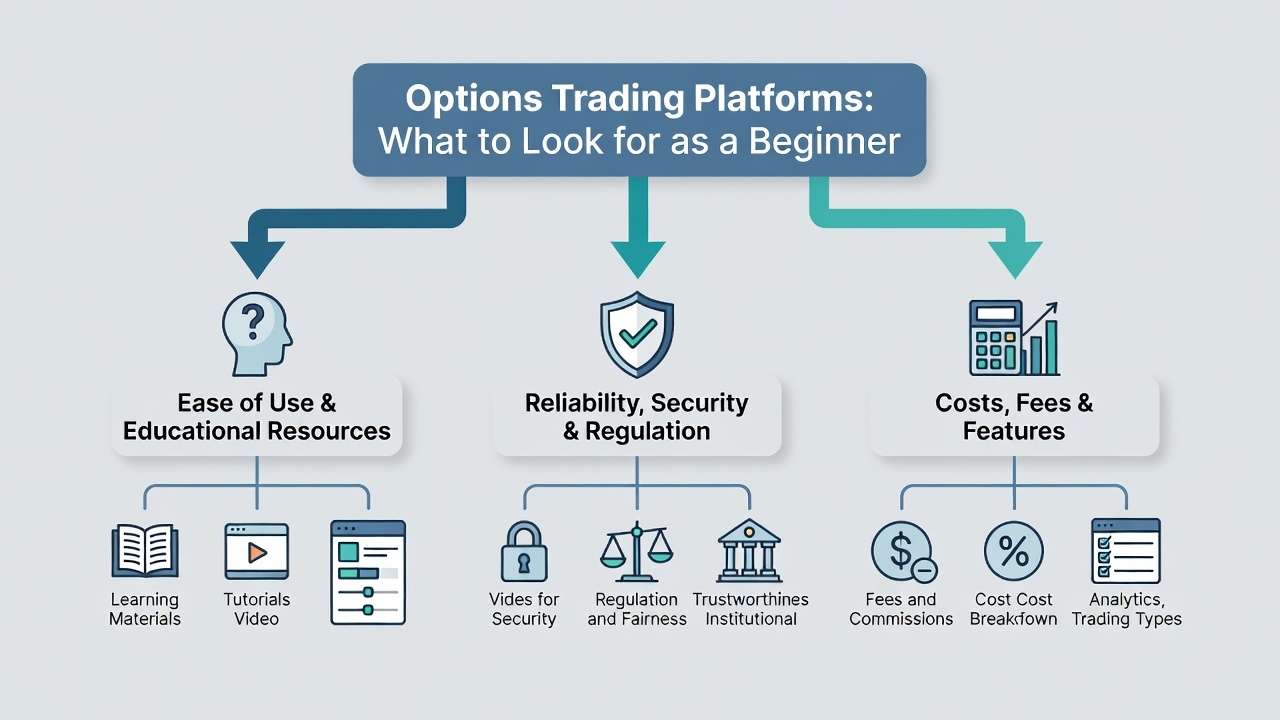
1. Why Options Platforms Require Different Features Than Stock Brokers
When you buy a standard share of stock, you only need to choose a ticker and click buy. Options require far more moving parts before you ever place a trade.
Think of trading regular shares like driving a basic automatic car with just a gas pedal and a brake. Trading options is more like flying a twin-engine plane where you need to monitor altitude, fuel mixture, and weather readouts simultaneously.
With options, you must select an expiration date, a strike price, an order type, and contract quantity. You also need to track Greek metrics and implied volatility in real time.
A broker designed purely for simple stock purchases often hides crucial data behind nested menus. That delay makes it harder to assess your probability of profit before entering a position.
You need a platform that displays the entire chain clearly on one screen so you can make fast, informed decisions.
2. Options Chain Customization and Usability
Earlier in this series, we covered how to read an options chain without feeling overwhelmed. A good broker makes that layout intuitive rather than painful.
Your software should allow you to filter strikes by delta, open interest, and implied volatility. If a platform forces you to click through five screens just to view both calls and puts together, look elsewhere.
You also want visible bid-ask spreads clearly marked on the chain. As we established in Part 13, wide spreads eat into your capital before your trade even starts working.
Top platforms let you customize columns so you see the exact Greeks and metrics that fit your strategy. If you focus on selling premium, you will want delta, theta, and implied volatility rank front and center.
If a screen feels cluttered or laggy when market volume spikes, that platform will frustrate you during live market hours.
Free For Traders
One Clear Arrow. Every High-Probability Setup. Free.
The Fusion Indicator combines multiple signals into a single buy/sell arrow on TradingView so you never miss a move.

3. Fee Structures: Per-Contract Costs vs. Hidden Fill Costs
Many beginners hunt for platforms advertising completely free trading. While zero-commission sounds appealing, execution quality matters far more in the options world.
Brokers generally charge either a flat rate per contract (such as $0.50 to $0.65 per contract) or zero base commissions. Free brokers often route orders to market makers who may fill you at slightly worse prices.
Let us look at a worked example comparing commission costs to fill slippage. Suppose you trade 5 call contracts on a stock trading around $100.
Broker A charges $0.65 per contract ($3.25 entry fee) but routes your order to the mid-price of $1.50, costing you $750 plus $3.25 for a total of $753.25. Broker B charges $0 commission but fills your order at the ask price of $1.53, costing you $765.00 flat.
| Broker Model | Fill Price Per Contract | Commission Fee | Total Out-of-Pocket Cost |
|---|---|---|---|
| Direct Routing ($0.65/contract) | $1.50 (Mid-Price) | $3.25 | $753.25 |
| Payment for Order Flow ($0 Fee) | $1.53 (Ask Price) | $0.00 | $765.00 |
In this scenario, the supposedly free trade cost you $11.75 more due to poor execution. Cheap fees never make up for bad fills on wide spreads.

4. Built-in Analytics: Risk Profiles and Greeks
You should never enter an options position without knowing your maximum loss, breakeven points, and theoretical profit at expiration. Quality platforms render a visual profit-and-loss graph before you confirm the trade.
This visual curve helps you see how changes in stock price and time decay impact your position. You can drag price sliders to simulate what happens if the underlying stock drops 5% tomorrow versus three weeks from now.
The platform must also show portfolio-level Greeks. Knowing your account-wide delta tells you immediately if you are dangerously exposed to a sudden market downturn.
Without these analytical tools built directly into the order ticket, you are forced to use third-party calculators. Doing math by hand during fast market moves leads to careless mistakes.
Make sure your platform updates option Greeks dynamically throughout the trading day as market conditions shift.
5. Easy Multi-Leg Trade Execution
Earlier in this guide, we explored vertical spreads, iron condors, and collars. These strategies require you to buy and sell different options contracts simultaneously as a single package.
A quality platform allows you to construct multi-leg trades with a single click. You select a strategy preset like vertical spread, and the platform links the buy and sell legs together automatically.
Executing multi-leg trades as a single order protects you from getting legged in. Legging in means one side of your spread fills while the other side sits unfilled, leaving you exposed to directional risk you never intended to take.
Let us look at a second worked example. Suppose you want to open a $5-wide vertical credit spread by selling a $100 put and buying a $95 put.
On a dedicated options platform, you submit the spread at a net credit limit of $1.80. Both contracts fill at the exact same instant, securing your $180 credit with defined risk of $320.
If your platform lacks integrated spread tools and forces you to submit each leg separately, the stock might drop while you wait. That leaves you holding a naked short put without your protective long put in place.
From Find Better Trades
Only Trade When Momentum Is HEAVILY In Your Favor
The Power Index oscillator measures trend conviction at a glance — it filters out weak, choppy action so you only take the strong moves.

6. Paper Trading and Real-Time Risk Simulation
In Part 23, we discussed why practicing on a simulator builds confidence before putting actual money on the line. Your chosen platform should offer a robust paper trading environment.
A good simulator mirrors real market conditions, including realistic options pricing, historical data playback, and order fill delays. It should track your virtual buying power and margin requirements accurately.
Simulators let you test new strategies like cash-secured puts or credit spreads without financial stress. You learn the platform interface, discover where the buttons are, and practice order entry safely.
If a platform makes it difficult to switch between paper trading and live trading, you lose a valuable testing lab for future strategies.
Look for brokers that provide full access to their analytical charting tools within their practice accounts.
7. Mobile Apps vs. Desktop Trading Terminals
Most beginners start trading on their phones because of convenience. Mobile apps work fine for checking existing positions or closing a basic covered call, but they have major limitations.
Desktop platforms give you the screen space needed to view multi-timeframe charts, extensive options chains, and Greeks all at once. Analyzing a complex multi-leg position on a small smartphone screen increases the likelihood of tapping the wrong strike or expiration date.
I recommend setting up and analyzing your trades on a desktop platform whenever possible. Save the mobile app for monitoring alerts and managing urgent adjustments when you are away from your desk.
Make sure the broker you choose synchronizes watchlists and orders seamlessly between desktop and mobile. A trade entered on your computer should appear instantly on your phone with identical risk parameters.
Having a dependable mobile app is an essential safety backup if your home internet connection goes down while you hold an open position.
Common Mistakes Beginners Make With This
The most frequent error is choosing a platform purely because it has a colorful, gamified mobile interface. Those apps often simplify screens by hiding essential Greek data, bid-ask spreads, and implied volatility ranks.
Another common mistake is ignoring order routing quality. Beginners assume all brokers get the same fill price, but routing orders through market makers that pay for order flow can cost you far more than a $0.50 contract fee.
Traders also run into trouble by opening accounts that lack multi-leg margin permissions. If your platform only grants you basic Level 1 approval, you will find yourself blocked from trading standard risk-defined vertical spreads.
Finally, beginners often skip the desktop client entirely and trade exclusively from small touchscreens. Tapping the wrong button on an order ticket can accidentally buy a call instead of selling a put, turning an intended hedge into unwanted risk.
Frequently Asked Questions About Options Platforms
Do I need a paid subscription to access good options data?
No, most reputable options brokerages include real-time options chains, streaming charts, and Greek analytics for free once you fund an account. You rarely need to pay third-party data providers when starting out.
What options approval level do I need on my platform?
For covered calls and cash-secured puts, Level 1 or Level 2 approval is standard. If you want to trade vertical debit and credit spreads, you will typically need approval for Level 3 options trading.
Can I trade options successfully on a smartphone?
You can monitor trades and close positions on a phone, but analyzing setups on a mobile screen is risky. A desktop platform allows you to evaluate chains, spreads, and risk charts with far fewer mistakes.
How much money should I deposit when opening my platform account?
As we covered in Part 22, you can start with a modest amount, but you should have enough capital to satisfy margin requirements for the specific strategies you plan to trade.
In the final installment, Part 51, we pull everything together into an actionable blueprint for your first 30 days of trading options.
📈 Want More? Join Our Free Trading Community
- Trading Strategy Guides Telegram — daily strategy tips and market insights
- Find Better Trades Telegram — free trade signals delivered to your phone
- Find Better Trades on YouTube — live trade breakdowns and tutorials