Options Bid Ask Spread Explained: How it Works and Costs

📚 Beginner’s Guide to Options — Part 13 of 51
- Part 1: What Is an Option? The Absolute Basics Explained
- Part 2: Calls vs. Puts: The Two Types of Options You Need to Know
- Part 3: Strike Price Explained: What It Actually Means for Your Trade
- Part 4: Expiration Date Explained: Why It Changes Everything
- Part 5: Premium Explained: What You’re Really Paying For
- Part 6: In the Money vs. Out of the Money: A Beginner’s Breakdown
- Part 7: Intrinsic Value vs. Extrinsic Value: What Makes Up an Option’s Price
- Part 8: How Buying a Call Option Works, Step by Step
- Part 9: How Buying a Put Option Works, Step by Step
- Part 10: What Happens When an Option Expires? Every Outcome Explained
- Part 11: Options Contracts 101: What One Contract Actually Represents
- Part 12: How to Read an Options Chain Without Getting Overwhelmed
- Part 13: Bid, Ask, and Spread: What They Mean When You’re Trading Options (you are here)
⚡ Key Takeaways
- The bid is the highest price buyers will pay, while the ask is the lowest price sellers will accept.
- The bid-ask spread is the price difference between those two quotes and acts as a direct transaction cost for traders.
- Always use limit orders instead of market orders to control your fills and avoid overpaying on wide spreads.
— Ben, Find Better Trades
When beginners look at an options chain for the first time, they usually focus entirely on the contract price. However, if you do not understand how prices actually get quoted, you can easily lose money the second you place a trade.
Welcome to Part 13 of my beginner’s guide to options series. Today, I am going to break down the bid, the ask, and the spread so you never overpay for a trade again.
What Is the Bid Price in Options Trading?
The bid price represents the highest amount that a buyer in the market is willing to pay for a specific option contract right now.
If you own an option contract and want to sell it immediately, the bid price is the maximum price you will receive in the market.
Think of the bid as the open offer from buyers standing ready to take the contract off your hands.
In earlier parts of this series, we covered how an option premium represents the total market value of a contract. The bid price is simply the buying side of that premium valuation at any given second.
When you look at your broker screen, the bid price is always listed on the left side of the quote pair.
Market makers and institutional liquidity providers continually adjust this number based on stock price movements, time decay, and demand.
If nobody wants to buy a particular option contract, you might see a bid price of zero, meaning there is currently no buyer for that contract.
What Is the Ask Price and Why Does It Matter?
The ask price, which is also called the offer, is the lowest price a seller is willing to accept for that option contract.
If you want to buy an option contract immediately from the market, the ask price is what you have to pay.
Think of the ask as the price tag pinned to the contract by sellers who are holding it in their inventory.
Just like the bid side, the ask price changes constantly as stock prices move and market conditions shift.
The ask price will always be higher than the bid price under normal trading conditions.
When you see a single premium price quoted on a financial news site, it is often an average of these two numbers rather than a guaranteed trade execution price.
Understanding the ask price prevents you from being surprised when your buy order fills at a higher price than you anticipated.
Free For Traders
Know What To Trade BEFORE The Opening Bell
The Big Dipper Dashboard hands you curated high-probability setups every single morning — free.

Understanding the Bid-Ask Spread as an Invisible Cost
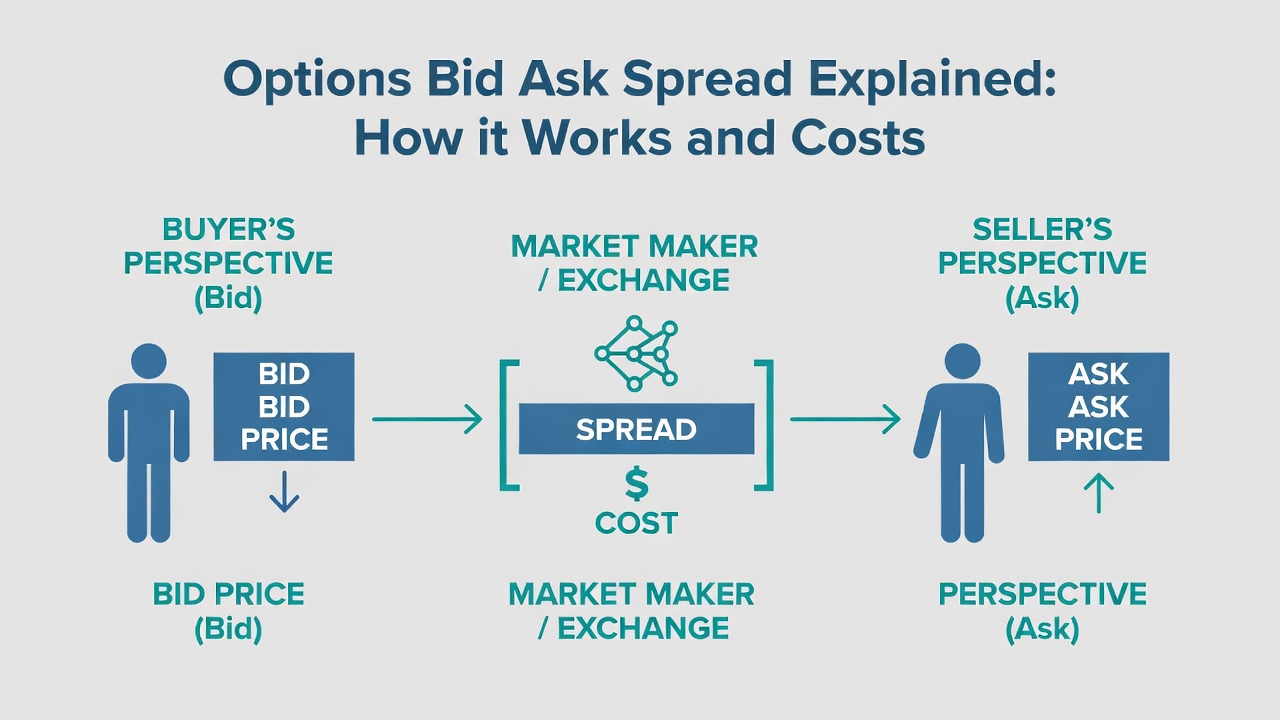
The bid-ask spread is simply the mathematical difference between the ask price and the bid price.
Formula: Spread = Ask Price – Bid Price.
This gap represents the profit margin collected by market makers who facilitate trades by taking the opposite side of your orders.
Every single time you buy at the ask and sell at the bid, you give up the spread to the market liquidity provider.
Because of this gap, you start every option trade at an immediate minor loss the instant your order gets filled.
If an option has a bid of $2.00 and an ask of $2.20, the spread is $0.20 per share, which equals $20 per contract.
We covered in Part 11 that one option contract controls 100 shares of stock, so every penny in the spread equals one full dollar per contract.
A tight spread means low transaction costs, while a wide spread means you are paying a heavy hidden toll to enter and exit.

A Simple Analogy: The Pawn Shop Window
To really understand how the bid-ask spread works in real life, imagine walking into a neighborhood pawn shop with a gold ring.
The pawn shop owner looks at your ring and offers to buy it from you right now for $100.
That $100 offer is the bid price.
If you change your mind five seconds later and decide to buy the exact same ring back from the shop owner, he will charge you $120.
That $120 price tag is the ask price.
The $20 difference between what he paid you and what he sells it for is his spread, which covers his business costs and risk.
Options market makers operate on the exact same business model, providing instant liquidity in exchange for collecting that spread gap on every single transaction.
Worked Example 1: Trading an Option With a Tight Spread
Let’s look at a concrete example using a highly liquid stock like stock XYZ, which is currently trading at $150 per share.
You want to buy a call option with a $150 strike price expiring in 30 days.
You open your trading platform and see the following market quote for this call option:
| Option Strike | Bid Price | Ask Price | Spread | Cost Per Contract |
|---|---|---|---|---|
| XYZ $150 Call | $3.00 | $3.05 | $0.05 | $305.00 |
The bid is $3.00 and the ask is $3.05, creating a very tight spread of just $0.05 per share.
If you buy one call contract using a market order, you will instantly buy at the ask price of $3.05, costing you exactly $305.00 total.
If you immediately turned around and sold that contract back to the market one second later, you would sell at the bid price of $3.00, getting $300.00 back.
Your total loss on that immediate round-trip trade would be only $5.00 per contract, which is a tiny $0.05 spread friction.
This tight spread makes it easy to manage your risk and enter or exit positions cleanly without leaking cash.
From Find Better Trades
When The Coil Is Ready To Explode, You’ll Know
Auto-maps ascending, descending, and symmetrical triangles with breakout alerts the moment price escapes the pattern.


Worked Example 2: The Hidden Danger of a Wide Spread
Now let’s examine what happens when you trade an option on an illiquid, low-volume stock named ABC.
Stock ABC trades at $50 per share, and you want to purchase an out of the money put option.
You pull up the option chain on your screen and see this quote:
| Option Strike | Bid Price | Ask Price | Spread | Cost Per Contract |
|---|---|---|---|---|
| ABC $45 Put | $1.00 | $1.60 | $0.60 | $160.00 |
Here, the bid is $1.00 and the ask is $1.60, creating a massive $0.60 spread between buyers and sellers.
If you buy this put option at the ask price of $1.60, you pay $160.00 total for the contract.
The moment your order fills, your broker platform will display your position value based on the current bid price of $1.00 ($100.00 total value).
You are instantly down $60.00 on a $160.00 investment, representing an immediate 37.5% loss purely due to the wide spread gap.
The underlying stock ABC would need to make a massive price move just for your option contract to break even.
How Liquidity and Option Volume Impact the Spread
The primary driver of the bid-ask spread size is liquidity, which refers to how easily an option can be bought or sold without impacting its price.
Popular mega-cap stocks and broad market index ETFs have millions of shares and contracts changing hands every single day.
Because thousands of traders and competitive automated market makers are actively quoting these popular assets, competition drives the spread down to just a penny or two.
On the other hand, smaller company stocks, obscure options strikes, or options with distant expiration dates have very low trading volume.
Market makers take on higher financial risk when quoting quotes for illiquid options because they cannot easily offset their inventory risk.
To compensate for taking on that extra holding risk, market makers widen the spread significantly on low-volume options contracts.
Checking the daily trading volume and open interest on an option contract before trading helps you avoid wide spreads before placing your order.
Common Mistakes Beginners Make With This
The single biggest mistake new traders make is using market orders instead of limit orders when opening or closing option positions. A market order fills instantly at whatever ask or bid price is active, which can result in horrific execution prices on wide spreads.
Another frequent mistake is ignoring the mid-price when placing an order. The mid-price is the exact midpoint between the bid and the ask, and setting your limit order near this price often gets filled while saving you money.
Beginners also regularly forget to check contract trading volume before placing a trade. Entering a position on an option with zero volume might feel harmless, but you will quickly find out how painful it is when you try to sell and nobody is bidding.
Finally, many new traders do not realize that the option spread expands during the first and last fifteen minutes of the trading day. Placing orders during those high-volatility window periods often results in overpaying relative to stable mid-day prices.
Frequently Asked Questions About Option Bid-Ask Spreads
What is a good or acceptable bid-ask spread for options?
A good bid-ask spread is generally $0.05 or lower for lower-priced options under $5.00, and under 5% of the total premium value for higher-priced contracts. If the spread is wider than 10% of the option’s total price, you should proceed with extreme caution.
Should I buy options at the bid price or the ask price?
You buy options at the ask price if you want an immediate fill, but you should always start by placing a limit order at or near the mid-price between the bid and ask. Placing your order at the midpoint forces market makers to improve their price if they want your business.
Why does my option show an immediate loss right after I buy it?
Your trading platform calculates your open account balance using the current bid price, but you paid the higher ask price to purchase the contract. That instant drop in reported account value is simply the cost of crossing the bid-ask spread on entry.
Can the bid price on an option contract drop all the way to zero?
Yes, an option bid price can fall to zero if the contract drops deep out of the money or approaches expiration with no buyers interested. When the bid is zero, you cannot sell the contract on the open market until a buyer steps in with a non-zero bid offer.
Next up in Part 14, we are going to demystify implied volatility so you can instantly tell whether an option price is cheap or wildly overpriced before you enter.
📈 Want More? Join Our Free Trading Community
- Trading Strategy Guides Telegram — daily strategy tips and market insights
- Find Better Trades Telegram — free trade signals delivered to your phone
- Find Better Trades on YouTube — live trade breakdowns and tutorials