What Happens When an Option Expires? Expiration Outcomes

📚 Beginner’s Guide to Options — Part 10 of 51
- Part 1: What Is an Option? The Absolute Basics Explained
- Part 2: Calls vs. Puts: The Two Types of Options You Need to Know
- Part 3: Strike Price Explained: What It Actually Means for Your Trade
- Part 4: Expiration Date Explained: Why It Changes Everything
- Part 5: Premium Explained: What You’re Really Paying For
- Part 6: In the Money vs. Out of the Money: A Beginner’s Breakdown
- Part 7: Intrinsic Value vs. Extrinsic Value: What Makes Up an Option’s Price
- Part 8: How Buying a Call Option Works, Step by Step
- Part 9: How Buying a Put Option Works, Step by Step
- Part 10: What Happens When an Option Expires? Every Outcome Explained (you are here)
☡ Key Takeaways
- At expiration, options either become valuable shares of stock or worthless pieces of digital paper.
- You do not have to hold an option until expiration; you can sell it early to lock in gains or cut losses.
- Understand automatic exercise rules so you never get surprised by a weekend position you did not want.
— Ben, Find Better Trades
Welcome back to my beginner series. We have reached Part 10 of our guide, and we are tackling the big moment every options contract eventually faces: the final buzzer of expiration.
For many beginners, expiration feels like a mysterious black box. You might wonder if your money just vanishes, or if you will suddenly wake up owning thousands of shares of stock you cannot afford.
Today, I am going to pull back the curtain on exactly what happens on expiration Friday. We will look at every possible path so you can trade with total confidence and zero anxiety.
1. The Two Ultimate Paths of an Option Contract
At its core, every single options contract in the world has a hard deadline. Unlike shares of stock, which you can hold for decades, options have a built-in shelf life that we discussed earlier in the series.
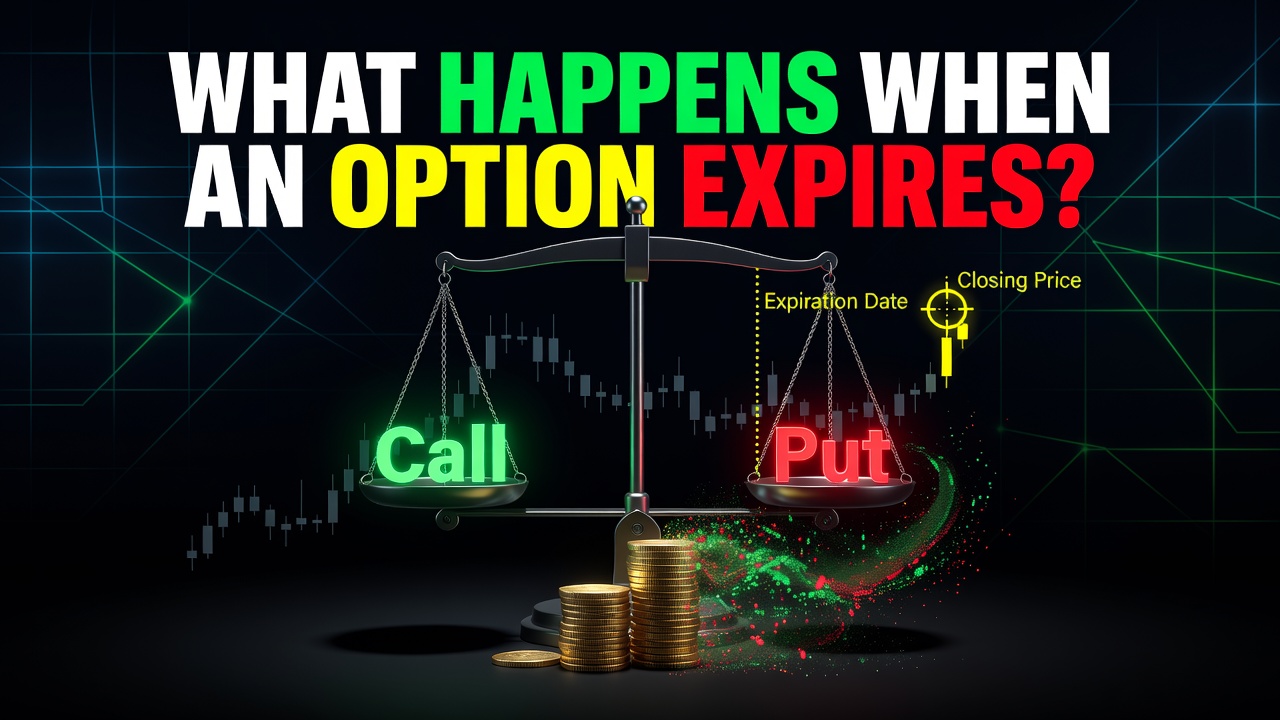
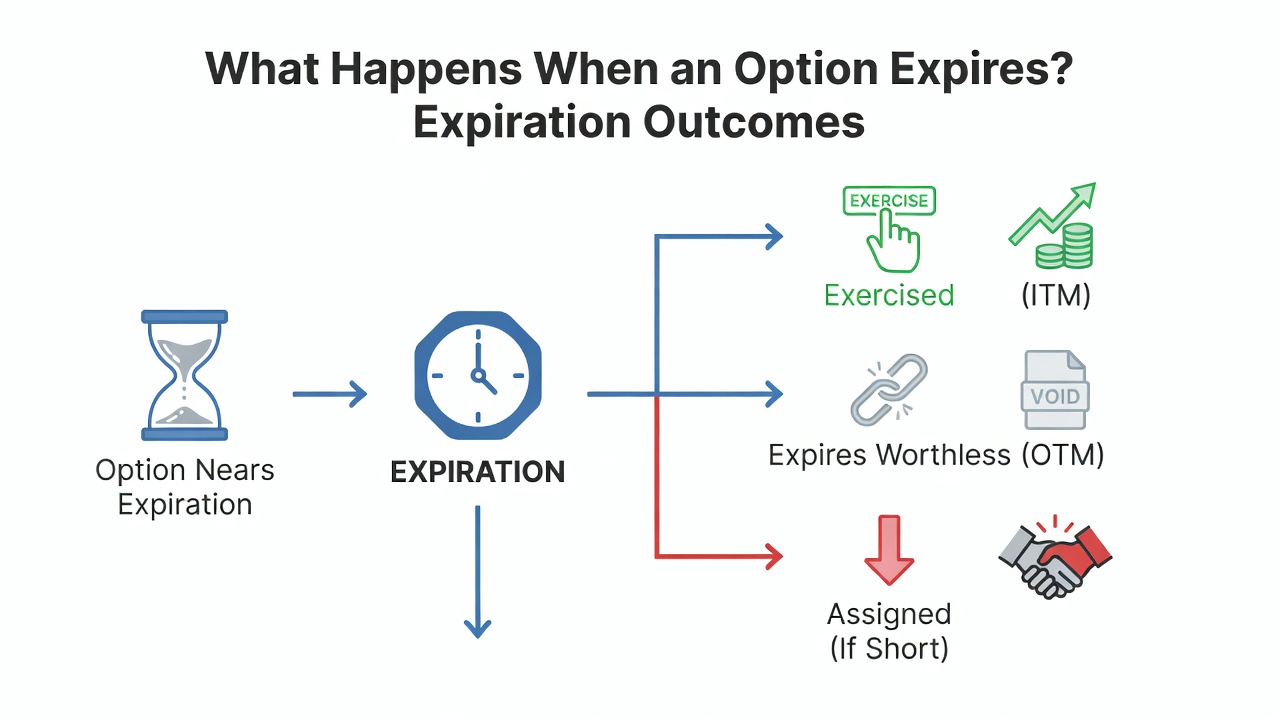
When that final clock runs out on expiration day, only two things can happen to your option. It will either be exercised, turning into actual shares of stock, or it will expire completely worthless.
Think of it like a train ticket that is only valid for a specific journey on a specific day. Once that day passes, the conductor will not accept it, and you cannot sell it to another passenger.
It is either used to board the train, or it becomes a useless scrap of paper in your pocket. There is no middle ground, no extensions, and no second chances once the market closes on expiration day.
2. What Happens to In-The-Money Options
If you hold an option that is In-the-Money at expiration, something very specific happens. Your broker will almost always step in and automatically exercise that option for you.
As we covered in earlier parts, an option is In-the-Money if it has intrinsic value. For a call option, this means the stock price ended up higher than your strike price.
For example, let us say you bought a call option with a strike price of $50, and the stock is trading at $55 at Friday’s close. Your option is In-the-Money by exactly $5.
Because it has value, your broker will automatically exercise this option to protect you from losing that value. They will use your option to buy 100 shares of the stock at your $50 strike price.
This means you will suddenly see 100 shares of stock in your account on Monday morning, and your cash balance will decrease by $5,000 to pay for them.
🎯 Get High-Probability Trade Setups — Free
The Big Dipper Dashboard delivers curated trade ideas straight to your screen every morning. Know what to watch before the opening bell.

3. What Happens to Out-of-the-Money Options
On the flip side, we have options that finish the day Out-of-the-Money. This means the option has absolutely no intrinsic value when the closing bell rings.
If you own a $50 call option and the stock ends the day at $48, nobody is going to use that option. Why would anyone pay $50 for a stock they can buy on the open market for $48?
Because the option is useless, it simply expires worthless. It quietly disappears from your brokerage account over the weekend, and you do not need to do anything at all.
The cash you originally paid to buy the option, which we call the premium, is gone forever. This represents your maximum potential loss on the trade, which we planned for from the start.
There are no hidden fees, no obligations, and no sudden stock positions to worry about. The trade is simply over, and your risk is completely resolved.

4. The Hidden Trap of Automatic Exercise
Most major brokerages have an automatic exercise threshold of one penny. If your option is In-the-Money by even $0.01 at the close, they will exercise it for you.
This is meant to be a helpful safety net, but it can sometimes catch beginners completely off guard. If you do not have enough cash in your account to buy 100 shares, your broker might buy them on margin.
This can lead to a dreaded margin call on Monday morning, forcing you to sell the shares immediately. In worst-case scenarios, your broker might even step in on Friday afternoon and sell your option early to protect themselves.
To avoid this headache, you must always keep a close eye on your positions as expiration approaches. Never leave an In-the-Money option unattended on Friday afternoon if you do not want to own the underlying stock.
You can easily avoid this entire situation by simply closing your trade before the market closes. Selling your option back to the market takes the expiration risk completely off the table.
5. Closing Your Trade Before the Buzzer
Here is a secret that many beginners do not realize: you do not have to hold your option until expiration. In fact, most experienced traders rarely do.
You can buy an option on Tuesday and sell it on Wednesday for a quick profit or a small loss. Selling to close your position is the easiest way to manage your risk.
Let us look at a simple comparison of your choices as expiration day approaches. This table shows your main options depending on where the stock price is trading.
| Your Position | Action If In-The-Money | Action If Out-of-the-Money |
|---|---|---|
| Hold to Expiry | Automatically exercised (you get shares) | Expires worthless (you lose premium) |
| Sell Before Expiry | Lock in cash profits immediately | Salvage any remaining small value |
As you can see, closing the trade early gives you total control over the outcome. It removes the stress of wondering what will happen over the weekend.

6. A Tale of Two Traders: Realistic Expiration Examples
Let us walk through two clear, realistic examples to show how these concepts work in the real world. We will look at Sarah and David, who both trade stock XYZ while it is at $100.
Sarah buys a call option with a $105 strike price for a premium of $2, meaning she pays $200 total. By Friday’s expiration, XYZ stock has surged to $110.
Sarah’s option is In-the-Money by $5. If she does nothing, her broker will exercise it, buying her 100 shares at $105 each, requiring $10,500 in her account.
Instead, Sarah decides to sell her option on Friday afternoon for its intrinsic value of $5, receiving $500 cash. Her net profit is $300 after subtracting her original $200 cost.
Now let us look at David, who buys the exact same $105 call option for $200. Unfortunately, XYZ stock only climbs to $104 by Friday’s expiration day.
Because $104 is below his $105 strike, his option is Out-of-the-Money. David does nothing, his option expires worthless, and he loses his $200 premium, with no further obligations.
7. Pin Risk: The Dangerous After-Hours Wildcard
There is one advanced concept you need to know about, and it is called pin risk. This occurs when the stock price closes incredibly close to your strike price at 4:00 PM on Friday.
Even though regular stock trading stops at 4:00 PM, options can actually be exercised for a short time after the close. This means news after the bell can change your outcome.
If the stock is at $49.99 at the close, you might think your $50 call option is safe and will expire worthless. But if positive news breaks at 4:15 PM, the stock might jump to $51.00.
The person who bought your option can still choose to exercise it, leaving you with a surprise short stock position on Monday. This is why holding near-the-money options through expiration is a gamble.
I always tell my traders to avoid this unnecessary stress. If the stock is hovering near your strike price on Friday afternoon, just close the trade and move on.
Common Mistakes Beginners Make With This
The biggest mistake I see beginners make is forgetting about their open positions on expiration Friday. They assume that if an option is losing money, they can just ignore it, but late-day price swings can push it In-the-Money and trigger an unwanted exercise.
Another common error is not having enough capital to cover an automatic exercise. If you do not have the cash to buy the underlying shares, your broker will liquidate your position, often at a terrible price, to protect themselves from risk.
Finally, many beginners do not realize they can sell a losing option early to save some of their premium. If your option is losing value and expiration is near, you do not have to watch it go to zero; you can often sell it for a small amount to salvage some cash.
What Happens to an Option at Expiration FAQ
What time do options actually expire on Friday?
While options stop trading at 4:00 PM Eastern Time on Friday, they do not officially expire until later that evening. This gap allows brokers to process exercise requests, which is why after-hours stock moves can still affect your options.
Do I have to buy the shares if my call option expires In-the-Money?
Yes, if you hold the option through expiration, your broker will automatically exercise it and buy the shares for you. If you want to avoid buying the shares, you must sell the option to close your position before the market closes on Friday.
What happens if I don’t have enough money in my account for exercise?
If your account lacks the funds to purchase the shares, your broker will usually sell the option on your behalf shortly before the market closes. If they fail to do this, you may wake up Monday with a margin call, forcing you to sell the shares immediately.
Can I lose more than the premium I paid if my option expires worthless?
No, if you are a basic option buyer, your risk is strictly limited to the premium you paid to enter the trade. If the option expires worthless, you lose that initial investment, but you will never owe any additional money or shares.
Now that you know exactly how the expiration buzzer works, we need to look at what you are actually trading when you buy or sell a contract, which we will cover in our next guide on what one contract represents.
📈 Want More? Join Our Free Trading Community
- Trading Strategy Guides Telegram — daily strategy tips and market insights
- Find Better Trades Telegram — free trade signals delivered to your phone
- Find Better Trades on YouTube — live trade breakdowns and tutorials