Intrinsic vs Extrinsic Value: Options Pricing Explained

📚 Beginner’s Guide to Options — Part 7 of 51
- Part 1: What Is an Option? The Absolute Basics Explained
- Part 2: Calls vs. Puts: The Two Types of Options You Need to Know
- Part 3: Strike Price Explained: What It Actually Means for Your Trade
- Part 4: Expiration Date Explained: Why It Changes Everything
- Part 5: Premium Explained: What You’re Really Paying For
- Part 6: In the Money vs. Out of the Money: A Beginner’s Breakdown
- Part 7: Intrinsic Value vs. Extrinsic Value: What Makes Up an Option’s Price (you are here)
☑ Key Takeaways
- Intrinsic value is the real, tangible worth an option has right now if you exercised it instantly.
- Extrinsic value is the premium you pay for the remaining time and the stock’s potential volatility.
- Understanding how these two values interact keeps you from overpaying for options that are guaranteed to expire worthless.
— Ben, Find Better Trades
When I first started trading, I looked at option prices and felt completely lost. I could not understand why two contracts with the same strike price had completely different costs just because of their expiration dates. This is Part 7 of our beginner series, and today we are going to demystify this exact pricing puzzle.
Understanding how an option is priced is the ultimate separator between gambling and actual, systematic trading. Once you master the relationship between intrinsic and extrinsic value, you will never look at an option chain the same way again.
1. What Actually Makes Up an Option’s Price?
Every single option price you see on your broker screen is called the premium, a concept we covered earlier in this series. This premium is not just a random number pulled out of thin air by market makers.
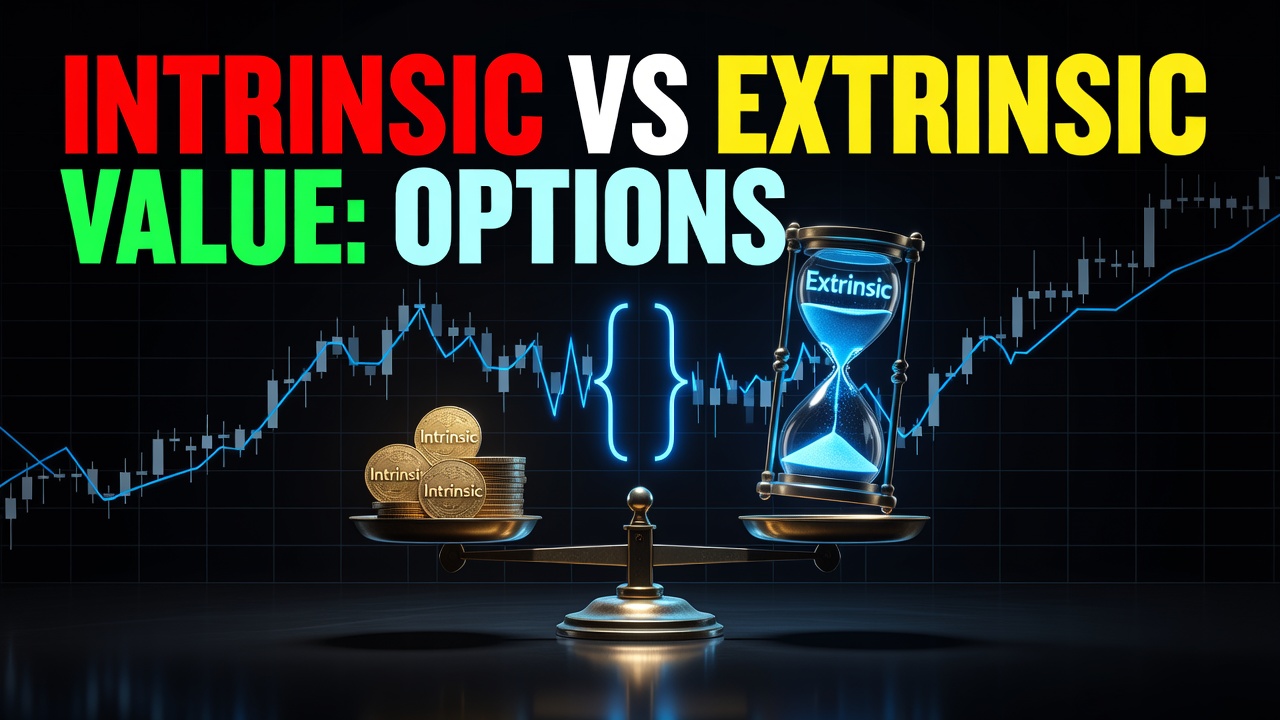
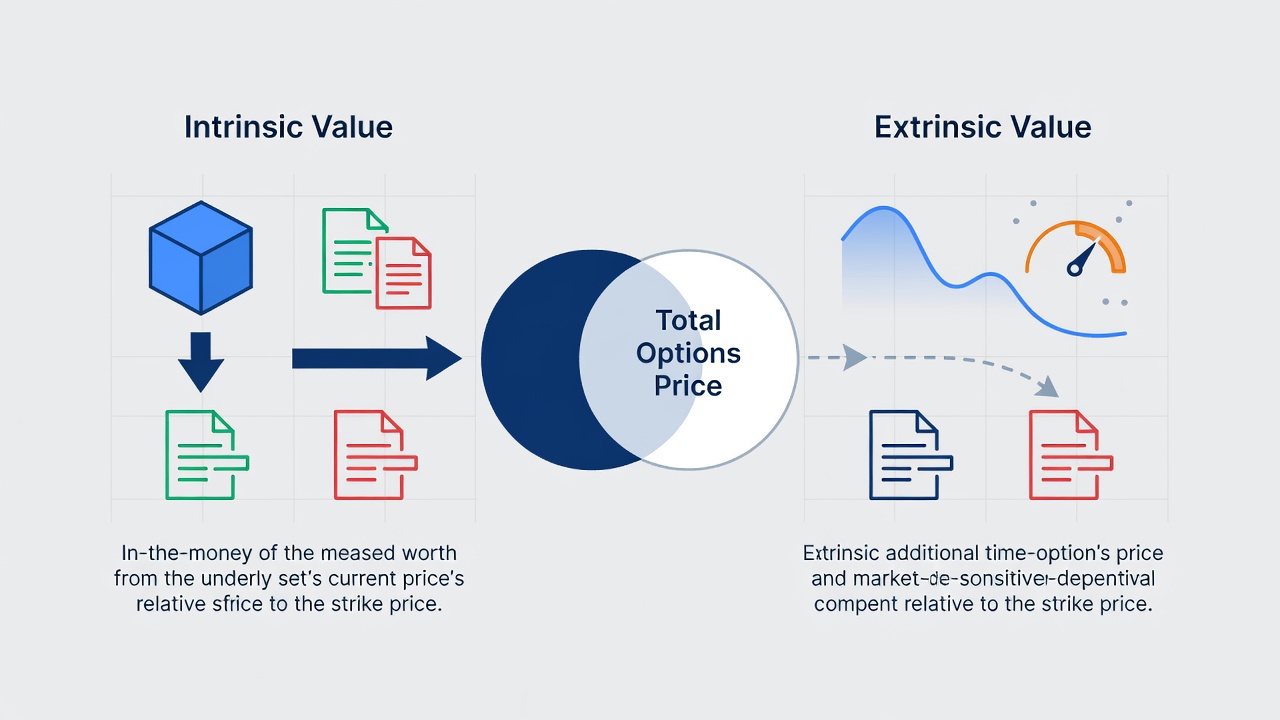
Instead, the premium is always made of two distinct components added together. Those two parts are intrinsic value and extrinsic value.
I like to think of this like buying a house. Part of the home’s price comes from the raw physical land and materials, while the other part comes from the future potential of the neighborhood.
If you do not know how much of your option’s price is real value versus how much is just hope and time, you are trading blind. Let’s break down the mathematical formula that traders use every single day to separate these two pieces.
The formula is incredibly simple: Premium equals Intrinsic Value plus Extrinsic Value. By rearranging this simple math, you can easily calculate exactly how much extra “fluff” you are paying for any contract on the market.
2. Intrinsic Value: The Real-World Tangible Worth
Intrinsic value is the absolute baseline, real-world value of the option right this second. It is the amount of money you would pocket if you exercised the option immediately and sold the shares.
If an option has intrinsic value, we call it “In the Money,” which is another concept we broke down in Part 6 of this series. If an option does not have any immediate real-world value, its intrinsic value is exactly zero.
Let’s look at our first worked example to make this concrete. Suppose you hold a Call option with a strike price of $100, and the underlying stock is currently trading at $105.
Because this Call option gives you the right to buy the stock at $100 when it is worth $105, the option has an immediate, real-world advantage. That advantage is worth exactly $5, which is your intrinsic value.
If the stock price drops to $95, your $100 Call option no longer has any real-world value. Intrinsic value can never be negative, so in this case, the intrinsic value simply drops to zero.
🎯 Get High-Probability Trade Setups — Free
The Big Dipper Dashboard delivers curated trade ideas straight to your screen every morning. Know what to watch before the opening bell.

3. Extrinsic Value: The Premium of Time and Hope
Now let’s talk about the second half of the equation, which is extrinsic value. This is the portion of the option’s price that represents time, volatility, and market expectation.
I think of extrinsic value like an insurance premium you pay on a car. You are paying for the safety of having that coverage over a specific period of time, even if you do not get into an accident today.
As long as there is time left on the clock before the expiration date, an option will have extrinsic value. This is because there is still a chance the stock price could move in a favorable direction for the holder.
This extra value is completely intangible and represents the market’s collective belief about what might happen next. It is essentially the cost of “hope” and “opportunity” bundled into a single price tag.
The moment the expiration Friday arrives and the closing bell rings, all extrinsic value instantly vanishes. At expiration, the option is worth only its raw, physical intrinsic value, and absolutely nothing more.

4. The Math in Action: A Worked Example
Let’s run through a realistic, step-by-step calculation so you can see how these two forces interact in the market. Suppose XYZ stock is currently trading at exactly $50 per share.
You decide to look at a Call option with a strike price of $45 that expires in exactly one month. The broker platform shows you that the current market price (premium) of this Call option is $7.00.
First, we calculate the intrinsic value by seeing how much “In the Money” the option is. Since the stock is at $50 and our strike is $45, the intrinsic value is $5.00 ($50 minus $45).
Next, we use our simple formula to find the remaining extrinsic value. We subtract the $5.00 of intrinsic value from the total $7.00 premium, leaving us with exactly $2.00 of extrinsic value.
This means you are paying $5.00 for the actual, tangible right to buy the stock cheaper, and $2.00 for the thirty days of time and potential movement. This simple breakdown tells you exactly where your money is going.
5. How Moneyness Dictates the Value Split
The state of the option relative to the stock price, also known as moneyness, completely changes how these values are distributed. This is where many beginners get tripped up when looking at an option chain.
For options that are Out of the Money (OTM) or At the Money (ATM), the calculation is incredibly easy. These contracts have zero intrinsic value because exercising them right now would yield absolutely no benefit.
Therefore, 100% of the price of an Out of the Money option is made up of extrinsic value. If you buy a $110 Call when the stock is at $100, every single penny you pay is just time and hope.
In contrast, In the Money options contain a mix of both intrinsic and extrinsic value. The deeper in the money the option goes, the more its price is dominated by intrinsic value, and the less extrinsic value it holds.
To help visualize this balance, look at how different Call strike prices split their value when the underlying stock is trading at $100:
| Strike Price | Option Price (Premium) | Intrinsic Portion | Extrinsic Portion |
|---|---|---|---|
| $90 (In the Money) | $12.00 | $10.00 | $2.00 |
| $100 (At the Money) | $4.50 | $0.00 | $4.50 |
| $110 (Out of the Money) | $1.50 | $0.00 | $1.50 |
6. The Impact of Time and Volatility
Extrinsic value is highly sensitive to external market conditions, which is why it constantly fluctuates throughout the trading day. The two main drivers of this fluctuation are time to expiration and implied volatility.
As every day passes, the amount of time remaining on the contract shrinks. This natural erosion is called time decay, and it slowly eats away at the extrinsic value of your option until it hits zero at expiration.
Volatility acts as a multiplier for extrinsic value because highly volatile stocks have a much higher chance of making big moves. When a stock gets wild, market makers increase the extrinsic value to protect themselves from big losses.
This is why you might see an option’s price rise even if the underlying stock price does not move at all. If the market suddenly expects a massive swing, the extrinsic value expands rapidly to reflect that new risk.
Understanding this dynamic is crucial because it means you can lose money on an option even if the stock goes your way, simply because volatility or time crushed the extrinsic value.
7. Why This Matters for Your Trading Strategy
When you buy an option, you are fighting a race against the clock because you are buying a decaying asset. Every single day you hold the trade, the extrinsic value of your option is slowly leaking away.
If you purchase an option that is entirely extrinsic value, you need the stock to move fast enough and far enough to beat that daily decay. This is a very difficult hurdle for most retail traders to clear consistently.
On the flip side, some traders prefer to sell options rather than buy them. By selling options, they put themselves on the winning side of time decay, collecting that eroding extrinsic value as pure profit.
No matter which side of the trade you choose, you must always look at the premium and run the math. Knowing exactly how much intrinsic versus extrinsic value you are trading is the foundation of managing your risk.
Common Mistakes Beginners Make With This
The most common mistake I see beginners make is buying cheap, far Out of the Money options because they look like a bargain. They do not realize these options contain absolutely zero intrinsic value, meaning they have a massive statistical probability of expiring completely worthless.
Another frequent error is failing to account for time decay on long-term holds. Beginners will buy a call option, watch the stock move slowly in their favor over three weeks, and still lose money because the daily loss of extrinsic value outpaced the small gain in intrinsic value.
Lastly, many new traders buy options right before major events like corporate earnings reports when extrinsic value is highly inflated by volatility. Once the news is released, volatility crashes, causing the extrinsic value to instantly collapse and leaving the trader with a massive loss even if they guessed the direction correctly.
Intrinsic vs Extrinsic Value FAQ
Why did my option lose value today even though the stock price went up?
This usually happens because the daily loss of extrinsic value, known as time decay, was greater than any gain in intrinsic value. It can also happen if the market’s expectation of future volatility dropped, causing the option’s extrinsic premium to shrink rapidly.
Can an option have negative intrinsic value if it is far out of the money?
No, intrinsic value can never fall below zero. If a strike price is completely unfavorable compared to the current stock price, the option simply has zero intrinsic value and its price is determined entirely by remaining time and volatility.
Is it always better to buy options with high intrinsic value?
Not necessarily, as options with high intrinsic value require a much larger upfront capital investment because you are paying for real, tangible worth. However, they do offer a higher probability of profit because they are less dependent on rapid, massive stock movements to stay valuable.
When does extrinsic value completely reach zero?
Extrinsic value reaches exactly zero at the very moment of the option’s expiration. Once there is no time left on the clock for the stock to move, the option is worth only its physical intrinsic value, and all remaining hope and time premium is gone.
In the next part of this series, we will put this knowledge to work by looking at exactly how buying a call option works, step by step.
📈 Want More? Join Our Free Trading Community
- Trading Strategy Guides Telegram — daily strategy tips and market insights
- Find Better Trades Telegram — free trade signals delivered to your phone
- Find Better Trades on YouTube — live trade breakdowns and tutorials
Lesson 7 of 55 in the free Options Trading Course.
← Previous: In the Money vs Out of the Money Options Explained
Next: How Buying a Call Option Works: Step-by-Step Guide →