Options Contracts 101: What One Contract Represents

📚 Beginner’s Guide to Options — Part 11 of 51
- Part 1: What Is an Option? The Absolute Basics Explained
- Part 2: Calls vs. Puts: The Two Types of Options You Need to Know
- Part 3: Strike Price Explained: What It Actually Means for Your Trade
- Part 4: Expiration Date Explained: Why It Changes Everything
- Part 5: Premium Explained: What You’re Really Paying For
- Part 6: In the Money vs. Out of the Money: A Beginner’s Breakdown
- Part 7: Intrinsic Value vs. Extrinsic Value: What Makes Up an Option’s Price
- Part 8: How Buying a Call Option Works, Step by Step
- Part 9: How Buying a Put Option Works, Step by Step
- Part 10: What Happens When an Option Expires? Every Outcome Explained
- Part 11: Options Contracts 101: What One Contract Actually Represents (you are here)
★ Key Takeaways
- One standard options contract always controls exactly 100 shares of the underlying stock.
- The quoted option price is the per-share cost, so you must multiply it by 100 to find your actual cash outlay.
- Always calculate your total financial risk based on the 100-share multiplier before entering any trade.
— Ben, Find Better Trades
Hey everyone, Ben here. Welcome back to my beginner’s series, where we are stripping away the Wall Street confusion and looking at how options actually function in the real world.
Today we are diving into Part 11 of our series, and we are tackling a massive point of confusion that trips up almost every single beginner I have ever mentored. It is the concept of what a single options contract actually represents in terms of shares and real money.
If you do not grasp this core mechanic, you are going to make massive, expensive mistakes the very first time you click the buy button in your brokerage account.
The Core Rule: The 100-Share Multiplier Explained
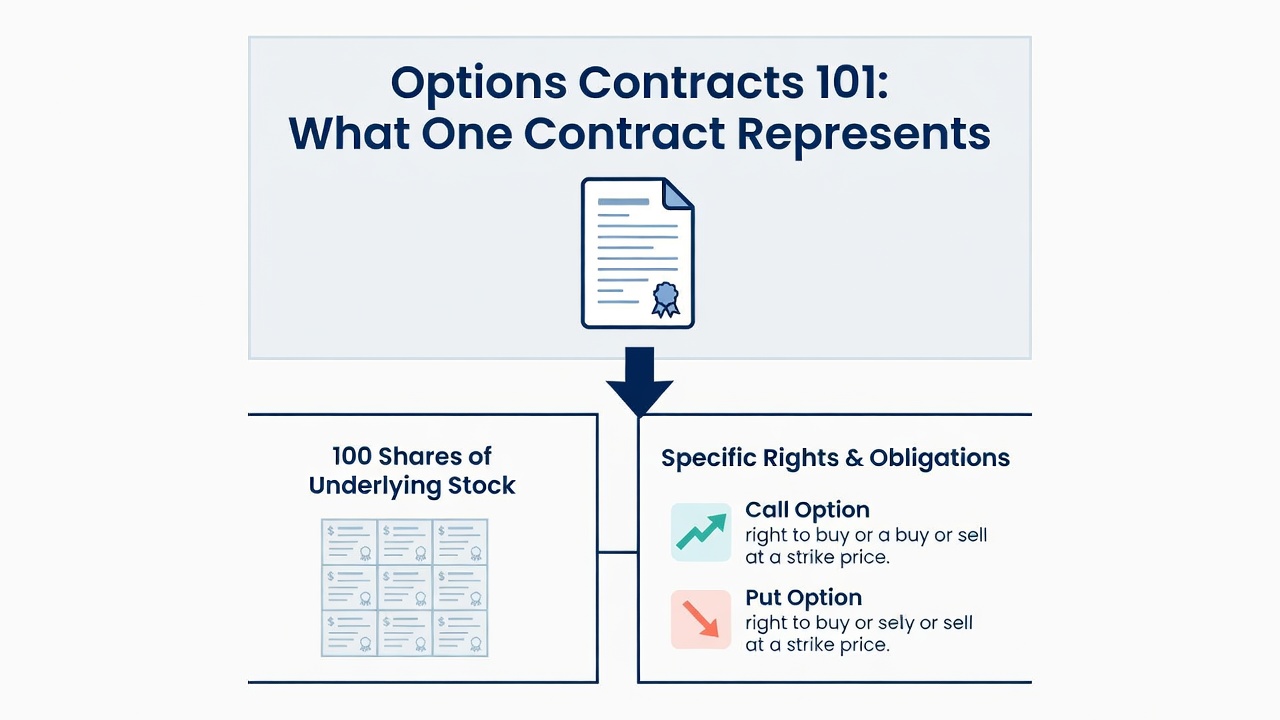
When you buy or sell a stock, you can trade any number of shares you want, whether it is one share, five shares, or seventy-three shares. Options do not work that way because they are standardized contracts that trade in fixed packages.
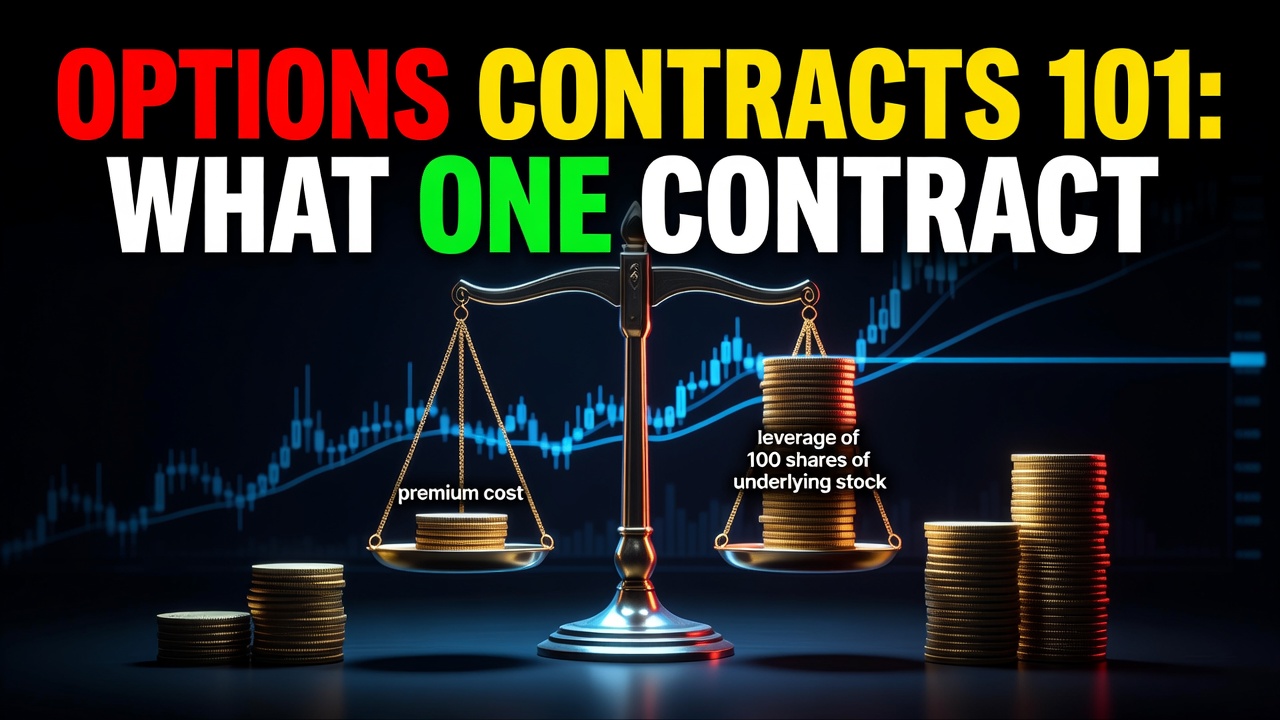
In the options market, one standard contract represents exactly 100 shares of the underlying stock. This is a non-negotiable rule set by the exchanges, and it applies to almost every stock and exchange-traded fund you will ever trade.
Think of it like buying soda at a warehouse club store. You cannot walk in and buy a single individual can of cola off the shelf; you have to buy the pre-packaged case of 24 cans. The case is the tradeable unit, even though the product inside is individual sodas.
In this analogy, the case is the options contract, and the 24 sodas are the 100 shares of stock. You trade the contracts, but you are always controlling a specific bundle of underlying shares underneath.
We touched on the basic definitions of calls and puts in Part 2, but now we are looking at the heavy leverage that comes with this 100-share relationship. Because you control 100 shares with just one contract, your potential gains and losses are amplified by a factor of 100.
The Multiplier Effect on Premium Prices
This is where almost every beginner gets caught off guard, and it can cause serious panic if you are not prepared. When you look at an option chain on your broker’s platform, the price of the option, which we call the premium, is always quoted on a per-share basis.
If you see an option quoted at $2.00, your brain might naturally assume that you can buy this contract for two dollars. But because that contract controls 100 shares, you have to multiply that quoted price by 100 to find the actual cash you will pay.
Let us walk through a simple calculation to show you how this works in practice. If the quoted premium is $2.00, your actual cost to purchase that single contract is $2.00 multiplied by 100, which equals $200.00 in real cash.
If you wanted to buy five of those contracts, you would multiply the quoted premium by 500. Your total outlay would be $2.00 multiplied by 500, which equals $1,000.00 out of your account.
I always tell my students to mentally slide the decimal point two spots to the right whenever they look at any option price. If an option is quoted at $0.45, it costs $45; if it is quoted at $12.50, it costs $1,250.
🎯 Get High-Probability Trade Setups — Free
The Big Dipper Dashboard delivers curated trade ideas straight to your screen every morning. Know what to watch before the opening bell.

Why the 100-Share Standardization Exists
You might wonder why the financial markets decided on 100 shares instead of some other round number like 10 or 50 shares. The short answer is efficiency and standardization for institutions and market makers.
Back when options trading was first formalized in the early 1970s, standardizing the contracts made it vastly easier for buyers and sellers to find each other. If everyone were trading different sized contracts, the market would be incredibly fragmented and messy.
Imagine a real estate market where every single house contract had a completely different set of custom rules and square footage definitions. It would take weeks of negotiation just to agree on what was being bought, which would grind trading to a halt.
By forcing every standard option contract to represent 100 shares, the exchanges created a highly liquid market where trades can execute in milliseconds. You know exactly what you are getting, and the market maker knows exactly what they are pricing.
This standardized size also aligns perfectly with standard stock trading units, as institutional traders traditionally buy and sell stock in 100-share blocks called round lots. It makes hedging and risk management seamless for the big players who keep the market moving.

How the Multiplier Affects Your Profit and Loss
Understanding the multiplier is not just about knowing how much money leaves your account when you buy a contract. It also dictates exactly how your trade’s value swings when the underlying stock moves up or down.
Let us look at a realistic scenario where you buy one call option on a hypothetical stock called ABC, which is currently trading at $50.00 per share. You buy a call option with a strike price of $50.00 for a quoted premium of $3.00, which means you pay $300.00 total.
If the stock price rises by just $1.00, the value of the stock underlying your contract has increased by $100.00 in total value. Because your contract controls those 100 shares, your option premium will rise to reflect that gain, though not always on a perfect one-to-one basis.
If the option premium rises from $3.00 to $4.20 because of that stock move, the total value of your contract is now worth $420.00. You could sell that contract back to the market for a net profit of $120.00, which is a 40% return on your initial $300.00 investment.
This table illustrates how the quoted prices translate to actual contract values across different premium levels:
| Quoted Premium Price | Contract Multiplier | Actual Cash Value per Contract |
|---|---|---|
| $0.10 | x 100 | $10.00 |
| $1.50 | x 100 | $150.00 |
| $5.00 | x 100 | $500.00 |
| $12.25 | x 100 | $1,225.00 |
The Concept of Leverage and Capital Efficiency
The 100-share multiplier is the exact mechanism that gives options their famous leverage, allowing you to control large amounts of stock with relatively little cash. This is what we call capital efficiency in the trading world.
Let us say you wanted to control 100 shares of a premium tech stock trading at $200.00 per share. If you bought those 100 shares outright in a standard brokerage account, you would have to shell out $20,000.00 of your own cash.
Instead, you could buy a single call option with a strike price of $200.00 for a quoted premium of $8.00. Your total cash outlay for this contract would be just $800.00, which is a fraction of the cost of buying the shares directly.
Now you control the upside of those $20,000.00 worth of shares for just an $800.00 entry fee. If the stock jumps to $210.00, the stock buyer makes $1,000.00 on their $20,000.00 investment, which is a 5% return.
Meanwhile, your option contract might double in value to $16.00, allowing you to sell it for $1,600.00. You made a $800.00 profit on an $800.00 investment, which is a massive 100% return on your risk capital.
Contract Specifications Beyond the 100-Share Rule
While the 100-share multiplier is the gold standard, there are rare exceptions and specific details you should understand so you are never caught off guard. These exceptions usually occur during corporate restructuring events.
The most common scenario where the contract multiplier changes is during a stock split or a corporate merger. When a company does an odd split, like a 3-for-2 split, the exchanges will adjust the existing options contracts so that they might represent non-standard share amounts.
These are called adjusted options, and they can represent weird amounts like 150 shares or even fractional share packages. I highly recommend that beginners completely avoid trading adjusted contracts because the liquidity is awful and the pricing is incredibly confusing.
You can easily spot these adjusted contracts on your platform because they will have a distinct “adjusted” label or a number like “1” next to the ticker symbol. Stick strictly to standard, newly issued contracts to ensure you are always dealing with the clean 100-share multiplier.
For normal trading, you can proceed with 100% confidence that every contract you click on represents exactly 100 shares of the company you are looking to trade.
How Multiple Contracts Scale Your Portfolio Risk
As you gain experience, you will eventually want to trade more than one contract at a time to match your growing account size. Scaling up requires a solid understanding of how your total risk multiplies with every additional contract.
If you purchase 10 contracts of an option priced at $1.50, you are not just buying a bigger position; you are commanding a massive block of stock. Those 10 contracts now control 1,000 shares of the underlying company.
If the stock is trading at $100.00, you are effectively controlling $100,000.00 worth of stock with your 10 contracts. Even though your maximum risk is limited to the $1,500.00 premium you paid, the price of your contracts will swing violently because of that huge underlying exposure.
A tiny move in the stock price will translate to major swings in your account balance. Always calculate your total exposure in terms of equivalent shares before you scale up your contract size.
I always advise my beginner traders to start with exactly one contract per trade for their first few months. This keeps your risk small and manageable while you learn how the pricing mechanics work in live market conditions.
Common Mistakes Beginners Make With This
The single most common mistake is entering an order for “100 contracts” when you actually meant to buy exposure to 100 shares of stock. Buying 100 contracts means you are controlling 10,000 shares, which can instantly wipe out a small account if the trade goes against you.
Another frequent error is failing to account for the actual cash cost when looking at a premium quote of $0.05. Beginners think this is basically free, but buying 20 of these contracts still costs $100.00 plus transaction fees, which can quickly add up over time.
Many beginners also forget that if they hold an option through expiration and it finishes in the money, they will be forced to buy or sell the full 100 shares per contract. If you do not have the cash in your account to buy those 100 shares, your broker may liquidate your position at a terrible price right before the closing bell.
Finally, traders often ignore the bid-ask spread on a per-share basis, forgetting that a $0.10 wide spread actually represents a $10.00 loss the moment you enter the trade. Always multiply that spread by 100 to understand the true friction cost of getting into and out of your position.
Options Contracts Multiplier FAQ
Why does my broker show my account balance dropping by $150 when I only bought one option for $1.50?
Your broker’s platform displays the quoted per-share price of $1.50, but the actual transaction requires you to pay for the entire 100-share block. Therefore, the actual cash removed from your account is $150.00, which is the quoted price multiplied by the standard contract size.
Can I buy a fractional options contract if I only want to control 50 shares of a stock?
No, you cannot buy fractional options contracts on standard public exchanges. The contract size is strictly standardized at 100 shares per contract, so you must trade in whole multiples of 100 shares.
What happens to my contract if a company does a standard 2-for-1 stock split?
When a stock undergoes a clean 2-for-1 split, the options clearing corporation typically splits your single contract into two separate contracts. The strike price of your contracts will be cut in half, but each contract will still represent the standard 100 shares.
Is there any difference in contract size between call options and put options?
No, there is absolutely no difference in contract size between calls and puts. Both call options and put options use the exact same standard 100-share multiplier, meaning one contract of either type controls 100 shares of the underlying asset.
In the next part of this series, we are going to look at the trading screen itself and learn how to read an options chain without getting completely overwhelmed by all the numbers.
📈 Want More? Join Our Free Trading Community
- Trading Strategy Guides Telegram — daily strategy tips and market insights
- Find Better Trades Telegram — free trade signals delivered to your phone
- Find Better Trades on YouTube — live trade breakdowns and tutorials