Why Beginners Lose Money Buying Options (And How to Fix It)


📚 Beginner’s Guide to Options — Part 25 of 51
- Part 1: What Is an Option? The Absolute Basics Explained
- Part 2: Calls vs. Puts: The Two Types of Options You Need to Know
- Part 3: Strike Price Explained: What It Actually Means for Your Trade
- Part 4: Expiration Date Explained: Why It Changes Everything
- Part 5: Premium Explained: What You’re Really Paying For
- Part 6: In the Money vs. Out of the Money: A Beginner’s Breakdown
- Part 7: Intrinsic Value vs. Extrinsic Value: What Makes Up an Option’s Price
- Part 8: How Buying a Call Option Works, Step by Step
- Part 9: How Buying a Put Option Works, Step by Step
- Part 10: What Happens When an Option Expires? Every Outcome Explained
- Part 11: Options Contracts 101: What One Contract Actually Represents
- Part 12: How to Read an Options Chain Without Getting Overwhelmed
- Part 13: Bid, Ask, and Spread: What They Mean When You’re Trading Options
- Part 14: What Is Implied Volatility? A Beginner’s Plain-English Guide
- Part 15: Why Options Lose Value Over Time: Theta Explained Simply
- Part 16: Delta Explained: What It Really Tells You About Your Option
- Part 17: Gamma Explained: Why Delta Doesn’t Stay the Same
- Part 18: Vega Explained: How Volatility Changes Your Option’s Price
- Part 19: The Greeks Cheat Sheet: Delta, Gamma, Theta, Vega in Plain English
- Part 20: What Is Assignment? What Happens If Your Option Gets Exercised
- Part 21: American vs. European Options: What’s the Difference?
- Part 22: How Much Money Do You Need to Start Trading Options?
- Part 23: Paper Trading Options: How to Practice Before Risking Real Money
- Part 24: The Biggest Mistake Beginners Make Buying Options
- Part 25: Why Most Beginners Lose Money Buying Options (and How to Avoid It) (you are here)
⚡ Key Takeaways
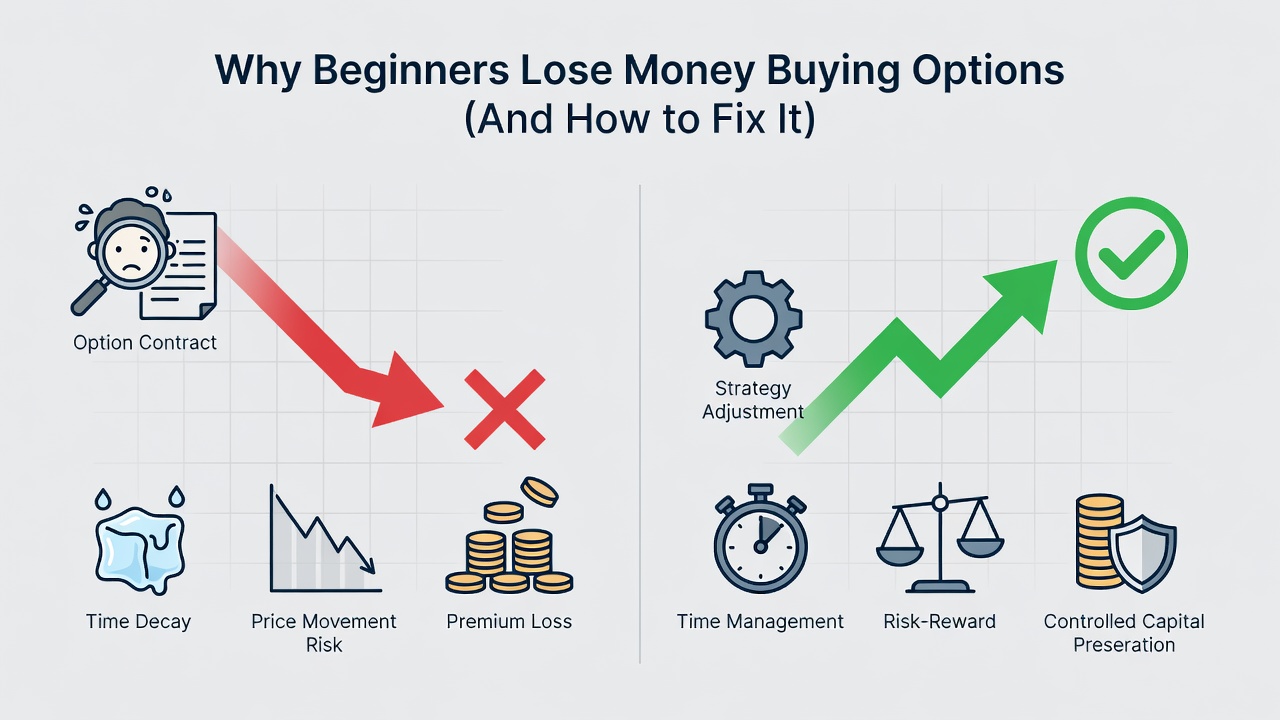
- Most new options traders lose money because they buy cheap, short-term contracts that get wiped out by time decay and volatility.
- Buying far out-of-the-money options acts like buying a lottery ticket where time is constantly working against you.
- You can drastically improve your win rate by choosing longer expiration dates, buying options with real intrinsic value, and managing risk aggressively.
— Ben, Find Better Trades
I see new options traders make the exact same heartbreaking mistakes week after week. They buy cheap call options, watch the stock move in their direction, and still lose every single dollar they put into the trade. Welcome to Part 25 of our beginner series, where we break down why most retail traders blow up their accounts buying options and how you can avoid joining them.
1. The Illusion of Cheap Leverage
When you first start trading options, buying contracts feels like finding a legal cheat code. You look at a stock trading at $200 per share and realize you cannot afford 100 shares, but you can buy a call option contract for just $2.00.
That $2.00 premium lets you control 100 shares of stock for $200 total instead of dropping $20,000 cash. We covered how single contracts represent 100 shares back in Part 11 of our series.
This massive leverage makes your eyes light up with visions of fast percentage returns. If the underlying stock jumps $10, your option contract might double or triple in value in a single afternoon.
However, that exact same leverage works against you with brutal force when a trade goes sideways. Options carry a structural drag that holding regular stock simply does not have.
When you own shares of stock, you can sit on them for five years waiting for a company to recover. An option contract has a hard expiration date, which means your idea must be right AND it must happen fast.
If the stock takes too long to make its move, your leverage turns into a fast track to losing 100% of your invested capital.
2. Fighting the Clock: The Silent Killer Called Theta
The single biggest reason long option buyers bleed capital is time decay. In Part 15, we introduced Theta, which measures the exact dollar amount an option contract loses every single day.
Think of buying an option like renting a luxury car for the weekend. Every single hour that car sits parked in your driveway, you are paying for the privilege of holding the keys regardless of whether you drive it.
The premium you pay for an option contains extrinsic value, which steadily bleeds away as the expiration date approaches. That extrinsic value is pure time, and time only moves in one direction.
Even if the underlying stock stands completely still all week, your option loses value every single afternoon when the market closes. You are effectively swimming upstream against a constant financial current.
To make money buying an option, the stock cannot just move in your direction. It must move fast enough to outrun the daily burn rate of time decay.
If you buy a call option and the stock moves up slowly over three weeks, you can easily end up with a net loss because time decay destroyed more value than the stock price gain created.
Free For Traders
One Clear Arrow. Every High-Probability Setup. Free.
The Fusion Indicator combines multiple signals into a single buy/sell arrow on TradingView so you never miss a move.
 → Get The Free Fusion Indicator
From Find Better Trades
Only Trade When Momentum Is HEAVILY In Your Favor
The Power Index oscillator measures trend conviction at a glance — it filters out weak, choppy action so you only take the strong moves.
 → See The Power Index
3. Buying High Volatility and Selling Low Volatility
Another silent account killer for new traders is buying options when implied volatility is sky-high. We broke down Implied Volatility in Part 14 and Vega in Part 18.
Right before major market events like corporate earnings reports, everyone wants to buy options contracts to speculate or protect their positions. This surge in demand inflates option premiums across the board.
When you buy an option right before earnings, you are paying a massive premium mark-up. Market makers know big moves are coming, so they charge top dollar for every contract.
The moment the earnings report comes out, the uncertainty vanishes instantly. Option premiums collapse in value within seconds, an event known in trading circles as a volatility crush.
You can buy a call option right before earnings, watch the underlying stock jump up by 4%, and still wake up the next morning to find your option value down 40%.
Buying options when volatility is at peak levels means you are buying high and setting yourself up to sell low once that volatility drops.

4. Picking Out-of-the-Money Lottery Tickets
Beginners almost always gravitate toward buying deep out-of-the-money options because they carry the lowest price tag. In Part 6, we explained that an out-of-the-money option contains zero intrinsic value.
When an option has no intrinsic value, its price tag is made entirely of hope and remaining time. Buying these contracts repeatedly is the fastest way to drain your brokerage account.
Let’s run through a realistic numeric example to see how this plays out in real life. Imagine stock XYZ is trading at $100 per share today.
You buy a call option with a $120 strike price expiring in two weeks for a premium of $0.50 per share ($50 total for one contract). To turn a profit at expiration, stock XYZ must rise above your breakeven price of $120.50.
That means the stock needs to rally over 20.5% in just 14 days just for you to make a single dollar. Take a look at how this compares to an in-the-money contract:
| Option Strike Price | Option Premium | Break-Even Stock Price | Required Stock Move |
|---|---|---|---|
| $120.00 Call (OTM) | $0.50 ($50 total) | $120.50 | +20.5% in 2 weeks |
| $95.00 Call (ITM) | $7.00 ($700 total) | $102.00 | +2.0% in 2 weeks |
Buying $50 options feels safe because you are risking a small dollar amount per trade. But if you take ten of those trades in a row and all ten expire worthless, you lost $500 with zero profits to show for it.
5. The Lure of Short Expiration Dates
Weekly options look extremely appealing on an options chain because they are cheap compared to options expiring several months down the road. We spent Part 12 learning how to read those chains.
When you buy an option contract with only three or four days left until expiration, time decay is running at its absolute maximum speed. In Part 15, we showed how the decay curve drops off a cliff in the final month.
Trading short-dated options gives your trade thesis zero room for error and zero time to play out. If the market opens slightly down or moves sideways for a few hours, your contract drops severely.
A short-term option leaves you completely at the mercy of short-term noise and random intraday market movements. You are no longer trading a company’s trend; you are gambling on noise.
Choosing shorter expirations might save you money on upfront capital, but it drastically reduces your probability of making a profitable trade.
[AD_PLACE_2]
6. Treating Options Like Stock Instead of Wasting Assets
When traders transition from buying stock to buying options, they often carry over a dangerous buy-and-hold mindset. If you buy shares of a solid company and the stock drops 10%, you can afford to hold on for a year until it recovers.
An option contract is an expiring asset that loses value every tick of the clock. Holding a losing option position while hoping for a miraculous recovery usually ends in a total loss.
Let’s walk through another step-by-step example. Suppose you buy an option contract for $4.00 ($400 total) when stock ABC is trading at $50 per share.
A week later, stock ABC dips slightly, and your option contract price falls to $2.00 ($200 total value remaining). Instead of cutting your loss at 50% to salvage $200, you decide to hold on and pray for a turnaround.
The stock stays flat over the final week before expiration, time decay takes over, and your option contract expires at $0.00. By refusing to exit, you turned a manageable $200 loss into a complete $400 failure.
7. How to Shift Your Odds and Protect Your Capital
To fix your trading and survive as an option buyer, you need to change how you select contracts and manage risk. The first step is giving yourself time by buying options with at least 45 to 60 days left before expiration.
Extra time flattens the daily time decay curve and gives the underlying stock room to move without putting immediate pressure on your position. You can always exit early when you hit a target profit.
Second, favor in-the-money or slightly out-of-the-money strike prices rather than super cheap options. In Part 16, we covered how higher Delta options move almost dollar-for-dollar with the underlying stock and retain value better.
Third, buy options when implied volatility is low or average, avoiding high-priced events like earnings announcements where volatility crush lies in wait.
Finally, set strict rules for exiting losing trades before entering them. If an option loses 30% to 50% of its initial value, close the contract and preserve your remaining capital for the next opportunity.
Common Mistakes Beginners Make With This
1. Buying options right before earnings releases without checking implied volatility. Beginners see an upcoming earnings report and buy call options assuming big stock moves equal big profits. They get wiped out by volatility crush the moment earnings drop and IV collapses.
2. Sizing trades based on contract cost instead of total risk. Traders look at a $0.30 option and buy 20 contracts because it only costs $600. They fail to realize that risking $600 on a low-probability lottery ticket is bad risk management.
3. Holding losing options contracts all the way to expiration. New traders hate taking a loss, so they hold onto dying option positions hoping for a last-second turnaround. This bad habit consistently turns small losses into total capital losses.
4. Ignoring the bid-ask spread on illiquid option chains. Beginners place market orders on options with wide spreads that we discussed in Part 13. They instantly lose 10% to 20% of their investment the second their order gets filled.
5. Over-trading short-dated weekly options. The cheap upfront price of weekly options tricks beginners into treating options trading like high-frequency gambling. They burn through their account balance taking dozens of high-decay trades every week.
Why Beginners Lose Money Buying Options: FAQ
Why do I lose money on a call option even when the stock goes up?
You lose money on a call option during a stock rise if daily time decay or a drop in implied volatility destroys value faster than the stock’s upward move adds value. If the stock does not move far enough or fast enough, the option contract will lose overall value.
Is buying options always a losing strategy for beginners?
Buying options is not inherently a losing strategy, but it requires high discipline and accurate timing compared to buying shares. Beginners who focus on in-the-money contracts, buy longer expiration dates, and manage risk strictly can trade long options profitably.
What is the safest expiration date for beginners buying options?
Choosing options with 45 to 60 days until expiration gives beginners a sweet spot of lower daily time decay and reasonable contract pricing. This timeframe provides enough room for the underlying stock to move without forcing you into quick panic decisions.
How much capital should I risk on a single option trade?
You should risk no more than 1% to 2% of your overall account balance on any single option purchase. Treating an option purchase as potential 100% risk keeps you from blowing up your total capital when a trade goes wrong.
Next up in Part 26, we are taking everything you have learned so far and introducing Covered Calls Explained: The First Options Strategy Every Trader Should Learn, where you finally get to play the role of the house and collect regular income instead of paying it.
📈 Want More? Join Our Free Trading Community
- Trading Strategy Guides Telegram — daily strategy tips and market insights
- Find Better Trades Telegram — free trade signals delivered to your phone
- Find Better Trades on YouTube — live trade breakdowns and tutorials
Lesson 25 of 52 in the free Options Trading Course.
← Previous: Biggest Mistake Beginners Make Buying Options Explained
Next: Covered Calls Explained: A Beginner’s Guide to Cash Flow →