American vs. European Options: What Is the Difference?

📚 Beginner’s Guide to Options — Part 21 of 51
- Part 1: What Is an Option? The Absolute Basics Explained
- Part 2: Calls vs. Puts: The Two Types of Options You Need to Know
- Part 3: Strike Price Explained: What It Actually Means for Your Trade
- Part 4: Expiration Date Explained: Why It Changes Everything
- Part 5: Premium Explained: What You’re Really Paying For
- Part 6: In the Money vs. Out of the Money: A Beginner’s Breakdown
- Part 7: Intrinsic Value vs. Extrinsic Value: What Makes Up an Option’s Price
- Part 8: How Buying a Call Option Works, Step by Step
- Part 9: How Buying a Put Option Works, Step by Step
- Part 10: What Happens When an Option Expires? Every Outcome Explained
- Part 11: Options Contracts 101: What One Contract Actually Represents
- Part 12: How to Read an Options Chain Without Getting Overwhelmed
- Part 13: Bid, Ask, and Spread: What They Mean When You’re Trading Options
- Part 14: What Is Implied Volatility? A Beginner’s Plain-English Guide
- Part 15: Why Options Lose Value Over Time: Theta Explained Simply
- Part 16: Delta Explained: What It Really Tells You About Your Option
- Part 17: Gamma Explained: Why Delta Doesn’t Stay the Same
- Part 18: Vega Explained: How Volatility Changes Your Option’s Price
- Part 19: The Greeks Cheat Sheet: Delta, Gamma, Theta, Vega in Plain English
- Part 20: What Is Assignment? What Happens If Your Option Gets Exercised
- Part 21: American vs. European Options: What’s the Difference? (you are here)
⚡ Key Takeaways
- American options allow you to exercise your contract at any point before expiration, while European options can only be exercised on the expiration date itself.
- Geography has nothing to do with option style; US stock options are American style, while broad market index options like SPX are European style.
- You can still sell both American and European option contracts on the open market long before expiration to take profits or cut losses.
— Ben, Find Better Trades
Welcome to Part 21 of my 51-part options trading series, where we break down the mechanics of the options market step by step. When I first heard the terms American option and European option, I thought it was purely about geographic location or currency. I quickly realized that these names describe exercise rights, not where you live or trade.
What Does American vs. European Style Actually Mean?
In options trading, the terms American and European refer strictly to exercise style. The name has zero connection to where the underlying stock is based or where your brokerage account resides.
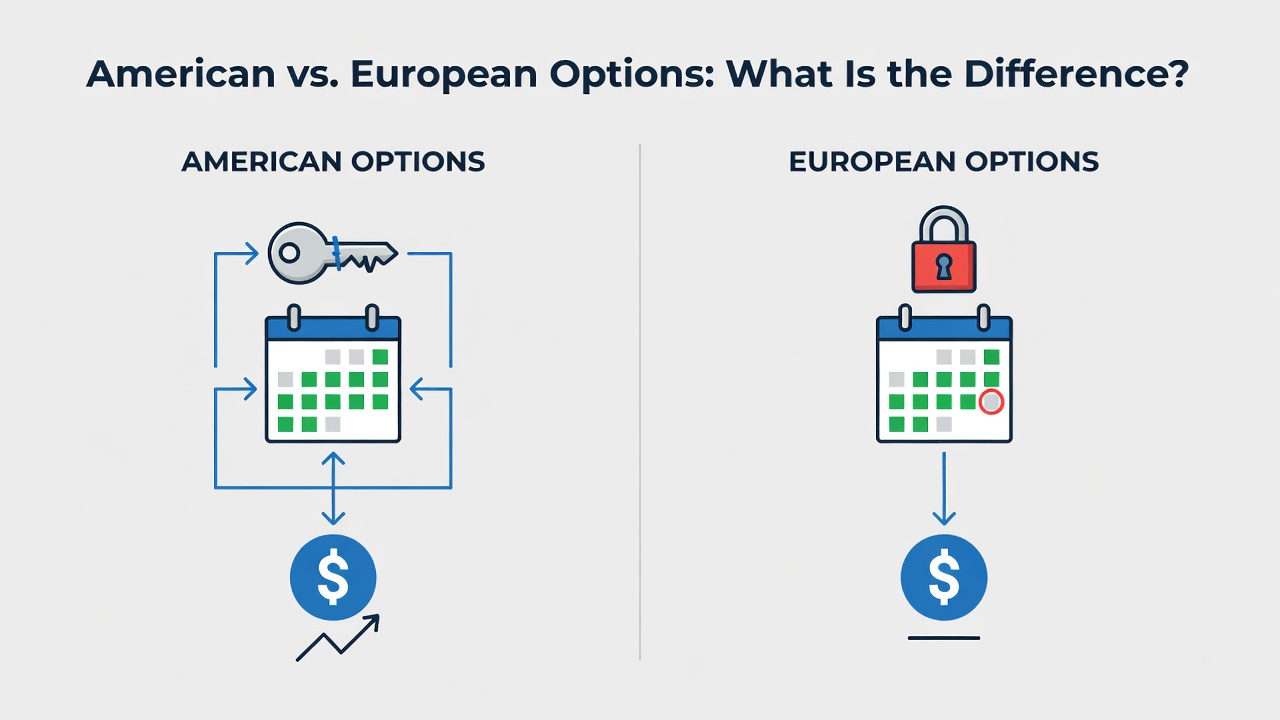
An American-style option grants the contract holder the right to exercise at any time between the day you buy it and the exact expiration date. This means if you own an American option, you can demand exercise on a Tuesday morning three weeks before expiration if you choose to do so.
A European-style option operates under stricter timeline rules. The owner can only exercise the contract on the exact expiration date itself, not a single day earlier.
Think of an American option like a gym pass that lets you walk in and workout any day during the month. A European option is like a ticket to a specific concert on Friday night; you can only use the ticket at that exact scheduled moment.
We covered what exercise and assignment mean back in Part 20, but remembering this timing distinction is critical when planning your trading strategy.
How American Style Options Work in the Real World
Almost all individual stock options and exchange-traded fund options traded on US exchanges are American-style options. If you trade options on Apple, Tesla, or SPY, you are dealing with American options.
Let’s look at a concrete numeric example to see how flexibility works in practice. Suppose XYZ stock is trading at $50 per share, and you buy a $50 strike call option for $3 per contract with 30 days remaining until expiration.
Two weeks later, XYZ stock skyrockets to $65 per share. Because this is an American-style option, you possess two distinct choices on that day.
Your first option is to exercise early, paying $5,000 to buy 100 shares at the $50 strike price, and immediately selling those shares on the open market for $6,500 to secure a $1,500 gross gain minus your original $300 premium.
Your second option is simply selling the contract back to the market for its current inflated market price, which usually nets you even more money because of remaining time value.
Free For Traders
One Clear Arrow. Every High-Probability Setup. Free.
The Fusion Indicator combines multiple signals into a single buy/sell arrow on TradingView so you never miss a move.

How European Style Options Work in the Real World
Most broad-market index options, such as the S&P 500 Index (SPX) or the NASDAQ-100 Index (NDX), are structured as European-style options. These contracts are tied directly to financial indices rather than individual shares of company stock.
A common misconception among beginner traders is assuming you cannot close a European option trade before expiration. That is completely untrue; you can easily buy or sell European options on your trading screen at any time market exchanges are open.
Let’s walk through a second numeric example to see how closing a European contract early actually works. Imagine you buy an SPX $4,000 call option expiring in 45 days for a premium of $20 per contract, representing a total outlay of $2,000.
Ten days after your purchase, the SPX index surges higher, and your call option’s market price jumps from $20 to $35 per contract. Even though you cannot exercise this European contract early, you can sell the contract back to the market for $35, locking in a $15 per contract profit, or $1,500 total cash gain.
The only restriction of European options is that you cannot demand physical exercise or cash settlement from the clearing firm until the final expiration bell rings.

Key Differences: American Options vs. European Options Compared
To keep these two styles organized in your mind, it helps to review their core characteristics side by side. Here is a direct breakdown of how American and European options differ across key operational categories.
| Feature | American Style | European Style |
|---|---|---|
| Exercise Window | Any business day prior to expiration | Expiration date only |
| Typical Assets | Individual stocks, ETFs (e.g. SPY, QQQ) | Broad market indices (e.g. SPX, NDX, RUT) |
| Settlement Type | Physical delivery of shares | Cash settlement |
| Early Assignment Risk | Yes (for option sellers) | None (zero risk before expiration) |
As you review this table, notice how exercise timing directly influences early assignment risk. If you sell an American option, you can be assigned at any moment, whereas selling a European option guarantees peace of mind until expiration week.
Understanding whether your trade delivers physical stock or cash balance changes how you manage risk inside your brokerage account.
Physical Settlement vs. Cash Settlement: Why It Matters to You
Beyond exercise timing, settlement methodology is one of the most practical differences between these contract styles. American stock options use physical settlement, meaning actual shares of stock change hands upon exercise.
When an American call option is exercised, the buyer pays cash and receives 100 physical shares per contract. If you sell a put and get assigned, you are required to purchase 100 shares of stock at the strike price, requiring sufficient capital or buying power.
European index options utilize cash settlement because you cannot physically deliver a fraction of an abstract market index like the S&P 500. Instead of transferring shares, the broker calculates the exact dollar difference between the strike price and the index price at expiration.
For example, if you hold an in-the-money SPX call option with a $4,000 strike and the index expires at $4,050, your account is simply credited $50 per point, or $5,000 cash. There are no shares to handle, no borrowing costs, and no surprise margin calls from stock delivery.
This cash settlement feature makes European index options extremely appealing to traders who want to avoid handling share inventory.
From Find Better Trades
High-Win-Rate Patterns, Spotted In Real Time
Automated pattern recognition for reversals and continuations — no manual drawing, no missed setups.

Which Style Are You Actually Trading on Your Brokerage App?
Many novice traders get confused by popular trading instruments like SPY and SPX. While both track the S&P 500 stock index, they trade under completely different option styles.
SPY is an Exchange Traded Fund (ETF), which means SPY options are American-style options that settle into 100 physical shares of SPY ETF stock. If you hold SPY options past expiration in the money, you will buy or sell actual ETF shares.
SPX is the official S&P 500 Index itself, meaning SPX options are European-style options that settle purely in cash. You will never wake up owning shares of SPX index stock because the index itself cannot be purchased directly.
The same pattern holds true for QQQ (American ETF options settling in physical shares) versus NDX (European index options settling in cash).
When looking at your brokerage order screen on platforms like Robinhood, Webull, or ThinkorSwim, check the contract specifications tab to confirm whether the ticker represents an ETF or a cash-settled index.
How Style Affects Option Pricing and Early Assignment Risk
Because American options offer the added flexibility of early exercise, they theoretically carry slightly higher pricing than an identical European contract. However, in practice, early exercise of American options is rare before expiration.
Reason being, exercising an option early destroys any remaining extrinsic value (time value) left in the option contract. In Part 7, we covered how extrinsic value forms part of an option’s total price; throwing that value away by exercising early is usually financial waste.
The major exception where early exercise happens on American options is right before an ex-dividend date. Option buyers may exercise an in-the-money call option early specifically to own the physical stock and collect the upcoming dividend payout.
If you are an option seller writing American call options on dividend-paying stocks, you face real early assignment risk on the day before the ex-dividend date. European options eliminate this concern entirely because early exercise is contractually impossible.
Knowing these mechanics helps you protect your trading account from unexpected early assignments when selling premium.
Common Mistakes Beginners Make With American and European Options
Assuming European options cannot be sold before the expiration date is the single most widespread mistake new traders make. Beginners often avoid European index options because they incorrectly believe their capital is locked up until expiration day. In reality, you can buy or sell European option contracts on the open market at any time during normal market hours.
Confusing ETF options like SPY or QQQ with cash-settled index options like SPX or NDX leads to major settlement surprises. A beginner might hold an in-the-money SPY call through expiration expecting a cash credit, only to discover their broker assigned them $40,000 worth of ETF shares on margin. Always double-check whether your ticker settles in physical shares or cash.
Ignoring dividend risk when holding short American call options often results in unexpected early assignment. If a stock pays a sizable quarterly dividend, call buyers frequently exercise early to capture that dividend payment, leaving short call sellers short stock overnight. If you sell American calls across ex-dividend dates, monitor your deep in-the-money positions carefully.
Exercising American call options early to take profits instead of selling the contract back to the market wastes valuable time premium. Beginners sometimes press the exercise button on their broker app thinking it is the standard way to close a winning position. Selling the option contract directly back to the market almost always yields a higher net payout because it preserves extrinsic time value.
Frequently Asked Questions About American vs. European Options
Can I close a European option before expiration?
Yes, you can sell a European option back to the market at any point prior to expiration to lock in profits or cap losses. The European restriction only applies to exercising the contract for underlying delivery or cash settlement, not standard open-market trading.
Why are SPX options European style while SPY options are American style?
SPY is a publicly traded fund that holds real shares of stock, so its options follow American physical-settlement rules for equity shares. SPX is a mathematical index rather than a tradable fund, making European cash settlement the standard regulatory structure for index contracts.
Which option style is better for beginner traders?
Neither style is inherently superior, as both serve distinct trading needs. Beginners trading individual stocks will naturally use American options, while traders who want cash settlement without physical share assignment often prefer European index options.
Do American options cost more than European options?
American options can carry a very small price premium due to the added flexibility of early exercise rights. However, for most short-term contracts, the pricing difference between American and European options with identical strikes and expirations is minimal.
Now that you know how exercise rules and settlement styles work, you might be wondering how much capital you actually need to put these concepts into practice — which is why in Part 22, we will look at exactly how much money you need to start trading options safely.
📈 Want More? Join Our Free Trading Community
- Trading Strategy Guides Telegram — daily strategy tips and market insights
- Find Better Trades Telegram — free trade signals delivered to your phone
- Find Better Trades on YouTube — live trade breakdowns and tutorials