What Is Option Assignment? What Happens When Exercised

📚 Beginner’s Guide to Options — Part 20 of 51
- Part 1: What Is an Option? The Absolute Basics Explained
- Part 2: Calls vs. Puts: The Two Types of Options You Need to Know
- Part 3: Strike Price Explained: What It Actually Means for Your Trade
- Part 4: Expiration Date Explained: Why It Changes Everything
- Part 5: Premium Explained: What You’re Really Paying For
- Part 6: In the Money vs. Out of the Money: A Beginner’s Breakdown
- Part 7: Intrinsic Value vs. Extrinsic Value: What Makes Up an Option’s Price
- Part 8: How Buying a Call Option Works, Step by Step
- Part 9: How Buying a Put Option Works, Step by Step
- Part 10: What Happens When an Option Expires? Every Outcome Explained
- Part 11: Options Contracts 101: What One Contract Actually Represents
- Part 12: How to Read an Options Chain Without Getting Overwhelmed
- Part 13: Bid, Ask, and Spread: What They Mean When You’re Trading Options
- Part 14: What Is Implied Volatility? A Beginner’s Plain-English Guide
- Part 15: Why Options Lose Value Over Time: Theta Explained Simply
- Part 16: Delta Explained: What It Really Tells You About Your Option
- Part 17: Gamma Explained: Why Delta Doesn’t Stay the Same
- Part 18: Vega Explained: How Volatility Changes Your Option’s Price
- Part 19: The Greeks Cheat Sheet: Delta, Gamma, Theta, Vega in Plain English
- Part 20: What Is Assignment? What Happens If Your Option Gets Exercised (you are here)
⚡ Key Takeaways
- Option assignment is the fulfillment of an obligation where an option seller must buy or sell shares because the buyer exercised their right.
- Assignment only happens to option sellers, while option buyers are the ones who initiate the exercise process.
- You can completely avoid assignment by closing your short option position before market close on expiration day.
— Ben, Find Better Trades
When I first started trading options, the word assignment sounded like a sudden financial penalty that would hit my account out of nowhere. It felt mysterious and intimidating until I actually went through my first short option assignment and realized it is just a standard settlement process.
Welcome to Part 20 of our beginner guide series, where we are going to demystify what option assignment actually means, how it works behind the scenes, and what you need to do when it happens.
1. The Fundamental Difference Between Exercising and Assignment
To understand assignment, you first need to remember that every options contract has two sides: a buyer and a seller. We covered the basics of buying calls and puts earlier in the series, but the dynamic between both parties is critical here.
The option buyer pays money to purchase a right. They hold the power to decide whether to trade the underlying stock at the agreed strike price.
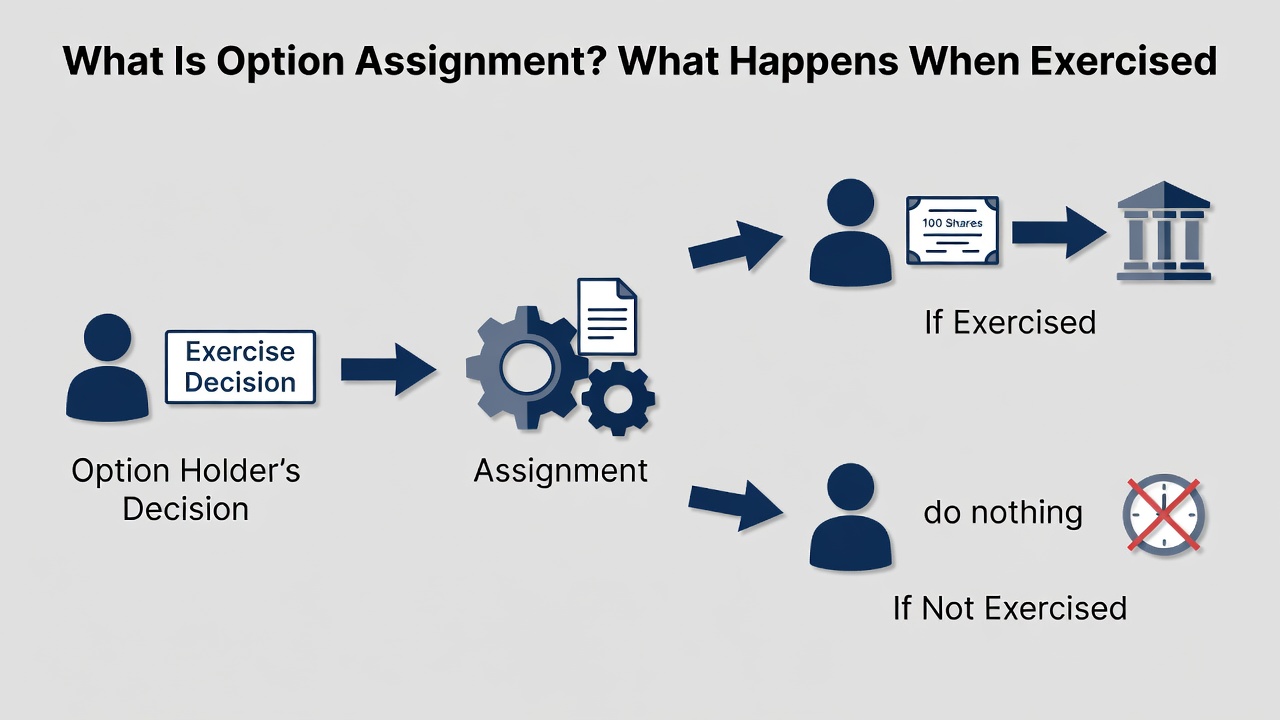
When the buyer decides to use that power, they perform an exercise. They tell their broker that they want to trade the stock right now under the terms of the contract.
Assignment is simply the other side of that exact same coin. When a buyer exercises their right, someone who sold that option contract gets chosen to fulfill the promise.
Think of it like buying a ticket to a concert. The ticket holder has the right to enter the venue whenever the doors open. The security guard at the door is assigned to let them in and grant access because a valid ticket was presented.
If you are an option buyer, you exercise. If you are an option seller, you get assigned. You can never exercise an option you sold, and you can never be assigned on an option you bought.
2. How the Options Clearing Corporation Handles Assignment
You might wonder how your broker knows that your specific account was picked to hand over cash or shares. The process is completely automated and managed by a central entity called the Options Clearing Corporation, or OCC.
The OCC acts as the central clearinghouse for every exchange-listed option trade in the United States. They stand between buyers and sellers to guarantee that every contract is honored without personal counterparty risk.
When an option buyer tells their broker to exercise a contract, that broker notifies the OCC. The OCC does not match that buyer back to the exact person who sold them the contract original day.
Instead, the OCC uses a completely random selection algorithm to assign the exercise notice to a brokerage firm that has clients holding short positions in that same contract.
Once your broker receives an assignment notice from the OCC, the broker assigns it to one of its customers holding that short option. Brokers usually use a random selection method or a first-in, first-out method to distribute the assignment.
This entire process happens overnight after the stock market closes. You will rarely see an assignment happen live while the trading floor is open during normal hours.
Free For Traders
One Clear Arrow. Every High-Probability Setup. Free.
The Fusion Indicator combines multiple signals into a single buy/sell arrow on TradingView so you never miss a move.

3. What Happens When You Get Assigned on a Call Option
Selling a call option creates an obligation to sell 100 shares of stock at the chosen strike price if the buyer exercises. Let’s walk through a realistic numerical example to see how this plays out in practice.
Imagine you sold a call option on stock XYZ with a strike price of $50 when the stock was trading around $48. You collected a $2.00 premium, which equals $200 in total cash deposited into your account.
Fast forward to expiration day, and stock XYZ has surged up to $55 per share. Because the stock price is above the $50 strike price, the call option is inside the money.
The buyer exercises their right to buy 100 shares at $50 because buying at $50 is much cheaper than paying the current market price of $55. The OCC processes this request, and your brokerage account gets assigned.
If you already owned 100 shares of XYZ stock (a covered call position), your broker simply takes those 100 shares out of your account and sells them to the buyer for $50 per share. You receive $5,000 in cash, keep your original $200 premium, and no longer own the stock.
If you did not own the stock (a naked call position), your account will suddenly show a short position of -100 shares of XYZ. You will owe those 100 shares to your broker, meaning you eventually have to buy them at the higher market price to close the loop.

4. What Happens When You Get Assigned on a Put Option
Selling a put option creates the exact opposite obligation: you agree to buy 100 shares of stock at the strike price if the buyer chooses to exercise. Let’s look at a concrete numeric example for a short put.
Suppose stock ABC is trading at $100, and you decide to sell a put option with a strike price of $90. You collect a premium of $3.00, which means $300 cash is credited to your account balance immediately.
A week later, bad news hits stock ABC, causing the price to drop down to $80 per share. The put option is now deep inside the money because the $90 strike price is higher than the $80 market value.
The put buyer exercises their contract to sell 100 shares at $90, which protects them from having to dump those shares on the open market for only $80. You receive the assignment notification overnight.
The next morning, your broker removes $9,000 from your cash balance ($90 strike price multiplied by 100 shares) and deposits 100 shares of ABC stock directly into your account. Your net cost basis for those shares is actually $87 per share because you kept the initial $3.00 premium per share.
You now own 100 shares of a stock trading at $80. You have an unrealized loss on the stock, but you now own the actual asset and can hold it or sell covered calls against it later.
5. Early Assignment: Can It Happen Before Expiration?
A common question beginners ask me is whether they can get assigned early, well before the contract expiration date arrives. The short answer is yes, but it happens far less often than you might expect.
Most equity options in the US are American-style options, which means the buyer has the legal right to exercise at any time prior to expiration. We will explore the structural details of American options in the next part of this series.
However, option buyers rarely exercise early because doing so destroys any remaining extrinsic value (time value) left in the contract. It is almost always more profitable for a buyer to sell the option back to the market than to exercise it early.
The main exception to this rule happens right before a stock pays a dividend. If a call buyer wants to collect an upcoming cash dividend, they might exercise an in-the-money call option early on the day before the ex-dividend date.
Another scenario for early assignment is when an option is deep in the money and has virtually no remaining time value left. In that case, the bid-ask spread might be wide, making direct exercise the easiest exit for the holder.
From Find Better Trades
Stop Scanning Charts. Let The Alerts Come To You.
Real-time Telegram alerts when stocks approach critical S&R levels across the whole market.


6. What Assignment Looks Like in Your Brokerage Account
When assignment takes place, the actual mechanics inside your trading platform happen automatically while you sleep. You usually wake up to an automated notification or email from your broker informing you of the transaction.
Your account ledger will reflect the transfer of cash or securities based on whether you were assigned on a call or a put option. The short option contract itself simply vanishes from your position tab because the contract obligation has been fully satisfied.
The table below summarizes the net account changes you will see after assignment occurs for both types of short options:
| Short Option Type | Action Taken On Account | Net Result In Portfolio |
|---|---|---|
| Short Call | Delivers 100 shares per contract | Shares removed, cash credited (Strike x 100) |
| Short Put | Purchases 100 shares per contract | Shares added, cash debited (Strike x 100) |
If you do not have enough cash in your account to cover a put assignment, your broker may issue a margin call or automatically liquidate the newly acquired stock positions immediately at market open.
This is why selling cash-secured puts is the safest way for beginners to start, ensuring you always have the necessary cash sitting ready to purchase the underlying shares.
7. How to Avoid Assignment If You Don’t Want the Stock
The simplest way to handle option assignment is to make sure it never happens in the first place if you do not want to trade the underlying shares. You are never locked into an option contract until expiration forces settlement.
If you sold an option and the trade is moving against you, you can simply buy the option back on the open market to close your position. Once you buy to close, your obligation is completely eliminated.
You should pay close attention to your short options during the final week before expiration. If the option is in the money or close to the strike price, the risk of assignment rises dramatically.
Most experienced options traders make it a strict habit to close out or roll their short positions well before 4:00 PM EST on expiration Friday. Closing early removes all expiration uncertainty and eliminates overnight assignment risk entirely.
Remember that automatically exercised options usually trigger if they are in the money by as little as $0.01 at expiration. Never leave a short option open at expiration unless you are fully prepared to own or sell the stock.
Common Mistakes Beginners Make With This
1. Holding short options into expiration Friday out of laziness. Many new traders let in-the-money short options sit in their account until the final market bell, assuming nothing big will happen. Brokers will automatically assign those options overnight, leaving you with unexpected stock positions on Monday morning.
2. Ignoring dividend dates on short call positions. Call option sellers frequently forget to check if the underlying stock has an upcoming ex-dividend date. If your short call is in the money, buyers will often exercise early to capture the dividend, catching you off guard with an unexpected assignment.
3. Panic selling shares immediately after a put assignment. Beginners who get assigned on a cash-secured put often panic when they see 100 shares of stock in their account and sell them right away at market open. Take a breath, calculate your true cost basis after accounting for the option premium received, and make a calm decision.
4. Selling naked calls without understanding margin requirements. Getting assigned on an unhedged short call forces you to go short 100 shares of stock, which carries theoretical unlimited risk. Beginners who do not realize this can trigger severe margin calls or broker liquidations before they even have a chance to react.
Frequently Asked Questions About Option Assignment
What happens if I get assigned on a put but don’t have enough cash?
If your account lacks sufficient cash to cover the assigned shares, your broker will accept the stock on your behalf and issue a margin call. They will typically give you a short window to deposit funds, or they will liquidate the shares immediately at current market prices to settle the debt.
Can I get assigned on an option that expires out of the money?
It is extremely rare, but technically possible if a buyer manually chooses to exercise an out-of-the-money contract before the deadline. In almost all practical cases, out-of-the-money options expire worthless and result in zero assignment for the seller.
What time of day does option assignment actually take place?
Assignment processing occurs overnight following the market close on the day the option is exercised or on expiration Friday. You will typically see the updated share balances and cash adjustments reflected in your brokerage account before trading opens the next business day.
Do brokerage platforms charge extra fees when you get assigned?
Many modern major brokerages have eliminated assignment and exercise fees entirely, offering $0 assignment transactions. However, some legacy or international brokers still charge a flat fee for assignment processing, so you should check your specific broker’s fee schedule beforehand.
Next time in Part 21, I am going to break down the critical structural differences between American and European options so you always know exactly when an option can or cannot be exercised against you.
📈 Want More? Join Our Free Trading Community
- Trading Strategy Guides Telegram — daily strategy tips and market insights
- Find Better Trades Telegram — free trade signals delivered to your phone
- Find Better Trades on YouTube — live trade breakdowns and tutorials