Biggest Mistake Beginners Make Buying Options Explained

📚 Beginner’s Guide to Options — Part 24 of 51
- Part 1: What Is an Option? The Absolute Basics Explained
- Part 2: Calls vs. Puts: The Two Types of Options You Need to Know
- Part 3: Strike Price Explained: What It Actually Means for Your Trade
- Part 4: Expiration Date Explained: Why It Changes Everything
- Part 5: Premium Explained: What You’re Really Paying For
- Part 6: In the Money vs. Out of the Money: A Beginner’s Breakdown
- Part 7: Intrinsic Value vs. Extrinsic Value: What Makes Up an Option’s Price
- Part 8: How Buying a Call Option Works, Step by Step
- Part 9: How Buying a Put Option Works, Step by Step
- Part 10: What Happens When an Option Expires? Every Outcome Explained
- Part 11: Options Contracts 101: What One Contract Actually Represents
- Part 12: How to Read an Options Chain Without Getting Overwhelmed
- Part 13: Bid, Ask, and Spread: What They Mean When You’re Trading Options
- Part 14: What Is Implied Volatility? A Beginner’s Plain-English Guide
- Part 15: Why Options Lose Value Over Time: Theta Explained Simply
- Part 16: Delta Explained: What It Really Tells You About Your Option
- Part 17: Gamma Explained: Why Delta Doesn’t Stay the Same
- Part 18: Vega Explained: How Volatility Changes Your Option’s Price
- Part 19: The Greeks Cheat Sheet: Delta, Gamma, Theta, Vega in Plain English
- Part 20: What Is Assignment? What Happens If Your Option Gets Exercised
- Part 21: American vs. European Options: What’s the Difference?
- Part 22: How Much Money Do You Need to Start Trading Options?
- Part 23: Paper Trading Options: How to Practice Before Risking Real Money
- Part 24: The Biggest Mistake Beginners Make Buying Options (you are here)
⚡ Key Takeaways
- The single biggest mistake new traders make is purchasing dirt-cheap, far out-of-the-money options expiring in just a few days.
- Cheap options look attractive because of their small dollar cost, but they carry an extremely low statistical probability of ever turning a profit.
- To fix this habit, buy options closer to the stock price with at least thirty to sixty days before expiration.
— Ben, Find Better Trades
When new traders open their first brokerage account, they almost always fall into the exact same trap. I watched dozens of my own trading students do this before I put a hard stop to it in my curriculum.
Welcome to Part 24 of our 51-part options series. Today, we are discussing the single biggest mistake beginners make buying options and how you can avoid losing your cash to it.
What Is the Single Biggest Mistake New Options Buyers Make?
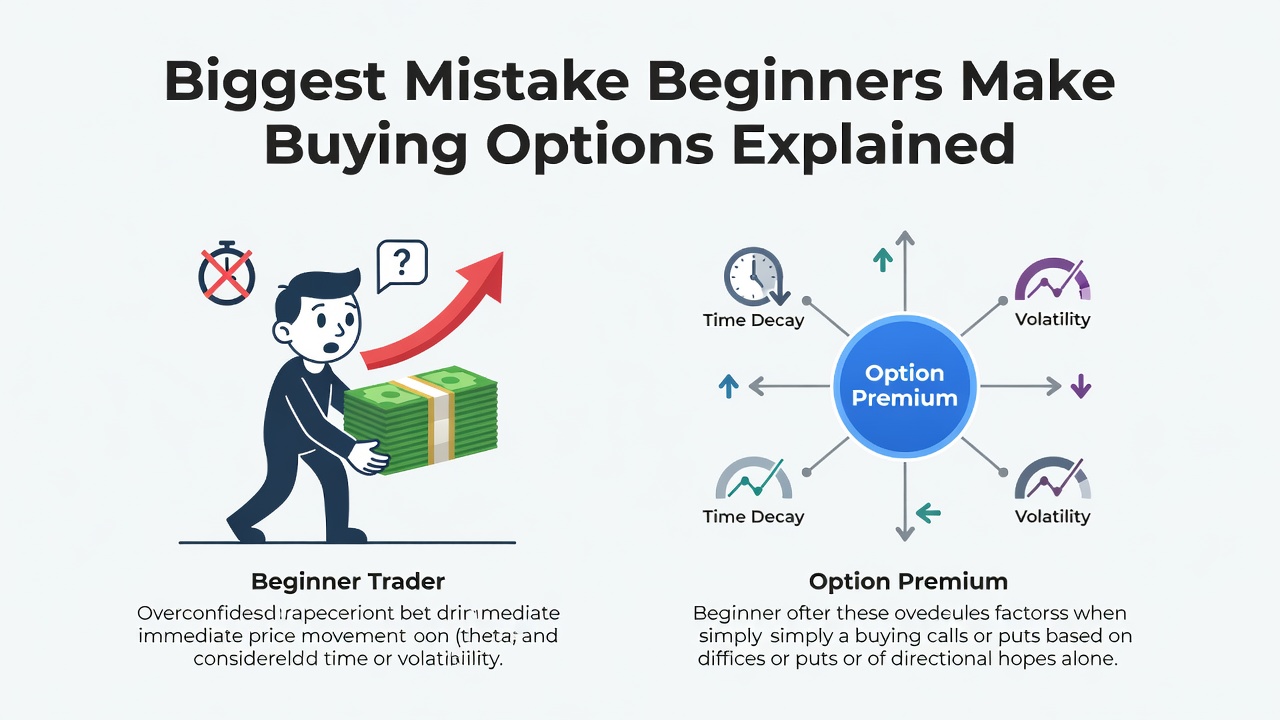
The single biggest mistake beginners make is buying far out-of-the-money (OTM) options with short expiration dates simply because they are cheap. A beginner opens an option chain, sees a contract trading for $0.15, and thinks they found a bargain.
In Part 6, we learned that out-of-the-money options have zero intrinsic value. Every single penny of that $0.15 price tag is pure extrinsic value, which is just time value and volatility.
New traders treat these cheap options like lottery tickets. They buy ten or twenty contracts at a time because the total dollar layout feels tiny and safe.
What they do not realize is that the market priced that contract at $0.15 for a very good reason. The probability of that option expiring worthless is usually higher than ninety percent.
Buying five out-of-the-money contracts for $20 each feels safer than buying one solid contract for $300. In reality, you are throwing that $100 directly into a trash can.
Why Cheap Options Look So Tempting to Beginners
Psychology plays a massive role in why beginners fall for cheap option contracts. Most people start trading options with small accounts, maybe $500 or $1,000 total capital.
When you look at an option chain with a small account, high-quality options look completely unaffordable. An in-the-money call on a popular tech stock might cost $800 per contract.
If you only have $1,000, spending $800 on a single contract feels terrifying because you are risking eighty percent of your portfolio on one trade. You naturally look for cheaper alternatives lower down on the option chain.
Suddenly, you spot a strike price far above the current stock price priced at just $0.20 per share. Since one contract covers 100 shares, as we covered in Part 11, that contract costs just $20 total.
Your brain tricks you into thinking you are being conservative by only risking $20. You buy five of them for $100, feeling like a genius who managed to diversify across multiple contracts.
Free For Traders
One Clear Arrow. Every High-Probability Setup. Free.
The Fusion Indicator combines multiple signals into a single buy/sell arrow on TradingView so you never miss a move.
 → Get The Free Fusion Indicator
The Math Behind Out-of-the-Money Option Decay
Let’s look at a concrete numeric example to see how the math actually plays out on these cheap contracts. Suppose stock XYZ is currently trading at $100 per share.
You believe stock XYZ is going to head higher over the next week. You open the option chain and look at two different call option choices expiring in seven days.
Choice A is the $102 strike call option, which costs $1.50 ($150 total per contract). Choice B is the $115 strike call option, which costs just $0.10 ($10 total per contract).
A beginner almost always picks Choice B because they can buy ten contracts for $100 instead of paying $150 for just one contract. Now let me show you what happens over the next seven days.
Stock XYZ experiences a solid move and climbs from $100 up to $106 by expiration day. That is a great six percent gain for the underlying stock in one week.
The trader who bought Choice A (the $102 call) sees their option expire with $4.00 of intrinsic value ($106 stock price minus $102 strike price). They turn their $150 investment into $400, making a clean $250 profit.
Meanwhile, your Choice B (the $115 call) expires completely worthless because the stock finished below $115. Even though your stock direction guess was totally right, you lost one hundred percent of your money.
| Option Selection | Strike Price | Initial Cost | Stock Price at Expiration | Final Option Value | Total Profit / Loss |
|---|---|---|---|---|---|
| Choice A (Near Money) | $102.00 | $1.50 ($150) | $106.00 | $4.00 ($400) | +$250.00 (+166%) |
| Choice B (Far OTM) | $115.00 | $0.10 ($10) | $106.00 | $0.00 ($0) | -$10.00 (-100%) |

How Theta and Delta Work Together to Destroy Cheap Contracts
To understand why Choice B failed, we have to look back at two Greeks we covered earlier in the series. In Part 15 we covered Theta, and in Part 16 we covered Delta.
Delta tells you how much an option’s price changes for every one-dollar move in the underlying stock. A far out-of-the-money option has a tiny Delta, often around 0.05 or 0.10.
If your option has a Delta of 0.05, the stock needs to move up by a full dollar just for your option to gain five cents in value. Small stock moves barely nudge the price of your contract at all.
At the same time, Theta is working non-stop against you every single hour of the day. Theta represents time decay, which measures how much value your option loses as each day passes.
When an option has only a few days left until expiration, Theta decay accelerates rapidly. The option loses a huge percentage of its remaining value every twenty-four hours.
When you hold a far OTM option with short expiration, Delta gives you almost nothing on stock gains while Theta aggressively bleeds your remaining capital away. You are fighting a steep uphill battle where time always wins.
Real-World Example: Watching a Cheap Trade Go to Zero
Let’s run through a second worked example so you can see how this decay looks day by day on a live chart. Imagine stock ABC is trading at $50 per share on Monday morning.
You buy a $55 strike call option expiring this Friday for $0.30, spending $30 per contract. You need the stock to rise above $55.30 by Friday afternoon just to break even.
On Tuesday, stock ABC rises from $50.00 to $51.50, which is a great single-day move. Because your option has a low Delta and lost one day of time value, its price stays flat at $0.30.
On Wednesday, the stock sits quietly at $51.50 without moving. Time decay hits hard, and your option contract drops from $0.30 down to $0.18 despite the stock holding its gains.
On Thursday, the stock pushes higher again to $53.00 per share. You are excited because the stock is up three full dollars since Monday, but your option price falls further to $0.08 due to expiring tomorrow.
On Friday afternoon, the stock closes at $53.50. You correctly predicted that stock ABC would rally $3.50 in a week, yet your $30 investment is worth exactly $0.00.
From Find Better Trades
The First 60 Minutes Pay The Best. Be There.
Rapid-fire day trading setups for the opening hour — when institutional volume is at its absolute peak.
 → Join Morning Power Hour

The Insurance Analogy: Paying for Cover That Never Pays Out
Think about options like buying an insurance policy on your house. This simple real-world analogy makes the flaw in cheap options crystal clear.
Imagine an insurance company offers you a policy that pays out $1,000,000 if a hurricane hits your house in Ohio next Tuesday. The premium for this policy is dirt cheap, costing you only $5 for the week.
You buy the policy because five dollars sounds like a harmless amount of money to spend. You feel smart because you secured a potential $1,000,000 payout for less than the price of a cup of coffee.
When Tuesday comes and goes without a hurricane in Ohio, your $5 is gone forever. If you repeat this process every week for a year, you spend $260 on completely useless policies.
Far out-of-the-money options are identical to hurricane insurance in Ohio. They are priced cheap because the event required to make them pay out is almost statistically impossible within the given timeframe.
How to Buy Options the Smart Way Instead
To break this habit, you need to change how you select both your strike price and your expiration date. Stop shopping in the bargain bin of the option chain.
First, pick strike prices that are either in-the-money (ITM) or very close to the current stock price (at-the-money). Look for options with a Delta of at least 0.50 or higher.
Second, give your trade plenty of time to work out. Instead of buying options expiring in three to seven days, buy options that have at least 30 to 60 days remaining before expiration.
Options with longer expiration dates decay much slower than short-term options. This extra time gives the underlying stock room to move without time decay eating your profits on day one.
Yes, these options will cost significantly more money per contract. You will buy fewer contracts, but your actual probability of making a profit will skyrocket.
Common Mistakes Beginners Make Buying Options
New options traders confuse having a high contract count with having a larger position. Buying ten cheap out-of-the-money contracts feels like a bigger trade than buying one in-the-money contract, but it actually gives you less total exposure to the stock’s price movement.
Beginners often focus entirely on the dollar price of the option premium rather than evaluating the option’s Delta and probability of profit. A $0.20 option is not cheap if it has a 95% chance of expiring worthless, it is simply overpriced for the risk you are taking.
Traders frequently hold short-dated out-of-the-money options all the way to expiration day hoping for a last-minute miracle move. In reality, time decay accelerates sharply during the final week, wiping out whatever remaining extrinsic value the option had left.
New buyers frequently forget to calculate their actual break-even price before placing an entry order. If you buy a $100 call for $5.00 premium, the stock must move past $105.00 just for you to break even, making a small stock move completely unprofitable.
Frequently Asked Questions About Options Buying Mistakes
Why are out-of-the-money options so cheap compared to in-the-money options?
Out-of-the-money options are cheap because they contain zero intrinsic value and have a low probability of finishing above the strike price before expiration. You are paying purely for time value and potential volatility, both of which erode quickly.
Is it ever smart to buy cheap out-of-the-money options?
Experienced traders occasionally buy out-of-the-money options as cheap tail-risk hedges or high-leverage plays around earnings events, but it requires precise timing. For beginners learning the ropes, relying on cheap OTM options is a guaranteed way to bleed account capital over time.
How far out in expiration should a beginner buy call or put options?
A good rule of thumb for beginners buying options is to purchase contracts with at least 30 to 60 days remaining until expiration. This timeline protects your position from the extreme Theta decay that happens during the final 30 days of an option’s life.
What Delta should I look for when buying a call option?
When buying call options, look for a Delta of 0.50 or higher, which corresponds to at-the-money or in-the-money strike prices. A higher Delta ensures your option moves meaningfully whenever the underlying stock moves in your predicted direction.
📈 Want More? Join Our Free Trading Community
- Trading Strategy Guides Telegram — daily strategy tips and market insights
- Find Better Trades Telegram — free trade signals delivered to your phone
- Find Better Trades on YouTube — live trade breakdowns and tutorials
Lesson 24 of 52 in the free Options Trading Course.
← Previous: Paper Trading Options: How to Practice Before Risking Capital
Next: Why Beginners Lose Money Buying Options (And How to Fix It) →