Poor Man’s Covered Call: Strategy Guide for Beginners

📚 Beginner’s Guide to Options — Part 48 of 51
- Part 1: What Is an Option? The Absolute Basics Explained
- Part 2: Calls vs. Puts: The Two Types of Options You Need to Know
- Part 3: Strike Price Explained: What It Actually Means for Your Trade
- Part 4: Expiration Date Explained: Why It Changes Everything
- Part 5: Premium Explained: What You’re Really Paying For
- Part 6: In the Money vs. Out of the Money: A Beginner’s Breakdown
- Part 7: Intrinsic Value vs. Extrinsic Value: What Makes Up an Option’s Price
- Part 8: How Buying a Call Option Works, Step by Step
- Part 9: How Buying a Put Option Works, Step by Step
- Part 10: What Happens When an Option Expires? Every Outcome Explained
- Part 11: Options Contracts 101: What One Contract Actually Represents
- Part 12: How to Read an Options Chain Without Getting Overwhelmed
- Part 13: Bid, Ask, and Spread: What They Mean When You’re Trading Options
- Part 14: What Is Implied Volatility? A Beginner’s Plain-English Guide
- Part 15: Why Options Lose Value Over Time: Theta Explained Simply
- Part 16: Delta Explained: What It Really Tells You About Your Option
- Part 17: Gamma Explained: Why Delta Doesn’t Stay the Same
- Part 18: Vega Explained: How Volatility Changes Your Option’s Price
- Part 19: The Greeks Cheat Sheet: Delta, Gamma, Theta, Vega in Plain English
- Part 20: What Is Assignment? What Happens If Your Option Gets Exercised
- Part 21: American vs. European Options: What’s the Difference?
- Part 22: How Much Money Do You Need to Start Trading Options?
- Part 23: Paper Trading Options: How to Practice Before Risking Real Money
- Part 24: The Biggest Mistake Beginners Make Buying Options
- Part 25: Why Most Beginners Lose Money Buying Options (and How to Avoid It)
- Part 26: Covered Calls Explained: The First Options Strategy Every Trader Should Learn
- Part 27: Cash-Secured Puts Explained: A Beginner-Friendly Way to Get Paid to Wait
- Part 28: Vertical Spreads Explained: Reducing Risk on Your First Options Trade
- Part 29: Credit Spreads vs. Debit Spreads: What’s the Real Difference?
- Part 30: The Protective Put Explained: Insurance for Your Stock Position
- Part 31: The Collar Strategy Explained: Protecting Gains Without Selling
- Part 32: Straddles Explained: Betting on a Big Move (In Either Direction)
- Part 33: Strangles Explained: A Cheaper Way to Bet on a Big Move
- Part 34: The Iron Condor Explained for Complete Beginners
- Part 35: The Wheel Strategy Explained: Getting Paid on Stocks You Want to Own
- Part 36: How Earnings Season Changes Options Pricing (and What to Watch For)
- Part 37: Why Options Get More Expensive Before Earnings: IV Crush Explained
- Part 38: Choosing the Right Strike Price for Your First Options Trade
- Part 39: Choosing the Right Expiration Date: Weekly vs. Monthly Options
- Part 40: How to Size an Options Position So One Bad Trade Doesn’t Wreck You
- Part 41: When to Take Profits on an Options Trade (Before It’s Too Late)
- Part 42: When to Cut a Losing Options Trade (Before It Goes to Zero)
- Part 43: Rolling an Options Position: What It Means and When to Do It
- Part 44: Liquidity in Options: Why It Matters More Than Beginners Think
- Part 45: Open Interest vs. Volume: What Each One Actually Tells You
- Part 46: How to Use Options to Hedge a Stock Position You Already Own
- Part 47: LEAPS Explained: Trading Options That Last a Year or More
- Part 48: The Poor Man’s Covered Call: A Cheaper Way to Run the Covered Call Strategy (you are here)
⚡ Key Takeaways
- A Poor Man’s Covered Call replaces 100 shares of expensive stock with a deep in-the-money, long-dated LEAPS call option.
- You sell short-term, out-of-the-money call options against your LEAPS to generate recurring cash flow at a fraction of the traditional cost.
- Your short call strike must always be placed high enough to guarantee a profit if the stock surges and you are forced to close the entire spread.
— Ben, Find Better Trades
Covered calls are one of the most reliable income strategies in trading, but buying 100 shares of a great company can easily tie up tens of thousands of dollars. In Part 48 of our beginner’s series, I will show you how to run the exact same income strategy using a fraction of the cash.
Traders call this setup the Poor Man’s Covered Call, though professionals technically refer to it as a long call diagonal debit spread. Once you understand how it works, you will see why it is one of my personal favorite tools for generating regular income.
What Exactly Is a Poor Man’s Covered Call?
In a standard covered call, you buy 100 shares of stock and sell a short-term call option against those shares. The shares act as your collateral, which prevents you from facing unlimited risk if the stock rallies hard.
A Poor Man’s Covered Call uses the exact same logic, but with one major substitution. Instead of buying 100 actual shares of stock, you buy a deep in-the-money LEAPS call option that expires many months or years into the future.
Think of it like leasing a commercial building with the right to sublease individual office spaces. You do not own the entire physical property outright, but your long-term lease gives you full control to collect regular rent from monthly tenants.
Because your long-term call is deep in the money, it behaves almost identically to owning 100 real shares of stock. It gains value when the stock rises and provides the backing you need to safely sell short-term calls against it.
By swapping physical shares for a long-term option contract, you drastically lower the upfront cash needed to start generating options income.
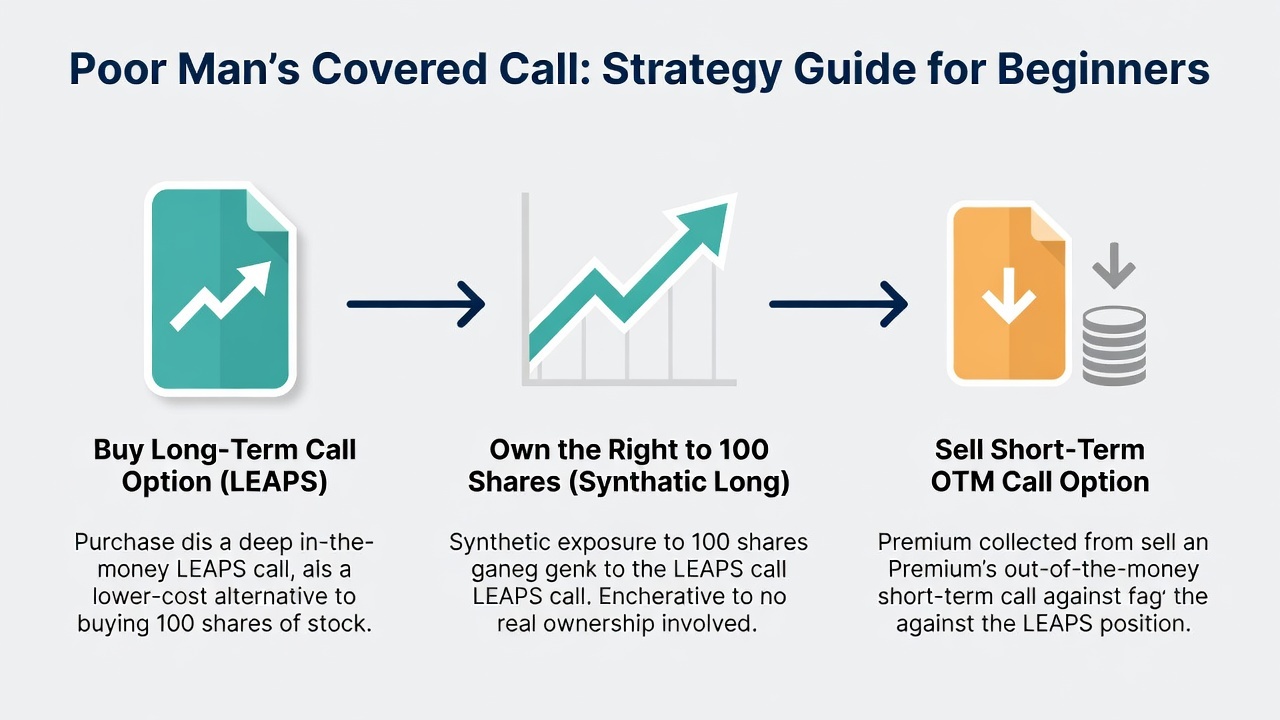
Traditional Covered Call vs. Poor Man’s Covered Call
The primary advantage of this strategy comes down to pure capital efficiency. Owning 100 shares of a $200 stock requires an upfront investment of $20,000 in cash.
With a Poor Man’s Covered Call, you might buy a deep in-the-money LEAPS call on that same stock for roughly $4,500. You gain upside exposure to the exact same 100 shares while keeping the remaining $15,500 in your account.
When you sell a monthly call against your position for a $150 credit, that income represents a much higher return on your invested capital. Earning $150 on a $4,500 position yields a significantly higher percentage return than earning $150 on a $20,000 stock purchase.
The table below shows how the upfront cash and income mechanics compare between both approaches on a hypothetical $150 stock:
| Metric | Traditional Covered Call | Poor Man’s Covered Call |
|---|---|---|
| Underlying Asset | 100 Shares of Stock ($150/share) | 1 Deep ITM LEAPS Call ($120 Strike) |
| Upfront Capital Required | $15,000 | $3,800 |
| Short Call Sold (30 DTE) | $155 Strike for $2.50 ($250) | $155 Strike for $2.50 ($250) |
| Gross Yield on Capital | 1.66% per month | 6.57% per month |
| Max Downside Risk | $14,750 (stock drops to $0) | $3,550 (premium paid minus credit) |
While the percentage returns look fantastic, remember that options have expiration dates whereas stock shares last forever. You must manage the trade properly so time decay does not erode your long option faster than you collect premium.
Free For Traders
The Options Cheat Sheet Thousands Of Traders Swear By
Calls, puts, spreads — one free download tells you the right options strategy for every market condition.
 → Download The Free Cheat Sheet
Step 1: Picking the Right Long LEAPS Call
The foundation of this entire strategy rests on buying the correct long call. If you pick the wrong strike or expiration date, the entire trade structure collapses.
First, look for an expiration date at least 6 to 12 months in the future. As we covered in our guide to LEAPS, long-dated options suffer from very slow daily time decay, which gives your trade ample time to work.
Second, choose a deep in-the-money strike price with a delta of 0.80 or higher. A 0.80 delta means that for every $1.00 move in the underlying stock, your option gains roughly $0.80 in value.
Buying deep in the money ensures that most of the price you pay consists of intrinsic value rather than overpriced extrinsic fluff. You want your long option to move almost dollar-for-dollar alongside the actual stock price.
Never buy an out-of-the-money option as your long leg for this strategy. Cheap out-of-the-money calls decay rapidly and do not provide the stability required to act as synthetic stock.

Step 2: Selling the Short Call for Income
Once your LEAPS call is safely in your account, you can sell a short-term call option against it to generate immediate cash flow. This short call is your income engine.
Target an expiration date roughly 30 to 45 days out. This timeframe sits squarely in the sweet spot where theta decay accelerates rapidly, allowing you to capture premium quickly.
Pick an out-of-the-money strike price with a delta between 0.20 and 0.30. A lower delta gives the underlying stock room to rise comfortably without immediately threatening your short strike.
Most importantly, your short call strike must be higher than your total cost basis. Specifically, the short strike must be greater than your long strike price plus the net debit paid to enter the trade.
If you ignore this mathematical rule and the stock rallies sharply, you could end up losing money even though your directional bet was correct.
Worked Example #1: The Basic Setup and First Cycle
Let us walk through a complete, realistic example from start to finish. Suppose shares of stock XYZ are trading at $100 per share.
Instead of spending $10,000 for 100 shares, you buy a 1-year expiration $80 strike LEAPS call with a 0.85 delta for $26.00 ($2,600 total). This $26.00 price consists of $20.00 intrinsic value and only $6.00 extrinsic value.
At the exact same time, you sell a 30-day $105 strike call option for $2.00 ($200 total). Your net cash outlay to open this entire diagonal spread is $2,400 ($2,600 paid minus $200 collected).
Thirty days pass, and XYZ stock closes comfortably at $102. Because the stock stayed below your $105 short strike, that short call expires completely worthless.
You keep the entire $200 credit as pure profit, and you still own roughly 11 months of time on your $80 LEAPS call. You can now sell another 30-day call for the next monthly cycle and repeat the process.
From Find Better Trades
Three Candles Tell You When The Move Accelerates
The 3-candlestick reversal pattern indicator that catches the exact moment momentum flips.
 → See The Hot Dog Indicator
Worked Example #2: Managing the Trade When the Stock Soars
Beginners often worry about what happens when the underlying stock explodes higher and shoots far past their short strike price. Let us see how the numbers actually play out.
Using our previous trade on XYZ, imagine a surprise earnings blowout pushes the stock from $100 straight to $115 in three weeks. Your short $105 call is now deep in the money and showing a significant paper loss.
However, your $80 LEAPS call has surged dramatically in value along with the stock. Because your long call holds a much higher delta than your short call, the long position gained far more cash than the short position lost.
To exit, you simply close both legs of the spread simultaneously in a single order with your broker. Let us look at the final accounting at expiration:
| Position Leg | Entry Value | Exit Value (Stock at $115) | Net Gain/Loss |
|---|---|---|---|
| Long $80 LEAPS Call | -$26.00 (-$2,600) | +$36.50 (+$3,650) | +$1,050 Profit |
| Short $105 Call | +$2.00 (+$200) | -$10.00 (-$1,000) | -$800 Loss |
| Total Spread Outcome | -$24.00 (-$2,400) | +$26.50 (+$2,650) | +$250 Net Profit |
You achieve your maximum potential profit on the cycle without having to panic or exercise your long option. Alternatively, if you still love the company, you can roll the short call out to a higher strike and later date for an additional credit.
Understanding the Real Risks and Tradeoffs
While the Poor Man’s Covered Call offers tremendous capital efficiency, it is not free money. You must understand the structural tradeoffs before placing real capital on the line.
Your biggest risk is a severe, prolonged downward trend in the stock. If the stock crashes, your LEAPS call can lose substantial value, and the small monthly premiums you collect will not be enough to offset the loss.
Unlike owning actual stock shares, options eventually expire. If a stock falls and stays depressed for two years, physical shares can be held indefinitely until recovery, whereas your LEAPS call could expire completely worthless.
Another major difference is dividends. When you own physical shares of dividend-paying companies, you receive regular quarterly cash payments directly into your account, but option holders receive zero dividends.
Finally, you need level 3 options approval with most brokerage firms to trade diagonal spreads. Make sure your account permissions allow multi-leg spreads before attempting to enter the trade.
Common Mistakes Beginners Make With This
Buying cheap out-of-the-money LEAPS: New traders often try to cut costs further by buying an out-of-the-money call with a 0.40 delta instead of a deep in-the-money contract. These cheap calls carry massive extrinsic value that decays quickly, making it almost impossible to maintain a profitable campaign.
Selling the short strike below total cost basis: If you buy an $80 strike LEAPS for $25 debit and sell a $100 short call, your total cost is $105 per share. If the stock explodes to $120 and you are forced out at $100, you will lock in a guaranteed net loss on a winning stock move.
Manually exercising the LEAPS upon assignment: When assigned on your short call, never exercise your long LEAPS to deliver the shares. Exercising destroys all remaining extrinsic time value on your long option; simply buy back the short call or close both legs together on the open market.
Overleveraging position size: Because a Poor Man’s Covered Call costs roughly 75% less than buying 100 shares, beginners often buy four times as many contracts. This turns a conservative income strategy into an aggressive, overleveraged gamble that can wipe out your account during a market pullback.
Poor Man’s Covered Call FAQs
Can I lose more money than I invest in a Poor Man’s Covered Call?
No, your risk is strictly defined and capped at the net debit paid to open the diagonal spread. Because your long LEAPS call covers your short call, you do not face the unlimited upside risk of a naked call.
What happens if my short call is assigned early?
If early assignment occurs, your broker will assign you a short 100-share stock position. You can simply sell your long LEAPS on the open market and use the proceeds to buy back the short shares, capturing the spread’s net profit.
How many times can I sell short calls against one LEAPS?
You can continue selling short-term calls repeatedly for as long as your LEAPS has time remaining. Most traders sell monthly calls for 6 to 10 consecutive cycles before rolling their LEAPS further out in time.
When should I roll my long LEAPS call?
I recommend rolling your LEAPS to a further expiration date once it has roughly 60 to 90 days left until expiration. At that point, theta decay begins to accelerate, so rolling early protects your remaining capital value.
In Part 49, we will pull together all the jargon from across the series into a definitive, no-nonsense options trading glossary that you can keep pinned next to your trading screen.
📈 Want More? Join Our Free Trading Community
- Trading Strategy Guides Telegram — daily strategy tips and market insights
- Find Better Trades Telegram — free trade signals delivered to your phone
- Find Better Trades on YouTube — live trade breakdowns and tutorials
Lesson 48 of 55 in the free Options Trading Course.
← Previous: LEAPS Options Explained: How to Trade Long-Term Options
Next: Options Trading Terms: A Complete Beginner’s Glossary →