How to Hedge a Stock Position with Options: Step-by-Step


📚 Beginner’s Guide to Options — Part 46 of 51
- Part 1: What Is an Option? The Absolute Basics Explained
- Part 2: Calls vs. Puts: The Two Types of Options You Need to Know
- Part 3: Strike Price Explained: What It Actually Means for Your Trade
- Part 4: Expiration Date Explained: Why It Changes Everything
- Part 5: Premium Explained: What You’re Really Paying For
- Part 6: In the Money vs. Out of the Money: A Beginner’s Breakdown
- Part 7: Intrinsic Value vs. Extrinsic Value: What Makes Up an Option’s Price
- Part 8: How Buying a Call Option Works, Step by Step
- Part 9: How Buying a Put Option Works, Step by Step
- Part 10: What Happens When an Option Expires? Every Outcome Explained
- Part 11: Options Contracts 101: What One Contract Actually Represents
- Part 12: How to Read an Options Chain Without Getting Overwhelmed
- Part 13: Bid, Ask, and Spread: What They Mean When You’re Trading Options
- Part 14: What Is Implied Volatility? A Beginner’s Plain-English Guide
- Part 15: Why Options Lose Value Over Time: Theta Explained Simply
- Part 16: Delta Explained: What It Really Tells You About Your Option
- Part 17: Gamma Explained: Why Delta Doesn’t Stay the Same
- Part 18: Vega Explained: How Volatility Changes Your Option’s Price
- Part 19: The Greeks Cheat Sheet: Delta, Gamma, Theta, Vega in Plain English
- Part 20: What Is Assignment? What Happens If Your Option Gets Exercised
- Part 21: American vs. European Options: What’s the Difference?
- Part 22: How Much Money Do You Need to Start Trading Options?
- Part 23: Paper Trading Options: How to Practice Before Risking Real Money
- Part 24: The Biggest Mistake Beginners Make Buying Options
- Part 25: Why Most Beginners Lose Money Buying Options (and How to Avoid It)
- Part 26: Covered Calls Explained: The First Options Strategy Every Trader Should Learn
- Part 27: Cash-Secured Puts Explained: A Beginner-Friendly Way to Get Paid to Wait
- Part 28: Vertical Spreads Explained: Reducing Risk on Your First Options Trade
- Part 29: Credit Spreads vs. Debit Spreads: What’s the Real Difference?
- Part 30: The Protective Put Explained: Insurance for Your Stock Position
- Part 31: The Collar Strategy Explained: Protecting Gains Without Selling
- Part 32: Straddles Explained: Betting on a Big Move (In Either Direction)
- Part 33: Strangles Explained: A Cheaper Way to Bet on a Big Move
- Part 34: The Iron Condor Explained for Complete Beginners
- Part 35: The Wheel Strategy Explained: Getting Paid on Stocks You Want to Own
- Part 36: How Earnings Season Changes Options Pricing (and What to Watch For)
- Part 37: Why Options Get More Expensive Before Earnings: IV Crush Explained
- Part 38: Choosing the Right Strike Price for Your First Options Trade
- Part 39: Choosing the Right Expiration Date: Weekly vs. Monthly Options
- Part 40: How to Size an Options Position So One Bad Trade Doesn’t Wreck You
- Part 41: When to Take Profits on an Options Trade (Before It’s Too Late)
- Part 42: When to Cut a Losing Options Trade (Before It Goes to Zero)
- Part 43: Rolling an Options Position: What It Means and When to Do It
- Part 44: Liquidity in Options: Why It Matters More Than Beginners Think
- Part 45: Open Interest vs. Volume: What Each One Actually Tells You
- Part 46: How to Use Options to Hedge a Stock Position You Already Own (you are here)
⚡ Key Takeaways
- Hedging means using options contracts to place a protective floor or reduce downside risk on stock shares you already own.
- Buying puts gives you direct insurance against market crashes, while covered calls and collars offer ways to lower or eliminate that insurance cost.
- Pick the hedge that matches your exact timeline, risk tolerance, and tax goals rather than panic-buying contracts when markets drop.
— Ben, Find Better Trades
You bought shares of a great company, you have substantial unrealized profits, and suddenly the broader market looks unstable. Selling your shares triggers taxes and ends your long-term position, but sitting there doing nothing feels reckless.
That is why hedging exists. In Part 46 of our beginner series, I want to show you exactly how to defend the stock you already own using options without dumping your shares.
What Does Hedging Actually Mean for a Stock Position?
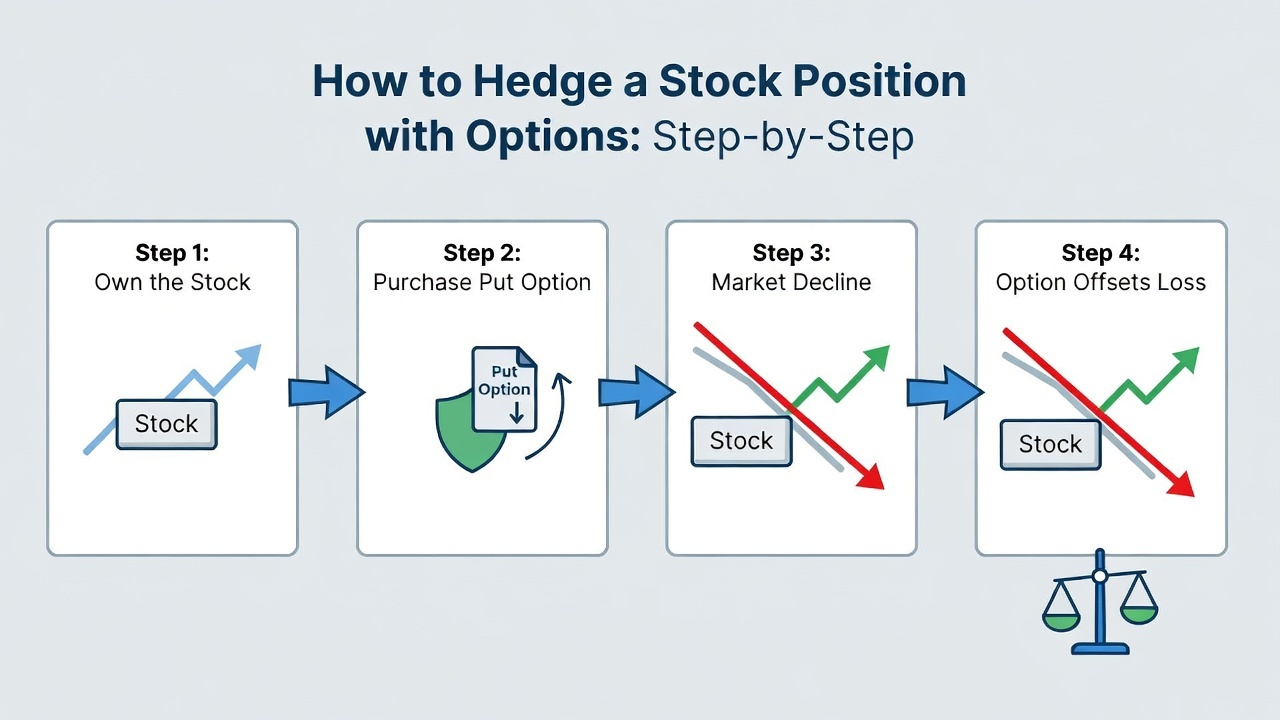
Hedging is simply buying financial insurance on an asset you own. When you hedge a stock position, you set up an options trade designed to gain value if your shares lose value.
Think of it like homeowners insurance. You pay an insurance company an annual premium hoping your roof never leaks or blows off in a storm.
If the storm never arrives, that premium is spent money. You do not get angry that your house stayed intact; you gladly pay the cost for peace of mind while your asset sits safe.
Hedging works the exact same way with stock positions. The goal of a hedge is not to make a killing on a speculative bet.
The goal is simply to survive market drops without having your portfolio destroyed. You accept a known, smaller cost today to defend against a catastrophic loss tomorrow.
The Core Reason to Hedge Instead of Just Selling Your Shares
The most common question I hear from new traders is simple: why not just sell the stock and buy it back later when the price is lower?
First, timing the market is brutally difficult. If you sell your stock and the market rips higher without you, you are stuck watching your favorite company run away without owning a single share.
Second, taxes can chew up your returns. Selling shares held in a standard brokerage account triggers capital gains taxes that you must pay to the government.
Hedging lets you remain the registered shareholder of record. You keep your dividend payments, you keep your voting rights, and you keep your long-term tax status intact.
You are simply adding an options layer over the top of your existing equity. This gives you downside protection while preserving your original thesis on the underlying business.
Free For Traders
Know The EXACT Moment A Stock Hits Support Or Resistance
Real-time alerts fire the instant a stock approaches a critical level. Completely free.
 → Claim Free S&R Alerts
Strategy 1: The Protective Put (Pure Portfolio Insurance)
We covered protective puts earlier in Part 30 of this series, but let us look at how they function as an active hedge on an existing winner. A protective put involves buying one put option for every 100 shares of stock you own.
A put option gives you the legal right to sell your shares at the strike price before expiration. If the stock plunges, your put option gains intrinsic value, offsetting your stock losses dollar-for-dollar below the strike.
Let us look at a realistic example. Suppose you bought 100 shares of XYZ stock at $50 per share, and today the stock is trading at $100.
You have a massive $5,000 gain on paper, but an earnings report is coming up in two weeks and you are nervous. You buy a 30-day $95 strike put option for a $3.00 premium per share ($300 total).
If XYZ collapses to $70 after earnings, you can still exercise your put to sell your shares at $95. Your maximum loss from today’s price is capped at $8.00 per share ($5 from stock drop down to strike, plus the $3 premium paid), keeping the vast majority of your $5,000 profit safe.
| Stock Price at Expiration | Stock Value (100 shares) | Put Value at $95 Strike | Net Total Value (Less $300 Cost) |
|---|---|---|---|
| $120 | $12,000 | $0 | $11,700 |
| $100 | $10,000 | $0 | $9,700 |
| $80 | $8,000 | $1,500 | $9,200 |
| $60 | $6,000 | $3,500 | $9,200 |

Strategy 2: Selling Covered Calls as a Partial Hedge
Buying puts costs money out of pocket, which acts as a drag on your portfolio over time. A covered call, which we touched on back in Part 26, is a way to hedge mildly while collecting cash upfront instead of spending it.
When you sell a covered call against your 100 shares, you collect a cash premium immediately. That cash acts as a small cushion against potential downside moves.
Let us say you own 100 shares of ABC stock trading at $50 per share. You sell a 30-day $55 strike call option and collect a $2.00 premium per share ($200 total into your account).
If ABC drops to $48 over the next month, your stock lost $200 in value, but you keep the $200 option premium. Your net position broke dead even instead of showing a loss.
The trade-off is clear: a covered call only offers shallow downside protection equal to the premium received. If ABC crashes to $30, a $2 cushion will not save your portfolio from serious pain.
Strategy 3: The Collar Strategy (The Zero-Cost Compromise)
What if you want the solid floor of a protective put, but you do not want to pay cash out of pocket for the contract? That is where the collar strategy comes in, which we explored in Part 31.
To build a collar, you own 100 shares of stock, buy an out-of-the-money put for protection, and simultaneously sell an out-of-the-money call to pay for that put. The cash you collect from selling the call covers the cost of buying the put.
Suppose your stock is trading at $100. You buy a 45-day $90 strike put for $2.50 per share, and you sell a 45-day $110 strike call for $2.50 per share.
Your net out-of-pocket cost is exactly $0.00. In exchange for this free insurance floor at $90, you have agreed to cap your upside profit potential at $110 if the stock rallies hard.
Collars are fantastic during turbulent market periods when volatility is high and you simply want to lock down your equity value. You give up the lottery-ticket upside temporarily to ensure your downside is rock-solid.
From Find Better Trades
The Pullback Isn’t A Warning. It’s Your Entry.
Slingshot catches the exact moment a trend pause is ready to rip back in your favor — built for explosive pullback continuations.
 → Catch The Next Slingshot Move

Strategy 4: Hedging with Index Puts (Macro Protection)
What if you own ten different individual stocks across several sectors and you want to protect your whole account? Buying ten individual put options on ten individual stocks gets expensive and difficult to manage quickly.
Instead of hedging every single ticker, you can buy put options on a broad-market exchange-traded fund like the SPY or QQQ. This is known as a macro hedge or a beta hedge.
If the entire stock market experiences a sharp correction, the index puts you bought will surge in value. The cash profit you gain from closing those index puts helps offset the unrealized drop in your individual holdings.
Remember that index hedges are not perfect one-to-one matches. If the overall market holds steady but one specific company in your portfolio posts awful earnings and drops 30%, your index put will not protect you from that company-specific disaster.
Use index puts when you fear systemic events like interest rate decisions, global conflicts, or broad economic downturns. Use single-stock puts when you fear company-specific events like product recalls or earnings reports.
How to Pick the Right Strike and Expiration for Your Hedge
Choosing the right strike price is simply choosing your deductible on an insurance policy. A strike price close to the current stock price offers strong protection, but it carries a steep premium.
A strike price further out of the money costs far less money today, but you must absorb more downside before the insurance kicks in. Most traders balance cost and safety by selecting put strikes that sit 5% to 10% below the current market price.
When it comes to expiration dates, buying weekly options is usually a mistake for hedging. Theta decay, which we explained in Part 15, eats away at short-dated options at an aggressive pace every single afternoon.
Look at expiration dates that are 45 to 90 days out. This gives your hedge enough runway to cover market pullbacks without bleeding all its extrinsic value in the first week.
If the risk passes or the market stabilizes, you can sell the put back to the market to recover whatever remaining extrinsic value is left in the contract. You do not need to hold a hedge all the way to expiration if the danger has cleared.
Common Mistakes Beginners Make With This
Panic-hedging after the stock has already crashed. Buying put options right after your stock drops 15% is the worst time to hedge because implied volatility will be sky-high. You end up paying peak prices for put protection after the damage has already occurred.
Over-hedging your position size. Some traders own 100 shares of stock and buy three or four put contracts out of fear. This transforms your position from a smart defensive hedge into a massive directional short bet that drains your capital if the stock goes up.
Treating covered calls as full downside protection. Selling an out-of-the-money call collects a tiny cash buffer, but it does nothing to protect against severe market crashes. Beginners mistakenly think a $1.00 premium will protect them when their stock falls by $20.00.
Letting hedges expire worthless repeatedly without a plan. If you buy expensive short-term put protection every single month during a bull market, that drag will destroy your long-term compounding. Hedge around specific high-risk windows or use collars to offset the cash cost.
Frequently Asked Questions About Hedging Stock with Options
Do I have to sell my actual stock shares if my put option goes in the money?
No, you are never forced to sell your stock shares. If your put gains value during a market drop, you can simply sell the put contract back to the market for a cash profit while holding onto your shares.
How many option contracts do I need to hedge my stock position?
Standard equity options control 100 shares per contract. If you own 300 shares of a company, you need exactly 3 put contracts to hedge your entire position on a one-to-one basis.
What happens to my hedge if the stock goes straight up instead of down?
If the stock rallies, your put option will lose value and eventually expire worthless, representing a small loss equal to the premium paid. However, your underlying stock shares will have gained value, leaving your total account balance higher.
Can I hedge odd lots of stock like 45 or 75 shares?
Standard options only cover increments of 100 shares, so you cannot perfectly hedge an odd lot. You would have to accept being slightly over-hedged with one full contract or look into mini-options if available on that ticker.
Now that you know how to lock down your equity against market crashes, let us flip the calendar completely and look at how to use LEAPS to control stock positions for a year or more without putting up standard share capital.
📈 Want More? Join Our Free Trading Community
- Trading Strategy Guides Telegram — daily strategy tips and market insights
- Find Better Trades Telegram — free trade signals delivered to your phone
- Find Better Trades on YouTube — live trade breakdowns and tutorials
Lesson 46 of 55 in the free Options Trading Course.
← Previous: Open Interest vs Volume in Options: What Each One Tells You
Next: LEAPS Options Explained: How to Trade Long-Term Options →