Collar Strategy Explained: Protect Gains Without Selling

📚 Beginner’s Guide to Options — Part 31 of 51
- Part 1: What Is an Option? The Absolute Basics Explained
- Part 2: Calls vs. Puts: The Two Types of Options You Need to Know
- Part 3: Strike Price Explained: What It Actually Means for Your Trade
- Part 4: Expiration Date Explained: Why It Changes Everything
- Part 5: Premium Explained: What You’re Really Paying For
- Part 6: In the Money vs. Out of the Money: A Beginner’s Breakdown
- Part 7: Intrinsic Value vs. Extrinsic Value: What Makes Up an Option’s Price
- Part 8: How Buying a Call Option Works, Step by Step
- Part 9: How Buying a Put Option Works, Step by Step
- Part 10: What Happens When an Option Expires? Every Outcome Explained
- Part 11: Options Contracts 101: What One Contract Actually Represents
- Part 12: How to Read an Options Chain Without Getting Overwhelmed
- Part 13: Bid, Ask, and Spread: What They Mean When You’re Trading Options
- Part 14: What Is Implied Volatility? A Beginner’s Plain-English Guide
- Part 15: Why Options Lose Value Over Time: Theta Explained Simply
- Part 16: Delta Explained: What It Really Tells You About Your Option
- Part 17: Gamma Explained: Why Delta Doesn’t Stay the Same
- Part 18: Vega Explained: How Volatility Changes Your Option’s Price
- Part 19: The Greeks Cheat Sheet: Delta, Gamma, Theta, Vega in Plain English
- Part 20: What Is Assignment? What Happens If Your Option Gets Exercised
- Part 21: American vs. European Options: What’s the Difference?
- Part 22: How Much Money Do You Need to Start Trading Options?
- Part 23: Paper Trading Options: How to Practice Before Risking Real Money
- Part 24: The Biggest Mistake Beginners Make Buying Options
- Part 25: Why Most Beginners Lose Money Buying Options (and How to Avoid It)
- Part 26: Covered Calls Explained: The First Options Strategy Every Trader Should Learn
- Part 27: Cash-Secured Puts Explained: A Beginner-Friendly Way to Get Paid to Wait
- Part 28: Vertical Spreads Explained: Reducing Risk on Your First Options Trade
- Part 29: Credit Spreads vs. Debit Spreads: What’s the Real Difference?
- Part 30: The Protective Put Explained: Insurance for Your Stock Position
- Part 31: The Collar Strategy Explained: Protecting Gains Without Selling (you are here)
⚡ Key Takeaways
- A collar locks in a price floor for 100 shares of stock by purchasing a protective put funded by selling a covered call.
- This strategy creates a defined trading range where your maximum risk and maximum profit are both strictly capped.
- Traders use collars to defend substantial unrealized gains against market drops without triggering an immediate stock sale.
— Ben, Find Better Trades
You bought a stock, watched it run up nicely, and now you are sitting on a solid unrealized profit. The dilemma is real: you want to protect your money against a sudden market drop, but selling triggers taxes and kicks you out of the trade completely.
Welcome to Part 31 of our beginner series. Today, we are walking through the collar strategy, which lets you lock in a safety net for your shares almost entirely for free.
What Is a Collar Option Strategy?
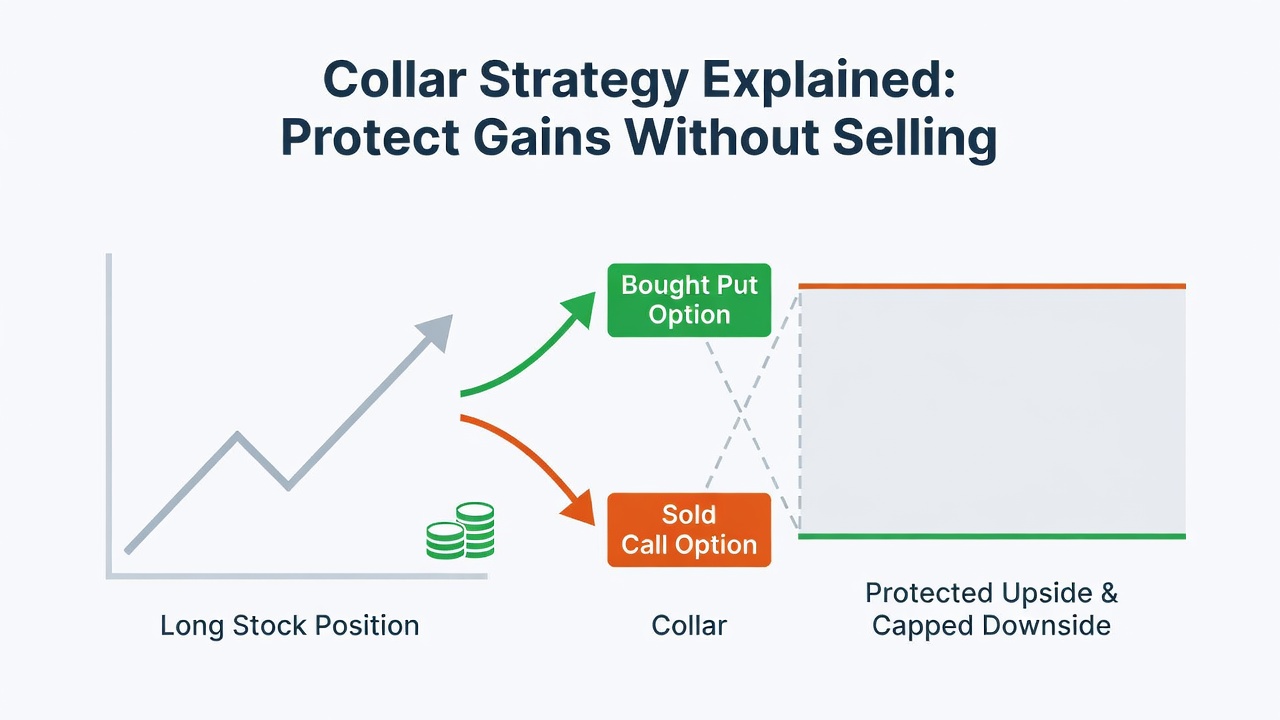
A collar is a defensive options strategy designed to protect a stock position you already own. It establishes a firm boundary around your shares by setting both a floor and a ceiling on your position value.
To build a collar, you must hold at least 100 shares of the underlying stock. Against those shares, you buy one out-of-the-money put option and simultaneously sell one out-of-the-money call option with the exact same expiration date.
Think of it like putting bumper guards on a bowling lane. The put option acts as the left bumper to ensure you cannot drop below a certain value, while the short call acts as the right bumper that caps your upside.
I think of this as an exchange agreement with the market. You give up the chance at runaway future gains in return for guaranteed protection against a total collapse.
Because you are combining three moving parts into one structure, every dollar of risk is clearly defined before you ever enter the order.
How the Collar Combines Two Strategies You Already Know
If you have been following our series in order, you already know the two component trades that form a collar. We are simply combining them into a single, cohesive framework.
Back in Part 26, we covered covered calls, where you sell a call against 100 shares to collect premium income. Then in Part 30, we covered protective puts, where you buy a put to insure your stock against a crash.
A protective put is great insurance, but buying premium over and over gets expensive fast. That out-of-pocket cash drag can eat away at your long-term portfolio performance if the crash never happens.
The collar solves this problem by using the cash generated from selling the covered call to pay for your protective put. You are basically getting someone else to buy your insurance policy for you.
By tying these two positions together, you create a self-funding hedge that eliminates the regular carrying cost of portfolio protection.
Free For Traders
Get Free Weekly Trade Ideas Sent Straight To Your Phone
Join thousands of traders who get high-probability setups delivered every week — no cost, no catch.
 → Get My Free Trade Ideas
The Math Behind a Zero-Cost Collar
The purest version of this trade is known as a zero-cost collar. This occurs when the premium you receive for selling the call perfectly offsets the premium you spend to buy the put.
Let’s say you want to buy a protective put that costs $2.50 per share ($250 total). Instead of paying that from your cash balance, you look for an out-of-the-money call trading for that exact same $2.50 price tag.
When you sell that call and buy that put simultaneously, your net cash outlay is exactly $0.00. You get full downside coverage without pulling a single extra penny out of your brokerage account.
Sometimes the math will not balance down to the exact cent, resulting in a tiny net credit or a tiny net debit. If the call pays $2.80 and the put costs $2.50, you put $30 in your pocket while locking down the hedge.
If the put costs $2.70 and the call brings in $2.50, you pay a tiny $20 net debit for the total protection. In both cases, the cost is microscopic compared to buying insurance outright.

A Complete Step-by-Step Trade Example
Let’s walk through realistic numbers so you can see how this trade works in practice. Suppose you bought 100 shares of Company XYZ at $50 per share a year ago, and the stock is now trading at $100.
You are sitting on a $5,000 gain, but an upcoming industry report has you worried about a sharp pullback. You want to guard that profit without selling your shares and triggering a capital gains tax bill today.
To build your collar, you buy a 60-day expiration Put with a $90 strike price for $3.00 ($300 total cost). At the same time, you sell a 60-day expiration Call with a $110 strike price for $3.00 ($300 total credit).
Because the $300 credit covers the $300 cost, your net cash paid for this entire setup is exactly zero. You have now drawn two distinct lines in the sand for the next two months.
Your floor is locked at $90 per share, meaning your minimum realized profit is $4,000 regardless of how low the stock drops. Your upside ceiling is $110, meaning your maximum profit potential is $6,000 if the stock rallies hard.
Payoff Scenarios: What Happens at Expiration
When expiration day arrives, Company XYZ can land in one of three zones. Understanding these three outcomes gives you total clarity over your trade management.
Scenario one: The stock crashes to $70. Your shares drop in value, but your $90 put is deeply in the money and guarantees you can sell your shares for $90 each, limiting your loss cleanly.
Scenario two: The stock stays flat at $100. Both options expire completely worthless, you paid nothing to set up the trade, and you still own your 100 shares at the current market value.
Scenario three: The stock rallies to $130. Your short $110 call gets assigned, meaning you must sell your shares at $110 each, securing your $6,000 profit but missing the extra move above $110.
| Stock Price at Expiration | Long $90 Put Value | Short $110 Call Value | Net Share Value Realized |
|---|---|---|---|
| $60.00 (Crash) | Worth $30.00 | Expires Worthless ($0) | $90.00 per share |
| $100.00 (Flat) | Expires Worthless ($0) | Expires Worthless ($0) | $100.00 per share |
| $130.00 (Rally) | Expires Worthless ($0) | Assigned at $110 | $110.00 per share |
From Find Better Trades
I Only Look For ONE Green Arrow. Here’s Why.
Coiled Spring PRO tracks institutional volume surges and extreme volatility compression — then prints a non-repainting arrow the exact moment a stock is ready to explode. No guessing. No repainting. One arrow.
 → See How The Arrow Works

Second Example: Setting Up an Asymmetrical Collar
You do not always have to make the trade completely cost-neutral. You can alter the strike prices based on whether you care more about preserving upside or tightening your protective floor.
Let’s say you own 100 shares of Stock ABC trading at $50 per share. You want very tight downside protection at the $48 strike, which costs $2.00 per share.
However, you do not want to cap your upside too tightly, so you choose to sell a far out-of-the-money $55 call for only $0.80. This leaves you with a net debit of $1.20 ($120 out of pocket).
In this asymmetrical setup, you paid a small fee to keep $5.00 of upside room while keeping your potential loss down to just $2.00 per share. You sacrificed zero-cost efficiency for greater upside freedom.
Conversely, an income-focused trader might sell a closer $52 call for $2.40 to buy that same $48 put for $2.00, collecting a net credit of $40 while narrowing their profit window.
When Should You Actually Use a Collar?
Collars are not everyday trades for every stock in your account. They are specialized tools built for specific market environments and portfolio situations.
The premier use case is protecting large, long-term gains ahead of volatile events like earnings announcements, FDA drug trial results, or macro interest rate decisions. If the news is disastrous, your floor protects your hard-earned capital.
Another common scenario involves managing tax timing. If you want to lock in your gains in December but want to delay realized capital gains into the next tax year, a collar bridges that gap cleanly.
I also use collars when my outlook on an individual stock shifts from aggressively bullish to neutral or uncertain. It lets me stay in the position without losing sleep over downside risk.
If you are extremely bullish and expect the stock to double next month, a collar is the wrong tool because that short call will cap your profits.
Common Mistakes Beginners Make With Collars
The most frequent error I see beginners make is setting the short call strike too close to the current stock price. They focus entirely on collecting a large credit to pay for an expensive put, leaving almost zero room for the stock to appreciate naturally.
Another trap is mismatching expiration dates across the two options. A collar requires the long put and short call to share the same expiration date; mixing dates turns the structure into a complicated diagonal spread with uneven time decay.
Beginners also panic when the stock rallies aggressively past their short call strike. Remember that having your shares called away at a higher price than where you entered is a win, not a failure.
Finally, traders frequently forget to account for ex-dividend dates on high-yielding stocks. If your short call goes into the money near a dividend payment, you face early assignment risk from buyers exercising early to capture the dividend.
Collar Strategy Frequently Asked Questions
Can I lose money on a collar strategy?
Yes, you can still lose money between your stock purchase price and your put strike price, or between the current price and the put floor if you opened the stock higher. However, your losses are strictly limited to the strike price of your long put.
Do I need margin approval to trade a collar?
Most brokers allow collars in standard cash or retirement accounts because the short call is fully covered by your 100 shares. Since the short position is secured by physical stock, the broker carries minimal risk.
What happens if the stock price drops below my put strike?
Your put option increases in value dollar-for-dollar as the stock continues to drop below that strike. You can either exercise the put to sell your shares at the strike price or sell the put back to the market for cash to offset your stock loss.
Can I close a collar before the expiration date arrives?
Yes, you can dismantle the collar at any point during market hours by selling your long put and buying back your short call. You are never forced to hold the structure all the way through expiration.
Next up, we are shifting from pure defense to explosive opportunity as we look at straddles, a strategy where you can profit from massive market moves no matter which direction the stock decides to rip.
📈 Want More? Join Our Free Trading Community
- Trading Strategy Guides Telegram — daily strategy tips and market insights
- Find Better Trades Telegram — free trade signals delivered to your phone
- Find Better Trades on YouTube — live trade breakdowns and tutorials
Lesson 31 of 52 in the free Options Trading Course.
← Previous: Protective Put Strategy Explained: How to Insure Stock
Next: Straddles Explained: Betting on a Big Move in Either Direction →