Straddles Explained: Betting on a Big Move in Either Direction

📚 Beginner’s Guide to Options — Part 32 of 51
- Part 1: What Is an Option? The Absolute Basics Explained
- Part 2: Calls vs. Puts: The Two Types of Options You Need to Know
- Part 3: Strike Price Explained: What It Actually Means for Your Trade
- Part 4: Expiration Date Explained: Why It Changes Everything
- Part 5: Premium Explained: What You’re Really Paying For
- Part 6: In the Money vs. Out of the Money: A Beginner’s Breakdown
- Part 7: Intrinsic Value vs. Extrinsic Value: What Makes Up an Option’s Price
- Part 8: How Buying a Call Option Works, Step by Step
- Part 9: How Buying a Put Option Works, Step by Step
- Part 10: What Happens When an Option Expires? Every Outcome Explained
- Part 11: Options Contracts 101: What One Contract Actually Represents
- Part 12: How to Read an Options Chain Without Getting Overwhelmed
- Part 13: Bid, Ask, and Spread: What They Mean When You’re Trading Options
- Part 14: What Is Implied Volatility? A Beginner’s Plain-English Guide
- Part 15: Why Options Lose Value Over Time: Theta Explained Simply
- Part 16: Delta Explained: What It Really Tells You About Your Option
- Part 17: Gamma Explained: Why Delta Doesn’t Stay the Same
- Part 18: Vega Explained: How Volatility Changes Your Option’s Price
- Part 19: The Greeks Cheat Sheet: Delta, Gamma, Theta, Vega in Plain English
- Part 20: What Is Assignment? What Happens If Your Option Gets Exercised
- Part 21: American vs. European Options: What’s the Difference?
- Part 22: How Much Money Do You Need to Start Trading Options?
- Part 23: Paper Trading Options: How to Practice Before Risking Real Money
- Part 24: The Biggest Mistake Beginners Make Buying Options
- Part 25: Why Most Beginners Lose Money Buying Options (and How to Avoid It)
- Part 26: Covered Calls Explained: The First Options Strategy Every Trader Should Learn
- Part 27: Cash-Secured Puts Explained: A Beginner-Friendly Way to Get Paid to Wait
- Part 28: Vertical Spreads Explained: Reducing Risk on Your First Options Trade
- Part 29: Credit Spreads vs. Debit Spreads: What’s the Real Difference?
- Part 30: The Protective Put Explained: Insurance for Your Stock Position
- Part 31: The Collar Strategy Explained: Protecting Gains Without Selling
- Part 32: Straddles Explained: Betting on a Big Move (In Either Direction) (you are here)
⚡ Key Takeaways
- A long straddle involves buying both a call and a put option at the exact same strike price and expiration date.
- The trade makes money when the underlying stock makes a massive move in either direction that exceeds the combined cost of both premiums.
- Your maximum financial loss is strictly limited to the total debit paid up front to buy the two option contracts.
— Ben, Find Better Trades
Welcome to Part 32 of my beginner options series. When most people start trading options, they assume they always have to predict whether a stock is going up or down.
A long straddle throws that entire idea out the window. This strategy allows you to profit from explosive price action even when you have no idea which direction the stock will actually break.
What Is a Long Straddle? (The Core Concept)
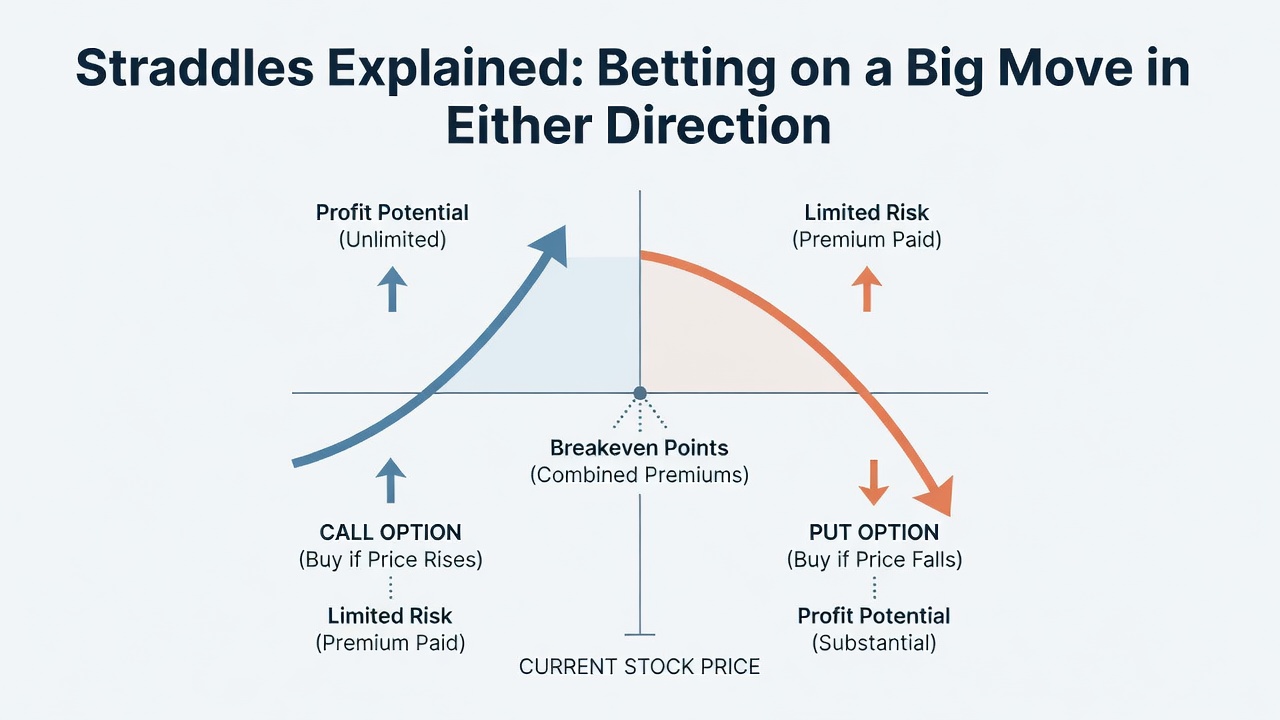
A long straddle is a market-neutral options strategy designed to capitalize on extreme price movement and rising volatility. To build one, you simultaneously buy an at-the-money call option and an at-the-money put option on the same underlying stock.
Both of these contracts must share the exact same strike price and the exact same expiration date. Because you are buying both sides of the market, you hold the right to profit if the stock skyrockets or if it falls off a cliff.
Think of it like buying two one-way train tickets at the exact same station, with one train heading north and the other heading south. You do not care which train leaves the station, as long as one of them travels far enough and fast enough down the track.
Earlier in this series, we covered how buying a call gives you upside exposure while buying a put gives you downside exposure. By combining them into a single trade, you eliminate the need to guess the market’s directional bias.
However, this flexibility comes at a real cost. Because you are purchasing two separate option contracts, your initial financial outlay is significantly higher than buying a single standalone call or put.
The Anatomy of a Straddle: Strike Price, Expiration, and Cost
Setting up a straddle begins by checking the current market price of the stock you want to trade. You locate the options chain and select the strike price that is closest to the current stock price, known as the at-the-money strike.
Once you identify that strike, you buy one call contract and one put contract at that specific price point. If a stock trades at $100, you buy the $100 call and the $100 put within the same expiration cycle.
The total cash you pay to enter the trade is called the net debit. This debit equals the ask price of the call plus the ask price of the put, multiplied by 100 shares per contract.
Because you are paying two separate premiums, your position begins with double the normal cost drag. The underlying stock must move substantially just to cover the cash you spent opening both legs.
Choosing an expiration date requires careful thought. Traders typically align the expiration with a known catalyst, such as an upcoming earnings release, a regulatory decision, or a major economic announcement.
Free For Traders
The Options Cheat Sheet Thousands Of Traders Swear By
Calls, puts, spreads — one free download tells you the right options strategy for every market condition.
 → Download The Free Cheat Sheet
How to Calculate Your Breakeven Prices on a Straddle
Because a straddle can profit in two different directions, the position has two distinct breakeven points. You must calculate both the upper breakeven price and the lower breakeven price before entering the trade.
To find the upper breakeven point, add the total premium paid for both contracts to the strike price. To find the lower breakeven point, subtract the total premium paid from the strike price.
Let us look at the simple mathematical formulas you will use to map out your trade parameters:
Upper Breakeven = Strike Price + Total Premium Paid
Lower Breakeven = Strike Price – Total Premium Paid
Any stock price outside this range at expiration represents pure profit for the position. Any stock price that settles between these two breakeven points represents a partial or total financial loss.
The maximum loss occurs if the underlying stock closes exactly at your chosen strike price on expiration day. In that worst-case scenario, both the call and the put expire worthless, and you lose 100% of the initial debit paid.

A Full Walkthrough: Trading a Real-World Straddle Example
Let us walk through a concrete example with numbers so you can see how the math plays out in practice. Suppose XYZ stock is trading at exactly $50 per share ahead of an upcoming product launch.
You believe the announcement will trigger a massive move, but you are not sure if the public reaction will be positive or negative. You decide to buy a 30-day $50 straddle.
You buy one $50 call for $2.50 per share ($250 total) and one $50 put for $2.50 per share ($250 total). Your combined cost to enter the trade is $5.00 per share, which equals an upfront cash debit of $500.
Your upper breakeven price is $55.00 ($50 strike + $5 total premium). Your lower breakeven price is $45.00 ($50 strike – $5 total premium).
| Stock Price at Expiration | Call Value | Put Value | Total Position Value | Net Profit / Loss |
|---|---|---|---|---|
| $35.00 (Huge Drop) | $0.00 | $15.00 | $1,500 | +$1,000 Profit |
| $45.00 (Lower Breakeven) | $0.00 | $5.00 | $500 | $0 (Breakeven) |
| $50.00 (Zero Movement) | $0.00 | $0.00 | $0 | -$500 (Max Loss) |
| $55.00 (Upper Breakeven) | $5.00 | $0.00 | $500 | $0 (Breakeven) |
| $65.00 (Huge Rally) | $15.00 | $0.00 | $1,500 | +$1,000 Profit |
If the stock climbs to $65, the $50 call is worth $15.00 ($1,500) while the put expires at $0. After subtracting your $500 initial cost, you walk away with a $1,000 net profit.
If the stock drops to $35, the call expires at $0 while the put is worth $15.00 ($1,500). Once again, your net profit is exactly $1,000 despite the market crashing.
The Two Silent Enemies of a Straddle: Theta Decay and IV Crush
On paper, the long straddle sounds like an unbeatable cheat code. In the real market, two powerful Greek forces constantly work together to erode your position.
The first headwind is time decay, measured by the Greek metric Theta, which we explored earlier in the series. Because you own two separate long options, you are paying double the normal daily time decay compared to a single-leg trade.
If the underlying stock consolidates and drifts sideways, both of your contracts will bleed extrinsic value every single afternoon. Every day that passes without a violent price move actively destroys your capital.
The second headwind is implied volatility collapse, commonly known across trading desks as IV crush. Before an anticipated event like earnings, market makers inflate option premiums because uncertainty is high.
As soon as the news breaks, that uncertainty disappears instantly, causing implied volatility to drop sharply. Even if the stock moves moderately in your favored direction, the sudden drop in vega value can cause both options to lose money simultaneously.
From Find Better Trades
Learn The Spread System From The Ground Up
Build, manage, and exit low-risk debit spreads for consistent income — full video course.
 → See The Course

Common Mistakes Beginners Make With Straddles
1. Buying straddles on the afternoon right before earnings announcements. When you buy options during peak implied volatility, you pay the absolute highest premium possible. Even if the stock moves after the earnings report, IV crush often wipes out both legs before you can take a profit.
2. Holding the position all the way into expiration day. Beginners frequently hold losing straddles until the final hours hoping for a last-minute miracle swing. Theta decay accelerates aggressively in the final two weeks, so exiting early preserves remaining capital when a move fails to develop.
3. Underestimating the required breakeven percentage. Many traders do not do the simple addition before clicking buy. If a straddle requires a 12% stock move just to break even, and the stock historically only moves 4% on news, the trade carries a massive statistical disadvantage.
4. Accompanying the trade with oversized capital allocations. Because straddles feel safe due to their non-directional nature, beginners frequently commit far too much account cash to a single setup. When the stock trades flat, losing 100% of a double-premium position can deliver a devastating blow to your portfolio balance.
Straddle Strategy Questions Answered (FAQ)
Can I lose more money than I initially spend on a long straddle?
No, your maximum risk is strictly capped at the total debit paid to purchase the call and the put contracts. You can never lose more than your initial investment, and you will never face unexpected margin calls on a long straddle.
When is the best time to close a profitable straddle?
You should look to exit as soon as the stock makes its sharp, explosive move rather than waiting for expiration. Closing the trade quickly locks in the intrinsic gains on your winning leg before time decay eats away the remaining value.
Do I have to close both legs of the straddle at the exact same time?
While you can legally sell one leg and keep the other open, doing so turns the remaining contract into a purely directional gamble. For most beginners, closing both legs simultaneously as a complete unit is the cleanest and safest way to manage risk.
How does a long straddle differ from a short straddle?
A long straddle buys both options to profit from huge market swings, risking only the upfront premium paid. A short straddle involves selling both options to collect premium, profiting when the stock stays completely still while taking on unlimited financial risk.
In Part 33, we are going to look at the straddle’s leaner, cheaper cousin: strangles, and how widening your strikes lets you bet on big moves for a fraction of the cost.
📈 Want More? Join Our Free Trading Community
- Trading Strategy Guides Telegram — daily strategy tips and market insights
- Find Better Trades Telegram — free trade signals delivered to your phone
- Find Better Trades on YouTube — live trade breakdowns and tutorials
Lesson 32 of 52 in the free Options Trading Course.
← Previous: Collar Strategy Explained: Protect Gains Without Selling
Next: Options Strangles Explained: A Cheaper Bet on Big Moves →