Credit Spreads vs Debit Spreads: The Complete Beginner Guide

📚 Beginner’s Guide to Options — Part 29 of 51
- Part 1: What Is an Option? The Absolute Basics Explained
- Part 2: Calls vs. Puts: The Two Types of Options You Need to Know
- Part 3: Strike Price Explained: What It Actually Means for Your Trade
- Part 4: Expiration Date Explained: Why It Changes Everything
- Part 5: Premium Explained: What You’re Really Paying For
- Part 6: In the Money vs. Out of the Money: A Beginner’s Breakdown
- Part 7: Intrinsic Value vs. Extrinsic Value: What Makes Up an Option’s Price
- Part 8: How Buying a Call Option Works, Step by Step
- Part 9: How Buying a Put Option Works, Step by Step
- Part 10: What Happens When an Option Expires? Every Outcome Explained
- Part 11: Options Contracts 101: What One Contract Actually Represents
- Part 12: How to Read an Options Chain Without Getting Overwhelmed
- Part 13: Bid, Ask, and Spread: What They Mean When You’re Trading Options
- Part 14: What Is Implied Volatility? A Beginner’s Plain-English Guide
- Part 15: Why Options Lose Value Over Time: Theta Explained Simply
- Part 16: Delta Explained: What It Really Tells You About Your Option
- Part 17: Gamma Explained: Why Delta Doesn’t Stay the Same
- Part 18: Vega Explained: How Volatility Changes Your Option’s Price
- Part 19: The Greeks Cheat Sheet: Delta, Gamma, Theta, Vega in Plain English
- Part 20: What Is Assignment? What Happens If Your Option Gets Exercised
- Part 21: American vs. European Options: What’s the Difference?
- Part 22: How Much Money Do You Need to Start Trading Options?
- Part 23: Paper Trading Options: How to Practice Before Risking Real Money
- Part 24: The Biggest Mistake Beginners Make Buying Options
- Part 25: Why Most Beginners Lose Money Buying Options (and How to Avoid It)
- Part 26: Covered Calls Explained: The First Options Strategy Every Trader Should Learn
- Part 27: Cash-Secured Puts Explained: A Beginner-Friendly Way to Get Paid to Wait
- Part 28: Vertical Spreads Explained: Reducing Risk on Your First Options Trade
- Part 29: Credit Spreads vs. Debit Spreads: What’s the Real Difference? (you are here)
⚡ Key Takeaways
- Debit spreads require cash out of pocket upfront, while credit spreads pay cash directly into your account when opened.
- Debit spreads benefit from strong directional stock moves, while credit spreads profit when stock prices stay flat, move in your favor, or drop slightly.
- Choose debit spreads when implied volatility is cheap and credit spreads when implied volatility is high.
— Ben, Find Better Trades
Welcome back to Part 29 of my beginner options education series. We covered the foundational mechanics of vertical spreads in Part 28, so now we need to answer the biggest question new traders face at the order entry screen.
When you place a spread trade, you will choose between paying money out of pocket or collecting money upfront. Understanding why you would choose one over the other is what separates strategic trading from blind gambling.
What Is a Debit Spread? Paying Cash Upfront for Directional Trades
A debit spread is an options strategy where you buy one option contract and simultaneously sell another option contract on the same underlying stock with the same expiration date.
The key detail here is that the option you buy costs more money than the option you sell. Because your buy leg is more expensive than your sell leg, cash flows out of your brokerage account to open the position.
Think of it like buying a full-price admission ticket to a concert, but then selling a pass to your friend for just the opening act. You spent money overall, but selling that smaller pass reduced your total out-of-pocket cost.
When you trade a debit spread, you are paying a discounted price to control a directional move in a stock. You want the stock to make a significant move in your chosen direction before the contracts expire.
Because you paid cash upfront, your risk is strictly capped at the net debit you paid to enter the trade. You can never lose more than that initial cash layout, no matter how terribly the underlying stock performs.
What Is a Credit Spread? Getting Paid Cash Upfront to Take On Risk
A credit spread flips the money flow of a debit spread entirely on its head. With a credit spread, you sell a more expensive option and buy a cheaper option at a different strike price for protection.
Because the option you sell generates more premium than the option you buy, your brokerage account receives an immediate cash deposit when the trade executes.
Think of a credit spread like running an insurance business. You collect a premium payment from a customer upfront, but you buy your own backstop insurance policy to make sure a single massive storm doesn’t bankrupt you.
When you trade a credit spread, you are setting up a boundary line on the stock chart. As long as the stock stays away from your boundary, you get to keep the upfront cash deposit as your profit.
Your risk is also strictly defined, even though you started the trade by selling an option. The cheaper option you bought acts as a hard stop-loss, capping your maximum possible loss to a fixed number.
Free For Traders
One Clear Arrow. Every High-Probability Setup. Free.
The Fusion Indicator combines multiple signals into a single buy/sell arrow on TradingView so you never miss a move.
 → Get The Free Fusion Indicator
The Flow of Money: Debit Means Net Cash Out, Credit Means Net Cash In
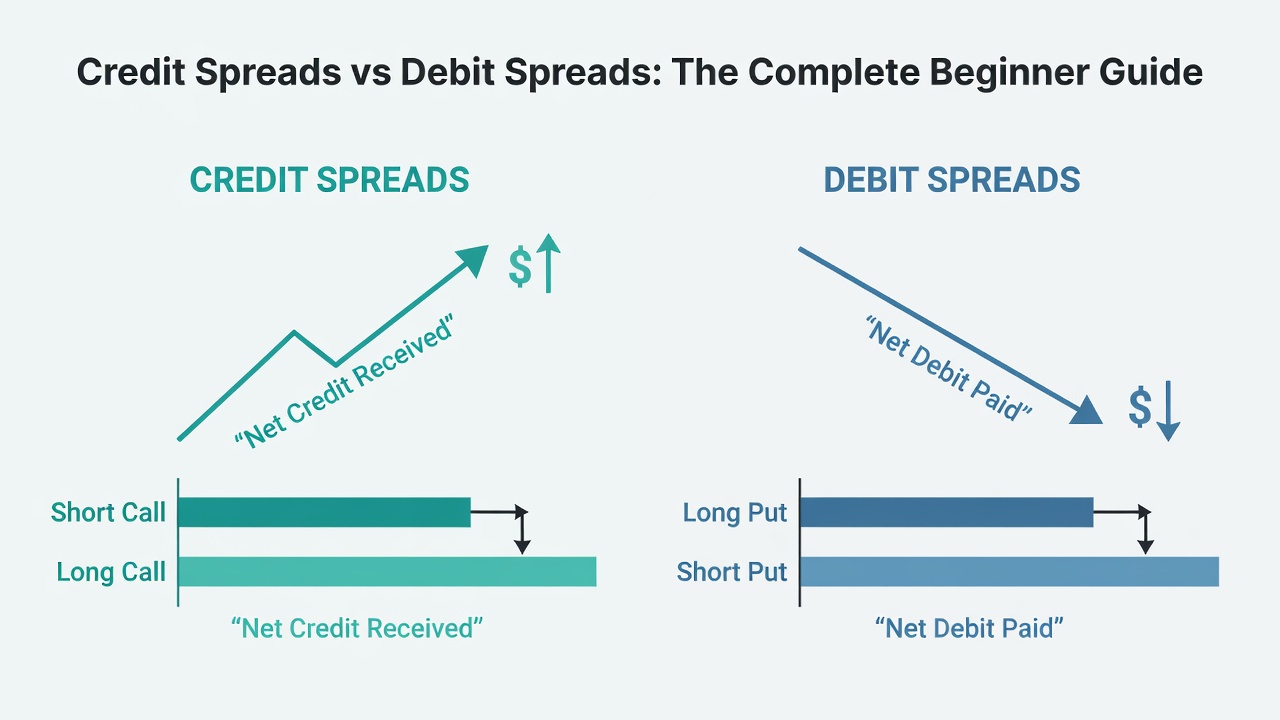
The core difference between these two strategies comes down to net cash movement. When a trader says they paid a net debit, it means cash left their trading account during order execution.
When a trader says they received a net credit, it means cash entered their trading account during order execution. This fundamental shift changes how you calculate your risk, reward, and breakeven prices.
For a debit spread, your maximum gain is limited to the difference between the two strike prices minus the net debit paid. Your maximum loss is simply the net debit you paid upfront.
For a credit spread, your maximum gain is capped at the exact net credit you received when opening the trade. Your maximum loss is the difference between the strike prices minus that net credit received.
Here is a direct side-by-side comparison to help you visualize how money and risk move in each structure:
| Feature | Debit Spread | Credit Spread |
|---|---|---|
| Initial Cash Flow | Cash leaves account (Debit) | Cash enters account (Credit) |
| Max Profit | Strike Width minus Debit Paid | Net Credit Received Upfront |
| Max Loss | Net Debit Paid Upfront | Strike Width minus Credit Received |
| Time Decay Impact | Hurts the trade overall | Helps the trade overall |
| Best Volatility Environment | Low Implied Volatility | High Implied Volatility |

How Theta Decay Affects Debit vs. Credit Spreads Differently
We spent Part 15 talking about Theta, which measures how much value an option contract loses every single day due to time decay. Time decay is the relentless ticking clock of the options world.
When you trade a debit spread, time decay is generally your enemy. Because you are a net buyer of option value, the calendar ticking away erodes the value of your position if the stock fails to move quickly.
You need the underlying stock to move toward your target price fast enough to overcome that constant daily loss of extrinsic value. If the stock sits completely still, your debit spread will slowly lose money.
When you trade a credit spread, time decay becomes your best friend. Because you are a net seller of option value, everyday time passes without stock movement works directly in your favor.
As expiration approaches, the options you sold lose their value through Theta decay. You can then buy back the spread for cheap or let it expire worthless, keeping the initial credit as pure profit.
Worked Numeric Examples: Seeing the Math Side by Side
Let me show you real hypothetical numbers so you can see how the dollars work in practice. Imagine stock XYZ is currently trading at exactly $100 per share.
First, let’s look at a Bull Call Debit Spread. You decide to buy the $100 Call for $4.00 ($400 total) and sell the $105 Call for $1.50 ($150 total).
Your net debit is $4.00 minus $1.50, which equals $2.50 per share, or $250 total out of pocket. Your maximum loss is capped at that $250 debit.
The width between your strike prices is $5.00 ($105 minus $100). Subtract your $2.50 debit from that $5.00 width, and your maximum potential profit is $2.50 ($250 total).
Now let me show you a Bull Put Credit Spread on the exact same $100 stock. You sell the $95 Put for $2.00 ($200 total) and buy the $90 Put for $0.60 ($60 total).
Your net credit is $2.00 minus $0.60, which equals $1.40 per share, or $140 deposited into your account immediately. That $140 net credit is your maximum profit.
The width between these put strikes is $5.00 ($95 minus $90). Subtract your $1.40 credit from that $5.00 width, and your maximum loss is capped at $3.60 ($360 total).
From Find Better Trades
Consistent Income. Any Market Direction.
The Income Project’s low-risk debit spread system generates steady returns whether the market runs up, down, or sideways.
 → See The Income Project

Probability vs. Payout: Finding the Right Trade-Off for Your Account
Notice the trade-off in the numbers we just calculated. The debit spread risked $250 to make $250, giving you an even 1-to-1 risk-to-reward ratio.
The credit spread risked $360 to make $140, meaning you are risking more capital than your potential profit payout. At first glance, beginners often wonder why anyone would ever choose a credit spread with those odds.
The answer comes down to probability of profit. For the debit spread to reach maximum profit, stock XYZ must rally above $105 by expiration.
For the credit spread to reach maximum profit, stock XYZ simply needs to stay above $95. The stock can stay at $100, drift up to $110, or even drop to $96, and you still make full profit on the credit spread.
Debit spreads offer higher potential returns relative to your capital at risk, but they win less frequently. Credit spreads offer lower potential returns relative to your capital at risk, but they win much more often.
Choosing Between Credit and Debit Spreads: My Personal Decision Matrix
When I analyze a potential setup, I use a simple decision framework based on market conditions and price action. Here is how I decide which spread type to use.
First, I check Implied Volatility, which we learned to analyze back in Part 14. If Implied Volatility is high, options premiums are inflated and expensive across the board.
In high volatility environments, I prefer credit spreads. Selling expensive options lets me collect higher net credits while placing my strike prices further away from the current stock price.
If Implied Volatility is low, options premiums are cheap. In low volatility environments, I prefer debit spreads because I can buy directional leverage at a heavily discounted price.
Second, I look at my directional conviction. If I expect an aggressive price explosion in a stock, I pick a debit spread to maximize my return on risk.
If I expect a stock to drift slowly or consolidate inside a price range, I pick a credit spread to let time decay do the heavy lifting for me.
Common Mistakes Beginners Make With This
Chasing high credit without checking the max loss. Beginners often sell credit spreads with strikes right next to the current stock price to grab a large upfront payout. They fail to realize this drastically lowers their win probability while exposing them to max risk.
Sizing credit spread positions too large. Because credit spreads can have win rates above 75%, new traders often get arrogant and bet huge portions of their account. A single max-loss trade can wipe out five or six previous winning trades instantly if position sizing is ignored.
Holding debit spreads until the final bell hoping for a miracle. When a debit spread moves against a beginner, they often leave it open until expiration day hoping for a sudden reversal. Managing the trade early to cut losses preserves precious capital for the next opportunity.
Confusing directional calls and puts with cash movement. Beginners frequently assume calls are always debit trades and puts are always credit trades. Remember that both calls and puts can be constructed as either credit or debit spreads depending on which strike you buy and sell.
Frequently Asked Questions About Credit and Debit Spreads
Are credit spreads safer than debit spreads for beginners?
Neither strategy is inherently safer than the other because both have strictly capped risk. Credit spreads win more frequently, but when they lose, you typically lose more relative to your potential profit than on a debit spread.
Can I close a credit spread early before expiration?
Yes, you can close a credit spread at any time by buying back the spread for less than the credit you received. Closing early locks in profits and removes your capital from market risk ahead of expiration.
What happens if a stock stays completely flat until expiration?
If a stock stays flat, a credit spread will generally make money due to daily time decay eroding the option values. Conversely, a debit spread will usually lose value under flat price action because time decay works against net option buyers.
Do I need a higher margin approval level to trade credit spreads?
Yes, most brokerages require a higher options approval level (usually Level 3) for credit spreads than debit spreads. This is because credit spreads involve short options legs, even though your total trade risk remains strictly limited by the long protection leg.
Next up in Part 30, we are going to look at how to protect a stock portfolio you already own using a classic strategy called the protective put.
📈 Want More? Join Our Free Trading Community
- Trading Strategy Guides Telegram — daily strategy tips and market insights
- Find Better Trades Telegram — free trade signals delivered to your phone
- Find Better Trades on YouTube — live trade breakdowns and tutorials
Lesson 29 of 52 in the free Options Trading Course.
← Previous: Vertical Spreads Explained: How to Reduce Options Risk
Next: Protective Put Strategy Explained: How to Insure Stock →