Vertical Spreads Explained: How to Reduce Options Risk

📚 Beginner’s Guide to Options — Part 28 of 51
- Part 1: What Is an Option? The Absolute Basics Explained
- Part 2: Calls vs. Puts: The Two Types of Options You Need to Know
- Part 3: Strike Price Explained: What It Actually Means for Your Trade
- Part 4: Expiration Date Explained: Why It Changes Everything
- Part 5: Premium Explained: What You’re Really Paying For
- Part 6: In the Money vs. Out of the Money: A Beginner’s Breakdown
- Part 7: Intrinsic Value vs. Extrinsic Value: What Makes Up an Option’s Price
- Part 8: How Buying a Call Option Works, Step by Step
- Part 9: How Buying a Put Option Works, Step by Step
- Part 10: What Happens When an Option Expires? Every Outcome Explained
- Part 11: Options Contracts 101: What One Contract Actually Represents
- Part 12: How to Read an Options Chain Without Getting Overwhelmed
- Part 13: Bid, Ask, and Spread: What They Mean When You’re Trading Options
- Part 14: What Is Implied Volatility? A Beginner’s Plain-English Guide
- Part 15: Why Options Lose Value Over Time: Theta Explained Simply
- Part 16: Delta Explained: What It Really Tells You About Your Option
- Part 17: Gamma Explained: Why Delta Doesn’t Stay the Same
- Part 18: Vega Explained: How Volatility Changes Your Option’s Price
- Part 19: The Greeks Cheat Sheet: Delta, Gamma, Theta, Vega in Plain English
- Part 20: What Is Assignment? What Happens If Your Option Gets Exercised
- Part 21: American vs. European Options: What’s the Difference?
- Part 22: How Much Money Do You Need to Start Trading Options?
- Part 23: Paper Trading Options: How to Practice Before Risking Real Money
- Part 24: The Biggest Mistake Beginners Make Buying Options
- Part 25: Why Most Beginners Lose Money Buying Options (and How to Avoid It)
- Part 26: Covered Calls Explained: The First Options Strategy Every Trader Should Learn
- Part 27: Cash-Secured Puts Explained: A Beginner-Friendly Way to Get Paid to Wait
- Part 28: Vertical Spreads Explained: Reducing Risk on Your First Options Trade (you are here)
⚡ Key Takeaways
- A vertical spread involves buying one option and selling another option of the same type and expiration date at a different strike price.
- By selling an option against the one you bought, you drastically lower your upfront cost and cap your maximum potential loss.
- The trade-off for reduced risk is a hard cap on your maximum potential profit, making vertical spreads ideal for realistic price targets.
— Ben, Find Better Trades
When I bought my very first single option years ago, I watched time decay slice my capital into pieces while waiting for a massive stock move that never arrived. Welcome to Part 28 of our 51-part beginner’s options series, where we are going to fix that exact problem forever.
If you have ever been terrified of losing 100% of your premium on a directional trade, vertical spreads are about to become your absolute favorite tool in your trading toolbelt.
What Is a Vertical Spread? The Simple Answer
A vertical spread is an options strategy where you simultaneously buy one option contract and sell another option contract of the exact same type and expiration date.
The only difference between the two contracts is their strike price, which sits above or below each other on your trading screen.
Because options chains display strike prices vertically in a single column, stacking these two positions together is why traders call it a vertical spread.
Think of it like buying a house with a co-investor who agrees to split the upfront purchase price with you in exchange for a piece of the future profits.
You give up unlimited profit potential in exchange for getting a massive discount on your entry cost and setting a hard cap on your total risk.
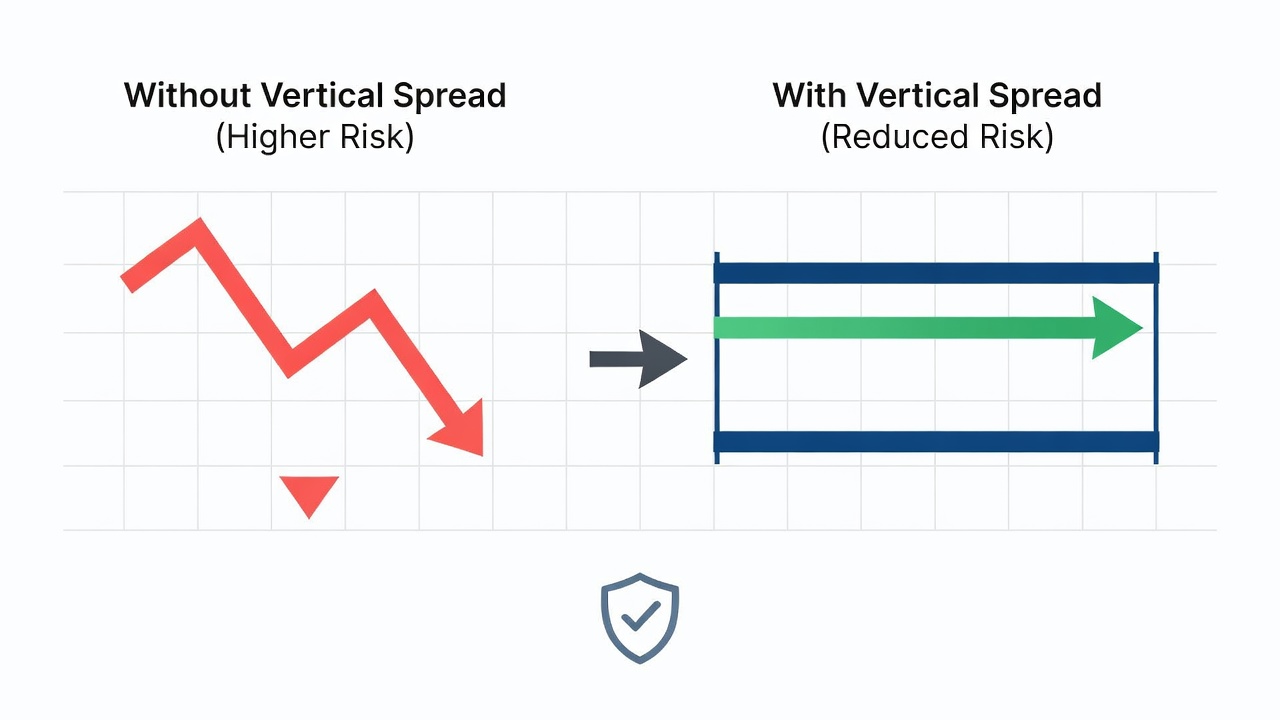
Why Single Options Can Be Brutal for Beginners
Earlier in this series, we covered how buying standard call and put options gives you clean directional exposure with unlimited upside potential.
However, single options suffer from two relentless enemies: high upfront costs and continuous extrinsic value loss, which we defined as theta decay back in Part 15.
If you buy a single call option and the underlying stock moves sideways for three weeks, you can easily lose half your money even if the stock never drops a single penny.
You are constantly racing against the expiration clock, requiring the stock to move fast enough and far enough just to break even on your entry price.
Vertical spreads soften this pressure by turning time decay into a partial ally, since the option you sell decays right alongside the option you buy.
Free For Traders
One Clear Arrow. Every High-Probability Setup. Free.
The Fusion Indicator combines multiple signals into a single buy/sell arrow on TradingView so you never miss a move.
 → Get The Free Fusion Indicator
How Vertical Spreads Clobber Option Costs and Risk
When you purchase a standard single option, you pay full retail price for every cent of extrinsic value built into that contract.
When you trade a vertical spread, selling that second contract offsets a major chunk of your total purchase price right away.
Imagine going to a hardware store to buy a high-end $100 ladder, but another customer pays you $40 on the spot for the right to use the top three rungs.
Your net cost out of pocket drops instantly from $100 down to just $60, meaning your financial break-even point on the transaction is far easier to reach.
Your absolute worst-case scenario is capped strictly at that $60 net cost, meaning no surprise earnings report or bad news can ever take more than what you paid to enter.

The Bull Call Spread: Step-by-Step Worked Example
Let’s walk through a realistic numerical example using a hypothetical stock named XYZ trading at $100 per share.
Suppose you are confident XYZ stock will rise toward $105 over the next 30 days, but you do not want to risk $4.00 per share ($400 total) for a single $100 call.
Instead, you construct a bull call spread by buying the $100 strike call for $4.00 and simultaneously selling the $105 strike call for $1.50.
Your net cost for this spread is $4.00 minus $1.50, which equals $2.50 per share, or $250 total out-of-pocket risk for one contract spread.
The width between your two strike prices is $5.00 ($105 minus $100), which represents the maximum theoretical value this spread can reach at expiration.
If XYZ trades at $105 or higher at expiration, the spread reaches its full $5.00 value, yielding a profit of $5.00 minus your $2.50 cost, or $250 net profit.
That is a 100% return on risk ($250 profit on $250 risked) on a modest 5% stock move, while the single call buyer needed XYZ above $104 just to break even.
The Bear Put Spread: Protecting Yourself in a Downturn
Vertical spreads work just as effectively when you expect a stock price to drop over a given time horizon.
Suppose XYZ stock is trading at $50 per share and you believe bad news will push it down toward $45 over the coming month.
Rather than buying a single $50 put for $3.00 ($300 total cost), you build a bear put spread to cut your outlay down substantially.
You buy the $50 put for $3.00 and sell the $45 put for $1.00, creating a net entry cost of exactly $2.00 ($200 total risk).
Because the difference between the $50 and $45 strikes is $5.00, your maximum payout at expiration if XYZ drops to $45 or lower is $5.00.
Subtracting your initial $2.00 cost leaves you with a maximum net profit of $3.00 ($300 total profit) while risking only $200 of total capital.
From Find Better Trades
Only Trade When Momentum Is HEAVILY In Your Favor
The Power Index oscillator measures trend conviction at a glance — it filters out weak, choppy action so you only take the strong moves.
 → See The Power Index
Comparing Single Options vs. Vertical Spreads
To really see why vertical spreads are standard practice among experienced traders, comparing them side-by-side makes the advantages obvious.
Single options give you unlimited theoretical profit potential, but they demand higher win rates and precise timing due to severe time decay.
Vertical spreads sacrifice that extreme tail-end profit potential in exchange for lower risk, higher probability of profit, and smaller capital requirements.
Here is how a standard single call option compares directly against a vertical bull call spread on a typical stock trade:
| Feature | Single Long Call | Bull Call Vertical Spread |
|---|---|---|
| Upfront Capital Required | High (Full Premium) | Low (Discounted Net Premium) |
| Maximum Risk | 100% of Premium Paid | Net Premium Paid Only |
| Maximum Profit Potential | Unlimited | Width of Strikes Minus Net Cost |
| Break-Even Price Target | Strike Price + Premium Paid | Lower Strike + Net Premium Paid |
| Impact of Theta (Time Decay) | Hurts the Trade Daily | Reduced / Partially Neutralized |
Notice how the break-even price for the vertical spread is significantly closer to the current stock price than the single call option.
This single structural difference turns trades that would have lost money as single options into profitable trades as vertical spreads.
How to Pick Your Strikes for Maximum Advantage
Choosing strike prices for vertical spreads boils down to setting realistic targets based on technical support and resistance levels.
For a bull call spread, I usually place my long strike near the current stock price and my short strike right at my realistic target resistance level.
There is zero benefit to choosing a short strike way above where you realistically expect the stock to go during the life of the option contract.
If you expect the stock to hit $105, selling the $105 strike collects immediate cash to lower your cost without sacrificing expected gains.
Always aim for spreads where the potential maximum payout offers at least a 1-to-1 reward-to-risk ratio relative to your total net capital spent.
Common Mistakes Beginners Make With Vertical Spreads
The most frequent error I see beginners make is placing short strikes way too far out of the money in an attempt to capture unlimited profit. Doing this yields almost no premium from the sold option, defeating the entire purpose of reducing risk and lowering your upfront entry cost.
Another common blunder is holding a winning vertical spread all the way to the final hour of expiration day to squeeze out the last $5 of profit. Closing your spread early at 80% or 90% of maximum profit frees up capital and eliminates unexpected late-day pin risk or assignment headaches.
Traders also get caught off guard by widening bid-ask spreads on illiquid option chains when trying to enter or exit multi-leg spread positions. Always use limit orders instead of market orders when trading vertical spreads so you never get filled at terrible prices.
Finally, beginners often forget that early assignment can happen on the short leg if a dividend date approaches or the option goes deep into the money. While assignment on a spread is easily managed by exercising your long option, it can cause panic if you do not understand how brokerages handle it.
Vertical Spreads FAQ: Real Questions From New Traders
Can I lose more money than I paid to open a vertical spread?
No, when you open a debit vertical spread, your maximum possible loss is strictly capped at the initial net debit amount you paid to enter the trade. No matter how wildly the stock moves against you, your broker cannot demand additional funds to cover the position.
What happens if the stock price ends up right between my two strike prices at expiration?
If the stock lands between your strikes, your long option will expire in the money and be exercised, while your short option expires completely worthless. Your broker will handle the automatic exercise, leaving you with stock shares or cash depending on whether you close or let it settle.
Do I need a special options trading approval level to trade vertical spreads?
Yes, most brokerages require Level 2 or Level 3 options approval to trade multi-leg spreads like vertical debit and credit spreads. You simply need to apply through your account settings and demonstrate basic knowledge of options strategies and risk parameters.
Should I close my vertical spread before expiration or let it expire naturally?
I almost always recommend closing vertical spreads a few days before expiration once you hit 75% to 90% of your maximum profit target. Taking profits early eliminates late volatility risks and prevents option exercise fees or assignment complications from your brokerage.
In Part 29, we are going to break down the exact differences between credit spreads and debit spreads so you know precisely when to collect cash upfront versus paying to enter a trade.
📈 Want More? Join Our Free Trading Community
- Trading Strategy Guides Telegram — daily strategy tips and market insights
- Find Better Trades Telegram — free trade signals delivered to your phone
- Find Better Trades on YouTube — live trade breakdowns and tutorials
Lesson 28 of 52 in the free Options Trading Course.
← Previous: Cash-Secured Puts Explained: Get Paid to Buy Stock
Next: Credit Spreads vs Debit Spreads: The Complete Beginner Guide →