Synthetic Long Stock: Replicate 100 Shares With Options

📚 Options Strategies, Step by Step — Part 18 of 30
- Part 1: The Bull Call Spread: A Cheaper Way to Bet on a Rise
- Part 2: The Bear Put Spread: Profiting From a Drop With Defined Risk
- Part 3: Bull Put Credit Spreads: Getting Paid to Be Right on Direction
- Part 4: Bear Call Credit Spreads: Selling Premium Above Resistance
- Part 5: Managing Credit Spreads: Closing Early at 50% Profit
- Part 6: The Iron Butterfly: When You Expect a Stock to Pin a Price
- Part 7: The Reverse Iron Condor: Profiting From a Breakout
- Part 8: Short Straddles and Strangles: The Risk Nobody Explains
- Part 9: Calendar Spreads: Trading Time Decay Between Two Expirations
- Part 10: Diagonal Spreads: A Calendar Spread With a Directional Lean
- Part 11: The Double Diagonal: Income From a Range With Room to Breathe
- Part 12: Butterfly Spreads: Cheap Trades Aimed at a Target Price
- Part 13: Broken Wing Butterflies: Taking the Risk Off One Side
- Part 14: Christmas Tree Spreads: A Directional Butterfly Variation
- Part 15: Front Ratio Spreads: Extra Premium, Extra Risk
- Part 16: The Put Ratio Backspread: Cheap Crash Protection
- Part 17: The Jade Lizard: Premium With No Upside Risk
- Part 18: Synthetic Long Stock: Owning the Move With Options (you are here)
⚡ Key Takeaways
- A synthetic long stock combines a long call and a short put at the same strike and expiration to mirror 100 shares of stock for little to no upfront cash.
- Your profit and loss profile behaves identically to owning shares dollar-for-dollar, which means your downside risk is just as severe.
- Always size the position based on the equivalent 100-share risk rather than the near-zero initial debit to prevent catastrophic leverage blowups.
— Ben, Find Better Trades
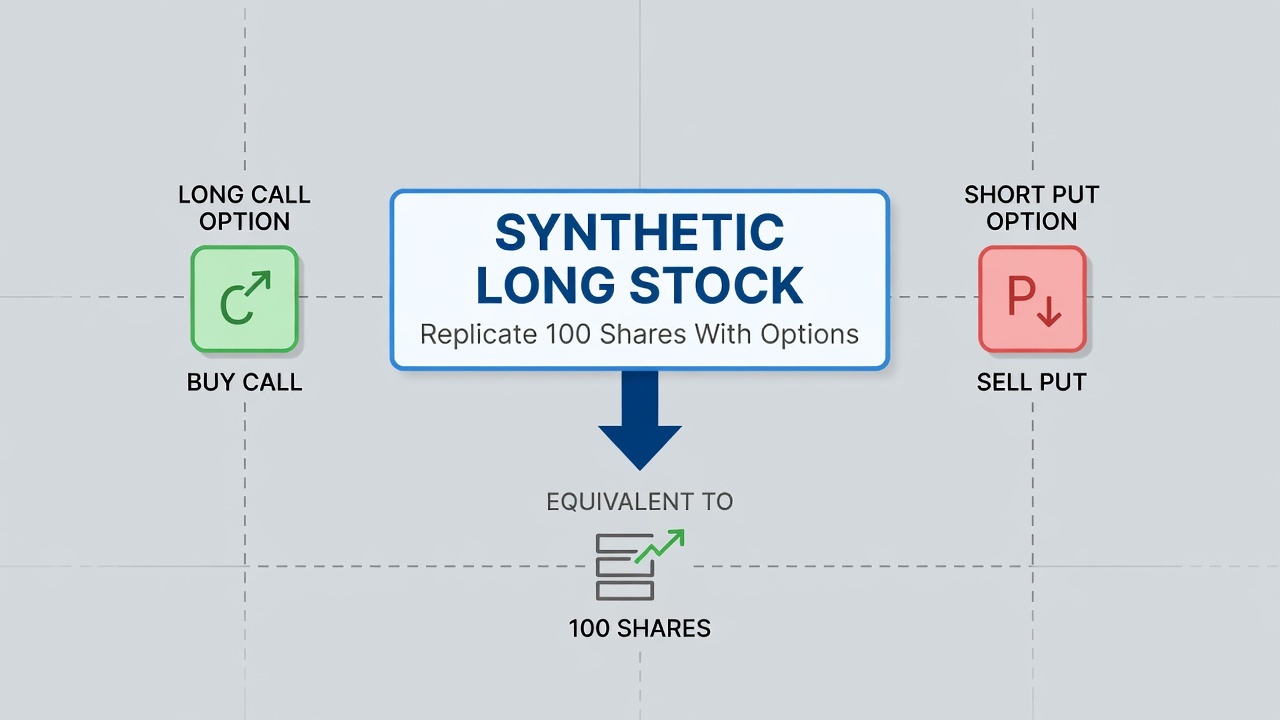
A synthetic long stock is an options strategy created by purchasing an at-the-money call and simultaneously selling an at-the-money put with identical strike prices and expiration dates. This combination mimics owning 100 shares of actual stock by establishing a position delta of approximately positive 1.00.
Welcome to Part 18 of our 30-part series, Options Strategies, Step by Step. Many retail traders get drawn into this trade because it looks like a free lunch where you can control an expensive stock for pocket change, but they fail to respect the real risks lurking beneath the surface.
What Is a Synthetic Long Stock?
A synthetic long stock is an options pairing that creates the exact same profit and loss behavior as owning 100 shares of common stock. You build it by buying one call option and selling one put option, using the exact same strike price and the same expiration cycle for both legs.
Because an at-the-money call has a delta of roughly +0.50 and an at-the-money put has a delta of roughly -0.50, selling that put reverses its sign to +0.50. When you combine them, your total position delta becomes +1.00, which moves identically to 100 shares of the underlying equity.
If the stock climbs by two dollars, your options position gains approximately two hundred dollars. If the underlying drops by two dollars, your position loses two hundred dollars.
I like to think of this setup like signing a contract to buy a house in six months at today's agreed market price. You get all the upside appreciation starting immediately, but you also bear every cent of property value decline.
Unlike simple directional plays like the bull call spread we covered earlier in the series, this trade has no upside cap and no built-in floor. You are exposed to the raw, unfiltered movement of the equity market.
The Real-World Mechanics: How Put-Call Parity Works
The synthetic long stock exists because of a core financial rule known as put-call parity. Put-call parity dictates that the price of a call option and a put option at the same strike must maintain a mathematically balanced relationship with the underlying share price.
Think of it like a playground seesaw with cash and stock on one seat, and calls and puts on the other. If one side shifts in price without the other matching it, professional arbitrageurs immediately trade the difference until equilibrium returns.
Because of this balance, buying a call and selling an offsetting put with identical parameters cancels out the extrinsic time value of both contracts. What you are left with is pure intrinsic tracking of the underlying asset.
When implied volatility spikes or collapses, the impact on this position is practically negligible. The long call gains from rising volatility at the exact same rate the short put loses value, meaning Vega remains near zero throughout the trade.
Theta decay is also essentially neutral at inception. Time decay erodes your long call, but you collect time decay at the identical rate on your short put contract.
Synthetic Long Stock vs Buying Shares Directly
The primary attraction of a synthetic long stock over buying direct shares is capital efficiency. Buying 100 shares of a $200 stock requires $20,000 in cash, or $10,000 in a standard margin account.
With a synthetic long, the call you purchase is largely funded by the put you sell. Your net upfront cash cost to enter the position is often near zero, requiring only the margin collateral set by your broker to secure the naked short put.
| Feature | Direct Stock Ownership | Synthetic Long Stock |
|---|---|---|
| Upfront Capital | Full share cost (100%) | Near zero net debit/credit |
| Downside Exposure | All the way to $0 | All the way to $0 |
| Dividend Rights | Yes, 100% of dividends paid | No dividends received |
| Voting Rights | Yes | No |
| Holding Duration | Indefinite | Tied to contract expiration |
However, there are trade-offs you cannot ignore. Synthetic shareholders do not collect quarterly dividends, nor do they get voting proxy cards in the mail.
Furthermore, actual shares never expire, allowing you to ride out multi-year drawdowns if you choose. Synthetic options positions always carry a ticking clock that forces a decision at expiration.

A Step-by-Step Numeric Example With Stock at $100
Let us walk through a concrete example so you can see the math in action. Suppose company XYZ is trading at exactly $100 per share, and you want to participate in a rally over the next 60 days.
You buy the 60-day expiration $100 call for $4.20, and simultaneously sell the 60-day expiration $100 put for $4.10. Your net outlay to enter the trade is a tiny $0.10 debit, which comes out to $10 total across the 100-share contract multiplier.
Now let us look at what happens at expiration across various stock prices to see how your balance sheet performs.
| XYZ Stock Price at Expiration | Long $100 Call Value | Short $100 Put Value | Net Trade Profit / Loss |
|---|---|---|---|
| $120.00 | +$20.00 ($2,000) | $0.00 | +$1,990 profit |
| $110.00 | +$10.00 ($1,000) | $0.00 | +$990 profit |
| $100.10 (Breakeven) | +$0.10 ($10) | $0.00 | $0.00 flat |
| $90.00 | $0.00 | -$10.00 (-$1,000) | -$1,010 loss |
| $80.00 | $0.00 | -$20.00 (-$2,000) | -$2,010 loss |
Notice how every single point above $100 produces an extra $100 in profit, minus the tiny $10 initial entry debit. Conversely, every point the stock drops below the $100 line costs you $100 out of your account balance.
Had you spent $10,000 buying 100 actual shares at $100, your dollar return at each milestone would be virtually identical. The difference is simply where your capital was parked during the life of the trade.
Capital Efficiency and Sizing: The Hidden Leverage Risk
Because entering a synthetic long costs almost nothing out of pocket, beginners routinely fall into the deadly trap of overleveraging. When a trader with a $20,000 account sees that a synthetic position costs only $20 in commissions and debits, they are tempted to open 10 or 20 contracts.
Opening 10 synthetic contracts does not mean you have a small trade; it means you are now holding the equivalent risk of 1,000 physical shares. On a $100 stock, you are controlling $100,000 worth of underlying equity on a $20,000 account balance.
If that stock drops 15% on bad news, a direct 100-share holder loses $1,500. But the overleveraged 10-contract synthetic trader loses $15,000, wiping out 75% of their total net worth in one afternoon.
Your brokerage firm will hold a margin requirement for the short put leg, typically around 20% of the underlying stock value plus the option premium minus out-of-the-money amounts. If the stock plunges, that margin requirement balloons quickly, triggering forced margin calls if your cash reserves are thin.
Here is my unbreakable sizing rule: never open more synthetic contracts than the number of 100-share blocks you could comfortably afford to own directly in cash. If your account plan only allows for a 100-share purchase, you trade exactly one synthetic contract.
From Find Better Trades
Consistent Income. Any Market Direction.
A low-risk debit spread every Thursday, built to make steady returns whether the market runs up, down, or sideways.
 → See Layered Options

When Should You Use a Synthetic Long Stock?
You should consider a synthetic long stock when you have a high-conviction, long-term bullish bias on a company but want to keep your liquid cash available for other investments. It serves as an aggressive capital-allocation tool rather than a quick speculative flip.
Many seasoned traders run this setup using LEAPS, which are options contracts with expirations twelve months to two years out. By picking an expiration eighteen months out, you give your directional thesis ample time to unfold without dealing with weekly expiration noise.
Consider an example where stock ABC trades at $50 per share. You can buy the January 2026 $50 call for $7.80 and sell the January 2026 $50 put for $6.90, entering the position for a net debit of $0.90, or $90 total.
You are now controlling $5,000 worth of stock ABC through 2026 for less than $100 in cash outlay, plus the broker's required margin cushion. The rest of your cash can sit in high-yielding short-term Treasury bills, earning safe interest while your synthetic long participates in the equity run.
However, you should avoid synthetic long positions on high-dividend paying stocks. Because market makers price dividends into options premiums, you lose the economic benefit of cash dividends while still taking on full share-price drops when the stock trades ex-dividend.
How to Manage and Exit a Synthetic Long Position
Managing a synthetic long position requires disciplined exit rules, because losses accumulate just as relentlessly as they do with ordinary stock. You must treat your short put leg with extreme vigilance as expiration approaches.
I recommend setting a hard stop-loss based on the underlying stock chart just as if you owned the actual shares. If the underlying breaks below your predetermined technical support level, close both options legs simultaneously in a single order ticket.
Never leave the short put leg open by closing only the long call when a trade moves against you. Doing that leaves you holding an uncovered, naked put with zero upside protection, turning a bad trade into an outright disaster.
When taking profits, you can close both legs for a net credit whenever your upside price target is reached. Alternatively, if expiration is near and the stock is well above your strike, you can exercise the long call to take delivery of actual shares, while the short put simply expires worthless.
If you want to maintain the trade into the next cycle, you can roll the entire structure forward. You buy back your short put, sell your long call to harvest profit or salvage value, and open a brand new synthetic pair further out in time.
Common Mistakes Beginners Make With This
The single most destructive mistake is sizing by initial debit instead of underlying stock exposure. A trader enters five synthetic contracts because it costs only $50, completely failing to recognize they just exposed their portfolio to the risk of 500 underlying shares.
Another common mistake is holding an in-the-money short put through expiration without the capital to take stock assignment. If the stock drops below your strike and you do not close the position before Friday afternoon, you will wake up Saturday morning forced to buy 100 shares per contract at the strike price.
Beginners also frequently trade synthetic long positions on stocks with heavy dividend yields. The underlying stock drops by the exact dividend amount on every ex-dividend date, and since options holders do not receive dividend checks, you bleed capital through artificial price drops you never recover.
Finally, traders often panic and leg out of the trade during a market downturn by selling their call at a loss while leaving the short put untouched. This exposes them to massive, unbounded downside on a naked put contract during a falling market.
Synthetic Long Stock FAQ
Does a synthetic long stock require a margin account?
Yes, you must have a margin-approved options account to trade a synthetic long stock. Because the strategy involves selling a short put option that is not covered by cash or a lower strike put, your broker will classify it as a naked or cash-secured position requiring strict collateral reserves.
What happens if the stock price drops to zero?
If the underlying company goes bankrupt and its stock drops to zero, your long call will expire worthless and you will be forced to buy worthless shares at your put strike price. On a $100 strike synthetic position, your total loss would be $10,000 per contract, exactly identical to having owned 100 shares directly.
Can I trade a synthetic long stock in an IRA retirement account?
You can trade this strategy in an IRA account only if your broker allows cash-secured puts. In a retirement account, you must hold 100% of the cash required to purchase the underlying shares at the put strike, which removes much of the leverage and capital efficiency advantages.
How does a synthetic long differ from a risk reversal?
While both strategies use a long call and a short put, a synthetic long uses the exact same strike price for both legs to mimic 100 deltas of stock. A risk reversal uses different strikes, typically buying an out-of-the-money call and selling an out-of-the-money put to fund it, creating an asymmetric payoff zone between the two strikes.
Next up, we will break down how to offset long-side costs using that exact out-of-the-money technique in our guide to Risk Reversals: A Directional Trade Funded by the Other Side.
📈 Want More? Join Our Free Trading Community
- Trading Strategy Guides Telegram — daily strategy tips and market insights
- Find Better Trades Telegram — free trade signals delivered to your phone
- Find Better Trades on YouTube — live trade breakdowns and tutorials
Lesson 75 of 75 in the free Options Trading Course.
← Previous: Jade Lizard Options Strategy: Complete Step-by-Step GuideYou have reached the latest lesson. New lessons are added every week.