Front Ratio Spreads: How to Trade Call and Put Ratios

📚 Options Strategies, Step by Step — Part 15 of 30
- Part 1: The Bull Call Spread: A Cheaper Way to Bet on a Rise
- Part 2: The Bear Put Spread: Profiting From a Drop With Defined Risk
- Part 3: Bull Put Credit Spreads: Getting Paid to Be Right on Direction
- Part 4: Bear Call Credit Spreads: Selling Premium Above Resistance
- Part 5: Managing Credit Spreads: Closing Early at 50% Profit
- Part 6: The Iron Butterfly: When You Expect a Stock to Pin a Price
- Part 7: The Reverse Iron Condor: Profiting From a Breakout
- Part 8: Short Straddles and Strangles: The Risk Nobody Explains
- Part 9: Calendar Spreads: Trading Time Decay Between Two Expirations
- Part 10: Diagonal Spreads: A Calendar Spread With a Directional Lean
- Part 11: The Double Diagonal: Income From a Range With Room to Breathe
- Part 12: Butterfly Spreads: Cheap Trades Aimed at a Target Price
- Part 13: Broken Wing Butterflies: Taking the Risk Off One Side
- Part 14: Christmas Tree Spreads: A Directional Butterfly Variation
- Part 15: Front Ratio Spreads: Extra Premium, Extra Risk (you are here)
⚡ Key Takeaways
- A front ratio spread involves buying a set number of options and selling a larger number of further out-of-the-money options of the same expiration.
- Traders enter front ratio spreads for a net credit or small debit to target a modest move without paying full price for long options.
- The extra short contract leaves one side of the trade with naked, undefined risk that requires strict stop-loss rules.
— Ben, Find Better Trades
A front ratio spread is an options strategy where you buy one closer-to-the-money option and sell two or more further out-of-the-money options of the exact same type and expiration date. Most traders enter this trade to finance a directional play so cheaply that they can even collect a net credit up front.
Welcome to Part 15 of our 30-part series, Options Strategies, Step by Step. Today we are looking at a structure that seduces beginners because it often looks like a completely free bet on paper.
The catch is simple: the moment the stock blows past your short strike, that extra short contract turns into a naked position. Let us walk through how this structure works, how the numbers shake out, and how to stay safe if you choose to run it.
What Is a Front Ratio Spread in Options Trading?
A front ratio spread is an options trade constructed by buying one option at an inner strike price and selling multiple options at an outer strike price in the same expiration cycle. The term front indicates that you are net short more front-month options than you own long, typically using a 1×2 ratio.
Think of it like buying a ticket to a concert, but promising to host two people at your house afterward to cover the cost of your ticket. If nobody shows up or only a few drop by, you got your ticket paid for without hassle.
If a massive crowd turns up at your front door, your modest savings get wiped out by the chaos. That is precisely how selling extra contracts works in the market.
In Part 1 and Part 2, we covered standard debit vertical spreads where you buy one strike and sell one strike. A front ratio spread breaks that 1:1 symmetry by selling an extra contract to bring in more cash.
That extra premium can eliminate the cost of the trade entirely or produce a net credit right into your cash balance. However, that second short option remains completely uncovered by the single long option you bought.
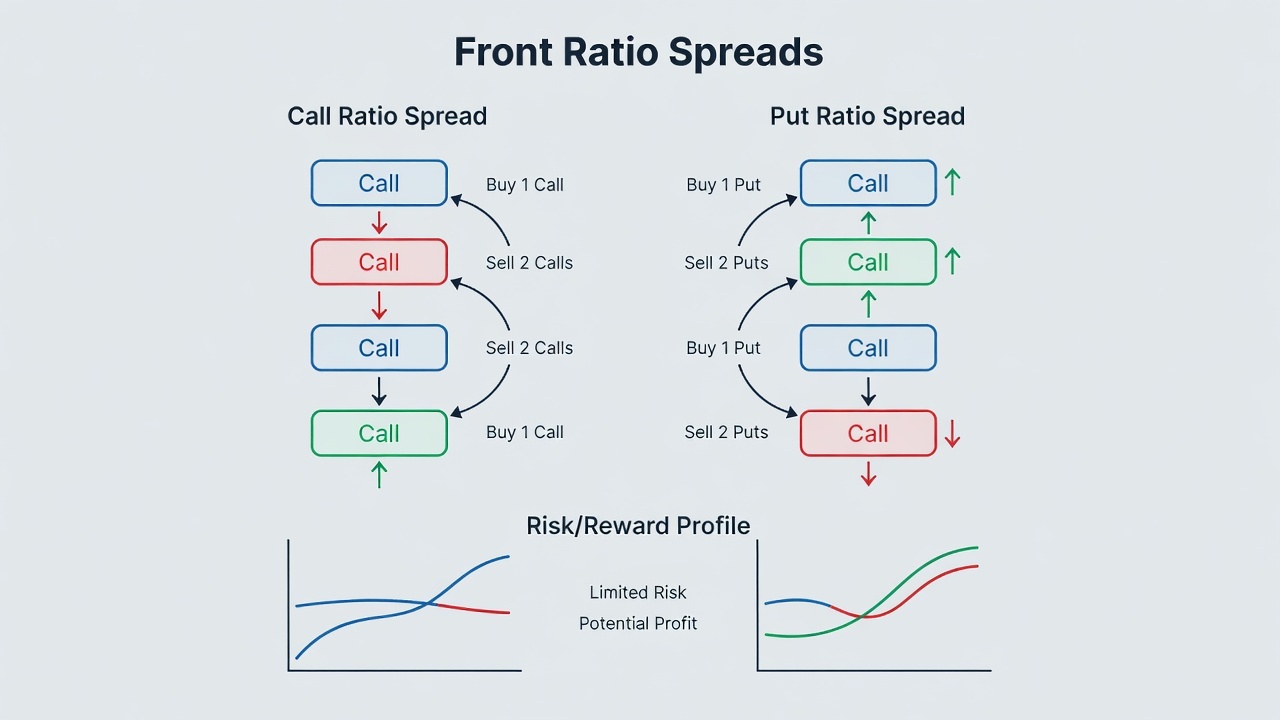
How a Call Front Ratio Spread Works Step by Step
A call front ratio spread combines one long call at a lower strike with two short calls at a higher strike price within the same expiration month. Traders set up this trade when they expect a stock to climb gently toward the higher strike, but not launch into the stratosphere.
Let us say stock XYZ is trading at $100 per share. You buy one $100 call for $4.00 and you sell two $105 calls for $2.20 each.
You pay $4.00 for the long call and you collect $4.40 total for selling the two out-of-the-money calls. That gives you an immediate net credit of $0.40, which equals $40 in cash per 1×2 spread.
If the stock sits dead flat at $100 at expiration, all options expire worthless. You keep the $40 net credit as pure profit without having been right on the direction.
If the stock climbs to exactly $105 at expiration, your $100 long call is worth $5.00 while both $105 short calls expire worthless. You make the full $5.00 width of the spread plus your initial $0.40 credit, yielding your maximum possible profit of $5.40, or $540 per unit.
| Stock Price at Expiration | Long $100 Call Value | Two Short $105 Calls Value | Net Profit / Loss ($0.40 Credit) |
|---|---|---|---|
| $95.00 | $0.00 | $0.00 | +$40.00 |
| $100.00 | $0.00 | $0.00 | +$40.00 |
| $105.00 | +$5.00 | $0.00 | +$540.00 (Max Profit) |
| $110.40 | +$10.40 | -$10.80 | $0.00 (Upper Breakeven) |
| $115.00 | +$15.00 | -$20.00 | -$460.00 (Loss Expands) |
The Naked Risk Hiding Inside a Front Ratio
The danger of a front ratio spread lies entirely in the uncovered short contract. When you buy one call and sell two calls, you have effectively built two separate positions: one standard bull call spread and one completely naked short call.
If the stock rips upward through resistance, the bull call spread reaches its maximum gain and simply stops making money. Meanwhile, that naked short call begins losing money at a rate of 100 deltas for every point the stock climbs.
To calculate your upper breakeven on a call ratio, take the higher short strike, add the width between the strikes, and add any initial net credit received. In our XYZ example, that formula is $105 plus $5.00 plus $0.40, setting our upper breakeven at $110.40.
Every dollar XYZ trades above $110.40 at expiration is a pure $100 loss per contract with no ceiling. If XYZ gets acquired overnight for $130, you face a loss of almost $2,000 against a trade you entered for a tiny $40 credit.
This asymmetrical payoff is why professional traders treat ratio spreads with the same caution as naked short options. You must never look at the credit collected and assume you are playing with house money.

How a Put Front Ratio Spread Works
A put front ratio spread is created by purchasing one put option at a higher strike price and selling two put options at a lower strike price with the same expiration. Traders use this structure when they have a mild bearish or neutral outlook and want to profit from sideways action or a gentle decline.
Let us say stock ABC is trading at $50 per share. You believe the stock might drift down toward support at $45, but you do not anticipate a collapse.
You buy one $48 put for $2.50 and you sell two $44 puts for $1.40 each. By selling two puts, you pull in $2.80 in total credit against your $2.50 purchase cost.
This generates an initial net credit of $0.30, or $30 cash deposited into your brokerage account. If ABC stays above $48 until expiration, all puts expire worthless and you walk away with the $30 credit.
If ABC falls precisely to $44 at expiration, your $48 put is worth $4.00 in intrinsic value while both $44 puts expire with zero value. Your total profit hits its peak at $4.30 ($430 per spread), combining the spread width and the net credit.
However, if ABC drops below your lower breakeven of $39.70 ($44 short strike minus $4.00 spread width minus $0.30 credit), losses begin to mount dollar-for-dollar. Unlike calls, put downside is technically capped at zero, but a drop to zero on a stock you are short naked puts on can still wipe out an account.
Volatility and the Greeks in Ratio Spreads
Front ratio spreads carry a distinctive relationship with implied volatility that differs from simple debit or credit spreads. Because you are net short more options than you own, your net position has negative vega.
Negative vega means that rising implied volatility hurts the value of your position, while falling implied volatility helps it. If earnings are around the corner and implied volatility spikes, your two short options will inflate in price faster than your single long option gains value.
Theta decay works in your favor as long as the underlying stock stays away from the danger zone beyond your short strikes. Because you sold two options and only bought one, time decay erodes the short contracts twice as fast, expanding your profit margin each day the stock idles.
Delta behavior in a ratio spread shifts dynamically based on price movement. Near the long strike, your position carries positive delta on a call ratio, meaning you want the stock to climb.
As the stock pushes past your short strike, your net delta flips negative because the second short call takes control of the position. Managing that flipping delta requires real-time vigilance so you do not wake up with an aggressively short position during an unexpected breakout.
From Find Better Trades
Consistent Income. Any Market Direction.
A low-risk debit spread every Thursday, built to make steady returns whether the market runs up, down, or sideways.
 → See Layered Options

When Should You Use a Front Ratio Spread?
Front ratio spreads belong in your playbook only during specific market conditions where you expect quiet consolidation near a distinct technical barrier. You want to place your short strikes right at heavy support or resistance levels where the stock is unlikely to run away.
I look for environments where implied volatility is relatively elevated, allowing me to collect a rich credit on the out-of-the-money short options. Entering when implied volatility is high gives you the dual tailwinds of time decay and volatility contraction.
Never trade a call front ratio spread immediately ahead of binary corporate events like earnings announcements or FDA trial readouts. A blowout earnings beat can gap the stock 20% past your short strikes before you can even open your trading app.
Similarly, avoid put ratio spreads on highly leveraged companies or speculative small caps prone to sudden bankruptcies. You want stable, large-cap stocks or index products that have established historical trading ranges.
If you cannot comfortably state where your trade becomes unacceptably dangerous before clicking the submit button, you have no business entering a ratio spread. The margin requirements for this trade are substantial because brokers recognize the naked risk involved.
Rules for Managing and Exiting Ratio Spreads
Managing front ratio spreads requires predefined rules that take emotion out of the equation. Because of the open-ended risk profile, hoping for a turnaround after your short strike is breached is a recipe for disaster.
When I trade ratio spreads, my primary goal is capturing between 50% and 75% of the distance between the strikes when the stock moves toward the peak. If the trade generates a rapid profit from time decay, I take the money and move on rather than squeezing out the last dime.
My stop-loss rule is ironclad: I close or adjust the entire position if the underlying stock price touches my short strike. You do not wait for the stock to hit your mathematical breakeven point; touching the short strike is your warning that the thesis has failed.
If you want to stay in the trade when tested, you can buy an additional cheap out-of-the-money option to convert the naked short into a broken wing butterfly, which we covered in Part 13. That adjustment caps your maximum loss immediately and turns an open-ended catastrophe into a defined-risk trade.
Never allow a tested ratio spread to go into expiration weekend. Early assignment risk on the short option can force you into short or long stock positions that require massive capital to maintain.
Common Mistakes Beginners Make With This
The single most dangerous error beginners make is treating front ratio spreads as free lottery tickets simply because they were entered for a net credit. They assume that since the trade cost nothing up front, they cannot get badly hurt if the stock moves. When a breakout occurs, the naked short option produces massive losses that completely dwarf the tiny original credit.
Another common mistake is sizing the ratio spread based on the margin required at entry rather than the potential loss. Margin requirements can expand violently if implied volatility explodes or if the stock runs directly toward your short strikes. Traders who open ten spreads because their initial buying power allows it often face catastrophic margin calls when the position goes against them.
Beginners also routinely hold ratio spreads through major earnings reports to capture the elevated credit. While the implied volatility crush can feel like easy money, any unexpected post-earnings gap past the short strikes will ruin the trade before market open. Entering ratio spreads right before unpredictable catalysts is simply reckless gambling.
Finally, new traders often freeze and fail to exit when the underlying asset breaches the short strike. They wait around hoping the stock reverses back into their profit tent, turning a manageable loss into an account-threatening disaster. If your short strike gets tested, the trade is done; close it out or buy insurance to cap the risk immediately.
Front Ratio Spread Frequently Asked Questions
What is the difference between a front ratio spread and a backspread?
In a front ratio spread, you sell more options than you buy, leaving you with net short exposure and undefined risk outside your profit zone. In a backspread, you buy more options than you sell, creating a trade with defined risk and unlimited profit potential if the stock makes a massive move.
Can I trade a front ratio spread in an IRA account?
Most brokerage firms do not permit traditional front ratio spreads in retirement accounts because of the naked short option leg. To run a similar concept in an IRA, you must purchase an extra deep out-of-the-money option to cap the naked risk, turning the position into a broken wing butterfly spread.
Why would I choose a front ratio spread instead of a regular credit spread?
A front ratio spread allows you to participate in a directional move toward a specific target with the potential for a much higher peak payout than a simple credit spread. It also lets you build a trade that profits if the stock stays flat, drifts slightly, or hits your target price exactly.
What happens if the stock pins right at my short strike at expiration?
If the stock settles exactly at your short strike price at expiration, you achieve the absolute maximum profit possible on the trade. Your long option reaches its maximum value across the spread width, and both of your short options expire worthless with zero assignment liability.
Next up in Part 16, we flip the script completely: I will show you how to use the put ratio backspread to buy dirt-cheap crash protection that pays off handsomely when the market falls out of bed.
📈 Want More? Join Our Free Trading Community
- Trading Strategy Guides Telegram — daily strategy tips and market insights
- Find Better Trades Telegram — free trade signals delivered to your phone
- Find Better Trades on YouTube — live trade breakdowns and tutorials
Lesson 71 of 75 in the free Options Trading Course.
← Previous: NVDA Just Broke Its 52-Week Low. Options Are Paying Up for Fear.
Next: Put Ratio Backspread: How to Trade Cheap Crash Protection →