Iron Butterfly Option Strategy: How to Profit When Stocks Pin


📚 Options Strategies, Step by Step — Part 6 of 30
- Part 1: The Bull Call Spread: A Cheaper Way to Bet on a Rise
- Part 2: The Bear Put Spread: Profiting From a Drop With Defined Risk
- Part 3: Bull Put Credit Spreads: Getting Paid to Be Right on Direction
- Part 4: Bear Call Credit Spreads: Selling Premium Above Resistance
- Part 5: Managing Credit Spreads: Closing Early at 50% Profit
- Part 6: The Iron Butterfly: When You Expect a Stock to Pin a Price (you are here)
⚡ Key Takeaways
- An iron butterfly is a defined-risk neutral trade that collects maximum credit by selling an at-the-money call and put while buying protective wings.
- The trade reaches maximum profitability when the underlying stock closes exactly on your center strike at expiration.
- Closing the position early when capturing 25% to 40% of the total credit collected keeps you from sweating the harsh expiration-week gamma risk.
— Ben, Find Better Trades
An iron butterfly is a four-legged options trade built to collect a substantial cash credit when you predict a stock will stall out and pin a specific price point before expiration. It combines an at-the-money bear call spread and an at-the-money bull put spread to give you defined risk with a massive target payout.
The tool I use for this: Gravity Zone Indicator. Gravity Zone detects hidden institutional accumulation on TradingView — so you’re in the breakout while retail is still waiting for confirmation. See Gravity Zone In Action →
Welcome to Part 6 of our options strategies series. Beginners often find neutral trading intimidating because guessing an exact stock price sounds impossible, but this structure gives you a defined safety corridor that pays you handsomely for sideways price action.
What is an Iron Butterfly spread?
An iron butterfly is a neutral options setup designed to extract income from a stock that refuses to move. When you place an iron butterfly, you sell two options right at the current stock price and buy two protective options further away on each side.
Think of it like setting up a camping tent on a windy ridge. Your center pole sits directly on the current stock price, holding up the roof where maximum profit lives, while your guide ropes are pegged down wide on both sides to cap your disaster losses.
We covered bull put spreads in Part 3 and bear call spreads in Part 4. An iron butterfly simply stitches those two credit setups together at the very same middle strike price.
Because both sold contracts sit right at the money, buyers pay top dollar for them. That gives you a much larger upfront credit than almost any other defined-risk options structure available.
If the stock stays pinned directly at your center strike through expiration, all extrinsic value decays into thin air. You walk away keeping the entire upfront payment as pure profit.
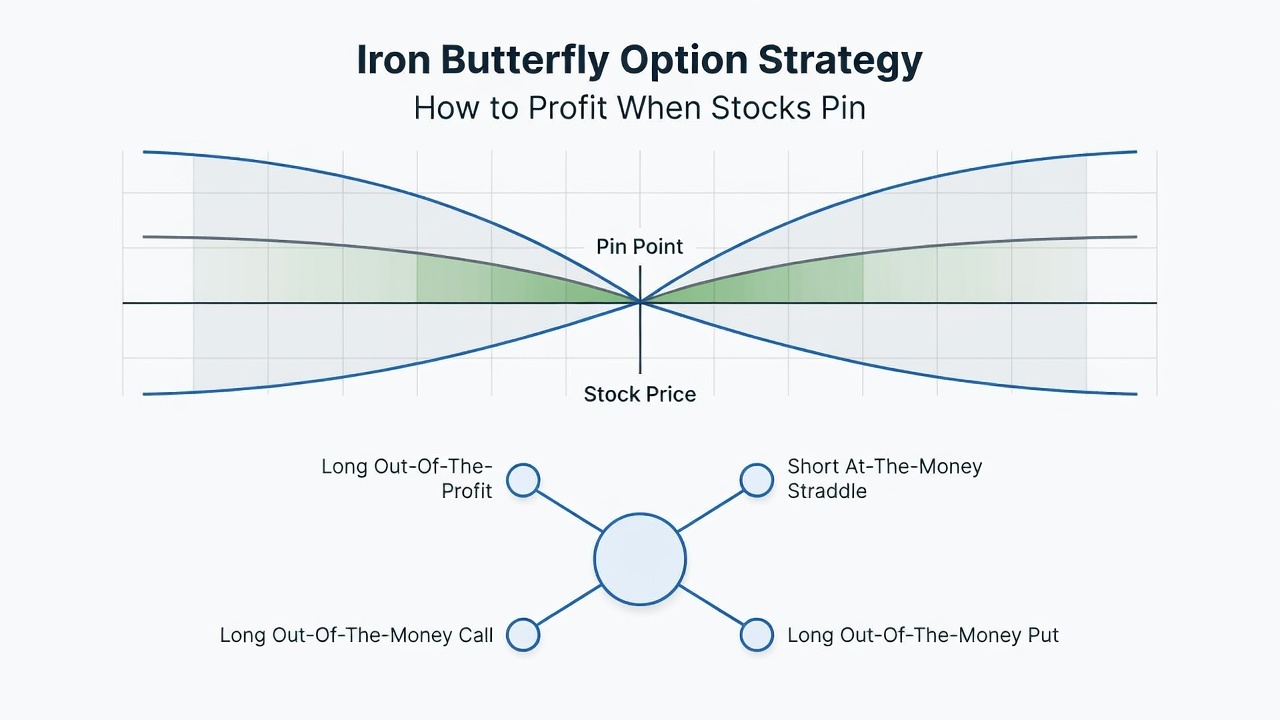
How the four legs create a peak profit zone
An iron butterfly relies on four distinct contracts sharing the exact same expiration cycle. You sell one at-the-money call and sell one at-the-money put right where the stock trades right now.
To protect yourself against runaway moves, you buy one out-of-the-money call higher up and buy one out-of-the-money put lower down. Those outer purchased contracts are known across trading desks as the wings.
The two sold options generate the thick credit that lands in your account balance on day one. Meanwhile, the purchased wings eat a fraction of that cash back up, acting as an absolute ceiling on your financial risk.
Your profit graph does not look like a flat tabletop; it looks like a steep pyramid. The very peak of that pyramid sits directly on the center strike price where you sold both short contracts.
As the stock drifts away from that exact center price in either direction, your profit drops rapidly. If the move continues past your outer wings, your loss hits a hard stop and cannot grow a single penny worse.
Worked example: setting up an Iron Butterfly on a $100 stock
Let us say shares of hypothetical company XYZ trade right at $100 per share. You look at the chart, notice heavy moving average congestion, and expect the stock to pin around $100 over the next month.
To build the trade, you sell the $100 put and sell the $100 call. For protection, you simultaneously buy the $95 put below and buy the $105 call above.
Suppose selling the $100 call brings in $3.00, and selling the $100 put brings in $3.00. That gives you an initial credit collection of $6.00 per share before buying insurance.
Next, you purchase the $105 call for $1.00 and purchase the $95 put for $1.00. That insurance costs you $2.00 total, leaving you with a net cash credit of $4.00, or $400 for one full contract setup.
| Option Leg | Strike Price | Action | Premium |
|---|---|---|---|
| Long Put Wing | $95.00 | Buy to Open | -$1.00 |
| Short Put Body | $100.00 | Sell to Open | +$3.00 |
| Short Call Body | $100.00 | Sell to Open | +$3.00 |
| Long Call Wing | $105.00 | Buy to Open | -$1.00 |
Your wing width is $5.00 wide on both sides. To figure out your absolute maximum risk, subtract your $4.00 net credit from that $5.00 spread width, which leaves just $1.00 per share, or $100.
Think about that balance: you risk $100 to potentially make $400. That exceptional reward-to-risk ratio is the reason seasoned traders love this setup when a stock goes to sleep.

Iron Butterfly vs Iron Condor: what is the difference?
An iron butterfly and an iron condor share the exact same genetic code, but their short strikes sit in completely different places. An iron butterfly sells its short call and short put at the identical middle strike price.
An iron condor splits those short strikes apart, selling an out-of-the-money call and an out-of-the-money put. That separation creates a wide, flat profit zone where the stock can drift freely between both strikes without costing you money.
| Feature | Iron Butterfly | Iron Condor |
|---|---|---|
| Short Strikes | Shared at-the-money strike | Separated out-of-the-money strikes |
| Credit Received | Very Large (30% to 50% of width) | Moderate (15% to 25% of width) |
| Profit Peak | Single sharp price point | Broad flat channel |
| Win Probability | Lower probability of max profit | Higher probability of max profit |
Because the iron condor gives the stock plenty of room to wander, buyers pay far less premium for those distant strikes. As a result, your upfront credit on an iron condor is substantially smaller.
The iron butterfly demands pinpoint accuracy in exchange for its fat payout. You sacrifice margin for error to secure an asymmetric reward profile where your upside potential easily dwarfs your total dollar risk.
When I expect a stock to wander aimlessly within a broad channel, I pick the condor. When I see clear evidence that a stock will violently stall on a round number, I deploy the butterfly.
How to pick the right strike width and expiration date
Choosing your expiration window requires balancing rapid time decay against dangerous directional sensitivity. When you sell at-the-money contracts, rapid price spikes can damage your trade quickly if you run too close to expiration.
I target expirations between 30 and 45 days out from today. This window allows time decay to accelerate aggressively while giving you enough runway to manage the position if the stock wanders early.
Entering weekly expirations with under seven days left is tempting due to blistering decay, but it turns into a gambling trap. In that final week, even tiny stock fluctuations create massive swings in contract values that can wipe you out.
For strike widths, your wings should reflect both the stock’s absolute share price and its average daily move. On stocks priced under $100, five-dollar wide wings generally offer a great blend of credit collection and modest capital outlay.
For shares trading well above $200, you will often need ten-dollar wide wings to pull in meaningful cash. Make sure the net credit you collect equals at least one-third the distance between your strikes before entering.
From Find Better Trades
Consistent Income. Any Market Direction.
A low-risk debit spread every Thursday, built to make steady returns whether the market runs up, down, or sideways.
 → See Layered Options

Second worked example: calculating maximum risk, breakevens, and early exits
Let us walk through another practical setup using a higher-priced stock to cement your math skills. Imagine stock ABC is pinned right at $200 per share, and you enter a 35-day iron butterfly with ten-dollar wide wings.
You sell the $200 call and sell the $200 put simultaneously. You buy the $210 call above and buy the $190 put below to frame your boundaries.
Let us say the trade fills for a net credit of $6.50, depositing $650 straight into your brokerage account. Calculating your breakeven levels requires adding and subtracting that credit from your center anchor strike.
Your upper breakeven point sits at $206.50 ($200 center strike plus $6.50 credit). Your lower breakeven point lands down at $193.50 ($200 center strike minus $6.50 credit).
| Trade Metric | Calculation Formula | Dollar Value |
|---|---|---|
| Net Credit (Max Profit) | Sold Premium Minus Bought Premium | +$650.00 |
| Max Capital Loss | Wing Width ($10.00) Minus Credit ($6.50) | -$350.00 |
| Upper Breakeven Level | Center Strike ($200) + Credit ($6.50) | $206.50 |
| Lower Breakeven Level | Center Strike ($200) – Credit ($6.50) | $193.50 |
We covered closing credit spreads early in Part 5, and the exact same philosophy applies here. Never hold an iron butterfly all the way into expiration day chasing that theoretical $650 perfection.
Instead, enter a resting buy-to-close order immediately after getting filled, aiming to buy back the entire bundle when you capture 30% of that initial credit. On this $650 credit, buying it back for $455 locks in a tidy $195 gain without exposing your capital to zero-day volatility.
When you should avoid trading the Iron Butterfly
The iron butterfly thrives on stagnant markets, which means running it ahead of explosive news catalysts is financial suicide. Never sell an iron butterfly right before an earnings announcement or major regulatory decision.
Those binary events routinely trigger double-digit percentage gaps overnight. A gap immediately blasts past your outer wings, shoving your trade into its maximum loss before the market opening bell even rings.
You should also avoid running an iron butterfly on low-volume, illiquid ticker symbols. Because you are managing four separate options contracts at once, wide bid-ask spreads will chew up your edge during fills.
Steer clear of momentum stocks breaking out of multi-month resistance levels to fresh all-time highs. When institutional buying floods an asset, stocks do not pin strike prices; they trend aggressively and run right through your defenses.
Save the iron butterfly for mature, heavy-volume stocks or index products that are trading near established technical ranges. Look for consolidation, dropping implied volatility, and obvious support-resistance clustering.
Common Mistakes Beginners Make With This
The single most destructive mistake is holding an iron butterfly straight into Friday afternoon of expiration week hoping to squeeze out maximum profit. At-the-money options carry extreme gamma risk near expiration, meaning a tiny half-dollar tick in the stock can instantly erase three weeks of accumulated gains.
Another common blunder is setting up wings that are far too narrow just to keep the required margin requirement tiny. When your wings are only one dollar wide, the commissions and wide bid-ask slippage will consume almost all your theoretical edge.
New traders also frequently set their center strikes using arbitrary guesses rather than major technical volume magnets. You should always anchor your short middle strikes to obvious price magnets, such as heavy open-interest clusters or dominant long-term moving averages.
Many beginners panic and try adjusting each individual leg separately once the stock starts testing one side of the spread. Breaking the structure apart creates unhedged directional exposure that can trigger losses far larger than your original defined risk parameter.
Iron Butterfly Strategy FAQ: Real Answers for Beginners
Can I lose more money than my initial margin requirement on an iron butterfly?
No, your risk is strictly capped from the second your trade fills. Because you bought outer protective wings on both sides, your absolute worst-case loss is permanently limited to the wing width minus the net credit you received.
What happens if the stock finishes exactly on my middle strike at expiration?
You achieve the theoretical maximum profit because all four options expire completely worthless. However, you must proactively buy to close your short contracts before the final bell to completely avoid unexpected after-hours assignment headaches.
Why would I trade an iron butterfly instead of just selling a straddle?
A short straddle carries completely unlimited financial risk if the stock unexpectedly explodes higher or collapses to zero. The iron butterfly uses long outer wings to convert that terrifying unlimited risk into a strictly defined, comfortable ceiling.
What is the best profit target to close an iron butterfly early?
Taking your profits when the spread gains between 25% and 40% of the initial credit collected is the sweet spot. Locking in gains early protects your portfolio from late-stage volatility spikes while freeing up your collateral for fresh trade setups.
Now that you know how to harvest cash when an asset refuses to budge, our next installment flips the script completely: we are tackling the Reverse Iron Condor so you can profit when a sleeping stock detonates into a massive breakout.
📈 Want More? Join Our Free Trading Community
- Trading Strategy Guides Telegram — daily strategy tips and market insights
- Find Better Trades Telegram — free trade signals delivered to your phone
- Find Better Trades on YouTube — live trade breakdowns and tutorials
Lesson 57 of 57 in the free Options Trading Course.
← Previous: Managing Credit Spreads: Closing Early at 50% ProfitYou have reached the latest lesson. New lessons are added every week.