Bear Call Credit Spreads: How to Sell Above Resistance


📚 Options Strategies, Step by Step — Part 4 of 30
- Part 1: The Bull Call Spread: A Cheaper Way to Bet on a Rise
- Part 2: The Bear Put Spread: Profiting From a Drop With Defined Risk
- Part 3: Bull Put Credit Spreads: Getting Paid to Be Right on Direction
- Part 4: Bear Call Credit Spreads: Selling Premium Above Resistance (you are here)
⚡ Key Takeaways
- A bear call credit spread collects cash upfront by selling a call near resistance and buying a higher call for protection.
- You reach maximum profit as long as the underlying stock stays below your short strike through expiration day.
- Position sizing protects your capital because your maximum loss is strictly capped at the spread width minus your net credit.
— Ben, Find Better Trades
A bear call credit spread is an options strategy where a trader sells a lower call option and buys a higher call option at the same expiration date to collect an upfront cash payment. Most traders struggle with down moves because they buy expensive puts and watch time decay destroy their positions. In Part 4 of our series, I want to show you how to flip that dynamic by getting paid when a stock runs into a ceiling.
The tool I use for this: Magnizone Indicator. Auto-plots institutional support & resistance zones from pure price action — no more guessing at levels. See Magnizone →
What Is a Bear Call Credit Spread?
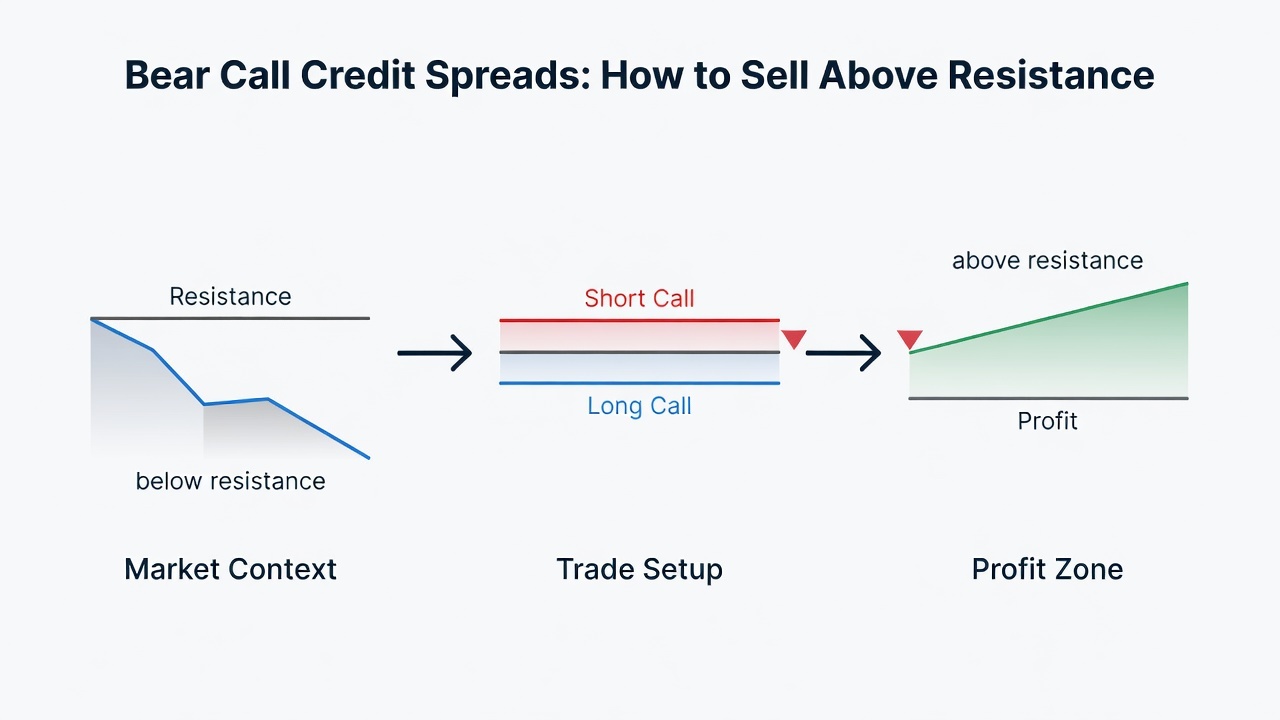
A bear call credit spread is a two-legged vertical options strategy where you sell an out-of-the-money call and purchase a higher out-of-the-money call with the same expiration cycle. When you place this trade, your broker deposits money straight into your account as a net credit.
Think of this trade like putting an electric fence across the roof of your house. As long as your neighbor’s kids do not climb over that specific boundary line before Friday afternoon, you keep the cash deposit they handed you.
The call you sell produces the bulk of your cash premium, but it exposes you to theoretical unlimited risk if the stock explodes upward. That is why you immediately buy a higher call strike to act as a permanent financial seatbelt.
If the stock drops, moves sideways, or even creeps slightly higher without reaching your short strike, both options expire completely worthless. You keep every single dollar of the initial credit you collected on day one.
This structure gives you three separate ways to win on a single trade. Directional traders have to guess the exact magnitude and timing of a move, but credit spread traders profit from simple stagnation.
Why Sell Premium Above Technical Resistance?
Technical resistance is a price chart ceiling where heavy selling pressure historically halts an advancing stock. By placing your short call strike just above this established level, you force the market to climb through heavy institutional supply before your position takes any heat.
Stocks rarely run through well-defined resistance levels on their first attempt without significant fundamental news. You give yourself a built-in statistical cushion by positioning your trade behind that barrier.
Earlier in the series, we covered how bull put spreads build a floor beneath market support. The bear call spread does the exact opposite by building an impenetrable ceiling above an exhausted rally.
When a stock approaches major overhead resistance, implied volatility often climbs slightly as nervous buyers bid up call options. Selling into that elevated implied volatility allows you to capture richer credits with wider margins for error.
I look for clear chart patterns like double tops, declining 50-day moving averages, or prior breakdown zones. If the market cannot punch through that price point, the decay of the options works directly in your favor every day.
Free For Traders
The Options Cheat Sheet Thousands Of Traders Swear By
Calls, puts, spreads — one free download tells you the right options strategy for every market condition.
 → Download The Free Cheat Sheet
How to Set Up a Bear Call Credit Spread Step by Step
Setting up a bear call credit spread begins by selecting an underlying asset that is overextended or consolidating below clear overhead resistance. You want an asset with tight bid-ask spreads and liquid options chains to avoid losing cash to slippage.
First, pick an expiration date between 30 and 45 days out from today. This window captures the steepest portion of options time decay without forcing you to sit in a position for months.
Second, locate your resistance level and choose a short call strike sitting just above that price point. For higher probability setups, look for a short strike with a delta between 0.20 and 0.30.
Third, buy an out-of-the-money call option with a higher strike price in the exact same monthly cycle. The distance between your short strike and long strike defines the spread width and controls your total risk.
Finally, enter the trade as a single order for a net credit with your brokerage platform. Entering both legs simultaneously ensures you do not get caught with an uncovered call during rapid market swings.

Worked Example: Trading a Bear Call Spread on XYZ
Let us say XYZ stock is trading at $100 after a sharp two-week rally into heavy technical resistance at $104. You decide to sell a bear call credit spread expiring in 35 days to capitalize on this overhead barrier.
You sell the 35-day $105 strike call for $2.40 per share and simultaneously buy the $110 strike call for $0.90 per share. Your account instantly receives a net credit of $1.50 per share, which equals $150 total for one contract.
| Metric | Value Per Share | Total Per Contract |
|---|---|---|
| Net Credit Received | $1.50 | $150.00 |
| Spread Width | $5.00 | $500.00 |
| Maximum Risk | $3.50 | $350.00 |
| Breakeven Price | $106.50 | N/A |
To calculate your maximum loss, subtract your net credit from the total distance between strikes. With a $5.00 spread width minus the $1.50 credit, your maximum theoretical risk is capped at $3.50, or $350 per contract.
Your breakeven level sits at your short strike price plus the credit received, which puts it at $106.50. XYZ stock can climb from $100 up to $106.49 at expiration, and you still walk away with a net gain.
If XYZ closes anywhere below $105 on expiration day, both call contracts expire at zero value. You retain the entire $150 initial cash credit without buying back either contract.
Second Worked Example: Handling an Earnings Resistance Level
Consider a second scenario where ABC stock trades at $50 right before a major earnings announcement, facing strict resistance at $53. Implied volatility is elevated, making call options priced far higher than usual across the board.
You sell the 40-day $55 call for $1.80 and simultaneously purchase the $58 call for $0.70. This execution secures a net credit of $1.10, or $110 in total cash deposited into your trading balance.
Your total spread width is $3.00, which means your maximum loss is the $3.00 width minus your $1.10 credit, equaling $1.90 per share. You risk $190 to make $110, representing a strong 57% potential return on capital at risk.
After earnings are announced, ABC stock rallies modestly to $52, failing to pierce the $53 resistance level. Because the stock remains under your $55 short strike, the post-earnings volatility crush completely drains the value from your short call.
Ten days later, the entire spread can be bought back for just $0.20 per share. You choose to close the position early, locking in a $90 profit without remaining in the trade through expiration.
From Find Better Trades
Consistent Income. Any Market Direction.
The Income Project’s low-risk debit spread system generates steady returns whether the market runs up, down, or sideways.
 → See The Income Project

Bear Call Spread vs. Buying a Put Option
Buying a long put option gives you negative delta, but it forces you to fight time decay throughout the entire trade life. A bear call spread also carries negative delta, but time decay generates profits for you instead of eroding your principal.
| Feature | Long Put Option | Bear Call Credit Spread |
|---|---|---|
| Initial Cost | Net Debit (Pay cash upfront) | Net Credit (Receive cash upfront) |
| Theta (Time Decay) | Negative (Hurts every day) | Positive (Helps every day) |
| Profit If Stock Flat | No (Loses value) | Yes (Full profit retained) |
| Upside Cap | Substantial if stock crashes | Capped at initial credit |
When you buy a standard put, the underlying stock must fall fast enough to overcome both the premium paid and daily theta decay. If the stock merely drifts sideways, your outright put option bleeds to zero.
With a bear call spread, time is your financial ally. Every single day the underlying stock spends dawdling below your short strike brings you closer to your full profit target.
The trade-off is capped upside potential on sharp downward market collapses. You sacrifice massive windfalls on sudden crashes in exchange for a significantly higher probability of producing consistent winners.
Managing Risk and Choosing Your Strike Width
Strike width selection on a bear call credit spread directly controls your maximum dollar risk and return on margin. A narrow $1.00 or $2.00 spread minimizes capital requirements, while a wider $5.00 or $10.00 spread behaves more like a naked call with higher credits.
If your account balance is smaller, sticking to $1.00 to $3.00 wide spreads keeps your worst-case loss small. This approach prevents a single outlier rally from wiping out gains accumulated over weeks of trading.
As a strict rule of thumb, you should aim to collect roughly one-third of the total spread width in net credit. For instance, on a $3.00 wide spread, try to collect at least $1.00 in total premium.
If you cannot collect at least thirty percent of the spread width while staying above resistance, walk away from the setup. Forcing a trade with poor risk-to-reward ratios will destroy your edge over a long series of trades.
Never risk more than two percent of your total trading account equity on any single credit spread trade. Proper position sizing allows you to endure normal losing trades without suffering emotional damage or account drawdowns.
Common Mistakes Beginners Make With Bear Call Spreads
The most frequent error beginners make is selling their short strike directly at or below resistance rather than above it. They reach for higher credits by placing the short call too close to the current stock price, which destroys their margin of safety when normal volatility tests the level.
Another common mistake is holding losing spreads all the way until the final afternoon of expiration day. Traders hope for a last-minute reversal, but gamma risk accelerates near expiration, turning small losses into maximum disasters in minutes.
Many new traders also sell spreads across illiquid option contracts with wide bid-ask pricing spreads. When you try to exit an illiquid position under pressure, market makers will extract punishing slippage fees on both legs of your order.
Finally, beginners routinely fail to account for upcoming corporate earnings dates or major economic announcements. Selling a call spread directly ahead of an earnings release turns a technical resistance play into an unpredictable gamble.
Frequently Asked Questions About Bear Call Spreads
Can I lose more money than my initial margin on a bear call spread? No, you cannot lose more than the spread width minus your net credit received, provided you hold both legs. The higher long call acts as a permanent ceiling on your losses no matter how high the stock price rallies.
What happens if the stock price ends up between my two strikes at expiration? If the underlying stock expires between your strikes, your short call will be assigned while your long call expires worthless. To avoid unexpected stock assignment over the weekend, always buy the spread back to close before the closing bell on expiration day.
When is the best time to enter a bear call credit spread? The best entry timing occurs when a stock rallies directly into a heavy daily or weekly resistance level and shows signs of slowing momentum. Entering during a temporary overbought bounce lets you sell inflated call premiums at optimal chart locations.
Do bear call credit spreads require a margin account? Yes, your brokerage requires a margin account to execute any multi-leg credit spread strategy. The broker locks up the maximum potential loss as collateral until you close the position or both options expire.
Next up in Part 5, we are tackling the exact exit system I use for credit trades: how to routinely close your spreads at 50% profit and leave zero easy money on the table.
📈 Want More? Join Our Free Trading Community
- Trading Strategy Guides Telegram — daily strategy tips and market insights
- Find Better Trades Telegram — free trade signals delivered to your phone
- Find Better Trades on YouTube — live trade breakdowns and tutorials
Lesson 55 of 55 in the free Options Trading Course.
← Previous: Bull Put Credit Spreads: How to Trade Them Step by StepYou have reached the latest lesson. New lessons are added every week.