Bear Put Spread Strategy: How to Profit When Stocks Drop


📚 Options Strategies, Step by Step — Part 2 of 30
- Part 1: The Bull Call Spread: A Cheaper Way to Bet on a Rise
- Part 2: The Bear Put Spread: Profiting From a Drop With Defined Risk (you are here)
⚡ Key Takeaways
- A bear put spread lets you profit from a downward stock move while capping your maximum risk to the net cash paid up front.
- Selling a cheaper, lower-strike put offsets the price of your higher-strike put and drastically cuts the negative impact of time decay.
- You give away open-ended profit below your short strike in exchange for a cheaper trade and a higher probability of success.
— Ben, Find Better Trades
A bear put spread is a two-legged debit options strategy built to profit when a stock heads downward, using a purchased put funded partly by a sold put. If you have ever bought a simple put contract only to watch time decay devour your trade while the stock drifted sideways, this strategy fixes that problem.
The tool I use for this: Greenlight Options Tool. Clear signals for directional options plays — momentum plus chain data tells you exactly which strike to buy. See Greenlight Options →
Welcome to Part 2 of our series. In Part 1, we tackled the bull call spread; now we are taking that exact same defined-risk logic and flipping it over to profit from falling prices.
What Is a Bear Put Spread?
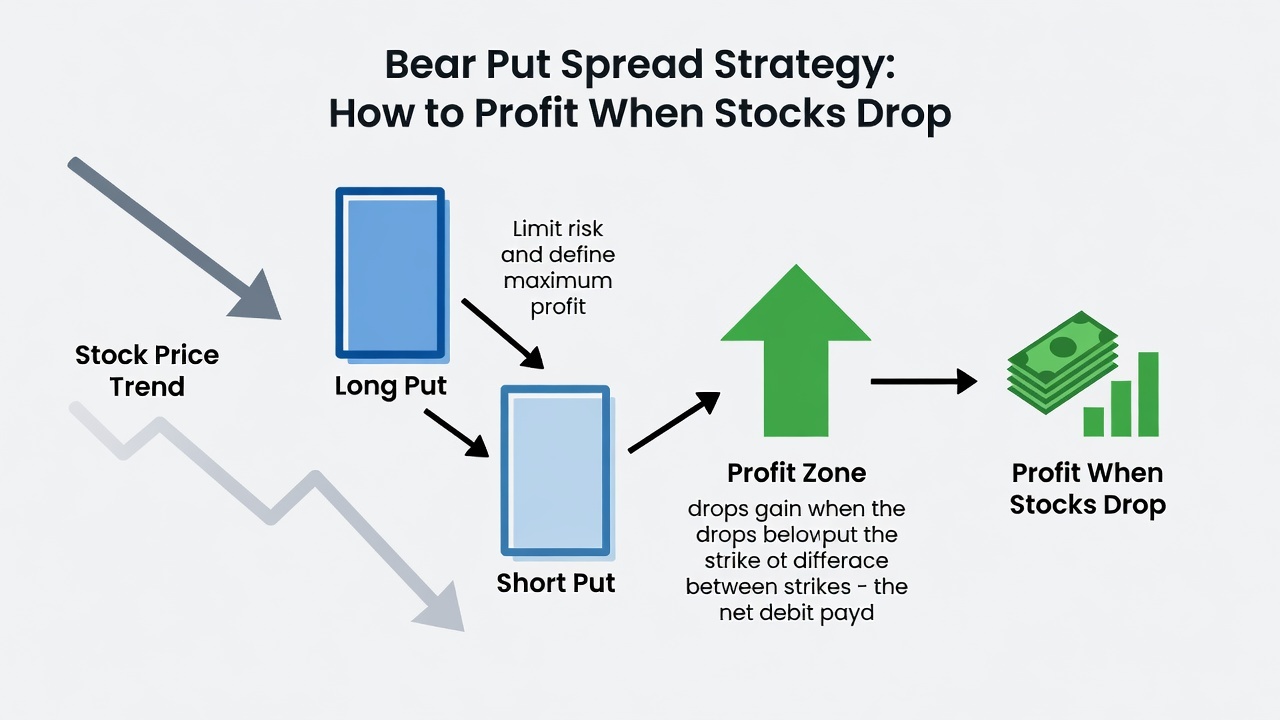
A bear put spread is an options order where you buy one put option at a higher strike price and simultaneously sell another put option at a lower strike price with the exact same expiration date.
Because the put option you buy sits closer to the stock price, it costs more money than the put option you sell. That difference means you pay money out of pocket to open the position, which makes this a debit spread.
Traders set up this position when they expect an underlying asset to fall moderately over a set period. You do not need the stock to crash to zero to make a solid return.
The goal is straightforward: you want the stock price to sink down through your lower strike price before the contracts expire. When that happens, your spread reaches its maximum possible value.
By selling the lower put, you actively surrender any additional profit if the stock collapses into an abyss. In return, you slash your upfront purchase price and soften the blow of every passing day.
How the Math Works: Cost, Risk, and Maximum Profit
The math behind a bear put spread is completely defined the instant your broker fills the order. There are zero hidden surprises, no margin calls, and no risk of losing more cash than you put down.
Your maximum risk is simply the net debit you pay to enter the trade. If you pay a net debit of $2.00, your maximum risk across the entire 100-share contract is exactly $200.00.
Your maximum profit equals the distance between your two strike prices minus the net debit you paid. If the gap between strikes is $5.00 and you paid $2.00, your absolute best outcome is $3.00, or $300.00 per spread.
Your breakeven point sits at your higher strike price minus the net debit paid. If your higher strike is $50.00 and your cost was $2.00, you break even at $48.00 at expiration.
Every penny the stock closes below that $48.00 mark becomes pure profit until the stock hits your lower strike price. Once the stock drops past that second strike, your profits stop growing.
Free For Traders
The Options Cheat Sheet Thousands Of Traders Swear By
Calls, puts, spreads — one free download tells you the right options strategy for every market condition.
 → Download The Free Cheat Sheet
Step-by-Step Example: Trading a Bear Put Spread on a $50 Stock
Let us walk through a concrete scenario so you can see how this plays out in dollars and cents. Suppose stock XYZ trades at $50.00, and you believe it will slide toward $44.00 over the next month.
Instead of buying an outright put for a steep price, you build a bear put spread expiring in 35 days. You buy the $50.00 put for $3.20 and simultaneously sell the $45.00 put for $1.20.
Your net debit comes out to exactly $2.00 per share, which totals $200.00 in cash paid out of your brokerage account. That $200.00 represents the total capital at risk on this trade.
The distance between the $50.00 strike and the $45.00 strike is $5.00. Subtract your $2.00 cost, and your maximum potential profit is $3.00, or $300.00 per contract.
| Stock Price at Expiration | Value of $50 Put | Value of $45 Put | Net Profit / Loss |
|---|---|---|---|
| $52.00 or higher | $0.00 | $0.00 | -$200.00 (Max Loss) |
| $48.00 | $2.00 | $0.00 | $0.00 (Breakeven) |
| $45.00 or lower | $5.00 | $0.00 (exercised) | +$300.00 (Max Profit) |
Notice how clean those boundaries are. If the stock rallies to $70.00, you lose only the original $200.00 you put up, and if it collapses to $30.00, you lock in the full $300.00 gain.

Why Sell the Lower Put? The Subletting Analogy
Beginners often ask why they should bother selling the second put option at all. Selling that lower contract caps your upside, so it feels counterproductive until you look at the economics.
Think of it like renting an apartment for a full season. Buying an outright put is like paying full rent on a prime downtown unit you plan to use only on certain weekends.
Selling the lower put is like subletting the spare room you never intended to occupy anyway. You accept a slight restriction on your living space, but your tenant covers a giant chunk of your monthly rent.
In the options world, the buyer of your short put gives you cash right now. That cash immediately lowers your breakeven threshold on the trade.
Furthermore, that sold put counteracts theta, which is the relentless loss of option value caused by time passing. When you hold an outright put, every passing weekend hurts you, but in a spread, the decay of your short put helps cushion the blow.
Choosing the Right Strikes and Expiration Dates
Setting up a bear put spread successfully comes down to strike selection and contract duration. You cannot just pick arbitrary strikes out of a hat and expect consistent results.
For timing, I generally focus on options contracts that have between 30 and 45 days until expiration. This window provides sufficient time for your bearish thesis to play out without forcing you to overpay for months of idle extrinsic value.
When picking the higher strike that you buy, look for an at-the-money put or one slightly in-the-money, usually hovering around a 0.50 delta. This gives you strong, immediate sensitivity to any downward price action.
For the lower strike that you sell, look toward a major support level on your chart, typically around a 0.25 to 0.30 delta. You want a realistic target where the stock could realistically land by expiration.
Avoid spacing your strikes too far apart just to chase a larger theoretical profit. Wide spreads cost more cash and behave almost identically to bare puts, stripping away the defensive benefits of the spread structure.
From Find Better Trades
Learn The Spread System From The Ground Up
Build, manage, and exit low-risk debit spreads for consistent income — full video course.
 → See The Course

How to Manage and Exit a Bear Put Spread
Entering the trade is easy, but how you handle the exit determines whether your account grows over time. You should never sit passively and wait for expiration day to make your move.
Let us look at a second realistic trade example. Suppose you enter a $100/$90 bear put spread on stock ABC for a net debit of $3.50, meaning your maximum profit potential is $6.50.
Two weeks into the trade, the stock drops sharply from $100.00 to $89.00. The spread value expands from your initial $3.50 cost up to $8.00 in the open market.
At this point, you have captured $4.50 of profit out of the maximum possible $6.50. You could hold for the final two weeks fighting for the remaining $2.00, but doing so exposes you to severe bounce risk.
My personal rule is to close debit spreads when they capture 50% to 75% of their maximum profit potential. In this case, booking the $4.50 gain removes all remaining risk and frees up your cash for fresh opportunities.
If the stock instead moves against you and rallies, establish a clear stop rule. If the spread loses 50% of its initial value, close both legs out together and move on rather than hoping for a last-second turnaround.
Single Long Put vs. Bear Put Spread: Which One Wins?
Neither tool is universally superior; each serves a different market environment and trader objective. Deciding between a naked put and a vertical spread comes down to your expectations for volatility and velocity.
A single long put offers completely unlimited profit potential all the way down to a stock price of zero. It also carries no ceiling on its gains if a company experiences an catastrophic overnight collapse.
However, that open-ended payoff comes with an expensive price tag and aggressive time decay working against you every single session. You must be right on direction, right on magnitude, and right on timing.
| Feature | Single Long Put | Bear Put Spread |
|---|---|---|
| Upfront Cost | Higher | Lower (discounted) |
| Max Profit | Virtually unlimited | Capped at strike width minus debit |
| Impact of Time Decay | Directly harms position | Significantly reduced by short put |
| Breakeven Price | Further below current price | Closer to current price |
A bear put spread is the superior choice when you foresee an orderly, measured decline rather than a sudden panic crash. It trades away unlikely lottery-ticket payouts in exchange for a significantly cheaper entry ticket.
Common Mistakes Beginners Make With This
Buying strikes that sit too far out-of-the-money. New traders often buy cheap, distant puts thinking they are getting a bargain. If the underlying stock never makes a massive move, both options expire worthless, handing you an unnecessary 100% loss on your capital.
Holding the position until the final hour of expiration. Traders often try to squeeze out the absolute last ten cents of theoretical profit by holding through expiration afternoon. This exposes you to unexpected pin risk and sudden closing bell reversals that can erase weeks of gains in minutes.
Ignoring low trading volume and wide bid-ask spreads. If you trade options contracts with sparse volume, you will pay a painful penalty getting into and out of the spread. Always check the bid-ask spread on both strikes to make sure market makers are not siphoning off your edge.
Panicking and closing only one leg of the trade. When the trade moves against them, beginners sometimes buy back the short put and leave the long put running alone. This instantly turns a controlled, balanced spread into a speculative long put position with accelerated time decay.
Bear Put Spread FAQ: Clear Answers for New Traders
Can I lose more money than I paid for a bear put spread? No, you cannot lose more than your initial net debit on a standard bear put spread. Because your long put strike is higher than your short put strike, your maximum loss is strictly capped at the cash you spent to open the trade.
What happens if the stock price finishes between my two strikes? If the stock finishes between your strikes at expiration, your short put expires completely worthless, while your long put retains intrinsic value. Your broker will exercise your long put, and you will capture the difference between that higher strike and the closing stock price.
Should I close both legs of the spread at the exact same time? Yes, you should almost always execute the exit as a single multi-leg spread order through your trading platform. Closing both legs together guarantees your net credit and prevents you from holding accidental naked short exposure.
How does implied volatility affect a bear put spread? Because you are both long and short an option, changes in implied volatility largely offset each other. A rise in implied volatility slightly helps if your trade is out-of-the-money, but the overall position is far less sensitive to volatility swings than a single naked option.
Next up in Part 3, we flip the script to credit spreads with Bull Put Credit Spreads: Getting Paid to Be Right on Direction, showing you how to collect cash upfront even if a stock barely moves.
📈 Want More? Join Our Free Trading Community
- Trading Strategy Guides Telegram — daily strategy tips and market insights
- Find Better Trades Telegram — free trade signals delivered to your phone
- Find Better Trades on YouTube — live trade breakdowns and tutorials
Lesson 53 of 55 in the free Options Trading Course.
← Previous: Bull Call Spread Strategy: Cheaper Bets on Rising Stocks
Next: Bull Put Credit Spreads: How to Trade Them Step by Step →