Why I Buy 60 to 90 Day Options Instead of Weeklies


📊 October 13, 2026
- Buying 60 to 90 day options gives your technical analysis room to breathe while shielding your account from terminal theta decay.
- Weekly options demand microscopic timing accuracy, turning textbook chart breakouts into guaranteed losses through accelerated time erosion.
- Buy 60 to 90 days out at a 0.65 delta, let the chart develop, and close the position before the contract reaches 30 days to expiration.
— Ben, Find Better Trades
Buying 60 to 90 day options is the single most effective adjustment you can make to stop bleeding capital on sound trade ideas. Weekly options look cheap on your broker screen, but they demand immediate perfection that almost no underlying stock ever delivers. I stopped buying short-dated contracts years ago because being right on direction while going broke on timing is the worst way to trade.
The tool I use for this: Greenlight Options Tool. Clear signals for directional options plays — momentum plus chain data tells you exactly which strike to buy. See Greenlight Options →
Most retail traders treat weekly calls and puts like lottery tickets with leverage. The reality is simple: market makers price short-dated volatility to capture that premium, while longer expiries put the mathematical odds back on your side.
Why Everyone Gets This Wrong
Weekly options trap traders because of the optical illusion of low dollar cost. You see an out-of-the-money call trading for $0.40 on a Tuesday, and your brain equates cheap premium with low risk. That contract is actually the most expensive asset you can buy on an annualized basis.
The conventional wisdom claims that weekly options offer higher leverage and faster gains on momentum breakouts. What retail traders forget is that options are pricing engines governed by Greek sensitivities, not pure equity leverage. When you buy an option with four days left to expiration, theta decay does not trickle out; it drops off a cliff.
Consider a textbook technical setup. Say a stock is consolidating at $100, riding right along its rising 20-period exponential moving average. The Bollinger Bands are pinching tight, volume is drying up, and resistance sits at $102.
The weekly trader buys a Friday expiration $102 call for $0.80. The breakout starts on Wednesday, but it pauses on Thursday with a retest of the $100 breakout level. On Friday morning, the stock finally pushes through to $103.50.
What happens to that weekly call? Two days of flat consolidation drained 70% of the premium through accelerated theta decay. Even though the stock broke out exactly as charted, the contract expires barely above breakeven or at a total loss.
When you trade weeklies, you do not just need to be right on the technical pattern. You must be right on the exact hour the move happens. That is not technical trading; that is guessing.
| Metric | Weekly Options (0–7 DTE) | Medium-Term Options (60–90 DTE) |
|---|---|---|
| Theta Decay Curve | Exponential cliff; drops heavily every 24 hours | Linear slope; minimal daily value erosion |
| Delta Sensitivity | Erratic; wild swings driven by short-term gamma | Stable; mirrors underlying equity price action |
| Margin for Error | Zero; consolidation crushes premium instantly | High; can absorb multiple pullbacks and retests |
| Typical Exit Strategy | Panic stop or hold to zero | Managed profit target or technical chart stop |
What Actually Works
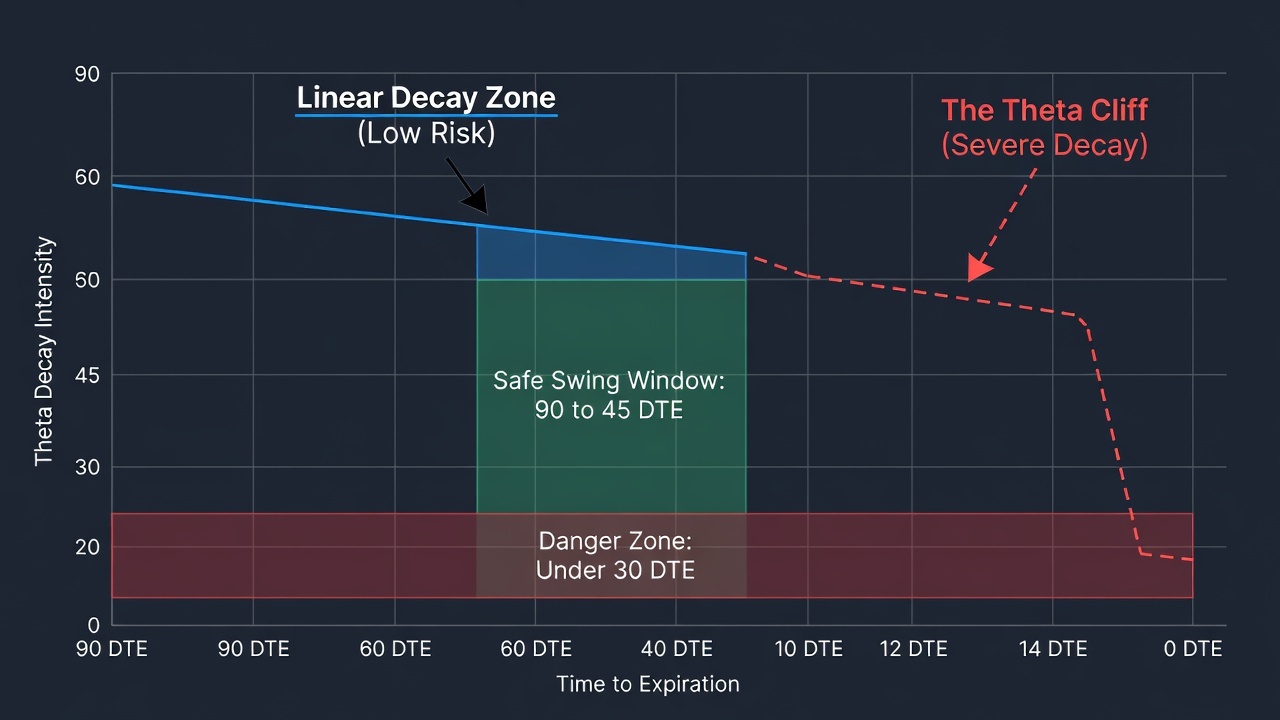
Buying 60 to 90 day options solves the timing problem by flattening the decay curve. Theta decay remains flat and predictable between 90 and 45 days to expiration, allowing your technical thesis to play out over several weeks without punishing your position during normal consolidations.
Here is my exact framework for entering long options. First, I identify a multi-week consolidation pattern breaking out on above-average volume. Instead of grabbing the nearest Friday contract, I open the option chain and look 60 to 90 days out on the calendar.
Second, I buy an in-the-money or close-to-the-money strike with a 0.65 to 0.70 delta. This ensures that for every dollar the underlying stock moves in my favor, the contract gains 65 to 70 cents, behaving almost like common shares while maintaining defined downside risk.
Third, I anchor my stop loss strictly to the underlying chart, not an arbitrary percentage on the option. If the stock drops below the swing low or violates the 20-period EMA on a daily close, the trade is dead and I sell the contract immediately.
Fourth, I run an ironclad exit rule: I never hold an option inside the 30-day expiration window. Once a contract crosses below 30 days to expiration, the theta decay curve starts steepening rapidly. If the move has hit my price target, I take profits; if it has stalled, I close the position or roll the contract back out to the 60 to 90 day zone.
Free For Traders
One Clear Arrow. Every High-Probability Setup. Free.
The Fusion Indicator combines multiple signals into a single buy/sell arrow on TradingView so you never miss a move.

When Buying Weekly Options Can Still Make Sense
Weekly options have one viable use case: intraday momentum scalping. If you are sitting at your screens trading opening-range volume spikes and closing your contracts before the closing bell, the high gamma of a weekly option can produce exceptional gains on sharp intraday moves.
Outside of strict intraday scalping where zero overnight risk is carried, holding weekly options is a losing game. The math is rigged against you, and no amount of technical precision can overcome an option losing 20% of its total value simply because the market spent 24 hours moving sideways.
🎯 Want Setups Like These? The Big Dipper Does the Scanning For You.
Every morning the Big Dipper delivers curated DIP ZONE trade ideas — stocks already at high-probability entry levels, with targets pre-set. No guessing, no scanning. Just setups.
From Find Better Trades
Learn The Spread System From The Ground Up
Build, manage, and exit low-risk debit spreads for consistent income — full video course.

Frequently Asked Questions About 60 to 90 Day Options
Q: Aren’t 60 to 90 day options too expensive compared to weeklies?
A: They cost more in upfront capital, but they are significantly cheaper in risk-adjusted value. A $5.00 contract with 75 days to expiration holds its value through sideways consolidation, while a $0.50 weekly option decays to zero in four sessions.
Q: When should you take profits on a 60 to 90 day option?
A: Take profits when the underlying stock reaches your predetermined technical resistance zone, or when the contract gains 50% to 100% of its initial value. You should also close the position regardless of profit if the contract reaches 30 days to expiration.
Q: Which strike price is best for 60 to 90 day contracts?
A: Target a 0.65 to 0.70 delta strike, which is slightly in-the-money. This gives you strong directional sensitivity and lower implied volatility risk than out-of-the-money lottery tickets.
📈 Want More? Join Our Free Trading Community
- Trading Strategy Guides Telegram — daily strategy tips and market insights
- Find Better Trades Telegram — free trade signals delivered to your phone
- Find Better Trades on YouTube — live trade breakdowns and tutorials