How to Pick a Strike Price: Stop Buying Cheap OTMs

📊 October 20, 2026
- Picking out-of-the-money strike prices because they look affordable is why most directional options traders bleed their accounts dry.
- The fatal flaw is paying pure extrinsic value that demands an unrealistic stock surge just to break even before theta destroys your position.
- Buy in-the-money strikes with a 70 to 80 delta positioned behind technical support to trade real price action instead of fighting the clock.
— Ben, Find Better Trades
How to pick a strike price comes down to a single principle: never buy a contract whose strike requires an abnormal historical move just for you to break even. Most retail traders pick cheap out-of-the-money strikes hoping for a lottery payout, but winning directional options trades requires buying deep in-the-money strikes with at least a 70 delta. When you buy deep in-the-money, you pay for real intrinsic value rather than time decay, allowing your position to mirror the actual stock move.
The tool I use for this: Layered Options Alerts. A low-risk debit spread every Thursday, built to make steady returns whether the market runs up, down, or sideways. See Layered Options →
I see traders blow up their accounts every single week doing the exact same thing. They pull up an options chain, see that a strike five dollars away from the current price costs fifty cents, and load up. You are not buying a bargain; you are donating your capital to market makers.
Why Everyone Gets This Wrong
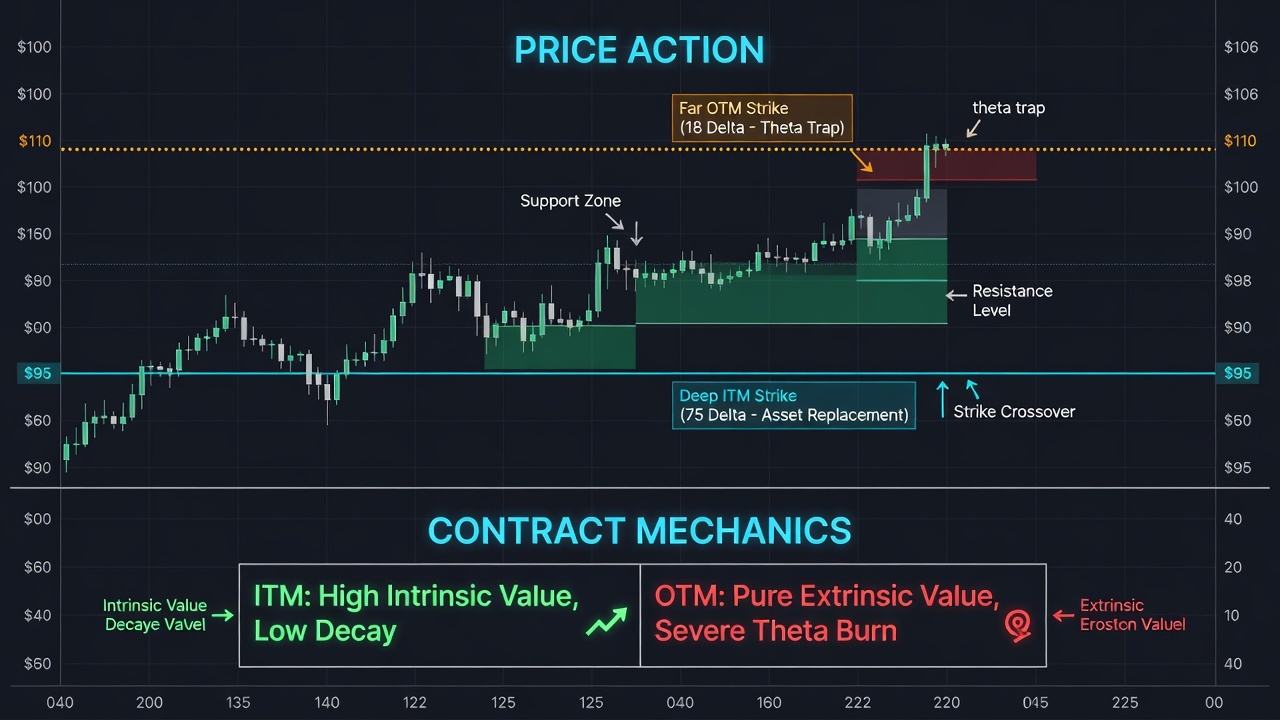
Why everyone gets this wrong is simple math mixed with pure greed. A trader with a three-thousand-dollar account looks at a stock trading at $100 and notices the $110 call expiring in two weeks costs $0.60, while the $95 call costs $7.20. The amateur buys twenty of the $110 calls because they want massive leverage, ignoring that the contract has an 18 delta and zero intrinsic value.
Consider what happens on the chart in a standard technical setup. The stock tests a clean support bounce off the daily 50-period EMA at $100, with clear overhead resistance sitting at $106. The setup works, and over the next four sessions, the stock stages a solid rally up to $105.50 before stalling at resistance.
The stock gained 5.5% in your direction, yet your $110 calls are down 45%. You nailed the direction, timed the bounce off the EMA, and still lost half your money. Because the underlying never breached the $110 strike, your contract never gained intrinsic value while daily theta decay steadily drained the premium.
You forced yourself into an impossible corner by demanding an outlier move. You did not just need the chart to follow technical analysis; you needed it to blast straight through overhead resistance without pausing. That is not trading; that is gambling on low-probability miracles.
What Actually Works
What actually works for directional options trading is buying deep in-the-money strikes with a 70 to 80 delta. If the stock trades at $100 with technical support at $98, I look directly at the $95 strike call with 45 to 60 days until expiration. That contract carries roughly an 75 delta and consists almost entirely of intrinsic value.
Every dollar the stock climbs adds seventy-five to eighty cents directly to your option. When the stock moves from $100 to $105, your $95 call expands from $7.20 to roughly $11.50, delivering a solid 60% gain on a normal, predictable swing. You get genuine synthetic stock replacement leverage without suffering crushing daily time decay.
| Strike Type | Delta Range | Primary Value | Theta Risk | Technical Viability |
|---|---|---|---|---|
| Deep ITM (Recommended) | 0.70 – 0.85 | Intrinsic | Very Low | High (Profits on standard moves) |
| At-The-Money | 0.45 – 0.55 | Extrinsic | High | Moderate (Needs immediate momentum) |
| Far OTM (Retail Trap) | 0.10 – 0.30 | Pure Hope | Severe | Unviable (Requires outlier breakouts) |
Your stop loss is dictated by the chart level, never by an arbitrary percentage drop on the option contract. If your technical trade thesis is built on that $98 support holding, you exit the moment the underlying stock prints a daily close below $97.80. You size your position so that a failure at support risks no more than one to two percent of your total account equity.
When Out-of-the-Money Strikes Can Still Make Sense
Out-of-the-money strikes make sense almost exclusively when you are the seller collecting premium rather than the buyer paying it. If I execute a bull put credit spread on a stock bouncing off $100, selling an out-of-the-money $95 put allows time decay and low delta to work entirely in my favor.
The only legitimate time to buy an out-of-the-money contract is during an explosive intraday catalyst where relative volume exceeds 300% and you intend to flip the position within two hours. If you are holding contracts overnight for a multi-day swing trade, buying out-of-the-money strikes is a guaranteed way to grind your balance down to zero.
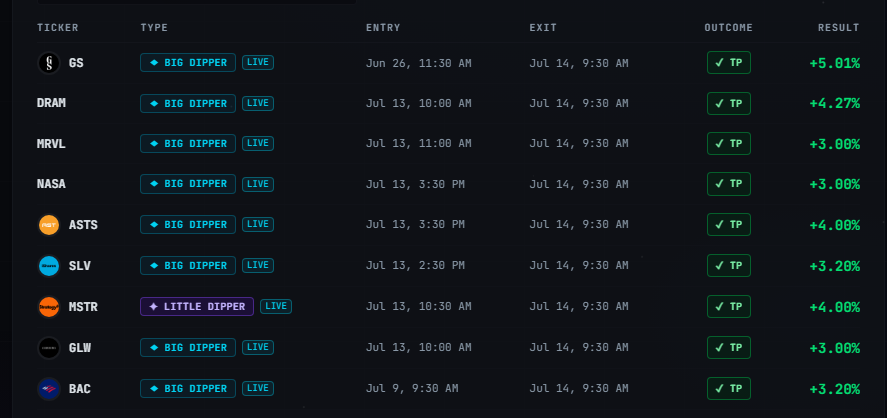
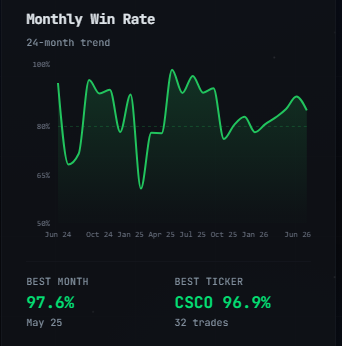
🎯 Want Setups Like These? The Big Dipper Does the Scanning For You.
Every morning the Big Dipper delivers curated DIP ZONE trade ideas — stocks already at high-probability entry levels, with targets pre-set. No guessing, no scanning. Just setups.
From Find Better Trades
See The Big Money Move BEFORE The Price Does
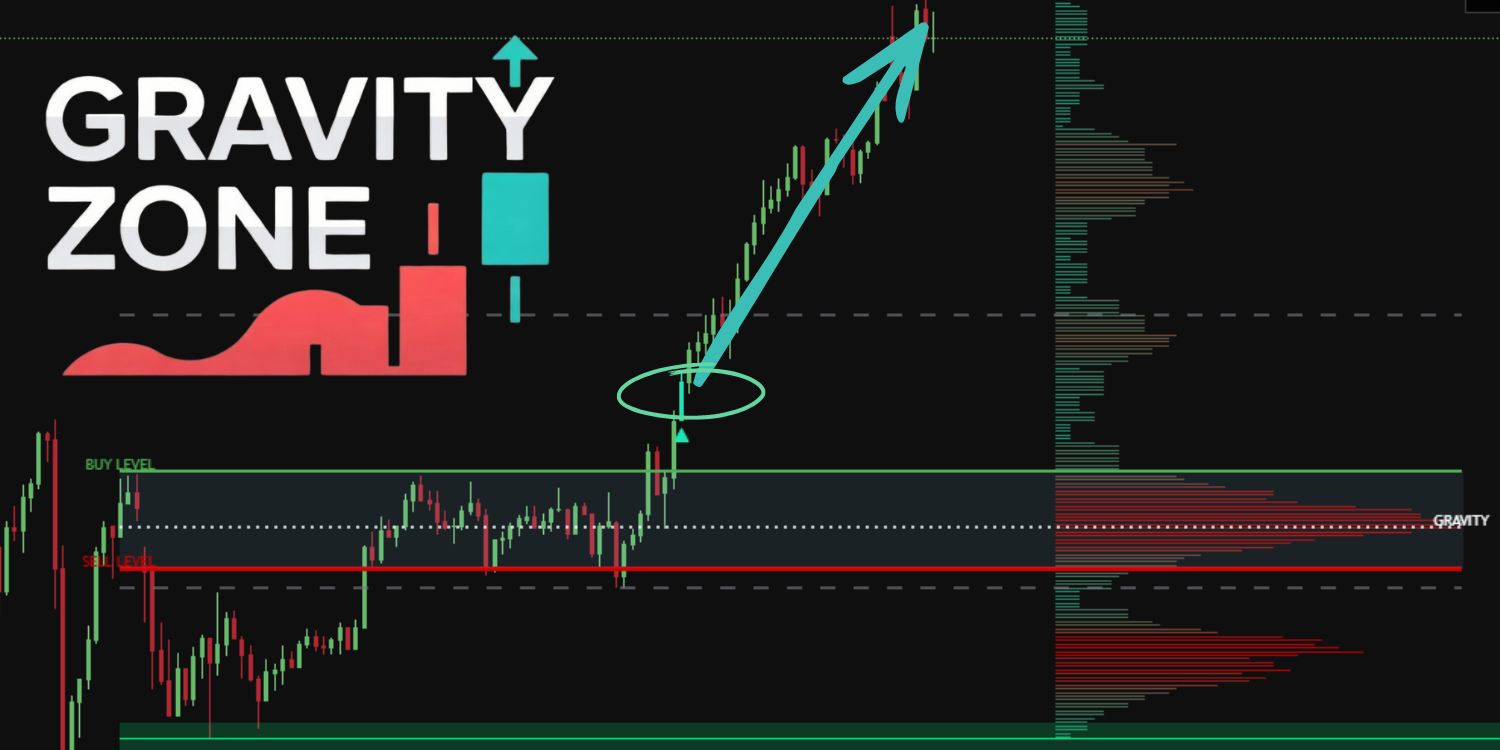
Gravity Zone detects hidden institutional accumulation on TradingView — so you’re in the breakout while retail is still waiting for confirmation.
Strike Price Selection FAQ
Q: What delta should I choose when buying directional options?
A: Choose a 0.70 to 0.80 delta strike with 45 to 60 days until expiration. This gives you strong price participation per dollar move while minimizing the percentage of your premium exposed to theta decay.
Q: Why do my call options lose money even when the stock goes up?
A: Your call options lose value during upward moves if you bought an out-of-the-money strike where daily theta decay outpaces delta gains. If the stock rallies too slowly to reach your breakeven threshold, the option loses extrinsic value every day.
Q: How far in-the-money should my strike be?
A: Position your strike below the nearest major daily support level for calls, or above the nearest daily resistance level for puts. Anchoring your strike past structural chart levels ensures your contract remains loaded with intrinsic value even during normal pullbacks.
📈 Want More? Join Our Free Trading Community
- Trading Strategy Guides Telegram — daily strategy tips and market insights
- Find Better Trades Telegram — free trade signals delivered to your phone
- Find Better Trades on YouTube — live trade breakdowns and tutorials