Christmas Tree Spread: Directional Butterfly Strategy


📚 Options Strategies, Step by Step — Part 14 of 30
- Part 1: The Bull Call Spread: A Cheaper Way to Bet on a Rise
- Part 2: The Bear Put Spread: Profiting From a Drop With Defined Risk
- Part 3: Bull Put Credit Spreads: Getting Paid to Be Right on Direction
- Part 4: Bear Call Credit Spreads: Selling Premium Above Resistance
- Part 5: Managing Credit Spreads: Closing Early at 50% Profit
- Part 6: The Iron Butterfly: When You Expect a Stock to Pin a Price
- Part 7: The Reverse Iron Condor: Profiting From a Breakout
- Part 8: Short Straddles and Strangles: The Risk Nobody Explains
- Part 9: Calendar Spreads: Trading Time Decay Between Two Expirations
- Part 10: Diagonal Spreads: A Calendar Spread With a Directional Lean
- Part 11: The Double Diagonal: Income From a Range With Room to Breathe
- Part 12: Butterfly Spreads: Cheap Trades Aimed at a Target Price
- Part 13: Broken Wing Butterflies: Taking the Risk Off One Side
- Part 14: Christmas Tree Spreads: A Directional Butterfly Variation (you are here)
⚡ Key Takeaways
- A Christmas Tree spread is a defined-risk 1-3-2 options combination that gives a directional butterfly a wider profit zone and zero runaway risk on an oversized move.
- The trade uses three different strike prices with an skipped strike between the long anchor and the three short body options.
- You trade this when you have a clear directional target and want higher potential reward than a vertical spread without paying a heavy debit.
— Ben, Find Better Trades
A Christmas Tree spread is an advanced butterfly variation designed for traders who want cheap directional exposure without the razor-thin target zone of a standard symmetrical fly. Most traders stumble here because the unusual 1-3-2 strike ratio looks confusing on an order screen. In this fourteenth part of our series, I will break down exactly how this spread works, why the strike math balances out, and how I use it in real market conditions.
The tool I use for this: Gravity Zone Indicator. Gravity Zone detects hidden institutional accumulation on TradingView — so you’re in the breakout while retail is still waiting for confirmation. See Gravity Zone In Action →
What is a Christmas Tree spread in options trading?
A Christmas Tree spread is a directional, defined-risk options strategy that combines elements of a vertical spread and an asymmetric butterfly spread. The trade uses six options contracts structured across three strike prices using a distinct 1-3-2 ratio.
We covered standard butterfly spreads in Part 12 and broken wing butterflies in Part 13. While those strategies balance two long wings around two short options, the Christmas Tree spread sells three short options in the middle.
To offset those three short options, you buy one option closer to the money and two options farther out of the money. You also deliberately skip an entire strike interval between your first long strike and your short strike cluster.
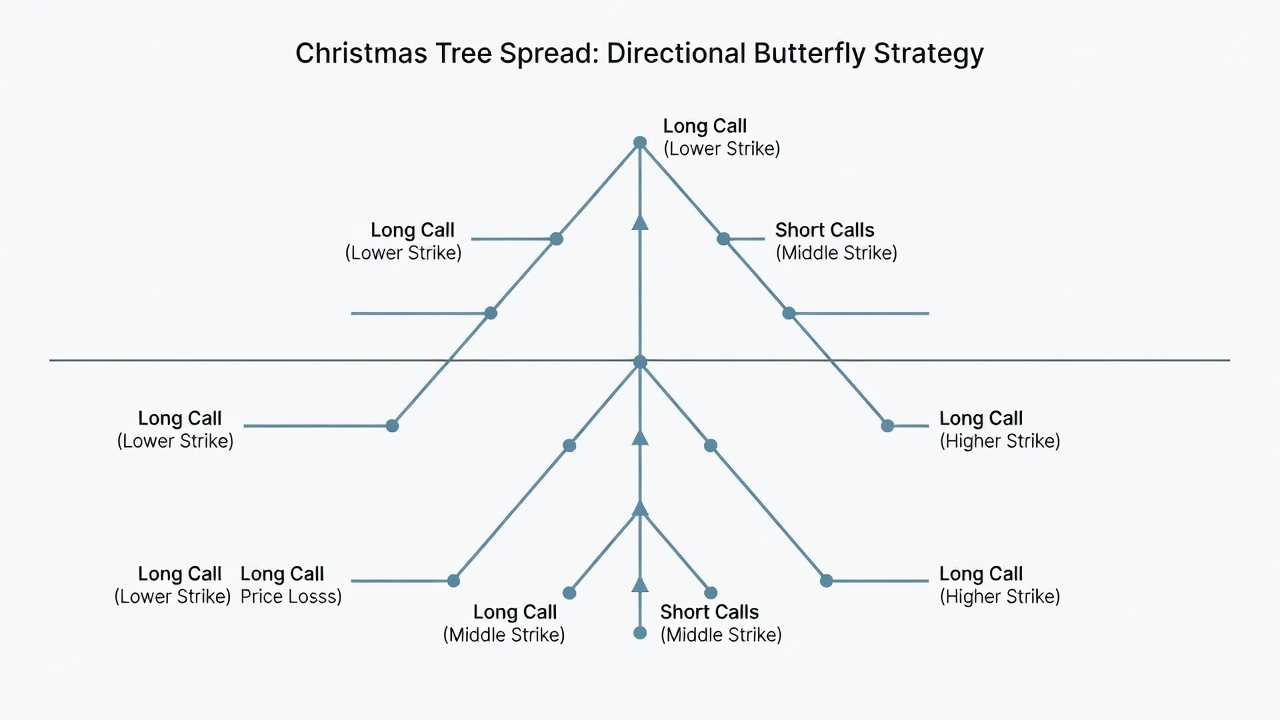
The name comes from how the position looks when plotted on an older quote board or payoff diagram. The laddered structure resembles the tiered branches of an evergreen tree stepping outward from a narrow base.
I view this strategy as a specialized tool for directional targeting. You use it when you expect a stock to move steadily toward a specific price level by expiration, but you want complete downside and upside protection.
How the 1-3-2 strike structure works
The 1-3-2 ratio functions because the internal strike distances mathematically cancel out excess risk at expiration. In a call Christmas Tree spread, you buy one lower strike call, skip a strike, sell three middle strike calls, and buy two higher strike calls.
Think of it like balancing a seesaw with uneven weights. A single long contract far down the board holds up one side, while two long contracts higher up hold up the far end.
The middle strike serves as the fulcrum where you sell three contracts. Selling three options brings in significant premium, which drastically lowers the net debit required to open the position.
The skipped strike is the engine of the entire trade. Leaving an empty space between your first long strike and the short strike cluster allows the trade to capture substantial directional gains before the short options begin exerting negative delta.
Because the mathematical weight of the outer wings exactly equals the three short contracts, the spread is entirely defined-risk. If the underlying asset blows past your upper strike, your profit drops back to zero, but you do not suffer an uncapped loss.
Call Christmas Tree spreads: A bullish directional setup
A call Christmas Tree spread is a bullish setup entered for a small debit or near-even credit. Let’s walk through an example using hypothetical shares of stock XYZ trading at $100 per share.
You expect XYZ to climb to $110 over the next 40 days. To build the spread, you buy 1 $100 call for $4.00, skip the $105 strike entirely, sell 3 $110 calls for $1.50 each ($4.50 total credit), and buy 2 $115 calls for $0.50 each ($1.00 total debit).
Let’s calculate your net entry cost. You spent $4.00 on the lower strike, took in $4.50 on the short strikes, and spent $1.00 on the upper strikes, resulting in a net debit of $0.50 ($50 per spread).
If XYZ remains below $100 at expiration, all contracts expire worthless, and you lose only the $0.50 net debit paid. If XYZ rises precisely to $110, your $100 call is worth $10.00 while the short $110 calls and long $115 calls expire worthless.
In that scenario, your gross payout is $10.00, yielding a net profit of $9.50 ($950 per spread) against a $50 initial risk. Even if XYZ rockets to $130, your single $100 call ($30 value) and two $115 calls ($30 total value) offset the three short $110 calls ($60 total loss), leaving you with a net payout of $0.00 and a tiny loss equal to your initial $0.50 debit.
| Stock Price at Expiration | Position Value | Net Profit / Loss ($0.50 Debit) |
|---|---|---|
| $95.00 | $0.00 | -$50.00 (Max Downside Loss) |
| $100.00 | $0.00 | -$50.00 |
| $105.00 | $5.00 | +$450.00 |
| $110.00 (Sweet Spot) | $10.00 | +$950.00 (Max Profit) |
| $115.00 | $0.00 | -$50.00 |
| $120.00+ | $0.00 | -$50.00 (Flat Upside Risk) |

Put Christmas Tree spreads: Targeting downside levels
A put Christmas Tree spread targets a lower price level by inverting the call structure while keeping the math intact. You structure this using puts when you have a bearish target and want to risk very little capital.
For a put Christmas Tree, you reverse the wing weighting. You buy two higher strike puts near the money, sell three middle strike puts at your downside target, skip a strike, and buy one lower strike put far out of the money.
Assume stock XYZ is at $100 and you anticipate a controlled pullback to $90 over the next month. You buy 2 $95 puts for $1.60 each ($3.20 total cost), sell 3 $90 puts for $0.80 each ($2.40 total credit), skip the $85 strike, and buy 1 $80 put for $0.30.
Your net debit on this trade comes out to $1.10 ($110 per spread). If the stock stays at $100 or higher, all puts expire worthless, capping your total loss at that $110 entry cost.
If the stock drops to exactly $90 at expiration, your two $95 puts are worth $5.00 each for a total of $10.00, while your short puts and long $80 put expire worthless. Your profit at the $90 target is $8.90 ($890 per spread), representing more than eight times your initial investment.
Christmas Tree spread vs standard butterfly: Key differences
A standard butterfly spread is non-directional or narrowly targeted, whereas a Christmas Tree spread is intentionally built for directional momentum. The extra short contract and skipped strike change how the trade accumulates value.
Standard butterflies use a symmetrical 1-2-1 ratio with identical strike widths between the long wings and the short body. Christmas Tree spreads use uneven wing spacing and a 1-3-2 ratio to create a wide directional profit runway.
In a standard butterfly, your upside and downside loss limits are identical. In a Christmas tree spread, one side generally risks only the small debit paid, while the other side flattens out entirely.
Standard butterflies also suffer rapid losses if the underlying stock makes a strong move early in the trade. A Christmas Tree spread benefits immediately from a directional push because the skipped strike gives your single long anchor contract room to appreciate before hitting short-strike drag.
| Feature | Standard Butterfly (1-2-1) | Christmas Tree Spread (1-3-2) |
|---|---|---|
| Strike Spacing | Equal on both sides | Skipped strike between long and shorts |
| Short Contract Quantity | 2 contracts | 3 contracts |
| Directional Bias | Neutral to mild lean | Aggressive directional lean |
| Early Move Sensitivity | Hurts profit if move happens fast | Helps position due to open gap strike |
From Find Better Trades
Know Exactly Where The Big Money Steps In
Auto-plots institutional support & resistance zones from pure price action — no more guessing at levels.
 → See Magnizone

Managing Greeks and time decay in Christmas Tree spreads
Understanding your option Greeks makes the difference between closing this trade for a double-digit gain and watching it melt away. The trade starts with a noticeable directional delta that gradually transitions into time decay reliance.
At trade entry, the spread carries positive delta on the call version and negative delta on the put version. This directional push helps you turn an unrealized profit early if the underlying stock begins moving toward your short strikes.
As the underlying stock reaches the short strike zone, theta decay turns strongly positive. Selling three middle contracts means you collect time decay three times faster than a single long option loses it.
Gamma becomes your primary risk factor late in the trade cycle. If the stock settles directly on your short strikes during expiration week, gamma risk spikes rapidly because any sudden move can pull you off the profit peak.
Vega exposure remains relatively low across the life of the trade. Because you are buying three long contracts and selling three short contracts, volatility shifts largely cancel out, leaving your trade driven almost entirely by price action and time.
Entry, exit, and trade management rules
I enter Christmas Tree spreads between 30 and 45 days before expiration. This timeline gives the underlying stock enough time to travel across the skipped strike gap without suffering immediate decay on the long anchor leg.
Select your short strikes at significant support or resistance levels where you expect price momentum to stall. If you place your short strikes in the middle of a clear vacuum, price is more likely to slice straight through your tent.
Never hold a Christmas Tree spread all the way into expiration afternoon trying to capture the theoretical maximum payout. The peak of the profit tent is extremely narrow, and a late-day move can wipe out substantial gains.
I routinely exit these trades when the position captures between 30% and 50% of its theoretical max value. Taking profits early locks in an excellent return on capital while taking expiration assignment risk off the table.
If the stock moves immediately against your trade, your downside is completely capped at the debit paid. Because the loss is already contained, you rarely need to make defensive adjustments; you simply cut the trade if your directional thesis fails.
Common Mistakes Beginners Make With This
The most frequent error beginners make is getting the strike spacing and contract ratios mixed up on their broker’s order ticket. If you fail to skip the correct strike or you enter a 1-2-1 ratio instead of a 1-3-2 ratio, you leave unhedged contracts that create uncapped risk.
Another major mistake is attempting to trade Christmas Tree spreads on illiquid underlyings with wide bid-ask spreads. Because this setup involves three distinct strikes and six total contracts per unit, slippage on entry and exit can quickly consume your profit cushion.
New traders also hold the spread too long into the final week of expiration hoping for a perfect pin at the short strike. Chasing that last 20% of theoretical profit exposes your three short options to severe pin risk and overnight gap hazards.
Finally, traders often select strikes that are spaced too tightly together. Compressing the strikes into one-dollar increments eliminates the benefit of the skipped strike, leaving you with a trade that lacks sufficient runway to develop value.
Christmas Tree Spread FAQ
What is the maximum risk on a Christmas Tree spread?
The maximum risk on a standard Christmas Tree spread entered for a debit is limited to the initial debit paid to open the trade plus commissions. If the stock moves entirely in the wrong direction or blasts past your outer long strikes, your loss cannot exceed this initial cost.
Can you trade a Christmas Tree spread for a net credit?
Yes, depending on prevailing implied volatility and strike selection, you can occasionally open a Christmas Tree spread for a small net credit. When entered for a credit, the trade carries no monetary risk on the side that moves away from your strikes.
How many total contracts are in a single Christmas Tree spread?
A standard Christmas Tree spread requires six total option contracts per unit. You buy one anchor contract, sell three middle contracts, and buy two wing contracts to balance out the mathematical exposure.
When should I close a Christmas Tree spread?
You should look to close the spread when the underlying stock reaches your short strikes and the trade captures between 30% and 50% of the maximum potential profit. Closing two to three weeks before expiration protects you from erratic late-cycle gamma swings.
Next up, we are turning up the intensity in Part 15 by taking on front ratio spreads, where we deliberately sell extra naked options for bigger upfront credits while managing real unhedged risk.
📈 Want More? Join Our Free Trading Community
- Trading Strategy Guides Telegram — daily strategy tips and market insights
- Find Better Trades Telegram — free trade signals delivered to your phone
- Find Better Trades on YouTube — live trade breakdowns and tutorials
Lesson 69 of 75 in the free Options Trading Course.
← Previous: NVDA Earnings: Options Are Pricing a ~$17 Move. Is That Too Much?
Next: NVDA Just Broke Its 52-Week Low. Options Are Paying Up for Fear. →