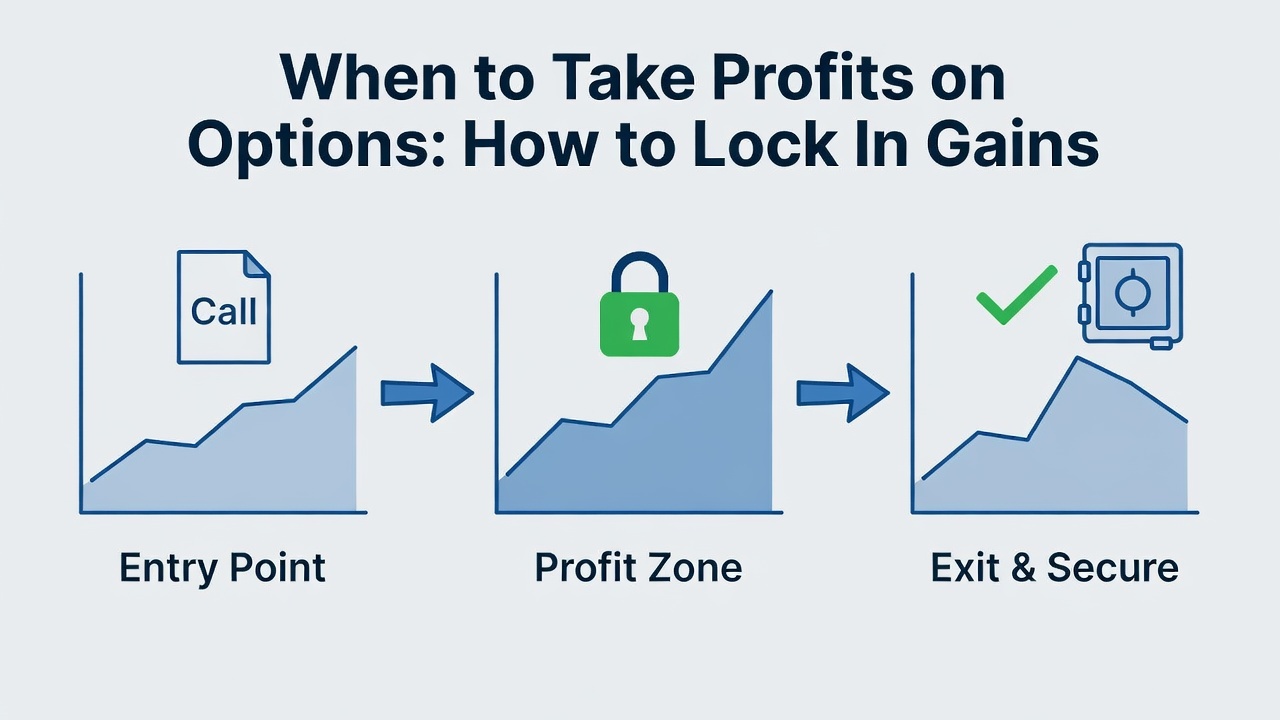
When to Take Profits on Options: How to Lock In Gains

📚 Beginner’s Guide to Options — Part 41 of 51
- Part 1: What Is an Option? The Absolute Basics Explained
- Part 2: Calls vs. Puts: The Two Types of Options You Need to Know
- Part 3: Strike Price Explained: What It Actually Means for Your Trade
- Part 4: Expiration Date Explained: Why It Changes Everything
- Part 5: Premium Explained: What You’re Really Paying For
- Part 6: In the Money vs. Out of the Money: A Beginner’s Breakdown
- Part 7: Intrinsic Value vs. Extrinsic Value: What Makes Up an Option’s Price
- Part 8: How Buying a Call Option Works, Step by Step
- Part 9: How Buying a Put Option Works, Step by Step
- Part 10: What Happens When an Option Expires? Every Outcome Explained
- Part 11: Options Contracts 101: What One Contract Actually Represents
- Part 12: How to Read an Options Chain Without Getting Overwhelmed
- Part 13: Bid, Ask, and Spread: What They Mean When You’re Trading Options
- Part 14: What Is Implied Volatility? A Beginner’s Plain-English Guide
- Part 15: Why Options Lose Value Over Time: Theta Explained Simply
- Part 16: Delta Explained: What It Really Tells You About Your Option
- Part 17: Gamma Explained: Why Delta Doesn’t Stay the Same
- Part 18: Vega Explained: How Volatility Changes Your Option’s Price
- Part 19: The Greeks Cheat Sheet: Delta, Gamma, Theta, Vega in Plain English
- Part 20: What Is Assignment? What Happens If Your Option Gets Exercised
- Part 21: American vs. European Options: What’s the Difference?
- Part 22: How Much Money Do You Need to Start Trading Options?
- Part 23: Paper Trading Options: How to Practice Before Risking Real Money
- Part 24: The Biggest Mistake Beginners Make Buying Options
- Part 25: Why Most Beginners Lose Money Buying Options (and How to Avoid It)
- Part 26: Covered Calls Explained: The First Options Strategy Every Trader Should Learn
- Part 27: Cash-Secured Puts Explained: A Beginner-Friendly Way to Get Paid to Wait
- Part 28: Vertical Spreads Explained: Reducing Risk on Your First Options Trade
- Part 29: Credit Spreads vs. Debit Spreads: What’s the Real Difference?
- Part 30: The Protective Put Explained: Insurance for Your Stock Position
- Part 31: The Collar Strategy Explained: Protecting Gains Without Selling
- Part 32: Straddles Explained: Betting on a Big Move (In Either Direction)
- Part 33: Strangles Explained: A Cheaper Way to Bet on a Big Move
- Part 34: The Iron Condor Explained for Complete Beginners
- Part 35: The Wheel Strategy Explained: Getting Paid on Stocks You Want to Own
- Part 36: How Earnings Season Changes Options Pricing (and What to Watch For)
- Part 37: Why Options Get More Expensive Before Earnings: IV Crush Explained
- Part 38: Choosing the Right Strike Price for Your First Options Trade
- Part 39: Choosing the Right Expiration Date: Weekly vs. Monthly Options
- Part 40: How to Size an Options Position So One Bad Trade Doesn’t Wreck You
- Part 41: When to Take Profits on an Options Trade (Before It’s Too Late) (you are here)
⚡ Key Takeaways
- Options are decaying assets, which means holding a winning trade too long will turn green trades into red losses.
- Setting hard profit targets between 30% and 50% on long options beats hoping for rare 500% home runs.
- Scaling out of multi-contract positions lets you lock in realized cash while keeping partial upside exposure.
— Ben, Find Better Trades
There is nothing more painful in trading than watching a position go up 80%, doing nothing because you wanted 200%, and ending up closing it for a loss. In this Part 41 of our series, I want to give you a clear, repeatable system to take money off the table before the market takes it back.
Stocks let you wait out bad timing, but options have an expiration date that makes hesitation extremely expensive. Learning when to ring the register is the single biggest step toward becoming a consistently profitable trader.
Why Options Profits Disappear Faster Than Stock Gains
When you own regular shares of stock, a profitable trade can sit in your account for months without losing value simply from the passage of time. If the stock stays flat at a higher price, your profit stays right where it is.
Options do not work that way because of extrinsic value and time decay, which we covered earlier in the series. Every single day you hold an option, theta chips away at its total premium.
Think of holding a profitable long option like holding a melting block of ice on a summer afternoon. Even if the temperature stays warm, the ice is continuously disappearing until nothing remains.
If an underlying stock makes a fast move in your favor, your option premium spikes immediately. But if the stock stalls for even three or four trading sessions, that rapid gain will evaporate due to decaying extrinsic value.
Greed tells you that a winning trade will keep going up forever. Reality dictates that options are temporary instruments designed to expire worthless if you do not actively capture your gains.
The Myth of the 1000% Moonbag
Social media is flooded with screenshots of traders turning $200 into $5,000 on crazy out-of-the-money call options. What those screenshots never show you is the fifty previous trades where those same traders lost 100% of their money chasing those exact numbers.
Expecting every winning trade to double or triple your money is the fastest path to blowing up an options account. Those massive percentage gains are rare statistical outliers, not a dependable business model.
Professional options traders build long-term wealth by taking steady, predictable bites out of the market. They treat trading like a business rather than a scratch-off lottery ticket.
If you make a 40% return on a trade in two days, that is an extraordinary annualized rate of return. Walking away with that cash in hand beats holding onto a fantasy that rarely plays out.
When you shift your mindset from chasing home runs to hitting consistent singles and doubles, your equity curve will stop swinging violently up and down.
Free For Traders
One Clear Arrow. Every High-Probability Setup. Free.
The Fusion Indicator combines multiple signals into a single buy/sell arrow on TradingView so you never miss a move.
 → Get The Free Fusion Indicator
The Percentage Profit Target Framework
Before you ever submit an order to buy an option, you should already know the exact price at which you will take your profit. Leaving the exit decision to your emotions during live market hours is a recipe for disaster.
For long single-leg calls and puts, I teach beginners to target profits between 30% and 50% of the premium paid. If you buy a call for $2.00, your plan should be to sell it when the bid hits $2.60 to $3.00.
For vertical debit spreads, which have capped maximum payouts, taking profits at 50% to 75% of the spread width is a reliable benchmark. Holding a debit spread all the way to expiration to squeeze out the final nickels exposes you to massive reversal risk for tiny reward.
| Strategy | Standard Profit Target | Why Exit Early? |
|---|---|---|
| Long Call / Put | 30% to 50% of debit | Protects gains against sudden theta decay and pullbacks. |
| Debit Spread | 50% to 70% of max profit | Avoids pin risk and expiration volatility for diminishing returns. |
| Credit Spread | 50% of credit received | Takes off risk early while freeing up buying power. |
| Covered Call | 75% to 85% of short premium | Lets you reset strikes or eliminate assignment risk ahead of time. |
Writing down your target before entering the trade removes subjective second-guessing. You can even set a limit order right after your entry fills so the exit happens automatically.

Taking Profits on Credit Spreads and Short Options
When you sell options for a credit, your profit dynamics are completely reversed from buying options. As we covered in our spreads guides, time decay works in your favor, and your maximum profit is limited to the credit collected upfront.
Many beginners think they should hold short options all the way until 4:00 PM on expiration Friday to squeeze out every penny. That is one of the most dangerous habits you can build in options trading.
The standard rule for credit spreads and short options is the 50% rule. When your short position has captured 50% of the initial credit, you buy it back to close the trade.
For instance, if you sold an iron condor or a credit spread for $2.00, you place a buy-to-close order at $1.00. Once filled, you lock in half the maximum gain and eliminate 100% of your remaining market risk.
Holding a trade for another three weeks just to collect the remaining 50% leaves you exposed to unpredictable news events and market crashes for very little additional cash.
Scaling Out: Locking in Gains While Leaving Runners
If you trade multiple contracts at a time, you do not have to choose between taking profits and catching a massive trend. Scaling out gives you the best of both worlds by splitting your position into tiers.
Let’s say you buy three call contracts on a stock you expect to break out. When your first profit target hits at +40%, you sell two contracts to lock in pure cash profit.
By closing those two contracts, you take your initial capital completely off the table. The trade is now mathematically risk-free because you have already extracted cash from the market.
You can then let that final remaining contract—often called a runner—stay open to catch any extended trend. If the underlying stock explodes higher, your runner will capture that windfall gain.
If the stock reverses and drops, your overall trade still closes with a net green balance because of the profit locked in on the first two contracts.
From Find Better Trades
Green Light Means GO. It’s That Simple.
Clear signals for directional options plays — momentum plus chain data tells you exactly which strike to buy.
 → See Greenlight Options

Worked Example: Closing a Long Call at Planned Targets
Let’s walk through an exact numeric scenario so you can see how scaling and taking profits works step by step. Suppose XYZ stock is trading at $100 per share, and you believe it is heading higher over the next month.
You buy 4 contracts of the $105 strike call expiring in 35 days for $2.00 per contract. Since each contract covers 100 shares, your total cash outlay is $800 ($2.00 x 100 x 4).
Four days later, XYZ stock surges to $104 on heavy volume, and your call contracts rise from $2.00 to $3.00. You are up 50% on your position, which hits your first pre-defined profit target.
You sell 2 contracts at $3.00 to close them out, collecting $600 in cash ($3.00 x 100 x 2). You still hold 2 contracts, but you have already recovered 75% of your entire original investment.
| Step | Action | Contract Price | Cash Flow | Remaining Risk |
|---|---|---|---|---|
| Entry | Buy 4 Calls | $2.00 | -$800 | $800 at risk |
| Scale 1 | Sell 2 Calls (+50%) | $3.00 | +$600 | $200 net out-of-pocket |
| Scale 2 | Sell 1 Call (+100%) | $4.00 | +$400 | +$200 guaranteed profit |
| Runner | Sell 1 Call (Trailing Stop) | $3.50 | +$350 | Trade fully closed |
The stock continues climbing to $107, pushing the options to $4.00. You sell 1 more contract for $400, bringing your total realized cash to $1,000 against your original $800 spend.
When the stock cools off, your final contract pulls back and triggers a stop order at $3.50, adding another $350. Your total return is $1,350 on an $800 trade—a clean $550 net gain accomplished without unnecessary stress.
Worked Example: Exiting a Credit Spread Early
Now let’s examine why closing early makes mathematical sense when you are selling options for income. Imagine ABC stock is trading at $150 per share.
You sell a 45-day out-of-the-money put credit spread for a $1.20 credit ($120 per contract) with a maximum loss potential of $380. Your maximum possible profit on this trade is $120 if both options expire fully worthless.
Just 8 days into the trade, ABC stock rallies up to $158. Because the stock moved away from your strike so rapidly, the spread’s value collapses from $1.20 down to $0.50.
You can now buy to close the spread for $0.50 ($50 per contract), locking in a $70 profit per contract. You captured nearly 60% of your maximum potential profit in only 18% of the trade’s total lifespan.
If you stay in the trade for the remaining 37 days, you are risking $380 in collateral just to make the remaining $50. That is a terrible risk-to-reward ratio.
By closing the trade immediately, you free up your capital to deploy into fresh trades with much better risk-to-reward setups.
Common Mistakes Beginners Make With This
Waiting for 100% gains on every trade. Beginners often look at a 40% gain and think it is too small to take. In reality, consistently banking 30% to 50% gains compounds an account far faster than holding out for rare doubles that frequently collapse.
Holding short options all the way to expiration. Squeezing the last $0.05 or $0.10 out of a credit spread leaves your entire capital collateral exposed to sudden late-week headline risk. Buying back cheap short options eliminates assignment risk and lets you sleep peacefully.
Letting green trades turn red without an exit plan. Many new traders watch a contract gain $200, pull back to flat, and then plunge into a $300 loss while hoping it rebounds. Having a rule that you never let a 50% winner turn into a loss prevents this emotional trap.
Refusing to sell because of seller’s remorse. Traders frequently fear selling too early because the stock might keep running. Scaling out of positions solves this psychological roadblock by securing cash while keeping skin in the game.
When to Take Profits on Options: Frequently Asked Questions
What is the best percentage to take profit on options?
For bought calls and puts, targeting a 30% to 50% return on your purchase price provides an optimal balance between profitability and win rate. For credit spreads and sold options, closing the position once you have captured 50% of the initial credit received is the widely accepted standard.
Should I use limit orders to take profit automatically?
Yes, placing a limit order to sell your options right after your entry order fills is one of the best habits you can build. It takes human emotion and hesitation out of the equation, ensuring you capture your target even during fast, short-lived price spikes.
What should I do if an option doubles in value immediately?
If an option gains 100% quickly, a proven strategy is to sell at least half of your contracts immediately. This returns your entire original capital outlay, allowing you to ride the remaining contracts with zero financial risk on the trade.
Why should I close a credit spread before expiration?
Closing a credit spread early removes 100% of your tail risk and frees up your margin collateral for new trades. Holding through expiration week exposes you to sudden reversal spikes and assignment fees just to capture the last few dollars of extrinsic value.
Now that you know how to lock in gains like a professional, we need to tackle the other side of the trade: how to cut a losing options trade before it wipes out your account.
📈 Want More? Join Our Free Trading Community
- Trading Strategy Guides Telegram — daily strategy tips and market insights
- Find Better Trades Telegram — free trade signals delivered to your phone
- Find Better Trades on YouTube — live trade breakdowns and tutorials
Lesson 41 of 55 in the free Options Trading Course.
← Previous: Options Position Sizing: How to Protect Your Account
Next: When to Cut a Losing Options Trade: How to Stop Losing Trades →