Wheel Strategy Explained: Earn Income on Stocks You Want to Own

📚 Beginner’s Guide to Options — Part 35 of 51
- Part 1: What Is an Option? The Absolute Basics Explained
- Part 2: Calls vs. Puts: The Two Types of Options You Need to Know
- Part 3: Strike Price Explained: What It Actually Means for Your Trade
- Part 4: Expiration Date Explained: Why It Changes Everything
- Part 5: Premium Explained: What You’re Really Paying For
- Part 6: In the Money vs. Out of the Money: A Beginner’s Breakdown
- Part 7: Intrinsic Value vs. Extrinsic Value: What Makes Up an Option’s Price
- Part 8: How Buying a Call Option Works, Step by Step
- Part 9: How Buying a Put Option Works, Step by Step
- Part 10: What Happens When an Option Expires? Every Outcome Explained
- Part 11: Options Contracts 101: What One Contract Actually Represents
- Part 12: How to Read an Options Chain Without Getting Overwhelmed
- Part 13: Bid, Ask, and Spread: What They Mean When You’re Trading Options
- Part 14: What Is Implied Volatility? A Beginner’s Plain-English Guide
- Part 15: Why Options Lose Value Over Time: Theta Explained Simply
- Part 16: Delta Explained: What It Really Tells You About Your Option
- Part 17: Gamma Explained: Why Delta Doesn’t Stay the Same
- Part 18: Vega Explained: How Volatility Changes Your Option’s Price
- Part 19: The Greeks Cheat Sheet: Delta, Gamma, Theta, Vega in Plain English
- Part 20: What Is Assignment? What Happens If Your Option Gets Exercised
- Part 21: American vs. European Options: What’s the Difference?
- Part 22: How Much Money Do You Need to Start Trading Options?
- Part 23: Paper Trading Options: How to Practice Before Risking Real Money
- Part 24: The Biggest Mistake Beginners Make Buying Options
- Part 25: Why Most Beginners Lose Money Buying Options (and How to Avoid It)
- Part 26: Covered Calls Explained: The First Options Strategy Every Trader Should Learn
- Part 27: Cash-Secured Puts Explained: A Beginner-Friendly Way to Get Paid to Wait
- Part 28: Vertical Spreads Explained: Reducing Risk on Your First Options Trade
- Part 29: Credit Spreads vs. Debit Spreads: What’s the Real Difference?
- Part 30: The Protective Put Explained: Insurance for Your Stock Position
- Part 31: The Collar Strategy Explained: Protecting Gains Without Selling
- Part 32: Straddles Explained: Betting on a Big Move (In Either Direction)
- Part 33: Strangles Explained: A Cheaper Way to Bet on a Big Move
- Part 34: The Iron Condor Explained for Complete Beginners
- Part 35: The Wheel Strategy Explained: Getting Paid on Stocks You Want to Own (you are here)
⚡ Key Takeaways
- The Wheel Strategy combines selling cash-secured puts and selling covered calls in a continuous, repeatable cycle.
- You only run this strategy on high-quality stocks you would be genuinely thrilled to own for years.
- Your goal is steady cash flow through options premiums, whether you currently hold cash or actual stock shares.
— Ben, Find Better Trades
Welcome to Part 35 of my options series, where we connect two core strategies we learned earlier into one powerful engine. If you have ever wanted a reliable, systematic way to generate cash flow while building a long-term stock portfolio, this is the blueprint.
A lot of traders treat options like lottery tickets, but the method we are breaking down today treats them like an income-producing business. Let us walk through how the entire cycle operates from start to finish.
What Exactly Is the Wheel Strategy?
The Wheel Strategy is a two-step options trading approach designed to generate recurring income from stocks you want in your portfolio anyway. It is sometimes called the triple income strategy because you collect option premiums, capture share price appreciation, and collect dividends.
Instead of guessing which way the market will explode tomorrow, you use time decay to your advantage. You systematically cycle between two fundamental trades: cash-secured puts and covered calls.
Think of it like running a high-end rental property business. When you have cash, you offer to buy quality assets at a discount while collecting a fee for your patience.
Once you own the asset, you collect rent on it until someone offers you an attractive price to buy it from you. When they buy it, you take your original cash plus your profits and start the entire process all over again.
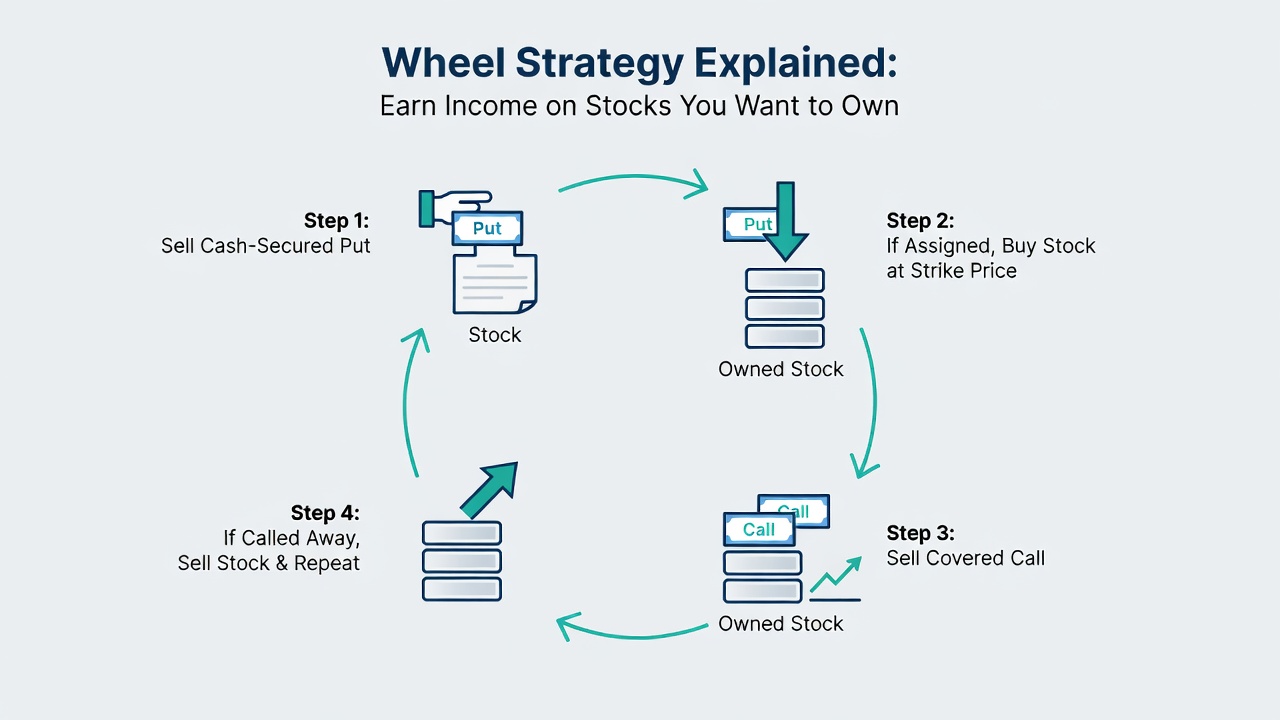
This cyclical, rotating nature is why traders call it a wheel. It turns continuously, generating cash at every stage of the cycle.
Step 1: Selling Cash-Secured Puts
The entire wheel begins with a pile of cash and a stock you love. In Part 27, we covered cash-secured puts in detail as a way to get paid to wait for a discount.
To start, you pick a strike price below the current share price where you would happily buy 100 shares. You sell an out-of-the-money put option contract and immediately pocket the premium cash in your brokerage account.
Your broker holds enough cash in your account to purchase those 100 shares if the stock drops to your chosen strike price. That cash stays locked up as collateral until the option expires or you close the trade.
From here, exactly two outcomes can occur by expiration date. Either the stock stays above your strike price, or it drops below it.
If the stock stays above your strike, the put expires completely worthless. You keep 100% of the premium as pure profit, your cash is unlocked, and you simply sell another put to repeat Step 1.
Free For Traders
One Clear Arrow. Every High-Probability Setup. Free.
The Fusion Indicator combines multiple signals into a single buy/sell arrow on TradingView so you never miss a move.
 → Get The Free Fusion Indicator
Step 2: Taking Assignment and Owning the Shares
The second possible outcome from selling your put is assignment, which we explored thoroughly in Part 20. If the stock finishes below your strike price at expiration, you are legally assigned the shares.
Your broker automatically uses your locked cash to buy 100 shares of the stock at your agreed strike price. Many beginners panic when this happens, but in the Wheel Strategy, assignment is an expected, welcomed milestone.
Remember, you chose this stock specifically because you wanted to own it at that price. Even better, your true cost basis is actually lower than the strike price because you keep the put premium you collected upfront.
Let us look at a quick mathematical example to see how the cost basis reduction works. Suppose you sell a $50 strike put on XYZ stock and collect a $2.00 per share premium ($200 total).
If the stock drops to $48 and you get assigned, you buy 100 shares at $50 each ($5,000 total outlay). But because you already banked $200 in premium, your effective net cost per share is only $48.00.

Step 3: Selling Covered Calls for Income
Now that you own 100 shares of stock, you immediately shift to Step 2 of the wheel: selling covered calls. We covered the mechanics of covered calls back in Part 26, and here is where they shine.
You pick a strike price at or above your net cost basis and sell a call option against your 100 shares. You immediately collect another cash premium directly into your account.
While you hold these shares, you are an official shareholder. That means you are entitled to collect any quarterly dividend payouts the company distributes while you wait.
Just like with the put, there are only two paths forward when your covered call reaches expiration. The stock will either finish below your call strike price, or above it.
If the stock stays below the call strike, the call option expires worthless. You keep the full premium, you keep all 100 shares of stock, and you sell another covered call for the next month.
Step 4: Completing the Circle (Getting Called Away)
If the stock rallies and finishes above your covered call strike price at expiration, your shares get called away. Your broker sells your 100 shares at the agreed strike price and deposits the full cash proceeds into your account.
When this happens, you have completed one full turn of the wheel. You won on multiple fronts across the entire journey.
You kept the initial put premium, captured the capital gain between your purchase price and call strike, collected any dividends paid along the way, and kept the call premium. You now have all your original capital back plus all accumulated profits, sitting purely in liquid cash.
Now the wheel starts fresh. You take that enlarged pool of cash, find your target strike price, and sell a new cash-secured put.
This repeatable loop is what makes the strategy so appealing for patient, methodical traders. You are constantly getting paid to enter positions, and getting paid while waiting to exit positions.
From Find Better Trades
Only Trade When Momentum Is HEAVILY In Your Favor
The Power Index oscillator measures trend conviction at a glance — it filters out weak, choppy action so you only take the strong moves.
 → See The Power Index

A Complete Worked Example from Start to Finish
Let us trace a full cycle with real numbers so you can see the math operating in sequence. Suppose solid blue-chip stock ABC is currently trading at $105 per share, and you have $10,000 in cash available.
Phase 1: The Cash-Secured Put
You sell one 30-day put contract with a strike price of $100 for a $3.00 premium. You immediately collect $300 in cash ($3.00 × 100 shares), while your broker reserves $10,000 in cash collateral.
At expiration, ABC stock trades down to $97, so you are assigned. You purchase 100 shares at the $100 strike price for $10,000, bringing your net cost basis down to $97 per share ($100 strike minus $3.00 premium).
Phase 2: The Covered Call
With ABC trading at $97, you now sell one 30-day call contract with a $102 strike price for a $2.50 premium. You instantly pocket another $250 in cash.
Over the next month, ABC announces solid quarterly earnings and rallies up to $104 per share. Because the stock price is above your $102 strike, your shares get called away at $102 each, yielding $10,200 in cash.
| Stage of the Wheel | Cash Inflow / Outflow | Running Profit |
|---|---|---|
| Sell $100 Put | +$300 premium | +$300 |
| Put Assignment (Buy 100 Shares) | -$10,000 (buy at $100) | +$300 (Net basis $97) |
| Sell $102 Call | +$250 premium | +$550 |
| Call Assignment (Sell 100 Shares) | +$10,200 (sold at $102) | +$750 Total Profit |
In two months, you turned your original $10,000 cash balance into $10,750, representing a total return of 7.5% across the full cycle. You now hold $10,750 in cash and are free to sell your next put.
How to Select the Right Stocks for the Wheel
The single most critical factor in running the wheel successfully is stock selection. If you pick the wrong underlying stock, the entire mechanics of the strategy fall apart.
You must only trade the wheel on companies with solid fundamentals, dependable balance sheets, and steady business models. Ask yourself one simple question before placing any trade: would I be completely comfortable holding this stock for the next three years if the market crashes?
If the honest answer is no, do not run the wheel on that ticker. Avoid speculative meme stocks, unprofitable penny stocks, and volatile biotech names offering sky-high premiums.
Those juicy premiums look tempting, but they exist because the market expects the stock price to collapse. If a stock falls from $40 to $8, no amount of call premium will rescue your broken position.
Stick to profitable companies, broad index exchange-traded funds, and market leaders with high options trading volume and tight bid-ask spreads.
Common Mistakes Beginners Make With This
Chasing high implied volatility on junk stocks: Beginners often sort options screeners by the highest yields and pick erratic, low-quality stocks. When those stocks tank 50%, you get stuck holding massive unrealized losses that wipe out months of small premium gains.
Selling calls below your adjusted cost basis: When an assigned stock drops sharply, novice traders get impatient and sell covered calls with strikes below what they paid. If the stock abruptly recovers, their shares are forced away at a permanent, realized net loss.
Panicking when assigned stock: Taking assignment on your put is an intended step in the process, not a failure. Beginners frequently panic-sell their assigned shares at a loss on Monday morning instead of calmly transitioning to Step 2 and selling a covered call.
Over-allocating capital to a single ticker: Putting 100% of your account into one single stock’s wheel leaves you dangerously exposed to company-specific disaster. Always spread your wheel trades across multiple uncorrelated sectors to protect your overall portfolio.
Wheel Strategy FAQ
How much capital do I need to start the Wheel Strategy?
You need enough cash to purchase 100 shares of your chosen stock at your desired put strike price. For a $30 stock, that means having $3,000 in cash collateral available in your account.
What happens if the stock price drops drastically below my put strike?
You will be assigned the 100 shares at your strike price, resulting in an immediate unrealized paper loss on the stock. You keep your put premium, own the shares, and can patiently sell covered calls at or above your cost basis while waiting for the stock to recover.
How far out in time should I sell my options contracts?
Most experienced wheel traders sell options expiring in 30 to 45 days. This timeframe sits right in the sweet spot of rapid theta time decay while still offering meaningful premium payouts.
Can I lose money running the Wheel Strategy?
Yes, your primary risk is identical to owning regular stock: the underlying share price can decline significantly. While collected option premiums soften the blow and lower your breakeven, severe downward drops will still produce net losses.
Next up in Part 36, I am going to show you how earnings season radically warps options pricing and how you can protect your trades from sudden post-announcement volatility crush.
📈 Want More? Join Our Free Trading Community
- Trading Strategy Guides Telegram — daily strategy tips and market insights
- Find Better Trades Telegram — free trade signals delivered to your phone
- Find Better Trades on YouTube — live trade breakdowns and tutorials
Lesson 35 of 52 in the free Options Trading Course.
← Previous: Iron Condor Explained: The Complete Beginner’s Guide
Next: How Earnings Season Affects Options Pricing: Beginner Guide →