Weekly vs Monthly Options: How to Choose the Right Expiration

📚 Beginner’s Guide to Options — Part 39 of 51
- Part 1: What Is an Option? The Absolute Basics Explained
- Part 2: Calls vs. Puts: The Two Types of Options You Need to Know
- Part 3: Strike Price Explained: What It Actually Means for Your Trade
- Part 4: Expiration Date Explained: Why It Changes Everything
- Part 5: Premium Explained: What You’re Really Paying For
- Part 6: In the Money vs. Out of the Money: A Beginner’s Breakdown
- Part 7: Intrinsic Value vs. Extrinsic Value: What Makes Up an Option’s Price
- Part 8: How Buying a Call Option Works, Step by Step
- Part 9: How Buying a Put Option Works, Step by Step
- Part 10: What Happens When an Option Expires? Every Outcome Explained
- Part 11: Options Contracts 101: What One Contract Actually Represents
- Part 12: How to Read an Options Chain Without Getting Overwhelmed
- Part 13: Bid, Ask, and Spread: What They Mean When You’re Trading Options
- Part 14: What Is Implied Volatility? A Beginner’s Plain-English Guide
- Part 15: Why Options Lose Value Over Time: Theta Explained Simply
- Part 16: Delta Explained: What It Really Tells You About Your Option
- Part 17: Gamma Explained: Why Delta Doesn’t Stay the Same
- Part 18: Vega Explained: How Volatility Changes Your Option’s Price
- Part 19: The Greeks Cheat Sheet: Delta, Gamma, Theta, Vega in Plain English
- Part 20: What Is Assignment? What Happens If Your Option Gets Exercised
- Part 21: American vs. European Options: What’s the Difference?
- Part 22: How Much Money Do You Need to Start Trading Options?
- Part 23: Paper Trading Options: How to Practice Before Risking Real Money
- Part 24: The Biggest Mistake Beginners Make Buying Options
- Part 25: Why Most Beginners Lose Money Buying Options (and How to Avoid It)
- Part 26: Covered Calls Explained: The First Options Strategy Every Trader Should Learn
- Part 27: Cash-Secured Puts Explained: A Beginner-Friendly Way to Get Paid to Wait
- Part 28: Vertical Spreads Explained: Reducing Risk on Your First Options Trade
- Part 29: Credit Spreads vs. Debit Spreads: What’s the Real Difference?
- Part 30: The Protective Put Explained: Insurance for Your Stock Position
- Part 31: The Collar Strategy Explained: Protecting Gains Without Selling
- Part 32: Straddles Explained: Betting on a Big Move (In Either Direction)
- Part 33: Strangles Explained: A Cheaper Way to Bet on a Big Move
- Part 34: The Iron Condor Explained for Complete Beginners
- Part 35: The Wheel Strategy Explained: Getting Paid on Stocks You Want to Own
- Part 36: How Earnings Season Changes Options Pricing (and What to Watch For)
- Part 37: Why Options Get More Expensive Before Earnings: IV Crush Explained
- Part 38: Choosing the Right Strike Price for Your First Options Trade
- Part 39: Choosing the Right Expiration Date: Weekly vs. Monthly Options (you are here)
⚡ Key Takeaways
- Weekly options cost less upfront but suffer from brutal, accelerating time decay that leaves zero room for error.
- Monthly options give your trade idea room to breathe, protecting you from being right on the stock’s direction but wrong on the timing.
- For most beginners buying calls or puts, targeting 30 to 60 days to expiration strikes the sweet spot between upfront cost and trade survival.
— Ben, Find Better Trades
Welcome back to Part 39 of our 51-part beginner series. In the previous part, we worked through how to pick the right strike price for your trade.
Now we have to solve the other half of the puzzle: choosing your expiration date. This single decision often determines whether a trade makes money or expires worthless, even when you get the direction of the stock completely right.
1. Weekly vs Monthly Options: What Are They Actually?
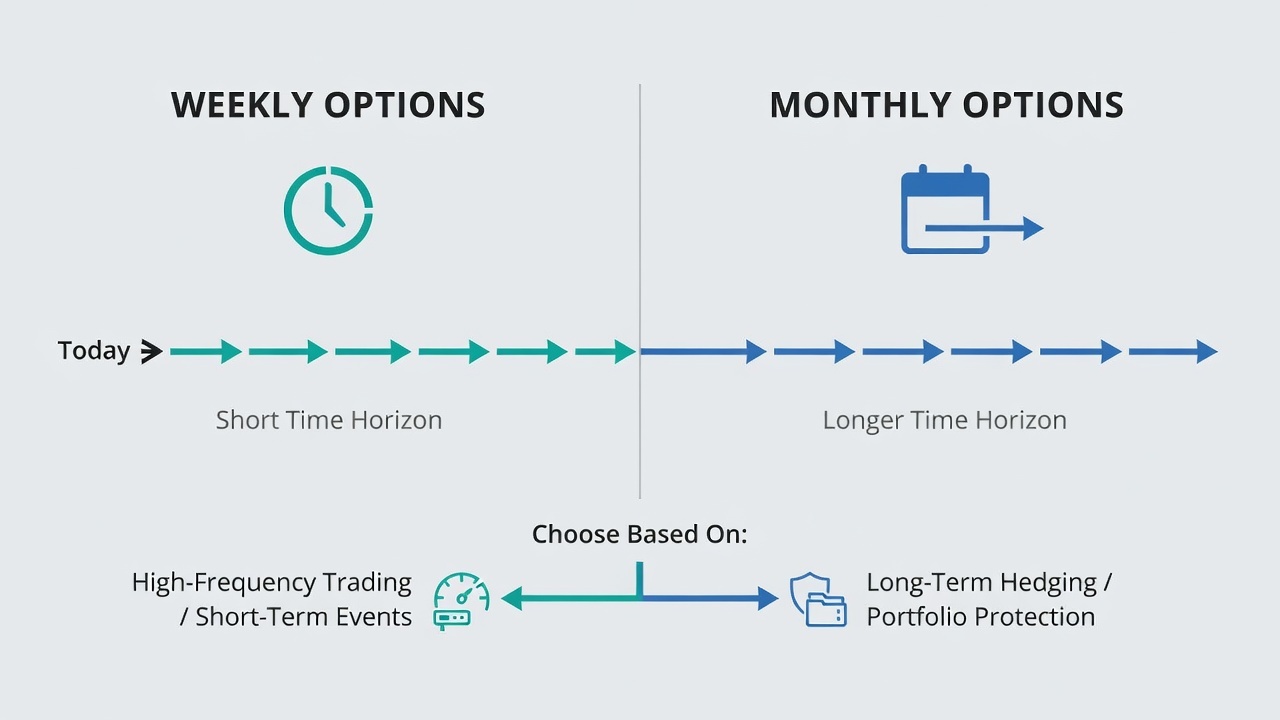
When options were first created, every contract expired on the third Friday of a given month. These are what we call monthly options, and they remain the backbone of the options market.
Over the last decade, exchanges introduced weekly options to give traders more flexibility. Weekly options expire on regular Fridays (and on major index funds like SPY, sometimes every single trading day).
A monthly option simply means the contract is pegged to that third Friday cycle, usually available months or even years in advance. A weekly option is created just a few weeks before it expires, offering short-term bursts of trading action.
Because monthly options have been around much longer, they almost always have higher trading volume and tighter bid-ask spreads. As we covered in Part 13, narrower spreads mean you lose less money just entering and exiting the position.
Weekly options are fantastic tools for very specific, fast-moving tactics. But for someone still finding their footing, they introduce massive hidden risks that can wipe out a small account in days.
2. The Time Factor: Why Expiration Controls Your Margin for Error
Think of buying an options contract like paying for a parking meter. If you put 15 minutes of change into the meter, you have to sprint into the store, grab your item, and sprint back before getting a ticket.
If you feed the meter for two full hours, you can walk at a normal pace, get stuck in a short checkout line, and still make it back to your car without stressing out. That extra time bought you a buffer against unexpected delays.
When you buy an option with 5 days until expiration, your stock cannot just go up; it has to go up immediately. If the stock chops sideways for three days before making a huge run on day six, your 5-day option still expires at zero.
When you buy an option with 45 days until expiration, you give your stock thesis time to play out. The stock can dip on Monday, recover on Thursday, drift sideways for a week, and still deliver a winning trade when its momentum finally arrives.
Time is the only asset in options trading that you cannot negotiate with. The less time you put on the clock, the more precision you need on both direction and timing.
Free For Traders
Know The EXACT Moment A Stock Hits Support Or Resistance
Real-time alerts fire the instant a stock approaches a critical level. Completely free.
 → Claim Free S&R Alerts
3. The Cost Illusion: Why Cheap Weekly Options Are Often a Trap
Here is how almost every beginner gets hooked on weeklies: they open an options chain, see a monthly call trading for $4.00 ($400 total), and see a weekly call trading for $0.50 ($50 total). They think, “I can buy eight weekly contracts for the price of one monthly contract!”
This is the classic lottery-ticket trap. The weekly option is not a bargain; it is priced cheaply because the market knows it has an extremely low statistical probability of finishing in the money.
Let’s walk through an example. Suppose stock XYZ is trading at $100 per share, and you believe it will climb to $105.
You look at a weekly $102 call expiring in 4 days for $0.40 ($40 per contract). You also look at a 45-day monthly $102 call selling for $2.50 ($250 per contract).
To make money on that weekly call by expiration, XYZ must gain more than $2.40 (a 2.4% move) in less than 96 hours just to break even. On the 45-day call, XYZ has six full weeks to make a 4.5% move, giving you dozens of market sessions to capture a swing.
Paying $40 for something that has an 85% chance of expiring worthless is far more expensive over ten trades than paying $250 for an asset that gives you room to manage the position.

4. Understanding Theta: How Time Decay Eats Weeklies vs Monthlies
Back in Part 15, we covered theta, which measures how much value an option loses each day simply because time passes. Time decay does not move in a straight line; it accelerates dramatically as expiration approaches.
Between 60 days and 30 days before expiration, time decay is relatively gentle and steady. An option might lose just a few pennies of extrinsic value every 24 hours.
Once an option enters its final 14 days, the decay curve drops off a cliff. During the final 3 to 5 days, an out-of-the-money option can bleed 20% to 40% of its remaining value every single day, even if the underlying stock does not move at all.
When you hold a weekly option, you are fighting this exponential decay from the second you click buy. You start each trading morning in a deficit because overnight decay chipped away at your contract’s value.
Monthly options shield you from that cliff. By entering a trade with 30 to 60 days to expiration and closing it with 15 to 20 days left, you bypass the worst part of the decay curve entirely.
5. Gamma Risk: The Double-Edged Sword of Short-Dated Expirations
In Part 17, we learned that gamma measures how fast your delta changes when the stock price moves. Short-dated weekly options have extremely high gamma.
High gamma sounds exciting because when the stock makes a sudden move in your favor, your option price explodes upward instantly. But gamma works both ways with equal violence.
A tiny 1% pullback in the stock price can cause an out-of-the-money weekly call to lose half its value in twenty minutes. That wild sensitivity makes it nearly impossible to set sane stop-losses without getting shaken out constantly.
Monthly options have much lower gamma. When the stock dips against you, the option loses value at a manageable, measured pace.
This stability allows you to stay calm, evaluate whether your core trade thesis is still intact, and make rational decisions rather than panic-selling at the first red candle.
From Find Better Trades
See The Big Money Move BEFORE The Price Does
Gravity Zone detects hidden institutional accumulation on TradingView — so you’re in the breakout while retail is still waiting for confirmation.
 → See Gravity Zone In Action

6. A Side-by-Side Trade Walkthrough: 7 DTE vs 45 DTE
Let’s put both approaches head-to-head in a realistic scenario so you can see how the math plays out in real life. Suppose stock ABC is trading at $150. You expect positive earnings sentiment to push the stock to $156 over the next two weeks.
Trader A buys a 7 DTE (Days to Expiration) $152.50 weekly call for $1.00 ($100 risk). Trader B buys a 45 DTE $152.50 monthly call for $4.20 ($420 risk).
Here is what happens over the next 14 trading days:
| Timeline | Stock ABC Price | Trader A (7 DTE Call) | Trader B (45 DTE Call) |
|---|---|---|---|
| Day 1 | $150.00 | Purchased for $1.00 | Purchased for $4.20 |
| Day 4 | $149.00 (minor dip) | Value: $0.20 (-80%) | Value: $3.60 (-14%) |
| Day 7 | $151.00 (bouncing) | Expires at $0.00 (-100%) | Value: $3.90 (-7%) |
| Day 12 | $156.00 (target hit!) | Position already dead ($0) | Value: $6.80 (+62%) |
Notice what happened here: both traders had the exact same bullish thesis, and the stock reached the exact target they predicted. Trader A lost 100% of their money because the stock took 12 days to make the move instead of 7.
Trader B weathered the early pullback easily, kept their position intact through the chop, and walked away with a $260 profit per contract when the move finally materialized.
7. Ben’s Rule of Thumb: How to Pick Your Expiration Date for Every Trade
To keep yourself out of trouble, I recommend using a simple set of guidelines based on whether you are buying or selling options.
When buying calls or puts (Debit Trades): Target 30 to 60 days to expiration (DTE). This gives you the best protection against rapid time decay while keeping the upfront capital reasonable.
Plan to close or roll your long options once they hit 15 to 20 DTE. You never want to sit through the aggressive final decay phase unless the option is already deep in the money.
When selling options (Credit Spreads, Covered Calls, Cash-Secured Puts): Look at 30 to 45 DTE for opening positions. As we covered in Parts 26 and 27, this window captures the steepest slope of the decay curve while still providing enough premium to justify your risk.
Save weekly options for very specific, mechanical day-trading strategies or catalyst events where you intend to be in and out of the position within hours, not days.
Common Mistakes Beginners Make With This
Buying weeklies purely because they cost less in total dollars. A $30 contract that expires worthless ten times in a row costs you $300 and leaves you with zero. Buying a $200 monthly contract that actually gives your trade a realistic shot at profiting is far cheaper in the long run.
Holding short-dated options through the weekend. Time decay does not take Saturday and Sunday off. If you buy a weekly option on Thursday expecting a move next week, two full days of weekend decay will hit the pricing model by Monday morning before you even get a chance to trade.
Confusing stock patience with options patience. When you own shares of stock, you can afford to sit through a three-month consolidation until the stock breaks out. If you try that same patient mindset with a 10-day option, the contract will quietly decay to zero right under your nose.
Ignoring open interest on weekly contracts. Monthly options almost always have tens of thousands of contracts open across major strikes, ensuring tight spreads. Weekly options on secondary stocks can have wide bid-ask spreads that make it painful to get filled at a fair price.
Frequently Asked Questions About Choosing Options Expiration Dates
Are weekly options ever good for beginners? Generally, no. Weekly options require near-flawless timing and active, minute-by-minute management, which creates immense stress for someone still learning the mechanics of options pricing.
Why do some stocks have expirations every day while others only have monthlies? Highly liquid exchange-traded funds like SPY and QQQ have daily expirations due to massive institutional trading demand. Smaller individual stocks only have standard monthly contracts because there is not enough volume to support weekly chains.
If I buy a 45-day option, do I have to hold it for the entire 45 days? No, you can sell your option to close at any time during market hours. Most profitable traders take their gains or cut their losses well before the expiration date arrives.
How many days to expiration is considered a LEAP? LEAPS (Long-Term Equity Anticipation Securities) are options contracts with expiration dates greater than one year out. They behave much more like stock replacement strategies due to their very low time decay.
Now that you know how to pick the right strike and the right expiration date, there is only one piece left before you place a trade: understanding how much cash to actually commit so a single loss never sets you back.
📈 Want More? Join Our Free Trading Community
- Trading Strategy Guides Telegram — daily strategy tips and market insights
- Find Better Trades Telegram — free trade signals delivered to your phone
- Find Better Trades on YouTube — live trade breakdowns and tutorials
Lesson 39 of 55 in the free Options Trading Course.
← Previous: How to Choose the Right Strike Price for Options: Beginner Guide
Next: Options Position Sizing: How to Protect Your Account →