LEAPS Options Explained: How to Trade Long-Term Options


📚 Beginner’s Guide to Options — Part 47 of 51
- Part 1: What Is an Option? The Absolute Basics Explained
- Part 2: Calls vs. Puts: The Two Types of Options You Need to Know
- Part 3: Strike Price Explained: What It Actually Means for Your Trade
- Part 4: Expiration Date Explained: Why It Changes Everything
- Part 5: Premium Explained: What You’re Really Paying For
- Part 6: In the Money vs. Out of the Money: A Beginner’s Breakdown
- Part 7: Intrinsic Value vs. Extrinsic Value: What Makes Up an Option’s Price
- Part 8: How Buying a Call Option Works, Step by Step
- Part 9: How Buying a Put Option Works, Step by Step
- Part 10: What Happens When an Option Expires? Every Outcome Explained
- Part 11: Options Contracts 101: What One Contract Actually Represents
- Part 12: How to Read an Options Chain Without Getting Overwhelmed
- Part 13: Bid, Ask, and Spread: What They Mean When You’re Trading Options
- Part 14: What Is Implied Volatility? A Beginner’s Plain-English Guide
- Part 15: Why Options Lose Value Over Time: Theta Explained Simply
- Part 16: Delta Explained: What It Really Tells You About Your Option
- Part 17: Gamma Explained: Why Delta Doesn’t Stay the Same
- Part 18: Vega Explained: How Volatility Changes Your Option’s Price
- Part 19: The Greeks Cheat Sheet: Delta, Gamma, Theta, Vega in Plain English
- Part 20: What Is Assignment? What Happens If Your Option Gets Exercised
- Part 21: American vs. European Options: What’s the Difference?
- Part 22: How Much Money Do You Need to Start Trading Options?
- Part 23: Paper Trading Options: How to Practice Before Risking Real Money
- Part 24: The Biggest Mistake Beginners Make Buying Options
- Part 25: Why Most Beginners Lose Money Buying Options (and How to Avoid It)
- Part 26: Covered Calls Explained: The First Options Strategy Every Trader Should Learn
- Part 27: Cash-Secured Puts Explained: A Beginner-Friendly Way to Get Paid to Wait
- Part 28: Vertical Spreads Explained: Reducing Risk on Your First Options Trade
- Part 29: Credit Spreads vs. Debit Spreads: What’s the Real Difference?
- Part 30: The Protective Put Explained: Insurance for Your Stock Position
- Part 31: The Collar Strategy Explained: Protecting Gains Without Selling
- Part 32: Straddles Explained: Betting on a Big Move (In Either Direction)
- Part 33: Strangles Explained: A Cheaper Way to Bet on a Big Move
- Part 34: The Iron Condor Explained for Complete Beginners
- Part 35: The Wheel Strategy Explained: Getting Paid on Stocks You Want to Own
- Part 36: How Earnings Season Changes Options Pricing (and What to Watch For)
- Part 37: Why Options Get More Expensive Before Earnings: IV Crush Explained
- Part 38: Choosing the Right Strike Price for Your First Options Trade
- Part 39: Choosing the Right Expiration Date: Weekly vs. Monthly Options
- Part 40: How to Size an Options Position So One Bad Trade Doesn’t Wreck You
- Part 41: When to Take Profits on an Options Trade (Before It’s Too Late)
- Part 42: When to Cut a Losing Options Trade (Before It Goes to Zero)
- Part 43: Rolling an Options Position: What It Means and When to Do It
- Part 44: Liquidity in Options: Why It Matters More Than Beginners Think
- Part 45: Open Interest vs. Volume: What Each One Actually Tells You
- Part 46: How to Use Options to Hedge a Stock Position You Already Own
- Part 47: LEAPS Explained: Trading Options That Last a Year or More (you are here)
⚡ Key Takeaways
- LEAPS are standard options contracts with expiration dates extending one year or further into the future.
- Deep in-the-money LEAPS calls allow you to control 100 shares of stock for a fraction of the share price while slashing the daily rate of time decay.
- The best way to trade LEAPS is treating them like leveraged stock substitutes rather than cheap lottery tickets.
— Ben, Find Better Trades
Most beginners start trading options by buying contracts that expire in two or three weeks. They quickly discover that rapid time decay eats away their balance before the stock ever makes its expected move.
Welcome to Part 47 of our series. Today, we are slowing the clock down and looking at LEAPS, which give you a year or more of breathing room on your trades.
What Exactly Is a LEAPS Option?
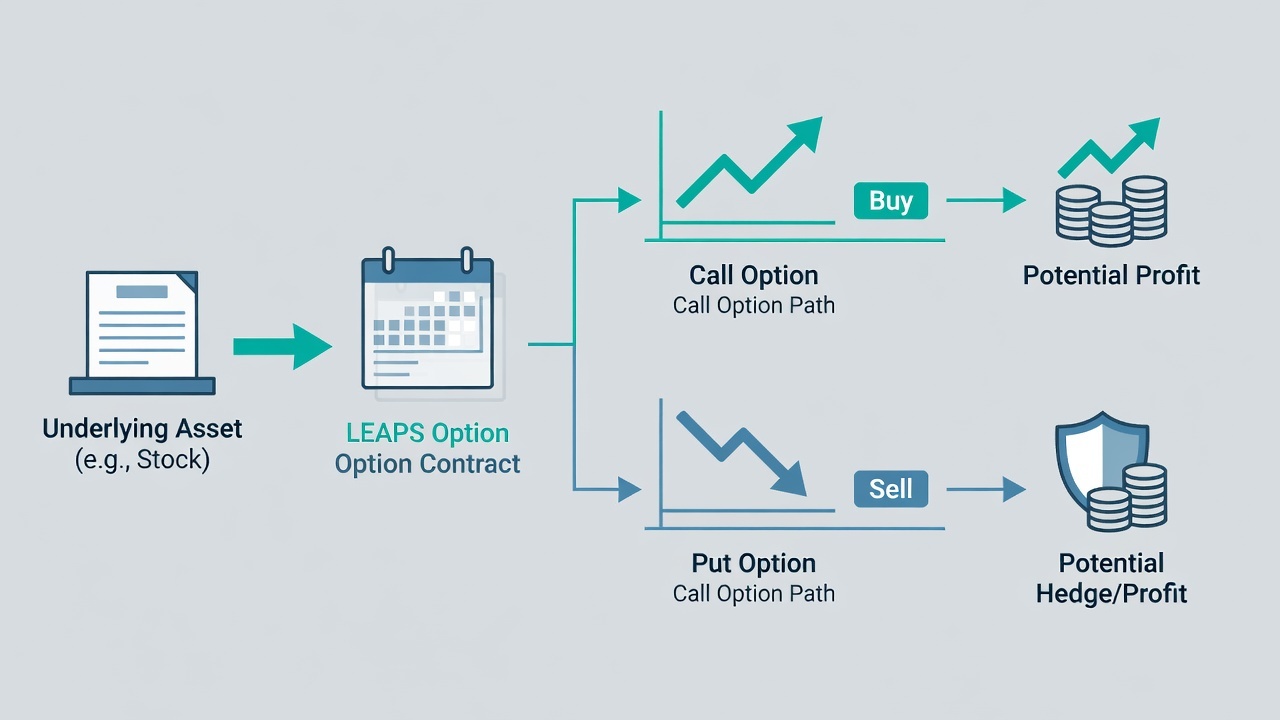
LEAPS stands for Long-Term Equity Anticipation Securities. Despite the formal financial acronym, they are mechanically identical to the regular calls and puts we have studied throughout this series.
A LEAPS contract controls exactly 100 shares of the underlying stock. It comes with a strike price, an expiration date, and trades on standard options exchanges just like a weekly or monthly contract.
The sole feature that defines a LEAPS contract is its expiration horizon. By industry convention, any listed option contract with an expiration date of one year or longer from today qualifies as a LEAPS.
Think of it like leasing a commercial building. A standard short-term option is like renting a pop-up storefront for thirty days, where you must generate sales immediately or pack up at a total loss.
A LEAPS is like securing a multi-year lease with a fixed purchase option down the road. You give your business plan plenty of runway to play out without worrying about what happens next Tuesday.
Why Traders Use LEAPS Instead of Buying Stock Directly
The primary appeal of a LEAPS call is capital efficiency. Buying 100 shares of a quality company trading at $200 per share requires $20,000 in upfront cash.
That is a substantial chunk of capital for most accounts. It ties up funds that you cannot deploy into other opportunities.
With a deep in-the-money LEAPS call, you might only need to put up $4,000 to control those exact same 100 shares for the next two years. That represents an 80% discount on initial cash outlay.
Your downside is also strictly capped at the premium you paid. If the company suffers an unforeseen catastrophe and goes bankrupt, you lose only that $4,000 premium instead of the entire $20,000 stock value.
You effectively capture the vast majority of the stock’s upside while risking a fraction of the out-of-pocket capital.
Free For Traders
One Clear Arrow. Every High-Probability Setup. Free.
The Fusion Indicator combines multiple signals into a single buy/sell arrow on TradingView so you never miss a move.
 → Get The Free Fusion Indicator
How Theta Decay Works on Long-Dated Options
Back in Part 15, we covered theta decay, which is the steady loss of an option’s extrinsic value as time ticks toward expiration. We learned that time decay is not linear.
For short-dated options expiring in 30 days or less, the decay curve looks like a steep cliff. The extrinsic value vanishes at an accelerating pace with every passing market session.
With a LEAPS contract that has 500 or 700 days remaining, that decay curve is remarkably flat. The daily erosion of extrinsic value is tiny, often amounting to just pennies per day.
This creates a massive strategic advantage for the buyer. You are no longer fighting the ticking clock every single morning you open your brokerage account.
You can be early on a long-term fundamental thesis without paying a brutal daily penalty for being patient.

Choosing the Right Strike and Delta for a LEAPS Call
When beginners discover LEAPS, their first instinct is often to buy cheap out-of-the-money strikes two years out. That is a costly habit that turns a high-probability strategy into an expensive lottery ticket.
Out-of-the-money LEAPS consist purely of extrinsic value. If the stock does not make an explosive move higher, all of that premium will eventually evaporate.
I prefer buying deep in-the-money calls with a Delta of 0.80 or higher. As we learned in Part 16, an 0.80 Delta means the option contract gains roughly $0.80 for every $1.00 increase in the underlying stock price.
Deep in-the-money options are made mostly of intrinsic value. Because you are paying very little extrinsic time value, you expose yourself to minimal time decay.
You gain a synthetic stock position that closely mirrors actual share ownership without carrying pure speculative fluff.
Worked Example: Buying Shares vs. Buying a Deep In-the-Money LEAPS Call
Let us walk through a practical scenario to see the real math behind a LEAPS call versus owning shares outright. Suppose hypothetical stock XYZ is trading at $150 per share.
An investor with a bullish two-year outlook decides between purchasing 100 shares or purchasing one deep in-the-money LEAPS call expiring in 700 days.
Buying 100 shares requires an upfront cash payment of $15,000 ($150 multiplied by 100). The investor looks at the 700-day expiration chain and finds a $110 strike call trading for a premium of $50 per share ($5,000 total).
Because XYZ is at $150, the $110 call contains $40 of intrinsic value ($150 minus $110) and only $10 of extrinsic time value ($50 total price minus $40 intrinsic). This contract has a Delta around 0.85.
| Metric | 100 Shares of Stock | $110 Strike LEAPS Call |
|---|---|---|
| Upfront Capital Required | $15,000 | $5,000 |
| Breakeven at Expiration | $150.00 | $160.00 ($110 strike + $50 premium) |
| Profit if Stock Hits $200 | +$5,000 (+33.3% return) | +$4,000 (+80.0% return) |
| Loss if Stock Drops to $100 | -$5,000 (-33.3% return) | -$5,000 (-100% of premium) |
| Max Loss Possible | $15,000 (if stock goes to $0) | $5,000 (premium paid) |
If XYZ rallies to $200 at expiration, the LEAPS is worth $90 ($200 stock price minus $110 strike). Subtracting the $50 initial cost yields a $40 per share profit, or $4,000 total.
The stock buyer made $5,000 on a $15,000 commitment (a 33.3% gain), while the LEAPS buyer captured $4,000 on a $5,000 commitment (an 80% gain). The remaining $10,000 of cash remained safely parked in interest-bearing cash equivalents.
From Find Better Trades
Only Trade When Momentum Is HEAVILY In Your Favor
The Power Index oscillator measures trend conviction at a glance — it filters out weak, choppy action so you only take the strong moves.
 → See The Power Index

Using LEAPS Puts for Long-Term Downside Protection
While LEAPS calls get the spotlight as stock replacements, LEAPS puts serve as long-term portfolio insurance. We introduced protective puts back in Part 30, but those are usually short-term hedges.
Buying a LEAPS put gives you the contractual right to sell shares at a specified strike price for over a year into the future. It operates like a multi-year disaster insurance policy on your investments.
Suppose you hold a large concentrated position in a growth stock with massive unrealized capital gains. Selling the shares triggers an immediate tax liability you want to avoid.
By purchasing an in-the-money or at-the-money LEAPS put, you lock in a guaranteed floor price for your shares over the next twelve to twenty-four months. If the sector crashes, your put value expands to offset the portfolio drawdown.
Because daily theta decay is minimal on LEAPS, the annualized cost of maintaining this insurance is much lower than constantly buying thirty-day puts and rolling them every month.
Managing and Exiting a LEAPS Position Over Time
The biggest psychological challenge with LEAPS is forgetting that time eventually runs out. Just because an option has 600 days to live does not mean you should hold it for 600 days.
As a LEAPS contract crosses below the 90-day to 120-day threshold, it transforms back into a standard short-term option. That flat theta curve suddenly steepens, and time decay begins chewing into your remaining extrinsic value.
A professional rule of thumb is to manage or roll your LEAPS position when it reaches six to nine months before expiration. We covered rolling mechanics back in Part 43.
If your trade is profitable, you can sell the LEAPS contract to book your gains long before expiration week arrives. You never have to exercise the option to extract its full monetary value.
If your thesis is still unfolding and you want continued exposure, you simply sell your current contract and buy a new one dated another year or two out in time.
Common Mistakes Beginners Make With LEAPS
Buying cheap out-of-the-money strikes: New traders see a two-year call trading for $1.50 and buy twenty contracts. Because the strike is far above current market prices, these contracts carry massive extrinsic value that steadily bleeds out unless a historic rally occurs.
Holding all the way into expiration week: Beginners treat LEAPS like long-term stock holdings and ignore them for two years. As the contract enters its final ninety days, accelerating theta decay destroys remaining profits that took months to accumulate.
Ignoring wide bid-ask spreads: Because LEAPS contracts have lower daily trading volume than weeklies (as we explored in Part 44), their bid-ask spreads can be wide. Submitting market orders instead of strict limit orders immediately gives away hundreds of dollars in slippage.
Over-leveraging the position size: Having $15,000 in your account does not mean you should buy three LEAPS contracts instead of 100 shares of stock. If the stock suffers a steep correction, losing 100% of three contracts ($15,000) wipes out your entire balance.
Frequently Asked Questions About LEAPS Options
Can I sell my LEAPS option before expiration?
Yes, you can sell your LEAPS contract on the open market at any time during normal trading hours. You do not need to hold the contract until expiration, and most traders close their positions months in advance to lock in gains.
Do LEAPS options pay dividends?
No, options contracts do not collect dividend distributions. However, expected dividend payments are already factored into the pricing of the LEAPS call and put contracts across the options chain.
How far out can you buy a LEAPS option?
Depending on the specific stock and exchange listings, LEAPS contracts are generally available with expiration dates ranging from one to nearly three years in advance. Expiration chains are typically added by exchanges in September, October, and January of each year.
Are LEAPS taxed as long-term capital gains?
If you hold an equity LEAPS option contract for more than one full year (366 days or more) before selling it at a profit, the gain qualifies for long-term capital gains tax rates in the United States. If you close it before reaching the one-year mark, it is taxed at standard short-term rates.
Now that you know how to use long-dated options as a leveraged stock replacement, in Part 48 we will combine this exact tool with an income engine in a strategy known as the Poor Man’s Covered Call.
📈 Want More? Join Our Free Trading Community
- Trading Strategy Guides Telegram — daily strategy tips and market insights
- Find Better Trades Telegram — free trade signals delivered to your phone
- Find Better Trades on YouTube — live trade breakdowns and tutorials
Lesson 47 of 55 in the free Options Trading Course.
← Previous: How to Hedge a Stock Position with Options: Step-by-Step
Next: Poor Man’s Covered Call: Strategy Guide for Beginners →