Rolling an Options Position: What It Means and When to Do It

📚 Beginner’s Guide to Options — Part 43 of 51
- Part 1: What Is an Option? The Absolute Basics Explained
- Part 2: Calls vs. Puts: The Two Types of Options You Need to Know
- Part 3: Strike Price Explained: What It Actually Means for Your Trade
- Part 4: Expiration Date Explained: Why It Changes Everything
- Part 5: Premium Explained: What You’re Really Paying For
- Part 6: In the Money vs. Out of the Money: A Beginner’s Breakdown
- Part 7: Intrinsic Value vs. Extrinsic Value: What Makes Up an Option’s Price
- Part 8: How Buying a Call Option Works, Step by Step
- Part 9: How Buying a Put Option Works, Step by Step
- Part 10: What Happens When an Option Expires? Every Outcome Explained
- Part 11: Options Contracts 101: What One Contract Actually Represents
- Part 12: How to Read an Options Chain Without Getting Overwhelmed
- Part 13: Bid, Ask, and Spread: What They Mean When You’re Trading Options
- Part 14: What Is Implied Volatility? A Beginner’s Plain-English Guide
- Part 15: Why Options Lose Value Over Time: Theta Explained Simply
- Part 16: Delta Explained: What It Really Tells You About Your Option
- Part 17: Gamma Explained: Why Delta Doesn’t Stay the Same
- Part 18: Vega Explained: How Volatility Changes Your Option’s Price
- Part 19: The Greeks Cheat Sheet: Delta, Gamma, Theta, Vega in Plain English
- Part 20: What Is Assignment? What Happens If Your Option Gets Exercised
- Part 21: American vs. European Options: What’s the Difference?
- Part 22: How Much Money Do You Need to Start Trading Options?
- Part 23: Paper Trading Options: How to Practice Before Risking Real Money
- Part 24: The Biggest Mistake Beginners Make Buying Options
- Part 25: Why Most Beginners Lose Money Buying Options (and How to Avoid It)
- Part 26: Covered Calls Explained: The First Options Strategy Every Trader Should Learn
- Part 27: Cash-Secured Puts Explained: A Beginner-Friendly Way to Get Paid to Wait
- Part 28: Vertical Spreads Explained: Reducing Risk on Your First Options Trade
- Part 29: Credit Spreads vs. Debit Spreads: What’s the Real Difference?
- Part 30: The Protective Put Explained: Insurance for Your Stock Position
- Part 31: The Collar Strategy Explained: Protecting Gains Without Selling
- Part 32: Straddles Explained: Betting on a Big Move (In Either Direction)
- Part 33: Strangles Explained: A Cheaper Way to Bet on a Big Move
- Part 34: The Iron Condor Explained for Complete Beginners
- Part 35: The Wheel Strategy Explained: Getting Paid on Stocks You Want to Own
- Part 36: How Earnings Season Changes Options Pricing (and What to Watch For)
- Part 37: Why Options Get More Expensive Before Earnings: IV Crush Explained
- Part 38: Choosing the Right Strike Price for Your First Options Trade
- Part 39: Choosing the Right Expiration Date: Weekly vs. Monthly Options
- Part 40: How to Size an Options Position So One Bad Trade Doesn’t Wreck You
- Part 41: When to Take Profits on an Options Trade (Before It’s Too Late)
- Part 42: When to Cut a Losing Options Trade (Before It Goes to Zero)
- Part 43: Rolling an Options Position: What It Means and When to Do It (you are here)
⚡ Key Takeaways
- Rolling an option is simply closing your current contract and opening a new one in a single transaction.
- You roll to buy yourself more time, adjust your strike price, or protect profits on a winning position.
- Never roll a losing trade blindly just to avoid taking a loss—only roll if your underlying thesis remains solid.
— Ben, Find Better Trades
When I first started trading options, I heard veterans talk about “rolling” positions like it was some kind of magical reset button. They made it sound as if you could wave a wand, push your mistakes into next month, and magically erase a bad trade.
Welcome to Part 43 of our beginner series. Today, we are stripping away the mystique around rolling options so you know exactly what happens behind the scenes and when to pull the trigger.
1. What Does Rolling an Option Actually Mean?
Let’s bust the biggest myth right out of the gate: rolling is not an automatic extension of your existing contract.
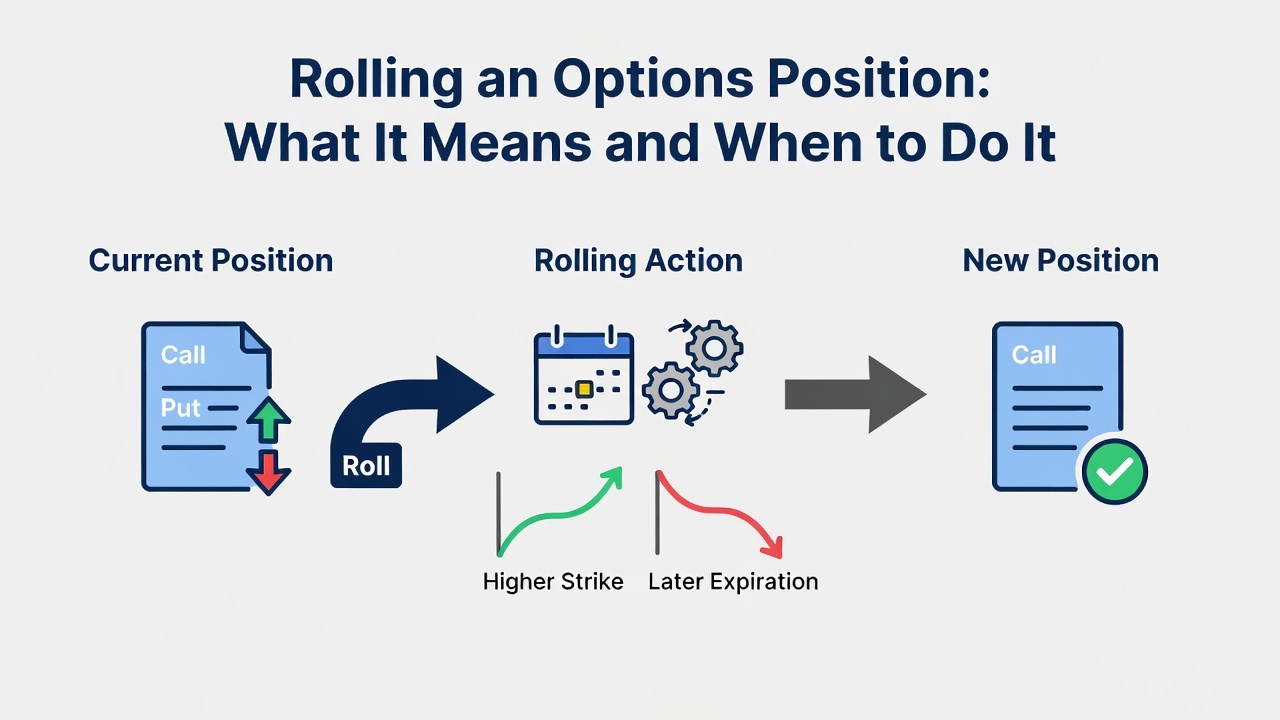
In reality, rolling is simply two separate trades packaged together into one single order ticket. You are closing an open contract that you already hold, and simultaneously opening a brand-new contract with a different expiration date, strike price, or both.
Think of it like leasing a car. When your two-year lease ends, you cannot just tell the dealership that the original agreement now lasts three years for free.
Instead, you turn in the old car, settle whatever balance or equity you have, and sign a brand-new lease agreement. Rolling an option works the exact same way with your broker.
You take your realized profit or loss on the existing contract right then and there. Then, you immediately deploy your capital into the new contract.
2. The Mechanics: Rolling Out, Rolling Up, and Rolling Down
Traders use specific terms to describe which direction they are moving their strikes or dates. Learning this language helps you understand exactly what an adjustment accomplishes.
The first term is rolling out, which simply means extending your expiration date further into the future while keeping the exact same strike price. You do this when your trade idea is working or needs more time, but the clock is ticking down on your current cycle.
The second term is rolling up, which means closing your current strike and opening a higher strike price with the same expiration date. Traders often do this on call positions when the stock has surged higher.
The third term is rolling down, which means closing your current strike and opening a lower strike price. You see this frequently when put sellers adjust their positions after a stock drops.
Finally, you can combine these moves into a roll up and out or a roll down and out. This changes both the strike price and the expiration date at the exact same moment.
| Roll Type | Strike Action | Expiration Action | Primary Goal |
|---|---|---|---|
| Roll Out | Keep Same | Move Further Out | Buy more time for the thesis to play out |
| Roll Up | Move Higher | Keep Same | Capture gains or follow an upward move |
| Roll Down | Move Lower | Keep Same | Defend downside or follow a downward move |
| Roll Up & Out | Move Higher | Move Further Out | Give a winning trade more room and time |
| Roll Down & Out | Move Lower | Move Further Out | Lower risk strike while collecting more time premium |
Free For Traders
This Free Indicator Finds Overbought & Oversold Levels For You
Add the Red & Green Zone indicator to TradingView at zero cost. It does the level-hunting automatically on any chart.
 → Get The Free Indicator
3. Rolling for a Credit vs. Rolling for a Debit
Whenever you roll an options trade, your broker calculates the net cash difference between the contract you close and the contract you open.
If the money you collect from opening the new option is greater than the cost to close the old option, you execute a roll for a net credit. Extra cash gets deposited directly into your account balance.
If the cost to close the old option is higher than the money you collect from the new one, you execute a roll for a net debit. In this scenario, you must pay additional cash out of your pocket to establish the new trade.
As a rule of thumb, options sellers (like covered call and cash-secured put traders) generally look to roll for a net credit whenever possible. Collecting a credit lowers your cost basis and keeps probability on your side.
Paying a net debit to roll a losing trade is dangerous. Doing that means you are paying extra money just to keep a broken idea alive, which turns a small loss into a much larger problem.

4. Worked Example 1: Rolling a Covered Call to Defend Shares
Let’s look at a realistic scenario with numbers so you can see how the math works in practice.
Suppose you own 100 shares of stock XYZ trading at $50 per share. Three weeks ago, you sold a monthly 30-day $52 strike covered call for a $1.00 premium ($100 total cash collected).
Unexpected good news hits the company, and XYZ stock surges quickly to $54 with only 4 days left until expiration. Because the stock is above your $52 strike, your shares are at risk of being called away at expiration.
You decide you want to keep the shares and capture more upside, so you choose to roll up and out to next month’s 30-day $55 call. Your broker executes this as a single spread order:
First, you buy back your current $52 call to close it for $2.30 ($230 cost). Next, you sell the next month’s $55 call to open it for $2.80 ($280 collected).
Your net result on the roll order is a $0.50 net credit ($2.80 collected minus $2.30 paid), putting another $50 in your pocket. At the same time, you moved your strike from $52 to $55, giving your 100 shares an extra $3.00 per share ($300 total) of potential upside room.
5. Worked Example 2: Rolling a Cash-Secured Put That Went Against You
Now let’s examine how to handle a trade that moves against you, using a cash-secured put as our example.
Imagine you sold a 30-day $100 put on stock ABC for a $2.00 premium ($200 collected) when the stock was trading at $103. You were happy to own the stock at $100, but a broader market pullback pushes ABC down to $96 with one week remaining.
Your $100 put is now in the money and trading at $4.50. If you do nothing, you will likely be assigned 100 shares at $100 each, putting you immediately down on paper.
Instead of taking assignment right now, you decide to roll out to the next monthly expiration at the same $100 strike to give the stock time to recover.
You buy to close your current $100 put for $4.50 ($450 paid) and sell to open the next month’s $100 put for $5.20 ($520 collected). You complete this trade for a $0.70 net credit ($70 added to your account).
Because you collected $2.00 originally and just added $0.70 from the roll, your total premium collected is now $2.70 per share. Your adjusted breakeven point drops to $97.30 ($100 strike minus $2.70), and you bought yourself another 35 days for the stock to bounce back.
From Find Better Trades
Know Exactly Where The Big Money Steps In
Auto-plots institutional support & resistance zones from pure price action — no more guessing at levels.
 → See Magnizone

6. When You Should Roll (And When You Should Walk Away)
Rolling is a powerful tool, but it is not always the right move. You need strict rules to decide whether to adjust a position or simply take your loss.
I only roll a position when my original fundamental or technical thesis on the stock remains completely valid. If a stock drops because the company committed accounting fraud or lost its core product, extending the trade is just throwing good money after bad.
You should walk away and take the loss if rolling requires you to pay a large debit that blows past your risk parameters. As we discussed back in Part 42, cutting a loser quickly is what keeps you in the game for the long haul.
You should also avoid rolling when implied volatility has completely collapsed, making the extrinsic value on future expiration dates too tiny to justify tying up your capital.
Rolling makes the most sense when you can collect a solid net credit, extend your timeline, or improve your strike price without adding undue risk.
7. How Your Broker Actually Executes a Roll Order
When you are ready to roll, never close your existing contract on one screen and then manually try to open the new one a few minutes later.
If you break the trade into two manual steps, the underlying stock price can move against you while you are waiting. You also risk paying two separate bid-ask spreads instead of getting filled smoothly on a combined spread price.
Modern trading platforms have a dedicated “Roll Position” button built right into the interface. When you click it, the software automatically builds a simultaneous two-legged order ticket for you.
You set a limit price for the net credit you demand or the net debit you are willing to pay. The order will only fill if both legs can be executed at the exact same moment at your specified net price.
Using a limit order on a combined roll ticket protects you from bad fills and ensures you never end up stuck in limbo halfway through an adjustment.
Common Mistakes Beginners Make With This
1. Treating a roll as a way to avoid losses. Many new traders convince themselves that rolling means they haven’t lost money yet. When you buy back a losing contract at a higher price than you sold it for, you realize an actual cash loss right then, regardless of what new trade you open next.
2. Rolling for a net debit on defensive trades. If a short put or short call moves against you, paying a debit to roll it out often digs a deeper hole. If you cannot roll a defensive short option for a net credit or at least break-even, you are usually better off taking assignment or closing the position.
3. Rolling forever on a broken stock. Some beginners get trapped in an endless cycle of rolling monthly contracts on a stock that is crashing straight to zero. If the company’s story has fundamentally changed for the worse, stop defending the trade and cut it loose.
4. Legging into the roll manually. Beginners often buy to close their current contract first, then hesitate or get distracted before selling the next one. Always use a simultaneous multi-leg order ticket so both sides execute together with zero price risk between legs.
Rolling Options FAQ: Plain-English Answers
Does rolling an option trigger a taxable event?
Yes, it absolutely does. Because rolling requires you to close your existing contract, the IRS views that closing trade as a realized gain or loss for that tax year, even if you opened a new contract in the same second.
Can I roll an option after it expires?
No, you cannot roll an expired contract. Once an option passes its expiration cutoff, it either settles for shares or expires worthless, meaning there is no longer an open contract to close on a roll ticket.
Why can’t I get a net credit when rolling my losing long call?
When you buy a long call and the stock plunges, that call loses most of its value. To buy a new call with more time or a better strike, you must pay full price for fresh extrinsic value, which almost always costs more than the scrap value of your dying contract.
How many times can you roll the same position?
There is no legal or broker limit to how many times you can roll a trade. However, each roll should be an active, independent decision based on current market conditions rather than an automatic habit.
In Part 44, we are tackling why options liquidity matters far more than beginners realize, and how wide bid-ask spreads can secretly eat your profits alive before you even get filled.
📈 Want More? Join Our Free Trading Community
- Trading Strategy Guides Telegram — daily strategy tips and market insights
- Find Better Trades Telegram — free trade signals delivered to your phone
- Find Better Trades on YouTube — live trade breakdowns and tutorials
Lesson 43 of 55 in the free Options Trading Course.
← Previous: When to Cut a Losing Options Trade: How to Stop Losing Trades
Next: Options Liquidity: Why It Matters More Than Beginners Think →