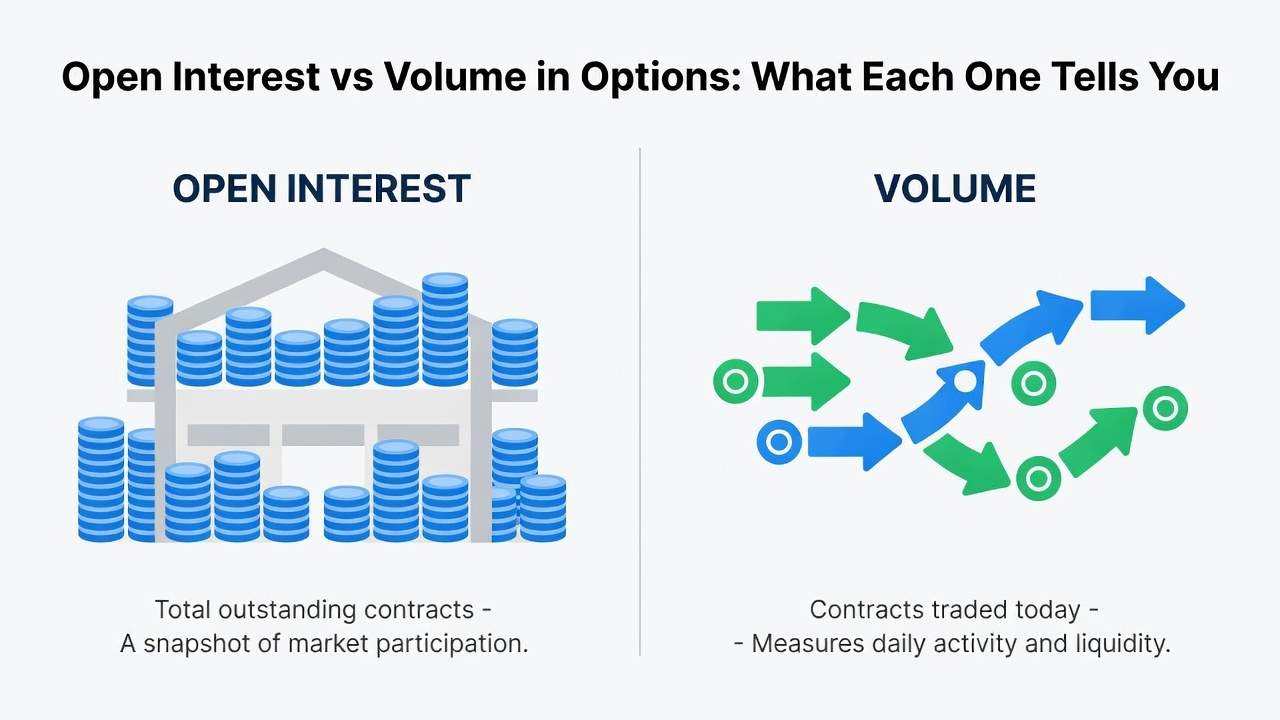
Open Interest vs Volume in Options: What Each One Tells You


📚 Beginner’s Guide to Options — Part 45 of 51
- Part 1: What Is an Option? The Absolute Basics Explained
- Part 2: Calls vs. Puts: The Two Types of Options You Need to Know
- Part 3: Strike Price Explained: What It Actually Means for Your Trade
- Part 4: Expiration Date Explained: Why It Changes Everything
- Part 5: Premium Explained: What You’re Really Paying For
- Part 6: In the Money vs. Out of the Money: A Beginner’s Breakdown
- Part 7: Intrinsic Value vs. Extrinsic Value: What Makes Up an Option’s Price
- Part 8: How Buying a Call Option Works, Step by Step
- Part 9: How Buying a Put Option Works, Step by Step
- Part 10: What Happens When an Option Expires? Every Outcome Explained
- Part 11: Options Contracts 101: What One Contract Actually Represents
- Part 12: How to Read an Options Chain Without Getting Overwhelmed
- Part 13: Bid, Ask, and Spread: What They Mean When You’re Trading Options
- Part 14: What Is Implied Volatility? A Beginner’s Plain-English Guide
- Part 15: Why Options Lose Value Over Time: Theta Explained Simply
- Part 16: Delta Explained: What It Really Tells You About Your Option
- Part 17: Gamma Explained: Why Delta Doesn’t Stay the Same
- Part 18: Vega Explained: How Volatility Changes Your Option’s Price
- Part 19: The Greeks Cheat Sheet: Delta, Gamma, Theta, Vega in Plain English
- Part 20: What Is Assignment? What Happens If Your Option Gets Exercised
- Part 21: American vs. European Options: What’s the Difference?
- Part 22: How Much Money Do You Need to Start Trading Options?
- Part 23: Paper Trading Options: How to Practice Before Risking Real Money
- Part 24: The Biggest Mistake Beginners Make Buying Options
- Part 25: Why Most Beginners Lose Money Buying Options (and How to Avoid It)
- Part 26: Covered Calls Explained: The First Options Strategy Every Trader Should Learn
- Part 27: Cash-Secured Puts Explained: A Beginner-Friendly Way to Get Paid to Wait
- Part 28: Vertical Spreads Explained: Reducing Risk on Your First Options Trade
- Part 29: Credit Spreads vs. Debit Spreads: What’s the Real Difference?
- Part 30: The Protective Put Explained: Insurance for Your Stock Position
- Part 31: The Collar Strategy Explained: Protecting Gains Without Selling
- Part 32: Straddles Explained: Betting on a Big Move (In Either Direction)
- Part 33: Strangles Explained: A Cheaper Way to Bet on a Big Move
- Part 34: The Iron Condor Explained for Complete Beginners
- Part 35: The Wheel Strategy Explained: Getting Paid on Stocks You Want to Own
- Part 36: How Earnings Season Changes Options Pricing (and What to Watch For)
- Part 37: Why Options Get More Expensive Before Earnings: IV Crush Explained
- Part 38: Choosing the Right Strike Price for Your First Options Trade
- Part 39: Choosing the Right Expiration Date: Weekly vs. Monthly Options
- Part 40: How to Size an Options Position So One Bad Trade Doesn’t Wreck You
- Part 41: When to Take Profits on an Options Trade (Before It’s Too Late)
- Part 42: When to Cut a Losing Options Trade (Before It Goes to Zero)
- Part 43: Rolling an Options Position: What It Means and When to Do It
- Part 44: Liquidity in Options: Why It Matters More Than Beginners Think
- Part 45: Open Interest vs. Volume: What Each One Actually Tells You (you are here)
⚡ Key Takeaways
- Volume measures the total number of options contracts traded during today’s session and resets to zero every morning.
- Open interest tracks the total number of outstanding contracts currently held by market participants that have not been closed or exercised.
- Comparing volume to open interest reveals whether big institutional players are opening fresh positions or merely closing out old ones.
— Ben, Find Better Trades
When you pull up an options chain, two columns sit right next to each other and cause endless confusion for new traders: volume and open interest. This is Part 45 of our beginner’s guide, and we are breaking down the exact difference between these two critical metrics so you never misread market activity again.
Think of them as two completely different lenses for viewing trade activity. One tells you what is happening right now, while the other shows you what has accumulated over time.
What Options Volume Actually Measures
Options volume is the total number of contracts bought and sold during the current trading day. Every single transaction adds to this running tally.
If you buy 5 call contracts at 10:00 AM, the daily volume for that specific strike increases by 5. If you sell those exact same 5 contracts at 2:00 PM, daily volume increases by another 5.
That means your activity generated 10 total volume for the day, even though you no longer hold any contracts. Volume simply counts the velocity of hands changing ownership.
Every single morning before the opening bell, volume resets to zero. It gives you a clean slate to measure how much attention a contract is getting today.
Think of volume like a turnstile at a football stadium. Every time someone walks through the gate, the counter clicks up by one.
The turnstile does not care if someone is entering, leaving, or walking back and forth. It only tracks raw foot traffic during that single afternoon.
What Open Interest Actually Measures
Open interest represents the total number of active, open contracts that exist in the market right now. These are positions that traders have opened and are still holding in their accounts.
Unlike volume, open interest does not reset to zero every day. It carries over from week to week and month to month until the contracts expire or traders close them.
To stick with our stadium analogy, open interest is the number of people currently sitting in their seats. It measures the existing crowd, not the people walking through the turnstiles.
If new fans enter the stadium and take new seats, open interest goes up. If seated fans get up and leave the stadium, open interest goes down.
If one fan sells their ticket to another person who takes their seat, the total number of seated people stays exactly the same. That is why heavy trading does not always increase open interest.
As we covered when discussing options liquidity earlier in the series, high open interest shows that a contract has established backing and deep market participation.
Free For Traders
One Clear Arrow. Every High-Probability Setup. Free.
The Fusion Indicator combines multiple signals into a single buy/sell arrow on TradingView so you never miss a move.
 → Get The Free Fusion Indicator
The Nightly Reset: Why Volume and Open Interest Update Differently
One of the biggest traps for beginners is expecting open interest to update in real time like volume. Volume updates tick by tick every second the market is open.
Open interest updates only once per day, usually early in the morning before the stock market opens. The Options Clearing Corporation (OCC) calculates this number overnight.
During the day, thousands of trades occur across dozens of brokerages. The OCC collects all those transaction records after the closing bell.
Overnight, the clearinghouse reconciles every opening trade against every closing trade. By 7:00 AM Eastern time the next morning, your broker displays the new, official open interest figure.
If you see a stock trade 50,000 contracts at noon, open interest will not budge all afternoon. You must wait until tomorrow morning to see how that massive volume impacted the total number of open contracts.
Understanding this delay prevents you from making erroneous assumptions during active market hours. You are always comparing live intraday volume against yesterday’s settled open interest.

The Four Trading Scenarios: How Trades Change Open Interest
Whether open interest rises, falls, or stays flat depends entirely on the intentions of both the buyer and the seller. Every trade requires both sides, and each participant is either opening a new position or closing an old one.
There are exactly four possible combinations when an options trade executes. Let’s walk through how each combination impacts the total contract count.
| Buyer Action | Seller Action | Daily Volume Impact | Net Open Interest Impact |
|---|---|---|---|
| Buy to Open (New) | Sell to Open (New) | +1 | +1 (Increases) |
| Buy to Open (New) | Sell to Close (Old) | +1 | 0 (No Change) |
| Buy to Close (Old) | Sell to Open (New) | +1 | 0 (No Change) |
| Buy to Close (Old) | Sell to Close (Old) | +1 | -1 (Decreases) |
When two traders create a brand-new contract out of thin air, open interest increases by one. Trader A buys to open and Trader B sells to open.
When an existing contract is transferred from one trader to another, open interest does not change. Trader A buys to open while Trader B sells to close their pre-existing position.
When two traders use a transaction to exit their existing obligations, the contract is destroyed. Trader A buys to close their short position while Trader B sells to close their long position, dropping open interest by one.
Worked Example: Tracking Volume and Open Interest on XYZ Corp
Let’s look at a concrete numeric example to see this math in action. Suppose stock XYZ is trading at $100, and we are watching the $105 strike call expiring in 30 days.
On Monday morning, before the opening bell, the options chain shows that the $105 call has an open interest of 500 contracts and a volume of 0.
At 10:30 AM, Trader Sarah buys 100 contracts to open a fresh bullish bet. At the exact same time, Market Maker Mike sells 100 contracts to open the opposite side.
Immediately after this trade, daily volume climbs to 100. Intraday open interest still reads 500 on your screen because the OCC has not processed the overnight batch yet.
At 2:00 PM, Trader Dave, who was already holding 40 contracts from last week, decides to sell them to close his position. Trader Lisa buys those 40 contracts to open a new position.
By the closing bell on Monday, total daily volume on the $105 call reaches 140 contracts (100 + 40). No other trades occurred all afternoon.
That night, the OCC reconciles the orders. Sarah and Mike created 100 brand-new contracts (+100), while Dave transferred his 40 contracts directly to Lisa (0 net change).
On Tuesday morning, the new numbers post: open interest is now 600 (500 starting + 100 new), and volume resets to 0 for the new day.
From Find Better Trades
Ride The Trend. Skip The Whipsaw.
Clear directional bias with built-in noise filters and trailing stop logic — from entry to exit.
 → See Trend Rider

What High Volume with Low Open Interest Really Tells You
When you spot an option strike where daily volume is significantly higher than existing open interest, you are looking at fresh, aggressive activity. This dynamic often signals a sudden wave of short-term interest.
For example, imagine a stock’s $50 put has an open interest of just 200 contracts, but by noon today, the volume reaches 8,000 contracts. That is 40 times the existing open interest.
This huge discrepancy tells you that today’s action is completely unusual for this specific strike. Traders are heavily piling into or trading around this contract right now.
However, you must be careful before assuming this is a massive institutional directional bet. If day traders or scalpers are rapidly flipping contracts back and forth, they will generate massive volume without adding much to open interest.
A trader buying and selling 500 contracts five times throughout the day creates 5,000 in volume. Yet by the end of the day, their net position is zero, adding nothing to open interest.
Check the open interest the following morning. If open interest spikes from 200 to 7,500, you know large players initiated and held new positions; if open interest barely moves, it was pure intraday day-trading churn.
What High Open Interest with Low Volume Means for You
The opposite scenario happens frequently: an option shows high open interest, say 25,000 contracts, but today’s volume is only 15 contracts. Here is how to interpret that setup.
High open interest tells you that significant capital was committed to this strike in the past. Thousands of contracts are currently locked in trading accounts across the market.
Low volume simply means that nobody is actively trading those contracts today. The existing holders are content to sit on their hands, and no new buyers are stepping up.
This is very common for longer-dated options or major strikes where institutions placed large hedges weeks ago. Those positions sit quietly, generating almost zero daily turnover.
For you as a retail trader, high open interest is still a positive sign. It indicates that the strike is well-established, which generally keeps the bid-ask spread tighter when you do decide to enter.
Just be aware that if volume is near zero when you want to execute, you will likely be trading directly against a market maker rather than another retail trader. Always use limit orders so you do not get penalized on price.
Common Mistakes Beginners Make With This
Assuming high volume always means open interest will increase tomorrow. If large traders are actively closing out older positions, heavy volume can actually cause open interest to drop overnight instead of rising.
Thinking high volume instantly guarantees the direction of the stock. Every options trade requires a buyer and a seller, so high volume alone does not tell you if the aggressor was buying calls or writing them.
Looking for live open interest updates in the middle of the trading day. Open interest is strictly calculated overnight by the OCC, so watching that number intraday will only lead to confusion.
Trading illiquid strikes with zero open interest and zero volume. If an option has zero open interest and single-digit volume, you will face wide bid-ask spreads and severe slippage when entering and exiting.
Believing high open interest acts as an unbreakable price magnet. While large open interest strikes can create hedging flows from market makers, they are not guaranteed support or resistance levels for the underlying stock.
Frequently Asked Questions About Volume and Open Interest
Can volume be higher than open interest on an options contract?
Yes, volume can easily exceed open interest on any given day. This happens frequently when day traders rapidly buy and sell the same contracts, or when a major news event triggers heavy new positioning.
What is considered good open interest for an options contract?
For most retail traders, an open interest of at least 500 to 1,000 contracts on a specific strike provides sufficient liquidity. Higher open interest typically ensures narrower bid-ask spreads and faster execution.
Does open interest decrease when an option expires?
Yes, when an expiration date passes, all contracts for that cycle are either exercised, assigned, or expire worthless. Once that happens, the open interest for those expired contracts drops to zero and disappears from the chain.
How can I tell if heavy volume was bought or sold?
You can look at whether trades executed closer to the bid price or the ask price on your platform. Trades executing at the ask generally indicate aggressive buyers, while trades hitting the bid suggest aggressive sellers.
Next up in Part 46, I will show you how to use options to hedge a stock position you already own so you can protect your portfolio without selling your shares.
📈 Want More? Join Our Free Trading Community
- Trading Strategy Guides Telegram — daily strategy tips and market insights
- Find Better Trades Telegram — free trade signals delivered to your phone
- Find Better Trades on YouTube — live trade breakdowns and tutorials
Lesson 45 of 55 in the free Options Trading Course.
← Previous: Options Liquidity: Why It Matters More Than Beginners Think
Next: How to Hedge a Stock Position with Options: Step-by-Step →