First 30 Days Trading Options: A Beginner’s Action Plan

📚 Beginner’s Guide to Options — Part 51 of 51
- Part 1: What Is an Option? The Absolute Basics Explained
- Part 2: Calls vs. Puts: The Two Types of Options You Need to Know
- Part 3: Strike Price Explained: What It Actually Means for Your Trade
- Part 4: Expiration Date Explained: Why It Changes Everything
- Part 5: Premium Explained: What You’re Really Paying For
- Part 6: In the Money vs. Out of the Money: A Beginner’s Breakdown
- Part 7: Intrinsic Value vs. Extrinsic Value: What Makes Up an Option’s Price
- Part 8: How Buying a Call Option Works, Step by Step
- Part 9: How Buying a Put Option Works, Step by Step
- Part 10: What Happens When an Option Expires? Every Outcome Explained
- Part 11: Options Contracts 101: What One Contract Actually Represents
- Part 12: How to Read an Options Chain Without Getting Overwhelmed
- Part 13: Bid, Ask, and Spread: What They Mean When You’re Trading Options
- Part 14: What Is Implied Volatility? A Beginner’s Plain-English Guide
- Part 15: Why Options Lose Value Over Time: Theta Explained Simply
- Part 16: Delta Explained: What It Really Tells You About Your Option
- Part 17: Gamma Explained: Why Delta Doesn’t Stay the Same
- Part 18: Vega Explained: How Volatility Changes Your Option’s Price
- Part 19: The Greeks Cheat Sheet: Delta, Gamma, Theta, Vega in Plain English
- Part 20: What Is Assignment? What Happens If Your Option Gets Exercised
- Part 21: American vs. European Options: What’s the Difference?
- Part 22: How Much Money Do You Need to Start Trading Options?
- Part 23: Paper Trading Options: How to Practice Before Risking Real Money
- Part 24: The Biggest Mistake Beginners Make Buying Options
- Part 25: Why Most Beginners Lose Money Buying Options (and How to Avoid It)
- Part 26: Covered Calls Explained: The First Options Strategy Every Trader Should Learn
- Part 27: Cash-Secured Puts Explained: A Beginner-Friendly Way to Get Paid to Wait
- Part 28: Vertical Spreads Explained: Reducing Risk on Your First Options Trade
- Part 29: Credit Spreads vs. Debit Spreads: What’s the Real Difference?
- Part 30: The Protective Put Explained: Insurance for Your Stock Position
- Part 31: The Collar Strategy Explained: Protecting Gains Without Selling
- Part 32: Straddles Explained: Betting on a Big Move (In Either Direction)
- Part 33: Strangles Explained: A Cheaper Way to Bet on a Big Move
- Part 34: The Iron Condor Explained for Complete Beginners
- Part 35: The Wheel Strategy Explained: Getting Paid on Stocks You Want to Own
- Part 36: How Earnings Season Changes Options Pricing (and What to Watch For)
- Part 37: Why Options Get More Expensive Before Earnings: IV Crush Explained
- Part 38: Choosing the Right Strike Price for Your First Options Trade
- Part 39: Choosing the Right Expiration Date: Weekly vs. Monthly Options
- Part 40: How to Size an Options Position So One Bad Trade Doesn’t Wreck You
- Part 41: When to Take Profits on an Options Trade (Before It’s Too Late)
- Part 42: When to Cut a Losing Options Trade (Before It Goes to Zero)
- Part 43: Rolling an Options Position: What It Means and When to Do It
- Part 44: Liquidity in Options: Why It Matters More Than Beginners Think
- Part 45: Open Interest vs. Volume: What Each One Actually Tells You
- Part 46: How to Use Options to Hedge a Stock Position You Already Own
- Part 47: LEAPS Explained: Trading Options That Last a Year or More
- Part 48: The Poor Man’s Covered Call: A Cheaper Way to Run the Covered Call Strategy
- Part 49: Common Options Trading Terms Every Beginner Should Know (Glossary)
- Part 50: Options Trading Platforms: What to Look for as a Beginner
- Part 51: Your First 30 Days Trading Options: A Beginner’s Action Plan (you are here)
⚡ Key Takeaways
- Your sole goal in the first month is developing clean execution habits rather than chasing big dollar gains.
- Limit yourself to a single contract on defined-risk setups to keep emotional friction completely under control.
- Follow a structured four-week roadmap spanning paper practice, live micro-sizing, active management, and post-trade review.
— Ben, Find Better Trades
You have spent fifty lessons learning the vocabulary, the mechanics, the Greeks, and the core strategies behind options trading. Now comes the moment where theory crashes straight into reality, which is usually where most new traders freeze up or blow their accounts within weeks. This is Part 51 of our series, and it is your blueprint for surviving and thriving during your first thirty days behind the screen.
Week 1: Platform Setup and Flight Simulator Drills
Your first seven days belong entirely inside a simulator. Think of this initial week like learning in a flight simulator before climbing into an actual cockpit.
We covered paper trading platforms earlier in the series, and this is where you put that software to work. Your goal right now is not to test your market predictions, but to make sure you never click the wrong button when real cash is on the line.
Spend your first three days getting comfortable with the order entry ticket. Practice opening a single contract call, placing a limit order at the mid-price, and immediately submitting a closing order.
Notice how the bid-ask spread behaves between 9:35 AM and 3:00 PM Eastern time. Liquid symbols will show tight spreads of one or two cents, while illiquid names will show wide gaps that eat your cash instantly.
By Friday of Week 1, you should execute at least ten practice trades from entry to exit. If you fumble through the interface or hesitate to find the Greeks column, you are not ready for live capital yet.
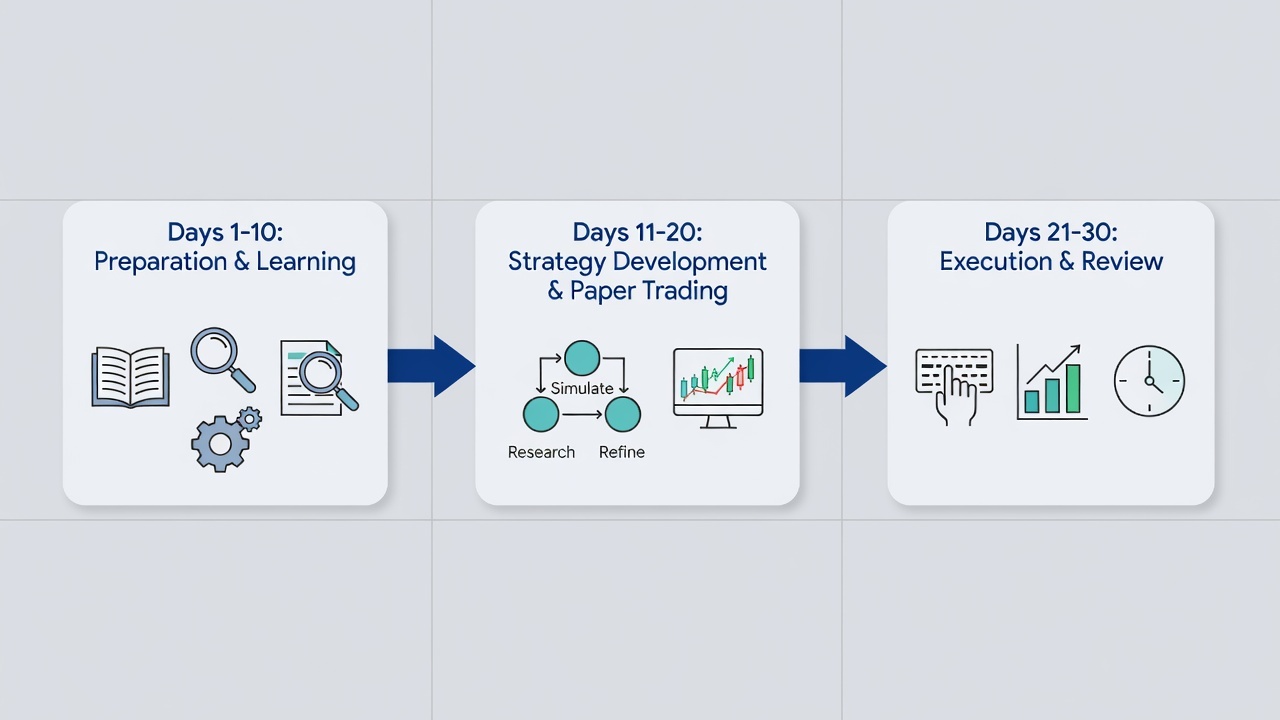
Week 2: Your First Real Single-Contract Trade
Welcome to live trading, where real money changes how your heart beats. Your only mission in Week 2 is executing exactly one single contract using defined risk.
Defined risk simply means your absolute worst-case scenario is capped the moment you submit the order. You know down to the exact penny the maximum dollar amount you can lose before the trade even fills.
Let us look at a realistic numeric example using a vertical debit spread, which we explored in detail earlier in this series. Suppose stock XYZ trades at $50.00 per share, and you believe it will drift higher over the next month.
Instead of buying a raw call, you buy the $50 call expiring in 35 days for a premium of $2.20 per share ($220 total). At the same time, you sell the $55 call with the exact same expiration for $0.90 per share ($90 received).
Your net debit is $1.30 per share ($2.20 paid minus $0.90 received), meaning your maximum loss on this single contract is exactly $130. Your maximum profit is the $5.00 width of the strikes minus your $1.30 cost, leaving you with $3.70 per share, or $370 total profit potential.
Placing this real $130 risk trade forces your brain to feel market fluctuation without putting your rent money on the line. Once the order fills, walk away from the computer screen for the afternoon to break the habit of manic price checking.
Free For Traders
The Options Cheat Sheet Thousands Of Traders Swear By
Calls, puts, spreads — one free download tells you the right options strategy for every market condition.

Week 3: Managing Daily Fluctuations and Position Rules
Week 3 is where reality tests your patience as the underlying stock chops around. This is when new traders start second-guessing their setup because they watch the profit-and-loss column bounce up and down.
Remember that options pricing is driven by multiple moving parts, especially theta (the daily time decay of your contract) and delta (how much your contract price changes per dollar move in the stock). When the stock stays flat for three days, your long contract naturally bleeds a small amount of value.
Do not panic-sell simply because your position is down $15 on a random Tuesday morning. You built this trade with defined parameters, which means normal intraday noise is already accounted for in your plan.
Set a mechanical profit exit rule right inside your broker platform using a good-til-canceled order. If your target is taking profits at 50% of the maximum potential gain, calculate that number immediately and let the broker wait for it.
In our XYZ spread example, taking profit at 50% of max gain ($185 profit) means you want to sell the spread back to the market when its value reaches $3.15. Putting that order in place removes your emotions from the equation entirely.

Week 4: Trade Exits, Expiration Week, and Capital Review
The fourth week of your journey is focused on the most critical phase of any trade: closing the position before expiration week turns erratic. As we covered back in our lesson on Greeks, gamma risk ramps up aggressively as expiration approaches.
Gamma measures how fast your delta changes, and in the final week before expiration, tiny stock movements cause massive, violent percentage swings in your contract value. That kind of volatility is dangerous for a beginner.
Make it your rule to close or roll your trades when they have between seven and ten days left until expiration. Never hold an out-of-the-money contract into the final forty-eight hours hoping for a miracle bounce.
Let us look at a second worked example showing how to handle a trade that goes wrong. Suppose you opened a cash-secured put on stock ABC by selling a $30 strike put for $1.00 ($100 credit), but the stock drops from $33 down to $29.50.
Your put option’s value swells from $1.00 up to $2.00, meaning you are currently down $100 on the position. If your pre-set stop-loss rule states that you cut trades when losses equal 100% of the initial credit received, you buy that put back at $2.00 and eat the $100 loss without hesitation.
Taking a clean $100 loss protects your remaining cash and prevents an unwanted assignment that ties up $3,000 worth of underlying stock. A controlled loss is a successful execution of your risk system.
Setting Up Your 15-Minute Daily Routine
Successful options trading does not require sitting in front of flickering charts for six hours every single day. In fact, staring at the screen all day almost always leads to overtrading and unnecessary losses.
A focused fifteen-minute routine every morning keeps you disciplined and sharp. You check your open positions, review overall market indexes, and verify that your exit orders remain active.
Spend five minutes before the opening bell scanning the news for earnings announcements or major economic reports affecting your watchlist. As we saw in our earnings lessons, surprises can crush option values through unexpected implied volatility collapses.
Spend five minutes around midday checking whether your stop-losses or profit targets were approached. Never adjust your target further away just because the market is moving in your favor; take the cash as planned.
Use your final five minutes after the closing bell to jot down the day’s notes in your trading journal. Documenting why you entered, how you felt, and where the price settled will teach you more than any finance book ever could.
| Week | Primary Focus | Max Position Size | Core Goal |
|---|---|---|---|
| Week 1 | Paper Trading & Platform Fluency | Simulated only | Master order entry without order mistakes |
| Week 2 | First Real Defined-Risk Trade | 1 contract | Experience emotional friction with minimal capital |
| Week 3 | Active Trade Monitoring & Rules | 1 contract | Hold through daily price noise using GTC orders |
| Week 4 | Exit Execution & Review | 1 contract | Close before expiration week and log journal entries |
From Find Better Trades
Three Candles Tell You When The Move Accelerates
The 3-candlestick reversal pattern indicator that catches the exact moment momentum flips.


The Survival Rules for Preserving Your Account
During your first month, defense matters infinitely more than offense. If you blow up half your account in month one, you will spend the next year clawing back to break-even.
First rule: never allocate more than two to five percent of your total trading capital to any single options trade. If you funded your account with $2,000, your absolute maximum risk on an individual position is $100.
Second rule: stick exclusively to high-liquidity underlyings like broad-market index ETFs and mega-cap blue-chip equities. As we covered in our liquidity breakdown, wide penny-spreads in small stocks silently bleed your performance over time.
Third rule: strictly ban zero-day-to-expiration (0DTE) contracts and weekly lottery tickets from your portfolio. Those products are designed for rapid speculation, not for a beginner trying to learn sustainable risk control.
Fourth rule: never average down on a losing long option position. Buying more cheap contracts when a trade is working against you is the fastest way to turn a paper cut into a fatal wound.
Graduating Past Day 30: What Comes Next
When day thirty arrives, your measure of success is not whether your account grew by twenty percent. Your success is defined by whether you followed your plan, respected your stop-losses, and logged every trade.
If you break even or walk away with a modest gain after your first month, you are already ahead of the vast majority of retail traders. You have proven that you can manage risk without giving in to emotional trading impulses.
Moving into your second month, resist the temptation to immediately scale your contract sizes from one up to ten. Scaling up position sizing should only happen gradually after multiple consecutive months of clean execution.
Now is the time to slowly expand your toolkit toward strategies like covered calls or cash-secured puts if you have sufficient capital. Continue to treat this as an ongoing craft that rewards patience, consistency, and disciplined risk management above all else.
Common Mistakes Beginners Make During Their First 30 Days
Over-allocating capital on a single hunch: Many new traders take a $1,000 account and buy $800 worth of out-of-the-money calls on a single ticker. When that stock moves sideways, the entire account is ruined in days instead of spreading risk across multiple calculated trades.
Trading straight through corporate earnings announcements: Beginners often buy calls right before an earnings release expecting a massive payout if the stock pops. They end up stunned when implied volatility crashes the next morning, leaving their contracts worthless even if the stock went in their direction.
Holding losing positions until the final Friday expiration: Hoping that an option expiring in twelve hours will miraculously recover is pure gambling. Experienced traders cut losers early when predefined thresholds trigger, preserving remaining capital for higher-probability opportunities.
Jumping straight into complex multi-leg setups before mastering single orders: Trying to trade iron condors or double diagonals before you even understand how bid-ask spreads affect your fills leads to confusion and panic when one leg gets tested. Master single contracts and simple two-leg spreads before adding complexity.
Frequently Asked Questions About Your First Month Trading Options
How much money should I put in my account for my first 30 days?
Starting with $1,000 to $2,000 is ideal because it gives you enough room to place micro-sized defined-risk spreads without risking catastrophic losses. If you have less than that, spend your first month trading in a paper account until you build up capital.
Should I trade naked options during my first month?
Absolutely not under any circumstances. Naked options carry undefined risk that can wipe out your account and even leave you owing money to your broker if a trade moves against you violently.
How many trades should I place in my first thirty days?
Aim for roughly two to four carefully planned trades during the entire month. Your goal is learning quality analysis and disciplined execution, not generating heavy trade volume that racks up commissions and induces stress.
What should I do if my trade hits maximum loss within two days?
Close the position immediately and accept the loss just as your original trade plan outlined. Do not attempt to revenge trade or roll the strikes out of desperation; simply log the outcome in your journal and examine what happened.
You have made it through all fifty-one parts of this comprehensive guide. Options are a remarkable tool when you treat them with the respect and discipline they demand. Take what you have learned, follow your plan, protect your capital on every trade, and trade with confidence.
📈 Want More? Join Our Free Trading Community
- Trading Strategy Guides Telegram — daily strategy tips and market insights
- Find Better Trades Telegram — free trade signals delivered to your phone
- Find Better Trades on YouTube — live trade breakdowns and tutorials