When to Cut a Losing Options Trade: How to Stop Losing Trades

📚 Beginner’s Guide to Options — Part 42 of 51
- Part 1: What Is an Option? The Absolute Basics Explained
- Part 2: Calls vs. Puts: The Two Types of Options You Need to Know
- Part 3: Strike Price Explained: What It Actually Means for Your Trade
- Part 4: Expiration Date Explained: Why It Changes Everything
- Part 5: Premium Explained: What You’re Really Paying For
- Part 6: In the Money vs. Out of the Money: A Beginner’s Breakdown
- Part 7: Intrinsic Value vs. Extrinsic Value: What Makes Up an Option’s Price
- Part 8: How Buying a Call Option Works, Step by Step
- Part 9: How Buying a Put Option Works, Step by Step
- Part 10: What Happens When an Option Expires? Every Outcome Explained
- Part 11: Options Contracts 101: What One Contract Actually Represents
- Part 12: How to Read an Options Chain Without Getting Overwhelmed
- Part 13: Bid, Ask, and Spread: What They Mean When You’re Trading Options
- Part 14: What Is Implied Volatility? A Beginner’s Plain-English Guide
- Part 15: Why Options Lose Value Over Time: Theta Explained Simply
- Part 16: Delta Explained: What It Really Tells You About Your Option
- Part 17: Gamma Explained: Why Delta Doesn’t Stay the Same
- Part 18: Vega Explained: How Volatility Changes Your Option’s Price
- Part 19: The Greeks Cheat Sheet: Delta, Gamma, Theta, Vega in Plain English
- Part 20: What Is Assignment? What Happens If Your Option Gets Exercised
- Part 21: American vs. European Options: What’s the Difference?
- Part 22: How Much Money Do You Need to Start Trading Options?
- Part 23: Paper Trading Options: How to Practice Before Risking Real Money
- Part 24: The Biggest Mistake Beginners Make Buying Options
- Part 25: Why Most Beginners Lose Money Buying Options (and How to Avoid It)
- Part 26: Covered Calls Explained: The First Options Strategy Every Trader Should Learn
- Part 27: Cash-Secured Puts Explained: A Beginner-Friendly Way to Get Paid to Wait
- Part 28: Vertical Spreads Explained: Reducing Risk on Your First Options Trade
- Part 29: Credit Spreads vs. Debit Spreads: What’s the Real Difference?
- Part 30: The Protective Put Explained: Insurance for Your Stock Position
- Part 31: The Collar Strategy Explained: Protecting Gains Without Selling
- Part 32: Straddles Explained: Betting on a Big Move (In Either Direction)
- Part 33: Strangles Explained: A Cheaper Way to Bet on a Big Move
- Part 34: The Iron Condor Explained for Complete Beginners
- Part 35: The Wheel Strategy Explained: Getting Paid on Stocks You Want to Own
- Part 36: How Earnings Season Changes Options Pricing (and What to Watch For)
- Part 37: Why Options Get More Expensive Before Earnings: IV Crush Explained
- Part 38: Choosing the Right Strike Price for Your First Options Trade
- Part 39: Choosing the Right Expiration Date: Weekly vs. Monthly Options
- Part 40: How to Size an Options Position So One Bad Trade Doesn’t Wreck You
- Part 41: When to Take Profits on an Options Trade (Before It’s Too Late)
- Part 42: When to Cut a Losing Options Trade (Before It Goes to Zero) (you are here)
⚡ Key Takeaways
- Options are decaying assets, which means holding a loser almost guarantees a complete loss of your capital.
- Having a hard percentage stop loss or a technical chart breakdown rule protects you from catastrophic drawdowns.
- Cutting a trade at a 30% to 50% loss keeps you alive to take the next high-probability setup.
— Ben, Find Better Trades
Welcome back to Part 42 of our beginner options series. In the previous part, we talked about locking in profits, but knowing when to take your money off the table during a bad trade is even more critical.
Most beginners blow up their trading accounts not because they pick bad stocks, but because they refuse to cut bad options trades. Watching an option slowly tick down toward zero while praying for a miracle is a habit that will end your trading journey fast.
The “Hope and Pray” Trap: Why Options Go to Zero Faster Than Stocks
When you buy a share of stock and it drops 10%, you still own a fractional piece of an actual company. If you wait long enough, that stock might recover next month or next year.
Options do not work that way because every single contract has an expiration date attached to it. As we covered earlier in the series when we broke down theta decay, options lose value simply because the clock is running out.
Think of holding a losing option like holding a melting block of ice in the summer sun. If the temperature does not suddenly drop below freezing, that ice is turning into water whether you like it or not.
Hoping for a sudden reversal does not stop the clock from ticking against you. When you refuse to cut an option trade, you are fighting both the stock’s price direction and the inevitable passage of time.
A 50% loss on a stock requires a 100% gain just to get back to even. On an option, that 50% loss can turn into a 100% loss within days if the underlying stock simply moves sideways.
The 50% Stop-Loss Rule: My Personal Baseline for Long Options
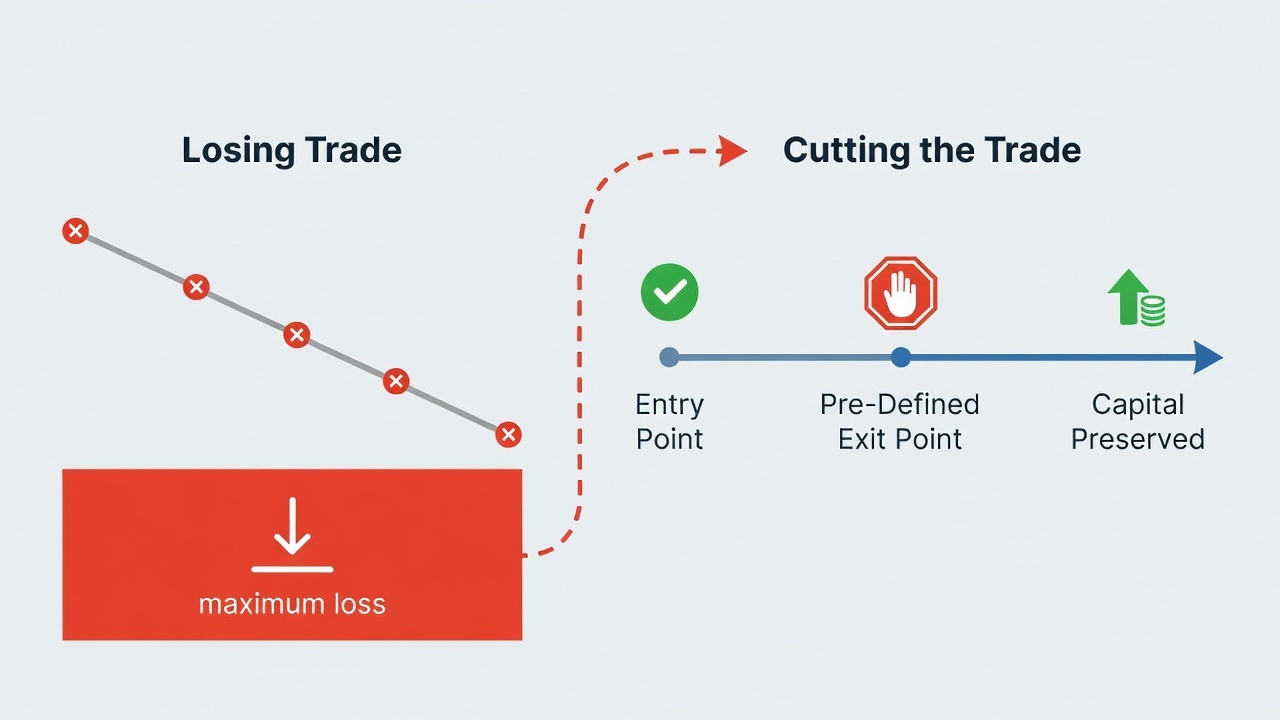
When I buy single-leg options like long calls or long puts, I treat 50% as my absolute line in the sand. If my contract loses half its value, I close the position immediately without asking questions.
Let’s walk through an example to see why this rule preserves your long-term trading capital. Let’s say XYZ stock is trading at $100, and you buy a 30-day $105 call option for $4.00 per share, or $400 total.
Two weeks pass, and XYZ stock drops to $98 instead of climbing higher. Your call contract is now priced at $2.00, meaning you are currently sitting on an unrealized loss of $200, or 50%.
If you cut the trade right now, you still walk away with $200 in real cash in your account. That $200 can be deployed into another trade with better momentum and a fresh expiration date.
If you choose to hold that call hoping for a rebound, XYZ stock needs a massive rally just to get your contract back to $4.00. More often than not, that remaining $200 decays directly into $0.00 by expiration day.
Free For Traders
Know What To Trade BEFORE The Opening Bell
The Big Dipper Dashboard hands you curated high-probability setups every single morning — free.
 → Get Free Big Dipper Access
Technical Invalidation: Cutting Based on the Chart, Not Just the Premium
A percentage stop loss is a great baseline, but the chart of the underlying stock should often trigger your exit first. Every trade you place should start with an underlying technical thesis.
For instance, let’s say you bought a call option because a stock was bouncing off a well-defined support level at $50. Your thesis is simple: the stock will stay above $50 and push higher.
If the stock breaks below $50 and closes at $48.50, your reason for entering that trade no longer exists. The trade thesis is broken, regardless of whether your option contract is down 15%, 30%, or 45%.
Waiting for the option premium to hit an arbitrary percentage loss when the chart has already failed makes no sense. The moment the underlying stock invalidates your technical setup, you should hit the sell button.
Exiting when the chart fails often lets you get out with much smaller losses than waiting for a full stop loss. Discipline means reacting to the chart in front of you, not the hope in your head.

The Time-Based Stop: When Theta Becomes Your Deadliest Enemy
Many traders focus entirely on price targets, but time stops are just as essential when managing options. Even if the stock price has not moved against you, a lack of movement can still kill your trade.
Options suffer from exponential time decay during the final 21 to 14 days before expiration. If your stock is drifting sideways and you are inside this window, theta decay will eat your remaining premium rapidly.
Let’s look at another scenario to understand how time destroys option value without a price drop. Imagine you buy an XYZ $50 call option with 45 days to expiration for $3.00 per share ($300 total) while XYZ is at $50.
Thirty days pass, and the stock is still trading at exactly $50. Because the stock failed to move into the money, that option might now be worth only $0.75 ($75 total) due strictly to time decay.
You are down 75% without the stock dropping a single penny. A time-based stop rule—such as closing any trade if nothing happens within 14 days of expiration—prevents this slow bleed from finishing you off.
Managing Defined-Risk Spreads vs. Naked Long Options
Cutting losses looks slightly different when you trade vertical debit spreads or credit spreads compared to single options. As we learned in our vertical spreads guide, spreads have built-in maximum loss caps from the start.
With a debit spread, you already know the absolute most you can lose is the premium you paid to enter. However, that does not mean you should always let losing spreads ride all the way to maximum loss.
For credit spreads, a common rule among experienced traders is to cut the trade when the loss reaches 2x or 3x the initial credit received. For debit spreads, cutting at a 50% loss of the initial debit helps keep your win-loss ratio healthy.
| Strategy Type | Typical Stop Level | Primary Reason to Exit |
|---|---|---|
| Long Call / Put | 30% to 50% of premium | Theta decay and delta erosion |
| Vertical Debit Spread | 50% of debit paid | Underlying fails to reach short strike |
| Vertical Credit Spread | 1.5x to 2x credit collected | Short strike breached by underlying |
Letting every losing credit spread hit its maximum theoretical loss will wipe out the gains from several winning trades in a row. Setting a clear boundary on your spreads is what keeps the math working in your favor.
From Find Better Trades
Stop Drawing Trendlines By Hand. Seriously.
Terraline auto-draws algorithmic trendlines that adjust in real time — perfectly connecting the swings you’d spend hours finding manually.
 → Let Terraline Draw For You

The Psychology of the Exit: Fighting the Urge to Average Down
When a stock falls, value investors often buy more shares to lower their average cost basis. Trying this same tactic with out-of-the-money options is one of the fastest ways to destroy your account.
Averaging down on a losing option is simply throwing good money after a decaying asset. If your first contract is failing because your timing or direction was wrong, buying five more contracts will not fix that mistake.
Traders usually average down because their ego refuses to take a loss on paper. Taking the loss feels like admitting defeat, while adding to the position creates an illusion of control.
You have to accept that losing trades are just the standard cost of running a trading business. You do not need to win every trade to be profitable over the course of a year; you just need to keep your losers small.
When a position goes south, cut it, accept the small loss, and clear your mental slate. Protecting your emotional energy is just as vital as protecting your account balance.
A Step-by-Step Trade Management Plan Before You Enter
The secret to executing a clean exit is deciding your exit point before you ever click the buy button. Once real money is on the line, fear and greed will distort your judgment every single time.
Before you enter any options trade, write down three specific exit triggers on a notepad or in your trading journal. The first trigger is your price target where you plan to lock in profits.
The second trigger is your technical stop level on the underlying stock chart. If the stock crosses that line, you exit the option position immediately at market price.
The third trigger is your hard percentage stop on the contract itself, such as a 40% loss on premium paid. Having these three boundaries mapped out removes all emotional hesitation in the heat of the moment.
When one of your stop conditions is met, you execute the order cleanly without bargaining with yourself. Professional traders do not debate their stops; they execute them automatically and move on.
Common Mistakes Beginners Make With This
Holding until expiration hoping for a miracle bounce: Many beginners refuse to sell a contract that is down 80% because “it might turn around on Friday.” In reality, that remaining 20% is real capital that could be recovered and redeployed into a working trade.
Averaging down on losing contracts: Buying more contracts of a failing strike to lower your entry price multiplies your risk on a broken trade. This habit turns what should have been a minor $100 loss into a catastrophic $800 loss.
Setting mechanical stop-loss market orders on options: Options often have wide bid-ask spreads and sudden volatility spikes that can trigger a market stop prematurely. It is usually better to set price alerts on the underlying stock or monitor limit exits manually.
Treating options like buy-and-hold stocks: Assuming you can simply “wait out” a bad move does not work when contracts expire. Options punish hesitation because every day spent waiting costs you money in time decay.
Cutting Losses on Options Trades: Frequently Asked Questions
Should I set an automatic stop-loss order on my options? Setting automated stop-loss market orders directly on options contracts can be risky due to wide bid-ask spreads and temporary liquidity drops. Instead, set price alerts on the underlying stock and execute your exit manually when your technical level breaks.
If my option is already down 85%, is it worth selling or should I just let it expire? If you can salvage $50 or $100 from an expiring position, you should take that money off the table. A series of small recovered amounts adds up over dozens of trades and preserves capital for your next opportunity.
How do I know if my trade thesis is broken before my stop loss hits? Your thesis is broken whenever the technical catalyst that prompted the trade disappears, such as a trendline break or a failed support bounce. If the reason you bought the option is no longer visible on the chart, exit immediately.
What should I do immediately after cutting a losing trade? Step away from your trading screens for a short break to prevent revenge trading. Log the trade in your journal, note what went wrong, and wait for a completely fresh, high-probability setup before risking more capital.
Now that you know how to protect your downside, next up we are going to look at rolling an options position to see how you can adjust trades without blowing up your account.
📈 Want More? Join Our Free Trading Community
- Trading Strategy Guides Telegram — daily strategy tips and market insights
- Find Better Trades Telegram — free trade signals delivered to your phone
- Find Better Trades on YouTube — live trade breakdowns and tutorials
Lesson 42 of 55 in the free Options Trading Course.
← Previous: When to Take Profits on Options: How to Lock In Gains
Next: Rolling an Options Position: What It Means and When to Do It →