How to Choose the Right Strike Price for Options: Beginner Guide

📚 Beginner’s Guide to Options — Part 38 of 51
- Part 1: What Is an Option? The Absolute Basics Explained
- Part 2: Calls vs. Puts: The Two Types of Options You Need to Know
- Part 3: Strike Price Explained: What It Actually Means for Your Trade
- Part 4: Expiration Date Explained: Why It Changes Everything
- Part 5: Premium Explained: What You’re Really Paying For
- Part 6: In the Money vs. Out of the Money: A Beginner’s Breakdown
- Part 7: Intrinsic Value vs. Extrinsic Value: What Makes Up an Option’s Price
- Part 8: How Buying a Call Option Works, Step by Step
- Part 9: How Buying a Put Option Works, Step by Step
- Part 10: What Happens When an Option Expires? Every Outcome Explained
- Part 11: Options Contracts 101: What One Contract Actually Represents
- Part 12: How to Read an Options Chain Without Getting Overwhelmed
- Part 13: Bid, Ask, and Spread: What They Mean When You’re Trading Options
- Part 14: What Is Implied Volatility? A Beginner’s Plain-English Guide
- Part 15: Why Options Lose Value Over Time: Theta Explained Simply
- Part 16: Delta Explained: What It Really Tells You About Your Option
- Part 17: Gamma Explained: Why Delta Doesn’t Stay the Same
- Part 18: Vega Explained: How Volatility Changes Your Option’s Price
- Part 19: The Greeks Cheat Sheet: Delta, Gamma, Theta, Vega in Plain English
- Part 20: What Is Assignment? What Happens If Your Option Gets Exercised
- Part 21: American vs. European Options: What’s the Difference?
- Part 22: How Much Money Do You Need to Start Trading Options?
- Part 23: Paper Trading Options: How to Practice Before Risking Real Money
- Part 24: The Biggest Mistake Beginners Make Buying Options
- Part 25: Why Most Beginners Lose Money Buying Options (and How to Avoid It)
- Part 26: Covered Calls Explained: The First Options Strategy Every Trader Should Learn
- Part 27: Cash-Secured Puts Explained: A Beginner-Friendly Way to Get Paid to Wait
- Part 28: Vertical Spreads Explained: Reducing Risk on Your First Options Trade
- Part 29: Credit Spreads vs. Debit Spreads: What’s the Real Difference?
- Part 30: The Protective Put Explained: Insurance for Your Stock Position
- Part 31: The Collar Strategy Explained: Protecting Gains Without Selling
- Part 32: Straddles Explained: Betting on a Big Move (In Either Direction)
- Part 33: Strangles Explained: A Cheaper Way to Bet on a Big Move
- Part 34: The Iron Condor Explained for Complete Beginners
- Part 35: The Wheel Strategy Explained: Getting Paid on Stocks You Want to Own
- Part 36: How Earnings Season Changes Options Pricing (and What to Watch For)
- Part 37: Why Options Get More Expensive Before Earnings: IV Crush Explained
- Part 38: Choosing the Right Strike Price for Your First Options Trade (you are here)
⚡ Key Takeaways
- Your strike price determines the exact price where your contract gains intrinsic value and starts behaving like real shares.
- Buying cheap, far out-of-the-money strikes is the fastest way new traders drain their accounts because the math works heavily against them.
- For your first directional trades, selecting slightly in-the-money strikes with a 0.65 to 0.75 Delta gives you the highest probability of walking away profitable.
— Ben, Find Better Trades
When you open your brokerage app and look at an options chain for the very first time, the endless ladder of numbers can freeze you in your tracks. Welcome to Part 38 of our beginner series, where we are going to fix that confusion for good.
Picking the wrong strike price is the single most common reason beginners lose money even when they correctly guess the stock’s direction. Today, I will teach you how to choose the right strike price every single time with zero guesswork.
What a Strike Price Actually Represents in Plain English
Think of a strike price as a legal contract line drawn directly in the sand. It is the guaranteed price where you reserve the right to buy or sell the underlying shares before the clock runs out.
If you buy a call option, the strike is the exact dollar amount where you can demand to buy 100 shares. If you buy a put option, it is the guaranteed dollar amount where you can force someone else to buy 100 shares from you.
The stock market does not care about what price you paid for your contract. The stock market only cares about where the stock price is trading relative to that specific line in the sand.
Think of it like booking a hotel room six months in advance with a locked-in rate of $150 per night. That $150 locked rate is your strike price.
If hotel prices surge to $300 across the city on that weekend, your reservation voucher becomes incredibly valuable. If city-wide hotel prices drop to $80, nobody wants your voucher because anyone can book a cheaper room on the open market.
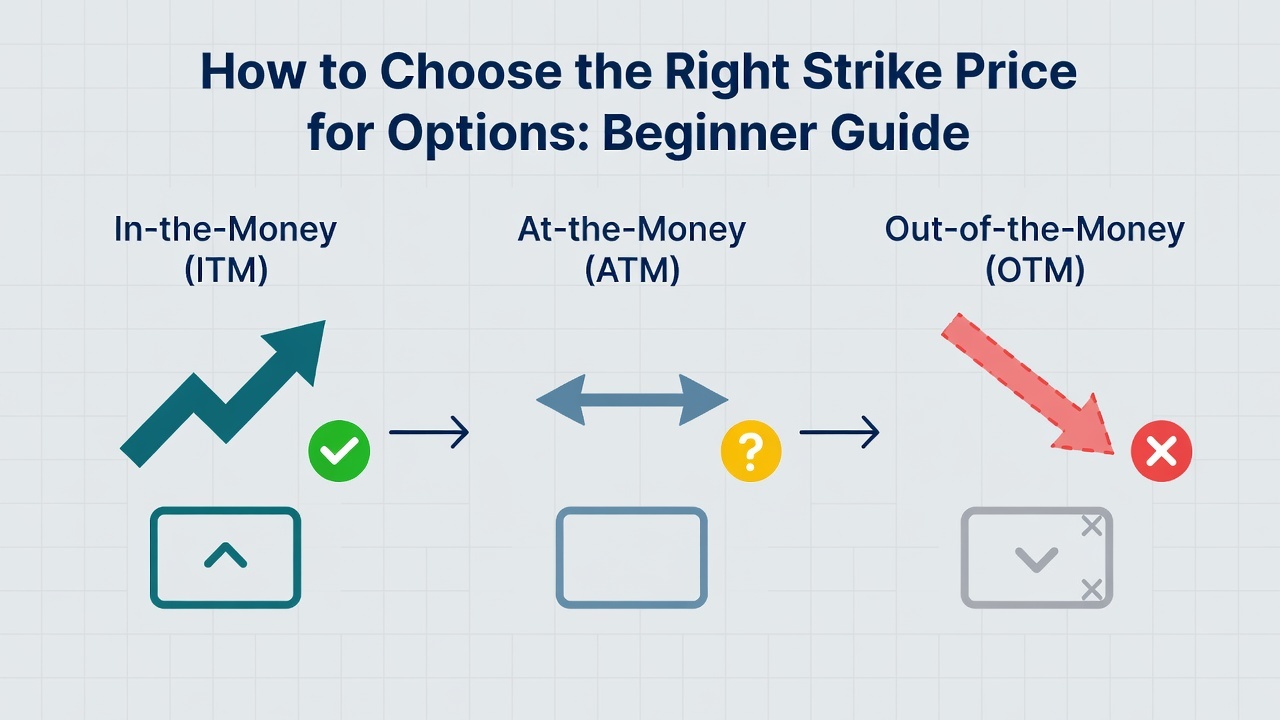
The Three Zones: ITM, ATM, and OTM Strike Prices
Every options chain divides strike prices into three distinct psychological and financial zones. Understanding where your strike sits relative to current stock price is the foundation of smart strike selection.
In The Money (ITM) strikes already possess real, tangible cash value. For a call, an ITM strike sits below the current share price, while for a put, it sits above the current share price.
At The Money (ATM) strikes sit right at or immediately adjacent to the current market price of the stock. These options have zero intrinsic value, but they react quickly to any movement in the underlying shares.
Out of The Money (OTM) strikes represent pure hope and zero current intrinsic value. For a call, an OTM strike sits higher than the stock’s current price, and for a put, it sits lower.
When you buy an OTM strike, you are buying 100% extrinsic value, which we broke down in Part 7 of this series. That means if the stock sits perfectly still until expiration day, your entire investment evaporates to zero.
Free For Traders
Know What To Trade BEFORE The Opening Bell
The Big Dipper Dashboard hands you curated high-probability setups every single morning — free.
 → Get Free Big Dipper Access
The Cheap Strike Price Trap (Why OTM Strikes Burn Beginners)
Almost every beginner instinctively scrolls down the options chain looking for the cheapest dollar price they can find. You see a $0.20 contract trading on a $100 stock and think you found an absolute bargain.
A $0.20 contract only costs $20 total out of your pocket. It feels safe because you cannot lose more than twenty bucks, but this is a dangerous psychological trap.
Those dirt-cheap contracts are cheap for a simple mathematical reason: they have almost zero statistical chance of expiring with real value. Professional market makers price those contracts cheaply because they are virtually certain to keep your $20 bill.
When you buy deep out-of-the-money options, you need a massive, violent move in the underlying stock just to break even. A modest, orderly move in your favor will still result in a total loss because time decay will chew your contract up faster than the stock can climb.
Buying five cheap lottery ticket strikes does not give you five chances to win. It simply gives you five separate positions that are all bleeding extrinsic value every single afternoon.

Worked Example 1: Buying an ITM vs. OTM Call Option
Let us look at a clear, realistic example to see how strike selection completely alters your profit potential. Suppose stock XYZ trades at exactly $100 per share, and you believe the stock is heading higher over the next 30 days.
Trader A buys one In-The-Money $95 Call for a premium of $7.00 ($700 total cash outlay). Trader B buys one Out-of-The-Money $110 Call for a premium of $0.80 ($80 total cash outlay).
Over the next three weeks, stock XYZ moves up moderately from $100 to $106 at expiration. Let us look at how both traders fare with their chosen strikes.
| Metric | Trader A ($95 ITM Call) | Trader B ($110 OTM Call) |
|---|---|---|
| Initial Cost | $7.00 ($700) | $0.80 ($80) |
| Stock Price at Expiration | $106.00 | $106.00 |
| Contract Value at Expiration | $11.00 ($1,100) | $0.00 ($0) |
| Net Dollar Profit / Loss | +$400.00 Profit | -$80.00 Loss |
| Return on Investment | +57.1% | -100% |
Trader A nailed the trade and locked in a $400 profit on their $700 investment because their strike held $11.00 of real intrinsic cash value ($106 stock minus $95 strike). Trader B correctly predicted the upward direction of the stock, but still lost 100% of their money because the stock never reached $110.
This is the harsh reality of strike selection. Trader B was technically right about the stock going up, but picked the wrong strike price and walked away with empty pockets.
Delta as Your Probability Compass for Picking Strikes
In Part 16, we covered Delta as the metric showing how much your contract price moves per $1 move in the stock. Delta also serves as an outstanding rough estimate of the probability that your strike finishes in the money.
A strike with a 0.70 Delta has roughly a 70% chance of expiring with real intrinsic value. A cheap out-of-the-money strike with a 0.10 Delta has roughly a 10% chance of expiring with any value at all.
When you buy an option with a 0.70 Delta, you are paying for real intrinsic cushion. The contract will mimic the price movement of 70 actual shares of stock while buffering you against aggressive time decay.
Lower delta strikes (like 0.20 or 0.15) require explosive, unexpected news events to become profitable. High delta strikes (like 0.65 to 0.80) simply require normal, steady market trends to produce solid gains.
If you want consistency in your trading account, you must stop shopping in the 0.10 Delta discount bin. Treat Delta as your quality filter before you ever click the buy button.
From Find Better Trades
Stop Drawing Trendlines By Hand. Seriously.
Terraline auto-draws algorithmic trendlines that adjust in real time — perfectly connecting the swings you’d spend hours finding manually.
 → Let Terraline Draw For You

Worked Example 2: Picking a Put Strike Price for a Bearish Trade
Now let us examine a bearish trade on stock ABC, which currently trades at $50.00 per share. You expect the stock to face heavy selling pressure over the coming month and drop toward $45.00.
Trader A buys one In-The-Money $52.50 Put for $3.50 ($350 total cost). Trader B buys one Out-of-The-Money $45.00 Put for $0.60 ($60 total cost).
Two weeks later, the stock drops moderately to $47.00 at expiration. The drop happened just as expected, but the choice of strike price decides who actually gets paid.
| Metric | Trader A ($52.50 ITM Put) | Trader B ($45.00 OTM Put) |
|---|---|---|
| Initial Cost | $3.50 ($350) | $0.60 ($60) |
| Stock Price at Expiration | $47.00 | $47.00 |
| Contract Value at Expiration | $5.50 ($550) | $0.00 ($0) |
| Net Dollar Profit / Loss | +$200.00 Profit | -$60.00 Loss |
| Return on Investment | +57.1% | -100% |
Trader A’s contract is worth $5.50 at expiration ($52.50 strike minus $47.00 stock price), producing a net gain of $200. Trader B’s contract expires completely worthless because the stock stopped at $47.00 instead of dropping below the $45.00 strike.
Trader A had breathing room because the strike already had intrinsic value when the trade started. Trader B needed perfection, and perfection rarely happens in the stock market.
Ben’s Step-by-Step Rule of Thumb for Your First Real Trade
When you are ready to execute your first directional option trade, here is the exact framework I recommend you follow. This rule of thumb prioritizes capital protection and statistical edge over reckless leverage.
First, identify your directional bias and verify that the stock has steady momentum. Never buy options on completely flat, sideways stocks.
Second, locate the strike price that sits one or two strikes In The Money. Look specifically for a Delta reading between 0.65 and 0.75.
Third, check your total capital commitment to ensure the trade fits your account size. If buying an ITM contract on a $200 stock requires too much cash, switch to a cheaper stock rather than buying a junk OTM strike on the expensive stock.
Finally, calculate your exact break-even point before submitting your order. For a call, add the premium to the strike price; for a put, subtract the premium from the strike price.
By sticking to deep or moderate ITM strikes, you give your thesis room to breathe. You no longer need a miraculous home-run move just to scratch out a profit.
Common Mistakes Beginners Make With This
Buying strikes based entirely on dollar cost rather than probability. Beginners often look at their remaining account balance and buy whatever strike fits their remaining $40, which almost always lands them on deep OTM junk with zero probability of success.
Ignoring the break-even math before submitting the trade. If you buy a $105 call for $3.00 on a $100 stock, the stock must reach $108.00 just for you to break even at expiration, meaning you need an 8% rally just to get your original cash back.
Choosing OTM strikes when stock implied volatility is low. When volatility is low, options are relatively cheap across the entire chain, making it the perfect time to buy high-quality ITM strikes rather than settling for low-probability OTM strikes.
Failing to adjust strike selection to the stock’s actual average range. If a stock historically moves only $2 per month, buying a strike that sits $10 away from the current price guarantees a losing trade regardless of market conditions.
Holding losing OTM strikes all the way to expiration day. Beginners often watch an OTM strike decay from $0.50 down to $0.05, refusing to cut the loss because it feels like a small dollar amount, which slowly drains their account over multiple trades.
Strike Price Selection FAQ for New Traders
Should I ever buy out-of-the-money options as a beginner? I strongly advise beginners against buying OTM options because the mathematical odds are stacked against you from the first minute. Until you have consistent profitability, stick to slightly ITM contracts that provide real intrinsic value.
Why are In-The-Money options so much more expensive? ITM options cost more because they contain real intrinsic cash value that you could extract immediately by exercising the contract. You are paying for higher probability and an asset that acts much more like actual stock.
How do I find the Delta of a strike on my broker screen? You can customize the table columns on your broker’s options chain to display Greeks. Look for the column labeled ‘Delta’ next to the strike prices to see each option’s sensitivity and approximate win probability.
What strike should I choose if I want to play an earnings announcement? As we covered in Part 36 and Part 37, playing earnings with long options is very risky due to IV crush, but if you do trade it, choose an At-The-Money or slightly ITM strike to minimize extrinsic value collapse.
Now that you know how to lock down the right strike price on your chain, let’s tackle the second half of the trade setup: figuring out whether you should buy weekly or monthly expiration dates in Part 39.
📈 Want More? Join Our Free Trading Community
- Trading Strategy Guides Telegram — daily strategy tips and market insights
- Find Better Trades Telegram — free trade signals delivered to your phone
- Find Better Trades on YouTube — live trade breakdowns and tutorials
Lesson 38 of 52 in the free Options Trading Course.
← Previous: Why Options Get More Expensive Before Earnings (IV Crush)
Next: Weekly vs Monthly Options: How to Choose the Right Expiration →