Why Options Get More Expensive Before Earnings (IV Crush)

📚 Beginner’s Guide to Options — Part 37 of 51
- Part 1: What Is an Option? The Absolute Basics Explained
- Part 2: Calls vs. Puts: The Two Types of Options You Need to Know
- Part 3: Strike Price Explained: What It Actually Means for Your Trade
- Part 4: Expiration Date Explained: Why It Changes Everything
- Part 5: Premium Explained: What You’re Really Paying For
- Part 6: In the Money vs. Out of the Money: A Beginner’s Breakdown
- Part 7: Intrinsic Value vs. Extrinsic Value: What Makes Up an Option’s Price
- Part 8: How Buying a Call Option Works, Step by Step
- Part 9: How Buying a Put Option Works, Step by Step
- Part 10: What Happens When an Option Expires? Every Outcome Explained
- Part 11: Options Contracts 101: What One Contract Actually Represents
- Part 12: How to Read an Options Chain Without Getting Overwhelmed
- Part 13: Bid, Ask, and Spread: What They Mean When You’re Trading Options
- Part 14: What Is Implied Volatility? A Beginner’s Plain-English Guide
- Part 15: Why Options Lose Value Over Time: Theta Explained Simply
- Part 16: Delta Explained: What It Really Tells You About Your Option
- Part 17: Gamma Explained: Why Delta Doesn’t Stay the Same
- Part 18: Vega Explained: How Volatility Changes Your Option’s Price
- Part 19: The Greeks Cheat Sheet: Delta, Gamma, Theta, Vega in Plain English
- Part 20: What Is Assignment? What Happens If Your Option Gets Exercised
- Part 21: American vs. European Options: What’s the Difference?
- Part 22: How Much Money Do You Need to Start Trading Options?
- Part 23: Paper Trading Options: How to Practice Before Risking Real Money
- Part 24: The Biggest Mistake Beginners Make Buying Options
- Part 25: Why Most Beginners Lose Money Buying Options (and How to Avoid It)
- Part 26: Covered Calls Explained: The First Options Strategy Every Trader Should Learn
- Part 27: Cash-Secured Puts Explained: A Beginner-Friendly Way to Get Paid to Wait
- Part 28: Vertical Spreads Explained: Reducing Risk on Your First Options Trade
- Part 29: Credit Spreads vs. Debit Spreads: What’s the Real Difference?
- Part 30: The Protective Put Explained: Insurance for Your Stock Position
- Part 31: The Collar Strategy Explained: Protecting Gains Without Selling
- Part 32: Straddles Explained: Betting on a Big Move (In Either Direction)
- Part 33: Strangles Explained: A Cheaper Way to Bet on a Big Move
- Part 34: The Iron Condor Explained for Complete Beginners
- Part 35: The Wheel Strategy Explained: Getting Paid on Stocks You Want to Own
- Part 36: How Earnings Season Changes Options Pricing (and What to Watch For)
- Part 37: Why Options Get More Expensive Before Earnings: IV Crush Explained (you are here)
⚡ Key Takeaways
- Option prices swell before earnings because implied volatility surges to price in heightened uncertainty.
- Once the quarterly report drops, implied volatility collapses instantly, wiping out massive amounts of extrinsic value.
- You can easily lose money on a call or put even if you pick the stock direction correctly.
— Ben, Find Better Trades
Nothing confuses a beginner faster than buying a call before earnings, watching the stock jump 5%, and waking up to a red trade. I have watched hundreds of new traders fall into this exact trap, convinced the market is rigged against them.
Welcome to Part 37 of our options series. Today, we are tearing down the mechanics behind pre-earnings price spikes and the brutal phenomenon known as implied volatility crush.
Why Uncertainty Makes Options So Expensive
Before a public company reports earnings, nobody knows what the numbers will look like. Management might beat revenue expectations by a mile, or they might lower forward guidance and tank the share price.
This giant question mark creates fear and anticipation in the marketplace. When market participants expect a violent move in either direction, demand for protective options explodes.
Think of an option like hurricane insurance on a coastal house. If a Category 5 storm is forecasted to hit your town tomorrow afternoon, buying insurance that morning will cost a fortune.
The insurance company knows a payout is imminent, so they spike their prices to protect themselves. Market makers do the exact same thing with options contracts ahead of an earnings release.
Because buyers are scrambling to hedge existing positions or gamble on a breakout, market makers raise option premiums across the board. Every strike price on the board becomes dramatically inflated.
What Implied Volatility Actually Does to Option Premiums
We covered implied volatility back in Part 14, but earnings season is where it shows its real teeth. Implied volatility, or IV, is simply the market’s forecast of how much a stock will swing over a given timeframe.
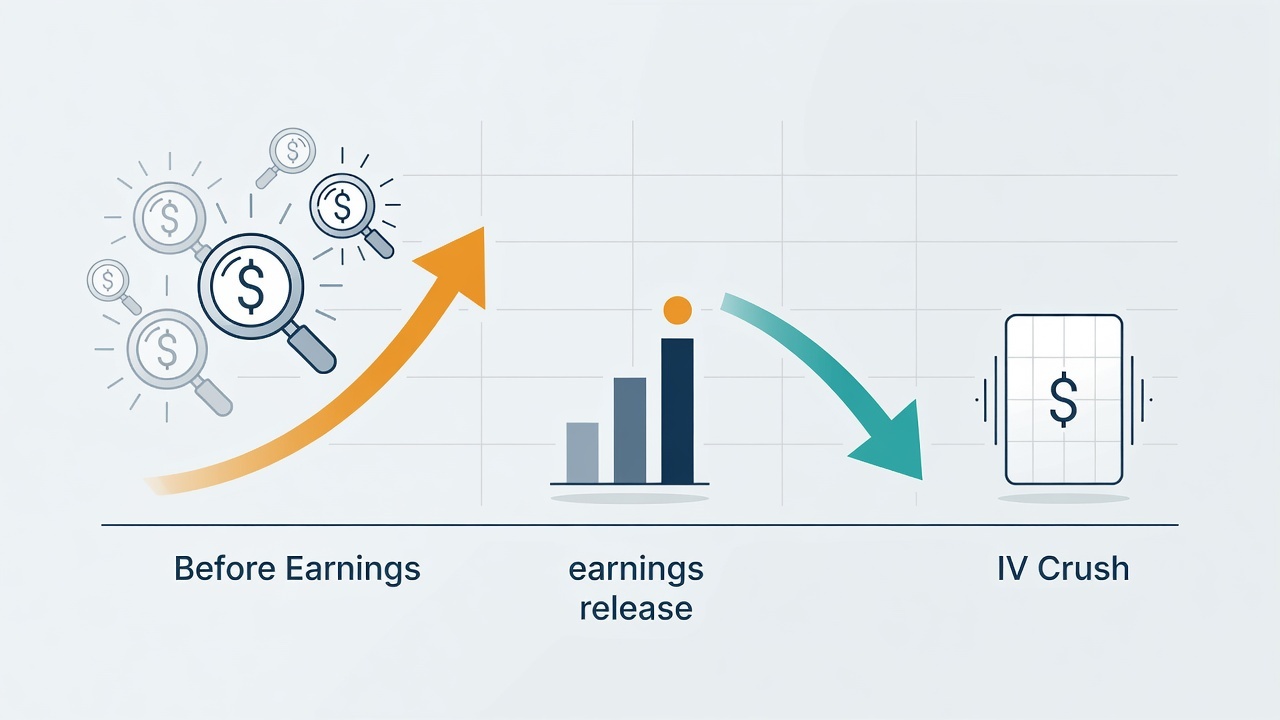
When earnings approach, implied volatility creeps higher day after day. As IV expands, it pumps pure extrinsic value directly into every call and put contract on the chain.
Remember our Greek friend Vega from Part 18 of the series. Vega measures how much an option’s dollar price changes for every single percentage point move in implied volatility.
When a stock’s IV spikes from a normal 30% all the way to 95% heading into an announcement, vega adds massive dollar value to the premium. You are paying a huge markup purely for future uncertainty.
The underlying stock might not move a single penny all week, yet your contracts get more expensive simply because earnings are 24 hours away. That added fluff is entirely extrinsic risk premium.
Free For Traders
One Clear Arrow. Every High-Probability Setup. Free.
The Fusion Indicator combines multiple signals into a single buy/sell arrow on TradingView so you never miss a move.
 → Get The Free Fusion Indicator
What Happens the Second Earnings Are Released
The moment the company releases its quarterly earnings report, the mystery vanishes instantly. Whether the numbers were spectacular or disastrous, the event has passed and the results are known.
Because the uncertainty is completely gone, implied volatility drops off a cliff. This sudden, violent evaporation of extrinsic value overnight is what traders call IV crush.
Returning to our hurricane analogy, imagine the day after the storm passes. The sky is clear, the winds are calm, and the immediate threat is over.
How much can an insurer charge for hurricane coverage the day after the storm clears out? Next to nothing, because the immediate danger has vanished.
The exact same thing happens to pre-earnings options. The moment the opening bell rings the next morning, that inflated volatility premium gets stripped away in seconds.
If the stock did not make a massive move that blew past the strike price, the option will lose substantial value regardless of what happened to the stock price.

Worked Example 1: The Winning Call That Lost Money
Let us look at real numbers so you can see how this mathematical trap springs on buyers. Suppose XYZ stock is trading at $100 per share two days before announcing earnings.
You believe the company will beat estimates, so you buy a 5-day expiration $105 Call for $6.00 per contract ($600 total). At the time you buy, implied volatility is sitting at an astronomical 90%.
The company reports earnings after the bell, and your thesis is correct: the stock jumps from $100 up to $107 the next morning. You open your broker app expecting a massive profit on your $105 Call.
Instead, you find that implied volatility has instantly collapsed from 90% down to 25%. Even though the stock rose $7, the extrinsic value you overpaid for has vanished entirely.
With XYZ at $107, your $105 Call has exactly $2.00 of intrinsic value ($107 stock price minus $105 strike price). Because IV got crushed, the remaining extrinsic time value is only worth $0.50.
Your contract is now worth $2.50 ($250), meaning you lost $3.50 per share ($350 total), representing a 58% loss on a trade where you predicted the direction perfectly.
| Metric | Before Earnings | After Earnings |
|---|---|---|
| Stock Price | $100.00 | $107.00 (+7.0%) |
| Implied Volatility | 90% | 25% (Crushed) |
| Intrinsic Value | $0.00 | $2.00 |
| Extrinsic Value | $6.00 | $0.50 |
| Total Option Price | $6.00 | $2.50 (-58%) |
Worked Example 2: How Put Buyers Get Crushed Just as Hard
Do not assume IV crush only attacks bullish traders buying calls. Put buyers trying to profit from earnings disasters walk straight into the exact same slaughterhouse.
Let us say stock ABC is trading at $50 per share the afternoon before its quarterly report. You expect poor guidance, so you buy a weekly $48 Put for $3.50 ($350 total) with IV at 110%.
Earnings come out, and the stock drops down to $46.50 at market open, falling a solid 7%. You nailed the drop, but let us check what happened to the premium.
With the stock at $46.50, your $48 Put now holds $1.50 of intrinsic value ($48 strike minus $46.50 stock price). Meanwhile, post-earnings IV crashed down from 110% to 35%.
That collapse leaves the option with just $0.40 of remaining extrinsic value. Your contract trades at $1.90 ($190), turning your accurate bearish prediction into a $160 loss per contract.
| Metric | Before Earnings | After Earnings |
|---|---|---|
| Stock Price | $50.00 | $46.50 (-7.0%) |
| Implied Volatility | 110% | 35% (Crushed) |
| Intrinsic Value | $0.00 | $1.50 |
| Extrinsic Value | $3.50 | $0.40 |
| Total Option Price | $3.50 | $1.90 (-45.7%) |
From Find Better Trades
Only Trade When Momentum Is HEAVILY In Your Favor
The Power Index oscillator measures trend conviction at a glance — it filters out weak, choppy action so you only take the strong moves.
 → See The Power Index

How to Measure the Expected Move Before It Happens
Market makers are not pulling these inflated prices out of thin air. They calculate an exact target range known as the expected move.
You do not need a fancy pricing model to see this calculation yourself. In Part 32, we explored straddles, and the at-the-money straddle gives you the market’s expectation directly.
Take the current price of the at-the-money call and add it to the at-the-money put for the front-week expiration. If stock XYZ is at $100, and the $100 Call costs $4 while the $100 Put costs $4, the combined straddle costs $8.
That $8 straddle price means the options market is pricing in an $8 swing up or down (8%). If the stock only moves $4 after earnings, both call and put buyers will get shredded by IV crush.
To profit on an outright long call or put, the stock must move significantly further than the priced-in expected move. If it moves anything less, extrinsic value deflation eats your profit alive.
How Smart Traders Handle Earnings Volatility
Once you understand how IV crush operates, you stop buying overpriced, front-week options right before the closing bell. Instead, you adapt your playbook to mitigate or exploit the volatility cycle.
One common adjustment is using vertical spreads (which we broke down in Part 28). When you buy a call and simultaneously sell a higher call, the short leg protects you by taking advantage of IV crush as well.
Another approach is buying contracts with expiration dates several months away. Longer-dated options experience far less IV crush because one single earnings report makes up a smaller portion of their total lifespan.
Some traders prefer to sell options strategies like iron condors (covered in Part 34) to harvest the collapsing extrinsic value directly. However, selling uncovered premium over earnings carries severe gap risk if the stock makes a generational move.
The simplest approach of all is often the most profitable: stay in cash until the numbers are out. Let the post-earnings dust settle, wait for IV to reset to normal levels, and trade the new trend cleanly.
Common Mistakes Beginners Make With This
Buying weekly out-of-the-money options right before the bell: Beginners love buying cheap $0.50 lottery tickets an hour before earnings. Because these contracts hold zero intrinsic value, IV crush wipes them out to $0.01 at the opening print.
Believing being right on direction guarantees a profit: If you buy an option with massive IV, the underlying stock must overcome both direction and the crush penalty. A positive move that falls short of the expected move still results in a total loss.
Holding long straddles through earnings without checking IV percentiles: Traders frequently think buying both a call and a put is a risk-free earnings trade. When IV collapses on both sides simultaneously, both legs lose value unless the stock makes an unprecedented historical move.
Failing to check the expiration cycle’s expected move: Placing an earnings trade without adding the ATM call and put premiums is trading blind. You must know what hurdle rate the market has priced in before risking capital on a directional bet.
IV Crush and Earnings Options FAQ
Does IV crush happen on every single earnings report? Yes, every stock experiences an immediate drop in implied volatility the moment its quarterly numbers become public information. The scale of the crush depends on how high IV ran up prior to the announcement.
Can I avoid IV crush by buying deep in the money options? Deep in-the-money options have very little extrinsic value and consist almost entirely of intrinsic value. Because there is minimal volatility premium baked in, they suffer far less from IV crush than out-of-the-money contracts.
Why did my long-dated option lose value after earnings? While contracts dated 60 to 90 days out suffer much less IV crush than weeklies, they still carry some earnings premium. If the stock barely moves, that modest IV drop combined with normal theta decay can still pull the contract value down.
What is the best time to buy options if I want to avoid IV crush? The best time to buy is after the earnings report has been released and implied volatility has fully reset to its historical baseline. Alternatively, enter positions several weeks before earnings before the volatility ramp begins, and sell before the actual report.
Next up in Part 38, we are going to look at the exact mechanics of choosing the right strike price for your trades so you stop leaving money on the table.
📈 Want More? Join Our Free Trading Community
- Trading Strategy Guides Telegram — daily strategy tips and market insights
- Find Better Trades Telegram — free trade signals delivered to your phone
- Find Better Trades on YouTube — live trade breakdowns and tutorials
Lesson 37 of 52 in the free Options Trading Course.
← Previous: How Earnings Season Affects Options Pricing: Beginner Guide
Next: How to Choose the Right Strike Price for Options: Beginner Guide →