How Earnings Season Affects Options Pricing: Beginner Guide

📚 Beginner’s Guide to Options — Part 36 of 51
- Part 1: What Is an Option? The Absolute Basics Explained
- Part 2: Calls vs. Puts: The Two Types of Options You Need to Know
- Part 3: Strike Price Explained: What It Actually Means for Your Trade
- Part 4: Expiration Date Explained: Why It Changes Everything
- Part 5: Premium Explained: What You’re Really Paying For
- Part 6: In the Money vs. Out of the Money: A Beginner’s Breakdown
- Part 7: Intrinsic Value vs. Extrinsic Value: What Makes Up an Option’s Price
- Part 8: How Buying a Call Option Works, Step by Step
- Part 9: How Buying a Put Option Works, Step by Step
- Part 10: What Happens When an Option Expires? Every Outcome Explained
- Part 11: Options Contracts 101: What One Contract Actually Represents
- Part 12: How to Read an Options Chain Without Getting Overwhelmed
- Part 13: Bid, Ask, and Spread: What They Mean When You’re Trading Options
- Part 14: What Is Implied Volatility? A Beginner’s Plain-English Guide
- Part 15: Why Options Lose Value Over Time: Theta Explained Simply
- Part 16: Delta Explained: What It Really Tells You About Your Option
- Part 17: Gamma Explained: Why Delta Doesn’t Stay the Same
- Part 18: Vega Explained: How Volatility Changes Your Option’s Price
- Part 19: The Greeks Cheat Sheet: Delta, Gamma, Theta, Vega in Plain English
- Part 20: What Is Assignment? What Happens If Your Option Gets Exercised
- Part 21: American vs. European Options: What’s the Difference?
- Part 22: How Much Money Do You Need to Start Trading Options?
- Part 23: Paper Trading Options: How to Practice Before Risking Real Money
- Part 24: The Biggest Mistake Beginners Make Buying Options
- Part 25: Why Most Beginners Lose Money Buying Options (and How to Avoid It)
- Part 26: Covered Calls Explained: The First Options Strategy Every Trader Should Learn
- Part 27: Cash-Secured Puts Explained: A Beginner-Friendly Way to Get Paid to Wait
- Part 28: Vertical Spreads Explained: Reducing Risk on Your First Options Trade
- Part 29: Credit Spreads vs. Debit Spreads: What’s the Real Difference?
- Part 30: The Protective Put Explained: Insurance for Your Stock Position
- Part 31: The Collar Strategy Explained: Protecting Gains Without Selling
- Part 32: Straddles Explained: Betting on a Big Move (In Either Direction)
- Part 33: Strangles Explained: A Cheaper Way to Bet on a Big Move
- Part 34: The Iron Condor Explained for Complete Beginners
- Part 35: The Wheel Strategy Explained: Getting Paid on Stocks You Want to Own
- Part 36: How Earnings Season Changes Options Pricing (and What to Watch For) (you are here)
⚡ Key Takeaways
- Earnings season creates massive uncertainty, which causes options premiums to swell across both calls and puts.
- The options market calculates an exact expected move for earnings, setting a high hurdle for option buyers.
- Knowing how volatility inflates prices before earnings prevents you from overpaying for contracts right before the announcement.
— Ben, Find Better Trades
Welcome to Part 36 of our 51-part series. Every quarter, I watch dozens of new traders buy a call right before their favorite company reports earnings, watch the stock jump 3%, and wonder why their account is in the red the next morning.
Options do not behave normally around earnings announcements. If you want to trade around these quarterly events without getting blindsided, you need to understand how the pricing mechanics change before the opening bell rings.
What Happens to a Stock During Earnings Season?
Every three months, public companies are required to open their books and show Wall Street how much money they made or lost. This event is what traders call a binary event, meaning the outcome is unknown until a single moment in time when all the information hits the market at once.
Before that report comes out, nobody knows for sure if the company beat expectations, missed revenue, or changed its future profit outlook. That lack of certainty creates a massive buildup of anticipation among buyers and sellers alike.
Because the numbers are released outside normal market hours, the stock cannot adjust smoothly throughout the day. Instead, it frequently gaps up or down violently the moment trading resumes.
This sudden repricing risk is unique to earnings season. Normal trading days feature gradual price discovery, but earnings days pack months of valuation adjustments into a single opening tick.
For options traders, this creates an environment where standard pricing rules get distorted by pure event risk.
Why Earnings Uncertainty Drives Implied Volatility Higher
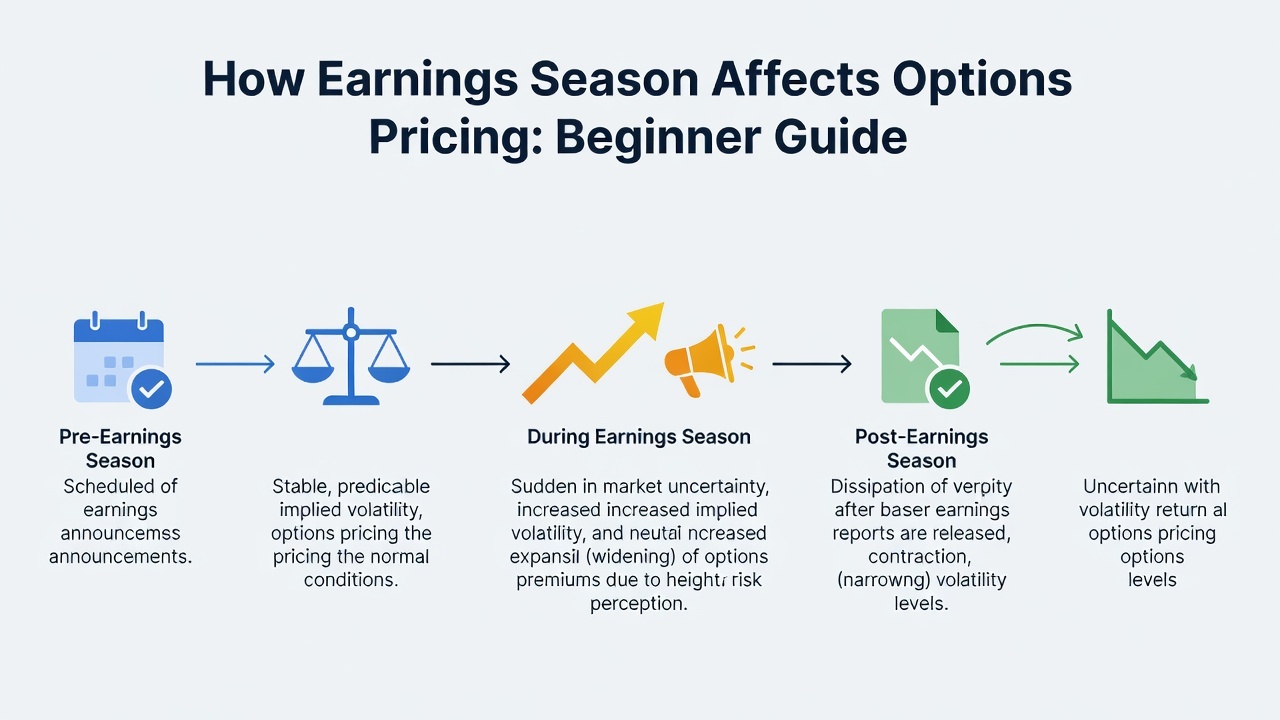
We covered implied volatility back in Part 14, where we established that implied volatility represents the market’s forecast of how much a stock might move. When an earnings date approaches, the market knows a large price move is likely, even if nobody knows the direction.
Think of it like buying coastal hurricane insurance. If you try to buy a policy in clear-skies April, the premium is cheap because the immediate risk is low.
If you try to buy that exact same policy twenty-four hours before a Category 5 hurricane makes landfall, the insurance company will charge you an astronomical rate. The company is not being mean; they are pricing in the obvious, imminent danger of a massive claim.
Options sellers act as the insurance underwriters of the financial markets. They know that holding an open contract through earnings exposes them to huge overnight swings.
To compensate themselves for taking that risk, sellers demand much higher premiums, which shows up on your screen as elevated implied volatility and expensive extrinsic value.
Free For Traders
Know What To Trade BEFORE The Opening Bell
The Big Dipper Dashboard hands you curated high-probability setups every single morning — free.
 → Get Free Big Dipper Access
The Concept of the “Expected Move”
The options market does not just blindly raise prices before earnings. It calculates an exact mathematical estimate called the expected move.
The expected move is the dollar amount the market anticipates the stock will swing, up or down, by the expiration date immediately following the report. Market makers price both the at-the-money call and the at-the-money put to reflect this combined swing.
A quick rule of thumb traders use to find the expected move is taking the price of the at-the-money straddle (which we covered in Part 32) expiring right after earnings. You add the call price and the put price together, then multiply by roughly 0.85.
If a $100 stock has an at-the-money call trading for $5 and an at-the-money put trading for $5, the straddle cost is $10. Multiplying $10 by 0.85 gives you an expected move of roughly $8.50 in either direction.
This means the market is pricing in a move between $91.50 and $108.50. If the stock ends up moving only $4, option buyers who paid for an $8.50 swing end up losing money, even if they guessed the direction correctly.

Worked Example 1: Pricing an Option Before vs. After Earnings
Let’s look at a concrete example so you can see the math in action. Suppose company XYZ is trading at $100 per share two days before reporting its quarterly numbers.
Under normal conditions, a 30-day $105 call option might trade for $1.50 with an implied volatility of 25%. But because earnings are on Thursday afternoon, implied volatility on that exact contract has spiked to 80%.
Because of that elevated volatility, the market price for the $105 call is currently $4.20. You buy one contract for $420, expecting a blowout quarter.
On Friday morning, XYZ reports solid earnings and the stock rallies 4%, rising from $100 to $104. You open your brokerage account expecting a great profit because the stock moved up substantially.
However, your $105 call is still out of the money because $104 is below your $105 strike price. Even worse, the event is over, so the implied volatility plummets from 80% back down to 25% instantly.
The contract extrinsic value collapses, and your $4.20 call is now worth only $0.90 on the market. You lost $330 on the trade despite being completely right that the stock would rally on earnings.
Why Both Calls and Puts Get Expensive at the Same Time
A common misconception among newer traders is that call options only get expensive when people are bullish, and puts only get expensive when people are bearish. Around earnings season, this assumption breaks down entirely.
Implied volatility is direction-agnostic. It does not care whether the stock goes up or down; it only measures the magnitude of the potential jump.
Because market makers have to hedge against sudden moves in either direction, they markup the extrinsic value on both sides of the chain simultaneously. Call buyers pay an elevated price, and put buyers pay an equally inflated price.
| Metric | Normal Trading Week | Earnings Announcement Week |
|---|---|---|
| Implied Volatility (IV) | Low to Moderate (e.g., 20%-30%) | Severely Elevated (e.g., 70%-120%) |
| Extrinsic Value Pricing | Standard time decay curve | Heavily inflated across all strikes |
| Post-Event Value Retention | Predictable daily theta loss | Instant drop in premium overnight |
| Directional Threshold to Profit | Modest move required | Massive move required to beat pricing |
This table demonstrates why buying outright options directly before earnings requires an exceptionally large move just to break even. Both sides of the market are paying an event surcharge.
From Find Better Trades
Three Signals Align. Your Phone Buzzes. That’s It.
Trisignal only fires when all three confluence conditions line up — high-probability alerts sent straight to Telegram.
 → Get Trisignal Alerts
Worked Example 2: How the Market Prices a Huge Tech Earnings Event
Let’s look at another scenario featuring a higher-priced tech stock, ABC, trading at $200 per share. ABC is scheduled to release its annual revenue numbers after the closing bell on Wednesday.
Looking at the options chain expiring on Friday, the $200 at-the-money call costs $12.00, and the $200 at-the-money put costs $11.50. Together, the straddle costs $23.50 per share, or $2,350 total for one pair of contracts.
To break even by Friday expiration, a call buyer needs ABC to climb past $212.00 ($200 strike + $12.00 premium paid). A put buyer needs ABC to collapse below $188.50 ($200 strike – $11.50 premium paid).
That means the stock must move more than 6% in under forty-eight hours just for an at-the-money option buyer to make one single penny of profit. If the company delivers a solid report and the stock rises a modest 3% to $206, the $200 call finishes in the money with $6.00 of intrinsic value.
However, because the buyer paid $12.00 for the contract, they still suffer a net loss of $6.00 per share, or $600 per contract. The stock went up, the trade was directionally correct, but the earnings premium was simply too high to overcome.
What to Watch For on the Options Chain Before Earnings
Before you ever place a trade during earnings season, there are specific signals on the options chain you should examine carefully. The first is IV Percentile or IV Rank, which shows where current volatility sits relative to its past 52-week range.
If IV Rank is above 80, options are trading near their most expensive levels of the entire year. That tells you immediately that buying single-leg contracts carries severe pricing risk.
The second detail to inspect is the difference in pricing between expiration cycles, known as the term structure. Normally, contracts with more time until expiration cost more than contracts expiring this week.
Ahead of earnings, this relationship often flips into what traders call backwardation, where the weekly expiration covering the earnings date becomes dramatically more expensive on a volatility basis than the months further out. The market concentrates the pricing surge directly onto the expiration that absorbs the announcement.
Finally, keep an eye on the bid-ask spread (which we studied in Part 13). As earnings approach, market makers frequently widen spreads to manage their own risk, meaning you will lose more money just getting into and out of the position.
Common Mistakes Beginners Make With This
1. Buying out-of-the-money calls right before the bell. Many new traders buy cheap out-of-the-money strikes hours before earnings, hoping for a lottery-ticket payout. Because these contracts hold purely extrinsic value, any failure to exceed the strike price combined with the post-earnings volatility drop reduces them to zero almost instantly.
2. Assuming a positive earnings report guarantees a stock rally. A company can beat its revenue estimates and still see its stock tumble if future profit guidance is weak. Trading earnings purely on headline numbers ignores the forward-looking nature of market expectations.
3. Ignoring the size of the implied expected move. Entering a trade without calculating the market’s expected move leaves you blind to what kind of price swing is already priced into the contract. If you need an 8% rally to profit on a stock that normally moves 3% on earnings, the odds are stacked heavily against you.
4. Forgetting that bid-ask spreads widen during high-volatility events. Placing market orders into an earnings options chain often leads to terrible fills on wide bid-ask spreads. You end up overpaying on entry and selling at a discount on exit, eating away your potential profits before the stock even moves.
5. Holding single-leg options through the event without a defined risk plan. Many beginners hold naked long options through earnings without understanding that the contract value will be drastically reset the next morning. If you hold through the report, you must be prepared for the rapid repricing that takes place overnight.
Earnings and Options Pricing: Frequently Asked Questions
Why did my call option lose money when the stock went up after earnings? Your option lost value because the drop in implied volatility destroyed more extrinsic value than the stock’s price gain added in intrinsic value. When the market prices in a 6% move and the stock only gains 2%, the premium deflates rapidly across the board.
When is implied volatility highest around an earnings announcement? Implied volatility typically reaches its peak during the final trading hours immediately preceding the earnings release. Once the numbers are published and uncertainty vanishes, implied volatility collapses almost immediately.
Is it better to buy options before or after earnings are released? Buying before earnings means paying peak prices for inflated volatility, while buying after the report allows you to trade with normalized premiums and clear direction. Most experienced retail traders avoid buying outright single-leg options immediately prior to the announcement.
How can I find out the exact date a company reports earnings? You can check your brokerage platform’s stock profile, review company investor relations websites, or use dedicated financial calendar tools. Always confirm the date and whether the report comes out before the market opens or after the market closes.
Now that you know how earnings inflate options prices, in the next part we are going to break down the exact phenomenon that wipes out these premiums overnight: IV crush.
📈 Want More? Join Our Free Trading Community
- Trading Strategy Guides Telegram — daily strategy tips and market insights
- Find Better Trades Telegram — free trade signals delivered to your phone
- Find Better Trades on YouTube — live trade breakdowns and tutorials
Lesson 36 of 52 in the free Options Trading Course.
← Previous: Wheel Strategy Explained: Earn Income on Stocks You Want to Own
Next: Why Options Get More Expensive Before Earnings (IV Crush) →