Options Strangles Explained: A Cheaper Bet on Big Moves

📚 Beginner’s Guide to Options — Part 33 of 51
- Part 1: What Is an Option? The Absolute Basics Explained
- Part 2: Calls vs. Puts: The Two Types of Options You Need to Know
- Part 3: Strike Price Explained: What It Actually Means for Your Trade
- Part 4: Expiration Date Explained: Why It Changes Everything
- Part 5: Premium Explained: What You’re Really Paying For
- Part 6: In the Money vs. Out of the Money: A Beginner’s Breakdown
- Part 7: Intrinsic Value vs. Extrinsic Value: What Makes Up an Option’s Price
- Part 8: How Buying a Call Option Works, Step by Step
- Part 9: How Buying a Put Option Works, Step by Step
- Part 10: What Happens When an Option Expires? Every Outcome Explained
- Part 11: Options Contracts 101: What One Contract Actually Represents
- Part 12: How to Read an Options Chain Without Getting Overwhelmed
- Part 13: Bid, Ask, and Spread: What They Mean When You’re Trading Options
- Part 14: What Is Implied Volatility? A Beginner’s Plain-English Guide
- Part 15: Why Options Lose Value Over Time: Theta Explained Simply
- Part 16: Delta Explained: What It Really Tells You About Your Option
- Part 17: Gamma Explained: Why Delta Doesn’t Stay the Same
- Part 18: Vega Explained: How Volatility Changes Your Option’s Price
- Part 19: The Greeks Cheat Sheet: Delta, Gamma, Theta, Vega in Plain English
- Part 20: What Is Assignment? What Happens If Your Option Gets Exercised
- Part 21: American vs. European Options: What’s the Difference?
- Part 22: How Much Money Do You Need to Start Trading Options?
- Part 23: Paper Trading Options: How to Practice Before Risking Real Money
- Part 24: The Biggest Mistake Beginners Make Buying Options
- Part 25: Why Most Beginners Lose Money Buying Options (and How to Avoid It)
- Part 26: Covered Calls Explained: The First Options Strategy Every Trader Should Learn
- Part 27: Cash-Secured Puts Explained: A Beginner-Friendly Way to Get Paid to Wait
- Part 28: Vertical Spreads Explained: Reducing Risk on Your First Options Trade
- Part 29: Credit Spreads vs. Debit Spreads: What’s the Real Difference?
- Part 30: The Protective Put Explained: Insurance for Your Stock Position
- Part 31: The Collar Strategy Explained: Protecting Gains Without Selling
- Part 32: Straddles Explained: Betting on a Big Move (In Either Direction)
- Part 33: Strangles Explained: A Cheaper Way to Bet on a Big Move (you are here)
⚡ Key Takeaways
- A long strangle involves buying an out-of-the-money call and an out-of-the-money put with the same expiration date.
- It costs less upfront than a straddle because both options sit out of the money, lowering your total capital at risk.
- Because your entry cost is lower, the stock has to move significantly further in either direction to generate a profit.
— Ben, Find Better Trades
Welcome back to Part 33 of our beginner options series. In our previous guide, we broke down the straddle—a trade where you buy an at-the-money call and put together because you expect an explosive breakout but do not care which way it goes.
Today, we are looking at the straddle’s close cousin: the strangle. It solves the biggest drawback traders face with straddles, which is the steep upfront price tag.
What Is an Options Strangle?
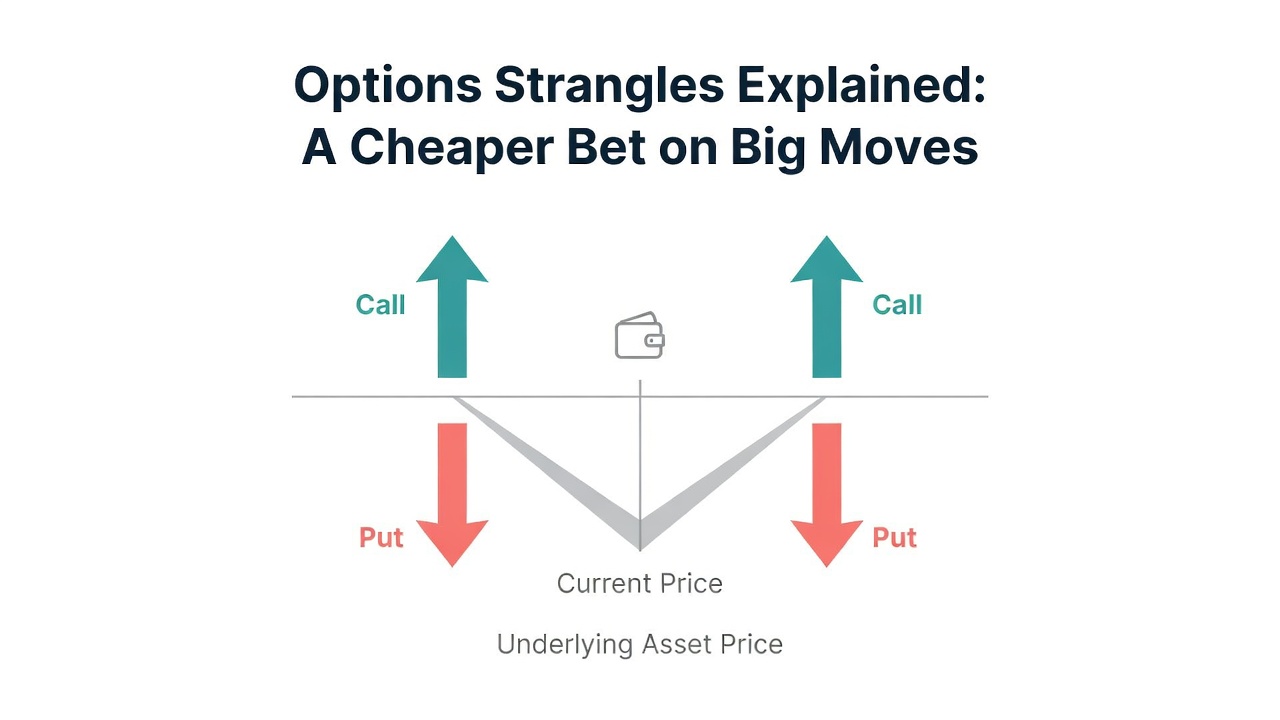
A long strangle is a direction-neutral strategy where you buy two distinct options on the exact same underlying stock with the exact same expiration date.
Specifically, you buy one out-of-the-money call option above the current stock price and one out-of-the-money put option below the current stock price.
Think of it like setting two separate tripwires away from where a stock is resting. If the stock explodes violently upward, your call catches fire and gains value, while your put expires worthless.
If the stock crashes through the floor, your put increases in value while your call sits at zero. As long as one side gains far more than the total combined price you paid for both contracts, you walk away with a net profit.
You are betting purely on magnitude rather than direction. You do not care if the CEO delivers record profits or resigns in disgrace, as long as the market reacts with sheer drama.
How a Strangle Differs from a Straddle
As we covered earlier in the series, a straddle forces you to buy an at-the-money call and put at the exact same middle strike price. Because both contracts sit right where the stock trades, at-the-money options carry heavy extrinsic value and demand a hefty price tag.
A strangle avoids this steep entry cost by using out-of-the-money strikes. Out-of-the-money options are inherently cheaper because they currently have zero intrinsic value.
Here is the core tradeoff you must understand before placing a single order. A strangle costs significantly less cash out of your pocket, but it demands a much larger price swing from the stock to make money.
With a straddle, the stock starts working toward your breakeven point the moment it moves a single cent in either direction. With a strangle, the stock first has to travel through the empty gap between your two strikes before one of your options even crosses into the money.
You are choosing to pay less upfront in exchange for needing a significantly more violent price explosion.
Free For Traders
One Clear Arrow. Every High-Probability Setup. Free.
The Fusion Indicator combines multiple signals into a single buy/sell arrow on TradingView so you never miss a move.
 → Get The Free Fusion Indicator
The Mechanics and Breakeven Math of a Long Strangle
Calculating your risk and reward on a strangle is straightforward once you know how the numbers fit together. Your maximum risk is always capped at the total premium you pay to open both legs of the trade.
If the stock refuses to move and sits comfortably between your two strike prices at expiration, both options will expire worthless. In that worst-case scenario, you lose 100% of the cash you spent on the trade, but not a single penny more.
Because you have two separate strikes, you also have two separate breakeven points at expiration. Let’s look at the exact formulas you use to find those points:
Upper Breakeven = Call Strike Price + Total Combined Premium Paid
Lower Breakeven = Put Strike Price – Total Combined Premium Paid
Any price point beyond these two boundary lines represents pure profit at expiration. The table below illustrates how the math lays out across different stock movements:
| Metric | Calculation | Financial Result |
|---|---|---|
| Max Risk | Call Premium + Put Premium | Total debit paid upfront |
| Upper Breakeven | Call Strike + Total Debit | Stock must exceed this to profit to upside |
| Lower Breakeven | Put Strike – Total Debit | Stock must drop below this to profit to downside |
| Max Upside Profit | Stock Price – Upper Breakeven | Theoretically unlimited |
| Max Downside Profit | Lower Breakeven – $0.00 | Substantial (capped if stock hits zero) |

A Full Numeric Example: Trading a Real-World Setup
Let’s walk through an illustrative scenario step by step so you can see the cash flows in action. Suppose stock XYZ trades at $100 per share ahead of an upcoming FDA trial announcement.
Instead of guessing the outcome, you decide to buy a 30-day strangle. You buy one $105 strike call for $2.00 ($200 total) and one $95 strike put for $1.50 ($150 total).
Your total combined outlay to enter this position is $3.50 per share, or $350 total. This $350 is your hard maximum risk on the entire trade.
Now let’s compute your breakeven thresholds using our formulas. Your upper breakeven sits at $108.50 ($105 call strike + $3.50 debit), and your lower breakeven sits at $91.50 ($95 put strike – $3.50 debit).
Suppose the FDA approves the drug and XYZ skyrockets straight to $120 by expiration. The $95 put expires with a value of $0, but your $105 call is now worth $15.00 ($1,500 total value).
Subtract your original $350 entry cost from that $1,500 value, and your net profit is $1,150. Conversely, if XYZ falls flat and finishes the month sitting at $98, both options expire worthless and you lose your full $350.
Comparing a Straddle vs. a Strangle Side by Side
To really cement why you would pick one strategy over the other, let’s compare both using the exact same hypothetical $100 stock. Seeing the numbers side by side shows you the fundamental balancing act between cost and probability.
With XYZ at $100, an at-the-money straddle (buying the $100 call and $100 put) might cost you $5.00 for the call and $5.00 for the put, creating a total upfront cost of $10.00 ($1,000).
Your breakeven points for this straddle would be $110.00 to the upside and $90.00 to the downside. You paid $1,000 upfront, but the stock only needs to move 10% in either direction for you to break even.
Now look at the strangle on that same stock, using the $105 call ($2.00) and $95 put ($1.50) for a combined cost of $3.50 ($350). Your breakeven marks are $108.50 and $91.50.
Notice that the strangle cuts your total dollar risk by nearly two-thirds ($350 versus $1,000). However, the strangle requires the stock to clear the $105 or $95 level first before it gains any intrinsic value.
The straddle gives you a wider window of responsiveness, but the strangle gives you cheaper leverage. Choosing between them comes down to your conviction regarding how monstrous the coming move will be.
From Find Better Trades
Ride The Trend. Skip The Whipsaw.
Clear directional bias with built-in noise filters and trailing stop logic — from entry to exit.
 → See Trend Rider

How Greeks Impact Your Strangle Trade
Just like any multi-leg trade we have discussed in this series, the Greeks play a massive role in whether your strangle wins or loses before expiration. The two biggest forces you must watch are Theta and Vega.
As we covered in Part 15, Theta represents daily time decay. When you hold a long strangle, you own two out-of-the-money contracts that consist entirely of extrinsic value.
Every single day that passes without a major price swing chips away at the value of both legs simultaneously. You are paying double the daily rent to keep the position open.
Vega, which we unpacked in Part 18, measures your sensitivity to implied volatility. Strangles love rising implied volatility because an increase in volatility pumps extrinsic value straight into both of your contracts.
However, if you buy a strangle right before a high-profile earnings report when implied volatility is inflated, you face an IV crush the moment the report goes public. Even if the stock moves moderately, a sharp drop in implied volatility can crush the value of both legs faster than the stock movement can rescue them.
When Does Using a Strangle Actually Make Sense?
A long strangle makes sense when three specific market conditions align. First, you must have a clear catalyst that will force market participants to reprice the stock dramatically in a short window.
Second, implied volatility needs to be relatively low or reasonably priced compared to the size of the potential catalyst. Buying cheap options before volatility ramps up is how you stack the odds in your favor.
Third, you should prefer a strangle when you want to define your absolute maximum dollar risk strictly without tying up massive amounts of account capital.
If an at-the-money straddle costs more cash than your personal risk management rules allow for a single trade, the strangle offers a structured, budget-conscious alternative.
Just remember that hope is not a strategy. If the stock drifts sideways inside your strike corridor, time decay will quietly consume your entire stake.
Common Mistakes Beginners Make With Strangles
Buying strikes that are way too far out of the money. Beginners often get seduced by super-cheap 50-cent strikes without doing the math. If you buy a strike that requires a 30% move just to reach breakeven, you are essentially buying a lottery ticket that will almost certainly expire worthless.
Holding all the way through expiration. You do not need to wait until the final closing bell to take your money off the table. If a stock makes a sudden, violent move two weeks into your 45-day contract, your winning leg may be up substantially; taking profits early locks in gains and avoids late-stage Theta decay.
Ignoring pre-earnings implied volatility spikes. Buying a strangle an hour before an earnings report means you are paying top dollar for inflated extrinsic value. When volatility collapses the next morning, both your call and put will lose value instantly, even if the stock made a decent jump.
Failing to cut the trade when the thesis dies. If the scheduled catalyst passes and the stock barely budges, your trade thesis is dead. Lingering in the position hoping for a miracle only allows time decay to claim whatever remaining salvage value your contracts have left.
Long Strangle Strategy FAQ
Can I lose more money than I paid for a long strangle?
No, your maximum potential loss is strictly limited to the total premium you paid upfront plus any trading commissions. Because you are buying options rather than selling them, you can never lose more than your initial investment.
Which option leg do I close first when the stock moves?
Most traders close both legs at the exact same time as a package deal. While you can sell the profitable winning leg and hold the losing leg as a runner, doing so exposes you to directional risk on the remaining piece.
How far out of the money should my strangle strikes be?
A common baseline for swing traders is targeting strikes around the 20 to 30 Delta mark. Striking that balance gives you a meaningful discount on premium without pushing your breakeven points impossibly far away from current prices.
Is a long strangle better than a long straddle?
Neither strategy is inherently better; they simply offer different balances of cost versus probability. Strangles cost less cash and carry lower maximum dollar risk, while straddles require smaller price moves to reach profitability.
Now that you know how to play big market moves for a fraction of the cost, get ready for Part 34, where we will flip the script and teach you how to collect upfront income using the legendary Iron Condor strategy.
📈 Want More? Join Our Free Trading Community
- Trading Strategy Guides Telegram — daily strategy tips and market insights
- Find Better Trades Telegram — free trade signals delivered to your phone
- Find Better Trades on YouTube — live trade breakdowns and tutorials
Lesson 33 of 52 in the free Options Trading Course.
← Previous: Straddles Explained: Betting on a Big Move in Either Direction
Next: Iron Condor Explained: The Complete Beginner’s Guide →