Protective Put Strategy Explained: How to Insure Stock

📚 Beginner’s Guide to Options — Part 30 of 51
- Part 1: What Is an Option? The Absolute Basics Explained
- Part 2: Calls vs. Puts: The Two Types of Options You Need to Know
- Part 3: Strike Price Explained: What It Actually Means for Your Trade
- Part 4: Expiration Date Explained: Why It Changes Everything
- Part 5: Premium Explained: What You’re Really Paying For
- Part 6: In the Money vs. Out of the Money: A Beginner’s Breakdown
- Part 7: Intrinsic Value vs. Extrinsic Value: What Makes Up an Option’s Price
- Part 8: How Buying a Call Option Works, Step by Step
- Part 9: How Buying a Put Option Works, Step by Step
- Part 10: What Happens When an Option Expires? Every Outcome Explained
- Part 11: Options Contracts 101: What One Contract Actually Represents
- Part 12: How to Read an Options Chain Without Getting Overwhelmed
- Part 13: Bid, Ask, and Spread: What They Mean When You’re Trading Options
- Part 14: What Is Implied Volatility? A Beginner’s Plain-English Guide
- Part 15: Why Options Lose Value Over Time: Theta Explained Simply
- Part 16: Delta Explained: What It Really Tells You About Your Option
- Part 17: Gamma Explained: Why Delta Doesn’t Stay the Same
- Part 18: Vega Explained: How Volatility Changes Your Option’s Price
- Part 19: The Greeks Cheat Sheet: Delta, Gamma, Theta, Vega in Plain English
- Part 20: What Is Assignment? What Happens If Your Option Gets Exercised
- Part 21: American vs. European Options: What’s the Difference?
- Part 22: How Much Money Do You Need to Start Trading Options?
- Part 23: Paper Trading Options: How to Practice Before Risking Real Money
- Part 24: The Biggest Mistake Beginners Make Buying Options
- Part 25: Why Most Beginners Lose Money Buying Options (and How to Avoid It)
- Part 26: Covered Calls Explained: The First Options Strategy Every Trader Should Learn
- Part 27: Cash-Secured Puts Explained: A Beginner-Friendly Way to Get Paid to Wait
- Part 28: Vertical Spreads Explained: Reducing Risk on Your First Options Trade
- Part 29: Credit Spreads vs. Debit Spreads: What’s the Real Difference?
- Part 30: The Protective Put Explained: Insurance for Your Stock Position (you are here)
⚡ Key Takeaways
- A protective put acts like an insurance policy for a stock you already own.
- You pay a premium up front to establish a guaranteed floor price for your shares.
- This strategy caps your maximum loss while leaving your stock profit potential completely unlimited.
— Ben, Find Better Trades
Holding stock through volatile markets or corporate earnings announcements can feel like driving without a seatbelt. Welcome to Part 30 of our beginner options series, where I am going to show you how to lock in peace of mind for your portfolio.
Most individual stock investors assume their only choice during market stress is selling out completely or hoping for the best. I want to show you how professional traders protect their core long positions using a straightforward technique called the protective put.
What Is a Protective Put?
A protective put is a defensive strategy where you buy a put option for stock you already own in your portfolio. We covered how buying put options works back in Part 9 of this series, so you know a put gives you the right to sell shares at a fixed price.
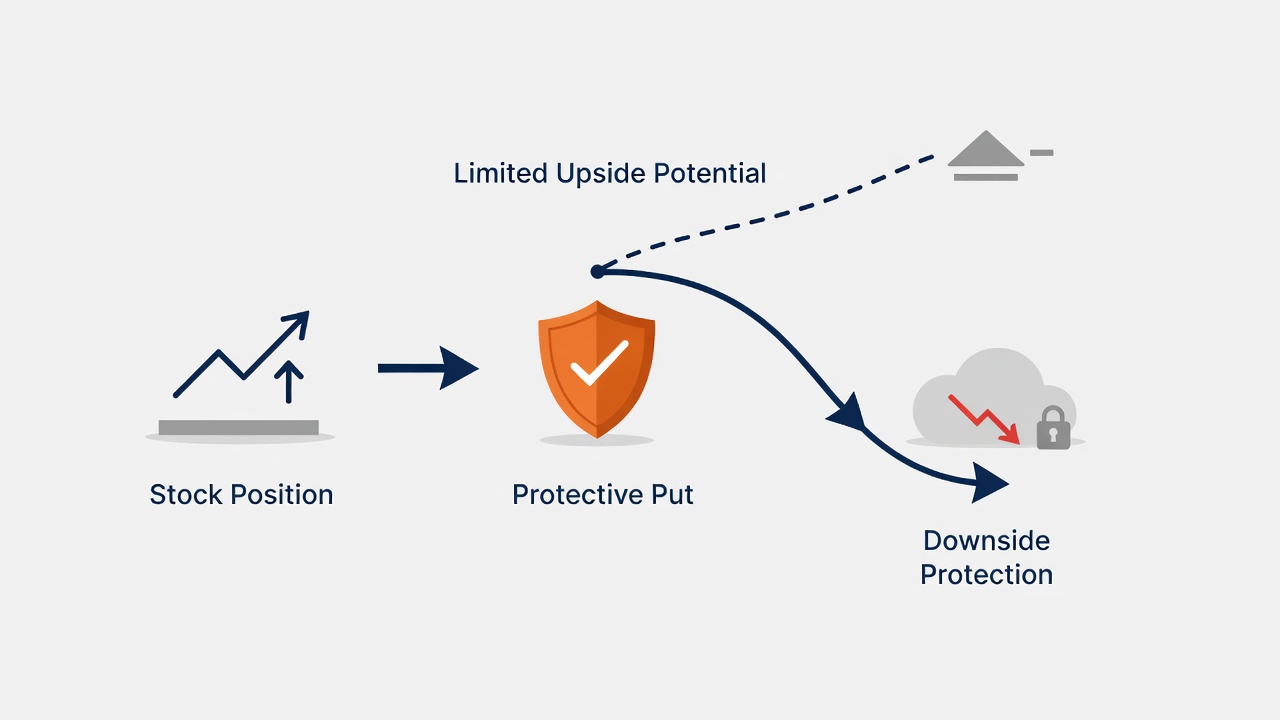
When you own shares of stock and buy a put option on that exact same stock, you create a synthetic floor under your position. No matter how far the stock drops in the open market, your minimum sale price remains completely guaranteed by the contract.
I like to think of this strategy as buying peace of mind for your stock holdings. You retain full ownership of your shares, including any dividend payments, while eliminating catastrophic market downside.
If the stock climbs higher instead of falling, your only loss is the cash fee you paid up front for the option contract. You keep every dollar of stock upside beyond that initial option cost.
This unique risk profile makes protective puts popular before binary events like quarterly earnings reports or clinical trial results. You maintain full participation in big market moves while establishing a firm safety net.
How a Protective Put Works: The Insurance Analogy
Think about how auto insurance or homeowner’s insurance works in your everyday life. You pay an insurance company a non-refundable fee called a premium to transfer risk away from yourself.
If nothing bad happens to your house during the year, you lose that premium money, but you do not complain. You are simply glad your house did not burn down or get damaged during a major storm.
Options work the exact same way when paired with stock shares you own. As we covered in Part 5, the option premium is simply the cash fee you pay up front for financial protection.
Your strike price acts just like an insurance deductible on your policy. Choosing a strike price right at the current market stock price gives you full coverage, but requires a higher upfront premium.
Choosing a lower strike price lowers your upfront cash bill for the option contract. However, it means you agree to absorb a larger initial drop in stock value before your option insurance kicks in.
Free For Traders
One Clear Arrow. Every High-Probability Setup. Free.
The Fusion Indicator combines multiple signals into a single buy/sell arrow on TradingView so you never miss a move.
 → Get The Free Fusion Indicator
Step-by-Step Example: Protecting Stock From Scratch
Let’s walk through a realistic numerical example to see how the dollars and cents actually work on a live position. Suppose you purchase 100 shares of company XYZ currently trading at $100 per share.
You want to protect your $10,000 investment from a sudden market sell-off over the next three months. You buy one 90-day put option with a $100 strike price for $4 per share, which costs $400 total since options cover 100 shares as explained in Part 11.
Now consider scenario one: XYZ stock suffers an catastrophic bad news event and crashes to $60 per share by expiration. An unprotected stock owner would suffer a massive $4,000 loss on their position.
Because you bought the $100 strike put, you exercise your right to sell your 100 shares at $100 each. You receive $10,000 cash for your stock, and after subtracting your $400 insurance fee, your net loss is strictly capped at $400.
Scenario two: XYZ stock skyrockets to $130 per share instead. Your 100 shares are now worth $13,000, your put option expires worthless, and your total net profit is $2,600 after accounting for your initial $400 option expense.
| Stock Price at Expiration | Stock Value | Put Option Value | Total Net Profit / Loss |
|---|---|---|---|
| $60.00 | $6,000 | $4,000 (Exercised at $100) | -$400 Max Loss |
| $80.00 | $8,000 | $2,000 (Exercised at $100) | -$400 Max Loss |
| $100.00 | $10,000 | $0 (Expires) | -$400 Max Loss |
| $110.00 | $11,000 | $0 (Expires) | +$600 Net Gain |
| $130.00 | $13,000 | $0 (Expires) | +$2,600 Net Gain |

Choosing Your Strike Price: Deductibles and Trade-offs
Selecting the right strike price for your protective put comes down to balancing cost against risk tolerance. As we discussed back in Part 3, the strike price determines where your floor sits.
An at-the-money put option matches the stock’s current trading price. It offers immediate downside protection from the moment you execute the trade, but commands the highest cash premium.
An out-of-the-money put option sets a strike price below the current stock price. We covered the technical definition of in-the-money and out-of-the-money options back in Part 6 of the series.
If XYZ trades at $100, buying a $90 strike put costs significantly less than buying a $100 strike put. The trade-off is that you agree to absorb the first $10 per share market drop out of your own pocket.
I recommend choosing lower strike prices if you want inexpensive protection against a complete financial crash. Choose strike prices closer to the current stock price when protecting significant capital you cannot afford to risk.
Calculating Your Breakeven and Maximum Loss
Calculating the risk metrics on a protective put setup requires simple, straightforward arithmetic. Your maximum possible loss is strictly defined and capped from the moment you place the trade.
Maximum loss equals your initial stock purchase price minus the put strike price plus the option premium paid per share. If you bought stock at $100 and a $95 strike put for $3, your maximum loss is $8 per share.
Your breakeven price on the combined position shifts slightly higher because of the insurance cost. Breakeven equals your initial stock purchase price plus the put option premium paid per share.
If you paid $100 for the share and $3 for the put, your new breakeven point becomes $103 per share. The stock must rise above $103 by option expiration for you to show an overall profit.
Notice that unlike standard stock ownership, your downside exposure is completely finite and predictable. No matter how severe a market crash gets, your worst-case outcome is known before you enter the market.
| Metric | Formula | Example ($100 Stock, $95 Put @ $3) |
|---|---|---|
| Maximum Loss | (Stock Price – Strike Price) + Premium Paid | ($100 – $95) + $3 = $8 per share ($800 total) |
| Maximum Gain | Unlimited | Unlimited (Minus $3 premium paid) |
| Breakeven Price | Stock Price + Premium Paid | $100 + $3 = $103 per share |
From Find Better Trades
Ride The Trend. Skip The Whipsaw.
Clear directional bias with built-in noise filters and trailing stop logic — from entry to exit.
 → See Trend Rider

Protecting Your Gains: Locking In Profits on a Winner
Protective puts are not just for brand new stock purchases. They are exceptionally useful tools for locking in unrealized gains on stocks you bought months or years ago.
Suppose you bought 100 shares of ABC stock two years ago at $40 per share. Today, ABC trades at $150 per share, giving you $11,000 in unrealized paper gains.
You want to stay invested because you believe in the company’s long-term future. However, an upcoming economic slowdown or earnings release could threaten those substantial profits.
If you sell the stock outright to lock in profits, you trigger an immediate capital gains tax event. Buying a 6-month $140 strike put for $6 per share lets you preserve your gain without selling the stock today.
If ABC crashes to $80, you can still sell your shares for $140 using your put contract. Your minimum profit remains locked at $94 per share ($140 strike minus $40 original cost minus $6 put fee).
Protective Put vs. Stop-Loss: Why Insurance Beats Orders
Traders often ask me why they should pay money for put options when traditional stop-loss orders are free. The answer lies in market gaps and execution slippage during severe selling panics.
A stop-loss order converts to a market order once your price threshold is breached. If terrible news breaks overnight, a stock trading at $100 might reopen the next morning at $70.
Your stop-loss set at $90 will execute at $70, forcing you to absorb a far larger loss than intended. Stop-loss orders offer zero price execution guarantees across overnight market gaps.
A put option contract is a legal, binding financial contract that guarantees your execution price. As we covered in Part 20, exercising an option forces the buyer to pay your strike price regardless of market gaps.
When markets panic and gap down heavily, a put option guarantees your exit price. You pay an option premium specifically to eliminate the gap risk that standard stop-loss orders cannot prevent.
Common Mistakes Beginners Make With Protective Puts
1. Buying puts with expiration dates that are too short. Buying weekly options seems appealing because the upfront dollar cost is low. However, fast time decay drains their value rapidly as we learned in Part 15 on Theta, making short-term options poor long-term insurance.
2. Buying strike prices that are far too low. Selecting a $50 strike put for a $100 stock costs very little cash, but leaves you exposed to a massive 50% drop. Practical portfolio protection should shield your capital against realistic market declines, not just economic collapse.
3. Constantly renewing put options without tracking costs. Buying monthly protective puts repeatedly burns through trading capital quickly over a full year. Paying 3% every month in options premium creates a 36% annual cost drag that completely destroys long-term stock returns.
4. Panic buying puts after a stock has already crashed. Volatility spikes dramatically during a sharp market sell-off, raising option prices across the board. As we explained in Part 18 regarding Vega, buying put options after a crash means paying top dollar for overpriced insurance.
Protective Put Strategy FAQ for Beginners
Do I have to sell my stock if I buy a protective put option? No, you retain full ownership and voting rights of your shares throughout the life of the option contract. The put option simply gives you the right to sell your shares if you choose to exercise that right.
Can I sell the put option contract early instead of exercising it? Yes, you can sell the put option back to the market at any time before expiration to collect its cash value. If the stock drops, your put option value rises, allowing you to harvest cash profits without selling your underlying stock.
How far out should my protective put expiration date be? Most experienced traders buy put options with 60 to 180 days remaining until expiration. This timeframe strikes a healthy balance between reasonable upfront premium costs and manageable daily time decay rates.
What happens to my protective put if the stock price goes up? If the stock price rises above your strike price, your put option simply expires worthless at expiration. Your stock shares gain value, and your net profit equals the stock appreciation minus the initial option premium paid.
Now that you know how to build a guaranteed floor under your stock positions using puts, next up in Part 31 we will explore how to offset the cost of that insurance completely using the Collar strategy.
📈 Want More? Join Our Free Trading Community
- Trading Strategy Guides Telegram — daily strategy tips and market insights
- Find Better Trades Telegram — free trade signals delivered to your phone
- Find Better Trades on YouTube — live trade breakdowns and tutorials
Lesson 30 of 52 in the free Options Trading Course.
← Previous: Credit Spreads vs Debit Spreads: The Complete Beginner Guide
Next: Collar Strategy Explained: Protect Gains Without Selling →