Cash-Secured Puts Explained: Get Paid to Buy Stock

📚 Beginner’s Guide to Options — Part 27 of 51
- Part 1: What Is an Option? The Absolute Basics Explained
- Part 2: Calls vs. Puts: The Two Types of Options You Need to Know
- Part 3: Strike Price Explained: What It Actually Means for Your Trade
- Part 4: Expiration Date Explained: Why It Changes Everything
- Part 5: Premium Explained: What You’re Really Paying For
- Part 6: In the Money vs. Out of the Money: A Beginner’s Breakdown
- Part 7: Intrinsic Value vs. Extrinsic Value: What Makes Up an Option’s Price
- Part 8: How Buying a Call Option Works, Step by Step
- Part 9: How Buying a Put Option Works, Step by Step
- Part 10: What Happens When an Option Expires? Every Outcome Explained
- Part 11: Options Contracts 101: What One Contract Actually Represents
- Part 12: How to Read an Options Chain Without Getting Overwhelmed
- Part 13: Bid, Ask, and Spread: What They Mean When You’re Trading Options
- Part 14: What Is Implied Volatility? A Beginner’s Plain-English Guide
- Part 15: Why Options Lose Value Over Time: Theta Explained Simply
- Part 16: Delta Explained: What It Really Tells You About Your Option
- Part 17: Gamma Explained: Why Delta Doesn’t Stay the Same
- Part 18: Vega Explained: How Volatility Changes Your Option’s Price
- Part 19: The Greeks Cheat Sheet: Delta, Gamma, Theta, Vega in Plain English
- Part 20: What Is Assignment? What Happens If Your Option Gets Exercised
- Part 21: American vs. European Options: What’s the Difference?
- Part 22: How Much Money Do You Need to Start Trading Options?
- Part 23: Paper Trading Options: How to Practice Before Risking Real Money
- Part 24: The Biggest Mistake Beginners Make Buying Options
- Part 25: Why Most Beginners Lose Money Buying Options (and How to Avoid It)
- Part 26: Covered Calls Explained: The First Options Strategy Every Trader Should Learn
- Part 27: Cash-Secured Puts Explained: A Beginner-Friendly Way to Get Paid to Wait (you are here)
⚡ Key Takeaways
- A cash-secured put is an income strategy where you get paid cash upfront for agreeing to buy 100 shares of stock at a discount price you choose.
- You must keep enough cash locked in your account to cover the cost of buying the shares if the stock drops to your strike price.
- This strategy turns time decay into your advantage, allowing you to generate income while waiting for a good entry on high-quality stocks.
— Ben, Find Better Trades
Welcome back to Part 27 of my 51-part beginner series. If you have been following along from the start, you already know how option buying works, but today we are switching sides completely.
Selling cash-secured puts is one of my favorite options strategies because it flips the script on traditional trading. Instead of paying money and hoping a stock moves fast, you collect money upfront while offering to buy a stock you already want at a discount.
What Is a Cash-Secured Put?
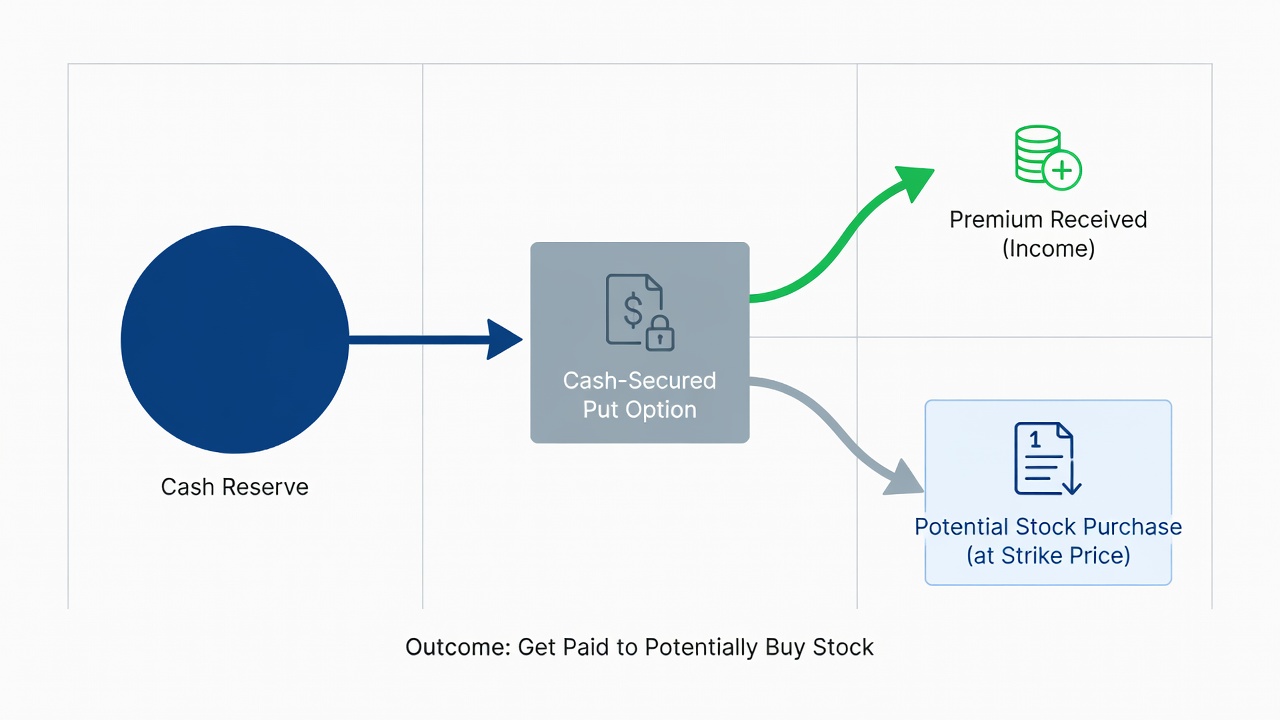
A cash-secured put is a neutral-to-bullish options trading strategy where you sell a put option contract while simultaneously holding enough cash in your trading account to buy 100 shares of the underlying stock.
When you sell a put option, you are taking on a legal obligation to buy 100 shares of stock at a specific strike price if the stock owner decides to exercise their option before expiration.
In exchange for taking on that purchase obligation, the buyer of the option pays you money immediately, which is known as the option premium.
We covered what a put option is in Part 2 and how contracts represent 100 shares in Part 11, but selling a put means you are acting as the insurance provider rather than the insurance buyer.
The term cash-secured simply means your broker sets aside the exact amount of cash required to buy those 100 shares, ensuring you cannot default if you are assigned.
Why Selling Puts Is Different Than Buying Them
When you buy a put option as covered in Part 9, you are paying cash for the right to sell stock, and you need the stock price to fall fast enough to overcome time decay.
We discussed theta decay in Part 15, and for option buyers, that daily loss of extrinsic value acts like an hourglass draining their account value every second.
When you sell a cash-secured put, time decay becomes your primary engine for profit because every day that passes reduces the value of the option you sold.
As the option loses value over time, you can buy it back for cheaper than you sold it, or simply let it expire worthless and keep every single penny of the premium you collected.
You do not need the stock to skyrocket to make money when selling puts. In fact, if the stock stays completely flat or even drops slightly, you still make your maximum profit.
Free For Traders
One Clear Arrow. Every High-Probability Setup. Free.
The Fusion Indicator combines multiple signals into a single buy/sell arrow on TradingView so you never miss a move.
 → Get The Free Fusion Indicator
How Cash-Secured Puts Work: A Step-by-Step Real-World Analogy
To understand cash-secured puts without getting lost in market terms, think of put selling like making a deal to buy a neighbor’s car.
Imagine your neighbor owns a reliable car currently worth $10,000, but you tell him you would gladly buy it if the price ever dropped to $8,000.
You tell your neighbor that you will give him a written guarantee to buy his car for $8,000 anytime over the next 30 days, provided he pays you $300 cash today for providing that safety net.
To make sure you can keep your promise, you lock $8,000 in a dedicated bank account where you cannot spend it on anything else during those 30 days.
If the car stays worth $10,000, your neighbor never forces you to buy it, the agreement expires, and you walk away with the $300 cash fee free and clear.
If the car market crashes and the vehicle value drops to $7,000, your neighbor hands you the keys, you use your $8,000 set-aside cash to buy it, and your effective purchase cost is only $7,700 because of the $300 fee you collected upfront.

A Complete Walkthrough of Your First Cash-Secured Put Trade
Setting up a cash-secured put trade in your broker account requires a deliberate step-by-step process before pushing the execution button.
First, you identify a high-quality stock that you genuinely want to own long term at a lower price than where it is currently trading.
Next, you open the options chain, which we learned to navigate in Part 12, and select an expiration date typically 30 to 45 days into the future.
Then, you select a strike price below the current market price where you would feel comfortable owning 100 shares of that company.
When you enter the order, you choose Sell to Open one put contract, and your broker instantly locks up the cash collateral while depositing the option premium directly into your account balance.
From that moment on, you simply sit back and wait as time decay wears down the value of the option contract day after day.
The Math Behind Cash-Secured Puts: Two Real-World Examples
Let’s walk through two detailed numeric trade examples to see how the numbers line up in real trading scenarios.
In Example A, let’s say company ABC is trading at $50 per share, and you sell a 30-day put option with a $45 strike price for a premium of $1.50 per share.
Because one contract controls 100 shares, you collect $150 upfront, while your broker reserves $4,500 of cash collateral in your account ($45 strike multiplied by 100 shares).
Your break-even price on this trade is $43.50 ($45 strike minus $1.50 premium), meaning you do not lose money unless ABC stock drops below $43.50 by expiration.
In Example B, let’s assume stock XYZ is trading at $100 per share, and you sell a 45-day put option with a $90 strike price for a premium of $3.00 per share.
You collect $300 in immediate cash, and your broker secures $9,000 in cash collateral ($90 strike multiplied by 100 shares).
Your break-even price on Example B is $87.00 ($90 strike minus $3.00 premium), giving you a massive 13 percent margin of safety below the stock’s starting price.
| Trade Metrics | Example A (ABC Stock) | Example B (XYZ Stock) |
|---|---|---|
| Current Stock Price | $50.00 | $100.00 |
| Put Strike Price | $45.00 | $90.00 |
| Premium Collected | $150.00 ($1.50/sh) | $300.00 ($3.00/sh) |
| Cash Collateral Required | $4,500.00 | $9,000.00 |
| Effective Buy Price (Break-Even) | $43.50 | $87.00 |
From Find Better Trades
High-Win-Rate Patterns, Spotted In Real Time
Automated pattern recognition for reversals and continuations — no manual drawing, no missed setups.
 → See The OCP Indicator

What Happens at Expiration? The Two Possible Outcomes
When the expiration date arrives, every cash-secured put trade ends in one of two plain-English outcomes depending on where the stock price lands.
Outcome 1 occurs if the stock price closes at or above your strike price when the market closes on expiration day.
In this scenario, the option expires completely worthless, the buyer has no reason to exercise it, your cash collateral is unlocked, and you keep 100 percent of the premium collected.
Outcome 2 occurs if the stock price closes below your strike price on expiration day, triggering automatic options assignment, which we detailed in Part 20.
In this second scenario, your cash collateral is used to buy 100 shares of the stock at your strike price, and you now own the stock at a net cost basis equal to the strike price minus the cash premium you received.
How Cash-Secured Puts Compare to Buying Stock Outright
To see why income traders love cash-secured puts, you need to compare selling a put directly against buying 100 shares on the open market.
If you buy 100 shares of stock directly at $50 per share, you spend $5,000 upfront and only make money if the stock moves higher.
If the stock stays completely flat at $50 for two months, the direct stock buyer makes zero dollars, whereas the cash-secured put seller who sold a $45 put keeps their premium profit.
If the stock drops to $45, the direct stock buyer is down $500 in unrealized losses, while the put seller is assigned the stock at an effective cost of $43.50, sitting in a far superior financial position.
The only downside to cash-secured puts compared to owning stock directly is that your upside profit is capped at the premium you received if the stock surges dramatically higher without you.
| Market Scenario | Buying 100 Shares Outright | Selling Cash-Secured Put |
|---|---|---|
| Stock Rallies Big | Unlimited Profit Potential | Max Profit (Premium Collected) |
| Stock Stays Flat | $0 Profit / Loss | Max Profit (Premium Collected) |
| Stock Drops Slightly | Unrealized Loss | Profit or Lower Cost Basis |
| Upfront Capital Required | Full Share Purchase Price | Collateral minus Premium received |
Common Mistakes Beginners Make With Cash-Secured Puts
The biggest mistake beginners make is selling cash-secured puts on garbage stocks simply because the premium payout looks gigantic. If you would not feel comfortable holding that stock in your long-term portfolio for years, do not sell a put on it just to chase fast yield.
Another common mistake is selecting strike prices that are far too close to the current stock price out of greed for higher payments. Selling puts with higher delta levels increases your probability of assignment, turning a simple income trade into unwanted stock ownership.
Beginners also frequently forget to factor earnings reports and major market events into their expiration dates. High volatility around earnings can drive stock prices far below your strike price before you can adjust your position.
Many new traders panic and close their put options for a massive loss the moment the stock drops below the strike price. Remember that assignment is not a failure; it is simply buying a stock you wanted at a pre-planned discount price.
Finally, traders often lock up all their available account capital into a single cash-secured put position. Over-concentrating your account into one single stock removes your flexibility if market conditions change suddenly.
Cash-Secured Puts FAQ
Do I need a special margin account to sell cash-secured puts? No, you can trade cash-secured puts in a standard cash brokerage account or even an IRA retirement account. Because you hold 100 percent of the required purchase price in cash collateral, brokers treat this as a safe, fully covered strategy.
What happens if I get assigned on my cash-secured put? If the stock finishes below your strike price at expiration, your cash collateral is automatically converted into 100 shares of the stock. You keep the upfront cash premium, which effectively lowers your cost basis on those newly acquired shares.
Can I close a cash-secured put before the expiration date? Yes, you can buy back the put option at any time before expiration using a Buy to Close order. If the option has lost most of its value early, closing it early allows you to lock in profits and release your cash collateral for new trades.
How much cash do I actually need to start selling cash-secured puts? You need enough cash to cover 100 shares at your chosen strike price. For example, if you sell a put on a stock with a $20 strike price, you need $2,000 in cash collateral sitting in your account.
In Part 28, I will break down vertical spreads so you can learn how to control your risk and trade options with even less starting capital.
📈 Want More? Join Our Free Trading Community
- Trading Strategy Guides Telegram — daily strategy tips and market insights
- Find Better Trades Telegram — free trade signals delivered to your phone
- Find Better Trades on YouTube — live trade breakdowns and tutorials
Lesson 27 of 52 in the free Options Trading Course.
← Previous: Covered Calls Explained: A Beginner’s Guide to Cash Flow
Next: Vertical Spreads Explained: How to Reduce Options Risk →