Covered Calls Explained: A Beginner’s Guide to Cash Flow

📚 Beginner’s Guide to Options — Part 26 of 51
- Part 1: What Is an Option? The Absolute Basics Explained
- Part 2: Calls vs. Puts: The Two Types of Options You Need to Know
- Part 3: Strike Price Explained: What It Actually Means for Your Trade
- Part 4: Expiration Date Explained: Why It Changes Everything
- Part 5: Premium Explained: What You’re Really Paying For
- Part 6: In the Money vs. Out of the Money: A Beginner’s Breakdown
- Part 7: Intrinsic Value vs. Extrinsic Value: What Makes Up an Option’s Price
- Part 8: How Buying a Call Option Works, Step by Step
- Part 9: How Buying a Put Option Works, Step by Step
- Part 10: What Happens When an Option Expires? Every Outcome Explained
- Part 11: Options Contracts 101: What One Contract Actually Represents
- Part 12: How to Read an Options Chain Without Getting Overwhelmed
- Part 13: Bid, Ask, and Spread: What They Mean When You’re Trading Options
- Part 14: What Is Implied Volatility? A Beginner’s Plain-English Guide
- Part 15: Why Options Lose Value Over Time: Theta Explained Simply
- Part 16: Delta Explained: What It Really Tells You About Your Option
- Part 17: Gamma Explained: Why Delta Doesn’t Stay the Same
- Part 18: Vega Explained: How Volatility Changes Your Option’s Price
- Part 19: The Greeks Cheat Sheet: Delta, Gamma, Theta, Vega in Plain English
- Part 20: What Is Assignment? What Happens If Your Option Gets Exercised
- Part 21: American vs. European Options: What’s the Difference?
- Part 22: How Much Money Do You Need to Start Trading Options?
- Part 23: Paper Trading Options: How to Practice Before Risking Real Money
- Part 24: The Biggest Mistake Beginners Make Buying Options
- Part 25: Why Most Beginners Lose Money Buying Options (and How to Avoid It)
- Part 26: Covered Calls Explained: The First Options Strategy Every Trader Should Learn (you are here)
⚡ Key Takeaways
- A covered call generates upfront cash income by selling someone else the right to buy stock you already own.
- Your existing shares act as collateral, making this a far safer strategy than selling options contracts without owning stock.
- You trade away potential upside stock gains above your strike price in exchange for immediate cash in your trading account today.
— Ben, Find Better Trades
Welcome to Part 26 of our 51-part options series. If you have been following along, we spent recent lessons talking about why buying options outright can be tough for beginners.
Today, we are flipping the table completely. I want to show you how to step into the shoes of the option seller using what I consider the absolute best foundational income strategy in options.
What Is a Covered Call? The Core Idea Explained
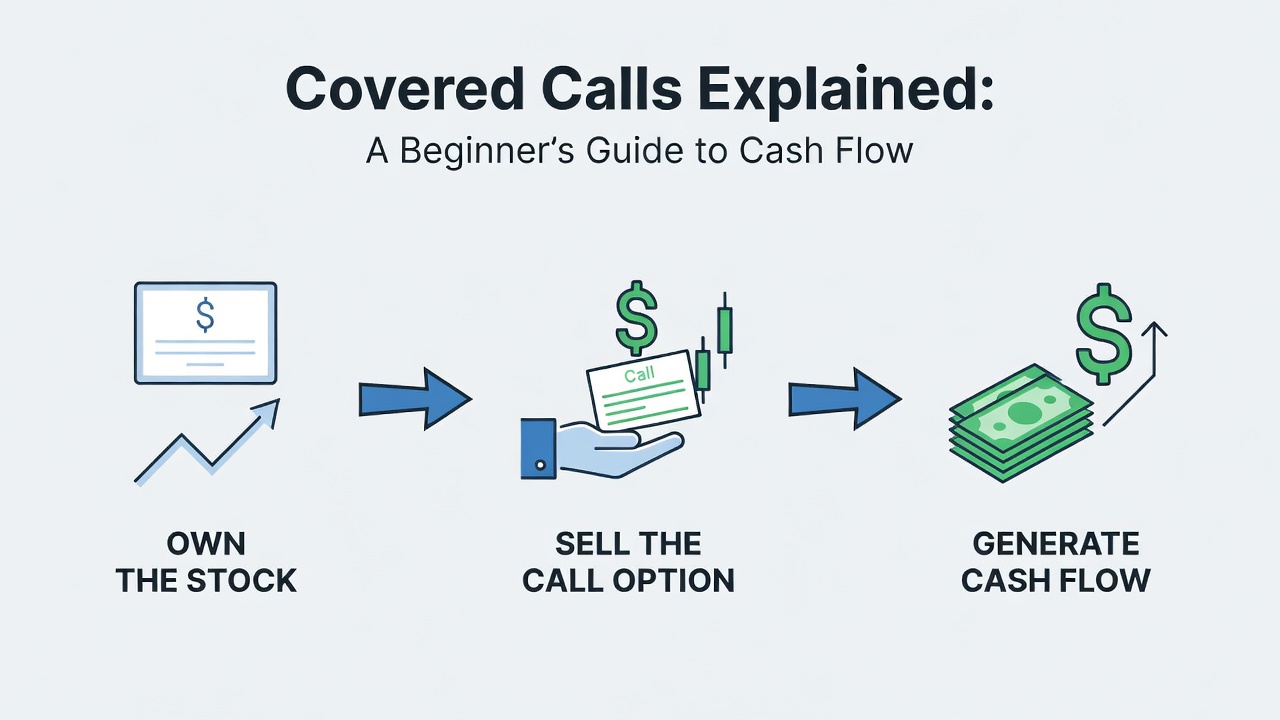
A covered call is an options trading strategy where you sell a call option against stock shares you already own in your account. As we covered earlier in the series, one standard options contract represents exactly 100 shares of stock.
When you sell a call option, another trader pays you cash right now for the right to buy your 100 shares at a specific agreed price later. That upfront cash payment is called the premium, and it lands in your account balance immediately.
Here is how I like to think about it using a simple real-world analogy. Imagine owning a house and renting out a spare bedroom to a tenant.
The tenant pays you monthly rent for the right to use that space under agreed terms. Selling a covered call is basically renting out your stock shares to collect steady cash payments while holding the underlying asset.
In exchange for taking that cash payment, you agree to a clear trade-off. You promise to sell your 100 shares at the agreed strike price if the option buyer decides to exercise their contract before expiration.
Why It’s Called a “Covered” Call: Understanding the Safety Net
The word “covered” in this strategy name is crucial for understanding why this trade is so popular. It means you already own the underlying shares required to fulfill your promise if assigned.
In Part 20, we discussed assignment and what happens when an option buyer exercises their rights. If you sell an option contract without owning the underlying stock, you face extreme risk because you must buy expensive shares on the open market.
With a covered call, your existing 100 shares act as full security for the trade. You never have to worry about buying expensive shares on short notice because you already have them sitting safely in your brokerage account.
Your broker recognizes those shares as collateral for the position. That is why most brokers allow beginners to trade covered calls even in basic accounts with conservative approval levels.
You are using an asset you already own to secure the contract obligations. That built-in safety net makes covered calls fundamentally different from naked options trades.
Free For Traders
One Clear Arrow. Every High-Probability Setup. Free.
The Fusion Indicator combines multiple signals into a single buy/sell arrow on TradingView so you never miss a move.
 → Get The Free Fusion Indicator
How Covered Calls Work: Step-by-Step Walkthrough
Setting up a covered call trade is straightforward once you know the basic sequence. Here is how I set up these trades in my own account step by step.
First, you must own at least 100 shares of stock in a company you are comfortable holding for the long run. If you only own 50 shares, you cannot sell a standard covered call contract yet.
Second, you open your options chain and pick an expiration date. As we covered in Part 4, expiration dates define how long your contract remains active.
Third, you pick a strike price that sits above the current price of your stock. As we learned in Part 3, the strike price is the line in the sand where you agree to sell your shares.
Fourth, you place an order to “Sell to Open” one call contract for every 100 shares you own. The premium payment instantly posts as cash to your account balance.
Finally, you monitor the position until expiration or choose to close the trade early by buying the option back. That cash income directly lowers your effective purchase price on the shares you hold.

Scenario Analysis: What Happens to Your Covered Call at Expiration?
When expiration day arrives, your covered call trade finishes in one of three ways depending on where the stock price lands. Let us break down each outcome clearly so you know what to expect.
If the stock stays below your strike price, the option expires completely worthless to the buyer. You keep the entire cash premium upfront, and you keep your 100 shares of stock intact.
If the stock finishes above your strike price, the buyer exercises their right to purchase your shares. You sell your 100 shares at the agreed strike price, keep the original premium, and exit the stock position with a profit.
If the stock price drops, you still keep your shares and the full premium payment. The cash premium helps cushion your overall loss, but it cannot fully offset a severe market drop.
Here is a quick comparison table showing how these three scenarios play out at expiration:
| Stock Price at Expiration | Option Status | What Happens to Shares? | Premium Kept? |
|---|---|---|---|
| Below Strike Price | Expires Worthless | You Keep Your Shares | Yes (100%) |
| Above Strike Price | Assigned / Exercised | Shares Sold at Strike Price | Yes (100%) |
| Drops Significantly | Expires Worthless | You Keep Your (Cheaper) Shares | Yes (100%) |
Real-World Example #1: Generating Income on a Steady Stock
Let us walk through a full numerical example to see how the dollars and cents work out in practice. Suppose you purchase 100 shares of stock XYZ at $50.00 per share for a total investment of $5,000.00.
You decide to sell a 30-day Call Option with a strike price of $52.50 for a premium of $1.50 per share. Since options contracts cover 100 shares, you immediately receive $150.00 in cash into your trading account.
Let us examine what happens under three distinct market results when expiration arrives 30 days later. First, assume stock XYZ moves sideways and finishes at $51.00.
Because $51.00 is below the $52.50 strike price, the option expires worthless. You keep your $150.00 cash premium plus your shares, which are now worth $5,100.00, giving you a total return of $250.00 for the month.
Second, assume stock XYZ rises to $54.00 at expiration. The option gets exercised because $54.00 is above your $52.50 strike price.
You sell your 100 shares for $52.50 each ($5,250.00 total) and retain the $150.00 cash premium. Your total return is $400.00 ($250.00 stock gain + $150.00 premium), achieving your maximum possible gain on this trade.
From Find Better Trades
Stop Scanning Charts. Let The Alerts Come To You.
Real-time Telegram alerts when stocks approach critical S&R levels across the whole market.
 → Get The Scanner

Real-World Example #2: What Happens When the Stock Explodes Higher
Now let us look at the primary downside of selling covered calls so you are never caught off guard. Suppose you own 100 shares of stock ABC bought at $100.00 per share, representing a $10,000.00 investment.
You sell a 45-day Call Option with a strike price of $105.00 for a premium of $3.00 per share ($300.00 total cash collected). Shortly after selling the call, company ABC releases a massive product update, and the stock skyrockets to $130.00.
Let us look at the math when expiration arrives with stock ABC sitting at $130.00. The call buyer exercises their right, requiring you to sell your shares at the agreed $105.00 strike price.
You receive $10,500.00 for your shares plus the $300.00 upfront premium, totaling $10,800.00. You made a clean $800.00 profit on your initial $10,000.00 investment, which is an 8% gain in 45 days.
However, if you had simply held the stock without selling the call option, your shares would be worth $13,000.00 for a $3,000.00 profit. By selling the covered call, you gave up $2,200.00 of potential upside in exchange for the upfront $300.00 cash payment.
This illustrates the core trade-off of covered call selling. You trade away runaway upside potential above the strike price in exchange for immediate cash income today.
When Should You Sell Covered Calls? (And When You Shouldn’t)
Covered calls perform best in neutral to moderately bullish market environments. If you expect a stock to drift slightly higher, stay flat, or pull back mildly, selling calls is an outstanding strategy.
This strategy works exceptionally well on established dividend-paying stocks that trade with low volatility. You collect regular dividend yield while simultaneously generating option premium on the exact same shares.
As we learned in Part 15 and Part 16, time decay (Theta) works in your favor as an option seller, while Delta helps you select appropriate strike prices. I like selling calls with Delta values around 0.20 to 0.30 to keep a high probability of keeping my shares.
Conversely, you should avoid selling covered calls on explosive growth stocks that could double overnight. If you are extremely bullish on a company and want uncapped upside, selling a call option will only lead to seller remorse when the stock surges.
You should also avoid selling covered calls on stocks you do not want to own for the long haul. Collecting a small option premium never justifies holding a weak stock that is falling through the floor.
Common Mistakes Beginners Make With Covered Calls
Selling calls below your purchase price: New traders often panic during stock pullbacks and sell strike prices lower than what they paid for the shares. If the stock rebounds sharply, you get assigned and lock in a permanent financial loss on your capital.
Chasing high premiums on unstable stocks: Beginners often look for options with massive premium payments, which usually belong to highly volatile companies. High option prices reflect extreme stock risk, and a crashing share price will wipe out far more capital than the premium you collected.
Selling call options right before earnings reports: Selling calls right before earnings caps your upside right when the stock has its biggest chance for a massive rally. If the company blows past expectations, you miss out on huge stock gains while taking full downside risk if earnings flop.
Forgetting that covered calls offer minimal downside protection: Collecting $2.00 in option premium does not protect you if your $50.00 stock drops down to $30.00. Never view a covered call as complete crash insurance when holding shares.
Panicking when the stock passes the strike price: Beginners often panic and buy back the call option at an inflated price when the stock rises above their strike price. Remember that getting your shares called away at a net profit is a successful trade outcome, not a failure.
Covered Calls FAQ: Real Questions from New Traders
Can I lose money on a covered call trade? Yes, you can still lose money if the price of your underlying stock drops significantly. The cash premium you collect reduces your cost basis, but it does not prevent stock losses if the company crashes.
What happens if my stock gets called away? If your stock gets called away, your broker automatically sells your 100 shares at the agreed strike price and deposits the cash into your account. You keep the original option premium, and the option contract disappears from your position list.
Can I close my covered call position early? Yes, you can buy back the call option contract at any time before expiration using a “Buy to Close” order. If the option price has fallen, you can buy it back cheap to lock in profit and free up your stock shares.
Do I still collect stock dividends while selling covered calls? Yes, as long as you own the underlying shares on the dividend ex-date, you collect full dividend payments. The option buyer does not receive dividend payouts unless they exercise the call option prior to the ex-dividend date.
Next up, we are turning this strategy inside out to show you how to get paid cash while waiting to buy stocks you love at a discount in Cash-Secured Puts Explained: A Beginner-Friendly Way to Get Paid to Wait.
📈 Want More? Join Our Free Trading Community
- Trading Strategy Guides Telegram — daily strategy tips and market insights
- Find Better Trades Telegram — free trade signals delivered to your phone
- Find Better Trades on YouTube — live trade breakdowns and tutorials
Lesson 26 of 52 in the free Options Trading Course.
← Previous: Why Beginners Lose Money Buying Options (And How to Fix It)
Next: Cash-Secured Puts Explained: Get Paid to Buy Stock →