How Much Money Do You Need to Start Trading Options?


📚 Beginner’s Guide to Options — Part 22 of 51
- Part 1: What Is an Option? The Absolute Basics Explained
- Part 2: Calls vs. Puts: The Two Types of Options You Need to Know
- Part 3: Strike Price Explained: What It Actually Means for Your Trade
- Part 4: Expiration Date Explained: Why It Changes Everything
- Part 5: Premium Explained: What You’re Really Paying For
- Part 6: In the Money vs. Out of the Money: A Beginner’s Breakdown
- Part 7: Intrinsic Value vs. Extrinsic Value: What Makes Up an Option’s Price
- Part 8: How Buying a Call Option Works, Step by Step
- Part 9: How Buying a Put Option Works, Step by Step
- Part 10: What Happens When an Option Expires? Every Outcome Explained
- Part 11: Options Contracts 101: What One Contract Actually Represents
- Part 12: How to Read an Options Chain Without Getting Overwhelmed
- Part 13: Bid, Ask, and Spread: What They Mean When You’re Trading Options
- Part 14: What Is Implied Volatility? A Beginner’s Plain-English Guide
- Part 15: Why Options Lose Value Over Time: Theta Explained Simply
- Part 16: Delta Explained: What It Really Tells You About Your Option
- Part 17: Gamma Explained: Why Delta Doesn’t Stay the Same
- Part 18: Vega Explained: How Volatility Changes Your Option’s Price
- Part 19: The Greeks Cheat Sheet: Delta, Gamma, Theta, Vega in Plain English
- Part 20: What Is Assignment? What Happens If Your Option Gets Exercised
- Part 21: American vs. European Options: What’s the Difference?
- Part 22: How Much Money Do You Need to Start Trading Options? (you are here)
⚡ Key Takeaways
- You do not need thousands of dollars; you can open a account and buy single contracts with as little as $50 to $200.
- Capital requirements depend heavily on your strategy, as buying options requires only the premium while selling options demands cash collateral.
- To avoid blowing up your account, never risk more than 2% to 5% of your total trading capital on any individual trade.
— Ben, Find Better Trades
When I first told a coworker I was trading options, he assumed I had a six-figure brokerage balance sitting in a specialized account. He genuinely believed trading derivatives was reserved for wealthy Wall Street professionals with massive war chests.
That assumption is completely false, and it keeps thousands of eager traders on the sidelines for way too long. Welcome to Part 22 of our beginner guide series, where I am going to break down the exact dollar amounts you need to start trading options safely without risking your life savings.
The Myth of Needing Thousands of Dollars to Start
There is a persistent myth that you need five figures in cash just to place your very first trade.
In reality, you can open a brokerage account today with zero account minimum and purchase a single option contract for $20 or $50.
Options contracts are priced on a per-share basis, and as we covered earlier in the series, one contract represents 100 shares of stock.
That means if a contract is listed for $0.50 per share, your total upfront cash outflow is $50.
Think of it like buying an entry ticket to a concert. You do not need to buy the entire music venue; you just pay for your individual ticket to participate in the performance.
Because you only pay the premium when buying calls or puts, your capital requirement is capped strictly at that upfront cost.
Account Minimums vs. Practical Trading Capital
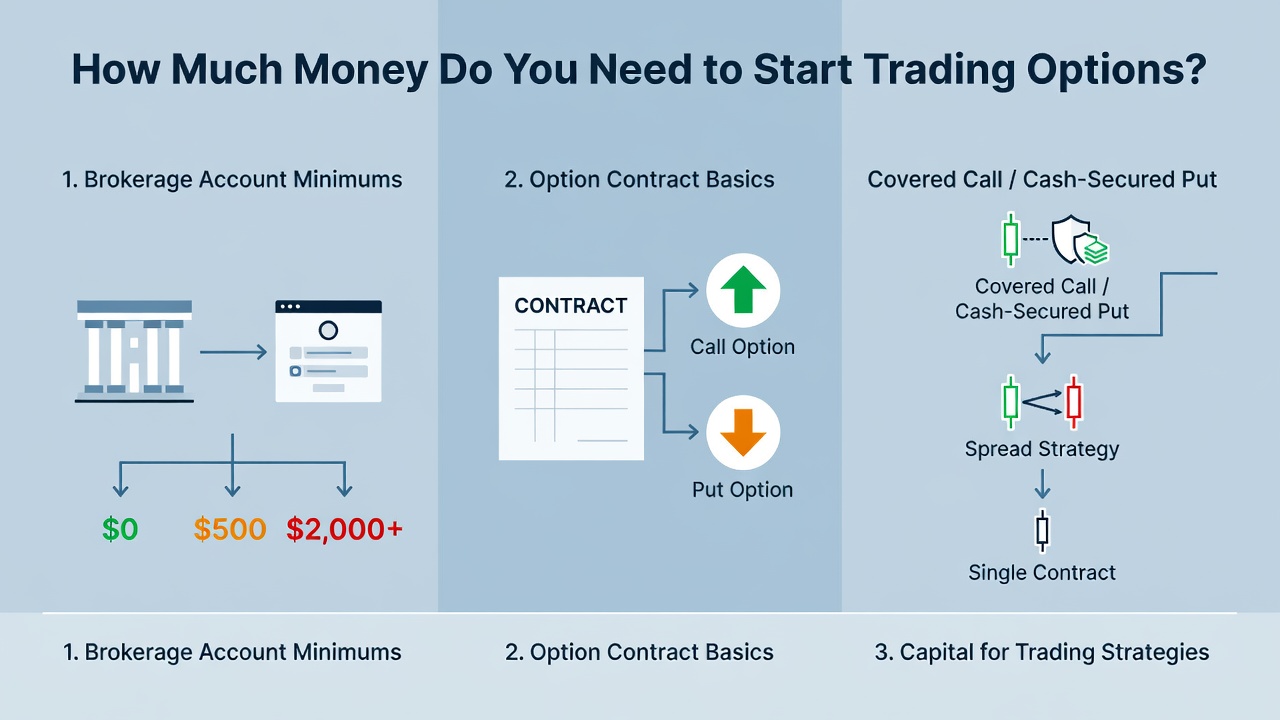
Brokers generally enforce two different rules: the regulatory minimum to open an account, and the practical capital you need to trade effectively.
Most modern online brokerages allow you to open a basic trading account for $0.
However, if you want to trade on margin, federal regulations require a minimum cash deposit of $2,000.
For simply buying basic calls and puts, you only need a standard cash account, which carries no federal $2,000 requirement.
Just because you can legally start with $50 does not mean it is the smartest choice for long-term survival.
Starting with $500 to $1,000 gives you enough breathing room to take small trades without single-trade commissions or minor losses wiping out half your balance.
Free For Traders
Know The EXACT Moment A Stock Hits Support Or Resistance
Real-time alerts fire the instant a stock approaches a critical level. Completely free.

Buying Options: How Much Capital You Actually Need for Long Calls and Puts
When you buy a call or a put, your total potential loss is limited to the exact premium you paid upfront.
This capped risk profile makes buying options extremely accessible for smaller accounts.
Let’s look at our first fully worked numeric example to see how the capital math plays out in real life.
Suppose stock ABC is trading at $50 per share, and you want to buy a call option with a $52 strike price expiring in 30 days.
If the option premium is listed as $1.50 per share, you multiply $1.50 by 100 shares to calculate your total cost of $150.
That $150 is the absolute maximum amount of money you can lose on this trade, regardless of how far stock ABC falls.
If ABC drops to zero, you lose $150. If ABC stays flat at $50, the option expires worthless and you lose $150.
Because your downside is strictly capped at $150, your broker only requires you to have $150 in available cash to execute the trade.

Selling Options and Spreads: Capital Requirements Explained
When you switch from buying options to selling options, the capital requirements change drastically.
Selling naked or unhedged options carries substantial risk, so brokers mandate significant cash reserves or collateral in your account.
For example, if you sell a naked put on stock XYZ trading at $100 with a $95 strike, your broker might require you to hold $9,500 in cash to cover potential assignment.
As we discussed in Part 20 when covering assignment, selling cash-secured puts requires enough money to purchase all 100 shares if assigned.
However, you can use defined-risk credit spreads to dramatically lower these capital requirements.
A vertical credit spread involves selling one option and buying another at a different strike price simultaneously.
Let’s walk through our second fully worked numeric example to see how spreads protect your capital.
Imagine selling a $100 put and buying a $95 put on stock XYZ when it trades at $105.
The width of the spread is $5 per share ($100 minus $95), which equals $500 total risk per contract ($5 multiplied by 100 shares).
If you collect $100 in total net credit when opening the spread, your broker only holds $400 in collateral ($500 maximum risk minus $100 credit received).
This lowers your required capital from $9,500 for a single cash-secured put down to just $400 for a spread.
The Hidden Costs: Spreads, Commissions, and Pattern Day Trading Rules
Besides the price of the contract itself, operational expenses can consume a chunk of your account if you are not careful.
The first cost is the bid-ask spread, which we covered in detail back in Part 13.
If an option has a bid price of $1.00 and an ask price of $1.20, you instantly lose $20 in theoretical value the moment you buy at the ask price.
The second hidden cost is broker commissions and exchange regulatory fees.
While many brokerages advertise commission-free trading, most still charge a regulatory fee of roughly $0.50 to $0.65 per contract.
If you trade 10 contracts in and out, those regulatory fees can add up to $13 per round trip.
The third major hurdle is the Pattern Day Trader rule, often referred to as the PDT rule.
If you trade in a margin account with less than $25,000, you are limited to three day trades in any rolling five-business-day period.
If you execute four or more day trades within five business days, your broker will flag your account and restrict your trading privileges for 90 days.
From Find Better Trades
The Pullback Isn’t A Warning. It’s Your Entry.
Slingshot catches the exact moment a trend pause is ready to rip back in your favor — built for explosive pullback continuations.


How Much Should You Allocate Per Trade as a Beginner?
Position sizing is the single most critical factor that determines whether a beginner survives or goes broke.
As a personal rule of thumb, I always recommend never risking more than 2% to 5% of your total account balance on a single trade idea.
If you have a $1,000 account, a 5% maximum risk limit means you should not spend more than $50 on any individual trade.
If you buy a $200 option contract with a $1,000 account, you are risking 20% of your total net worth on a single idea.
Just five consecutive losing trades would completely wipe out your account balance.
By sticking strictly to small position sizes, you ensure that losing trades are just minor bumps in the road rather than fatal accidents.
A Realistic Dollar Breakdown for Different Account Sizes
To help you decide how much cash to start with, let’s look at what is realistically possible at different account tiers.
The table below summarizes what strategies and risk management levels you can expect at various starting capital balances.
| Account Balance | Best Strategies Available | Trade Frequency | Main Limitation |
|---|---|---|---|
| $100 – $500 | Buying single cheap call/put options | 1-2 trades per month | Slippage and bid-ask spreads eat profits fast |
| $500 – $2,000 | Buying single options, defined-risk credit/debit spreads | 1-2 trades per week | PDT rule applies if using margin |
| $2,000 – $5,000 | Spreads, small cash-secured puts on low-cost stocks | 2-4 trades per week | Cannot trade high-priced stocks naked |
| $25,000+ | All options strategies, unlimited day trading | Unlimited | Requires disciplined capital control |
If you are starting with under $500, focus exclusively on learning mechanics with tiny single contracts or cheap out-of-the-money trades.
If you have between $1,000 and $2,000, you have plenty of capital to execute defined-risk spreads and build consistent habits.
Never stretch your financial comfort zone just because you think you need more capital to make real money.
Common Mistakes Beginners Make With This
Over-leveraging a small account on a single position: Many beginners open a $500 account and immediately spend $400 on a single call option. When that stock moves against them by just 2%, the option loses half its value and destroys 40% of their total account balance in minutes.
Buying ultra-cheap lottery tickets: New traders often buy options priced at $0.05 ($5 total) simply because they are cheap. These options are usually deep out-of-the-money with almost zero statistical probability of expiring profitable, making them a guaranteed drain on capital over time.
Ignoring contract fees and bid-ask slippage: On small accounts, taking trades with a $0.30 bid-ask spread destroys profitability before the trade even moves. A trader entering a $1.00 option with a wide spread is starting the trade down 20% immediately.
Attempting uncovered option sales without cash collateral: Beginners sometimes try to sell puts without realizing their broker will lock up thousands of dollars in cash reserves. When the trade is entered, they are shocked to find their available buying power completely frozen.
How Much Money Do You Need to Start Options FAQ
Can I start trading options with just $100? Yes, you can technically start buying options with $100 because many individual contracts cost less than $50. However, with only $100, your choices are limited to cheaper stocks or shorter-dated contracts, leaving very little margin for error.
Do I need a margin account to trade options? No, you do not need a margin account if you are simply buying call and put options. A basic cash account allows you to buy options using settled cash without meeting the $2,000 federal margin deposit requirement.
How much capital do I need to trade option spreads? To trade defined-risk spreads like vertical debit or credit spreads, you generally need between $500 and $2,000 in a margin account. The required capital is based on the maximum width of the spread minus any credit received.
What happens if I try to trade options with less than $25,000? You can trade options freely under $25,000, but if you use a margin account, you are subject to the Pattern Day Trader rule. This limits you to three day trades within any rolling five-business-day window.
Ready to put these numbers into practice without taking any actual financial risk? Next up in Part 23, I will show you exactly how to set up a paper trading account so you can test your strategies in real time with fake money.
📈 Want More? Join Our Free Trading Community
- Trading Strategy Guides Telegram — daily strategy tips and market insights
- Find Better Trades Telegram — free trade signals delivered to your phone
- Find Better Trades on YouTube — live trade breakdowns and tutorials