Option Greeks Cheat Sheet: Delta, Gamma, Theta, Vega Explained

📚 Beginner’s Guide to Options — Part 19 of 51
- Part 1: What Is an Option? The Absolute Basics Explained
- Part 2: Calls vs. Puts: The Two Types of Options You Need to Know
- Part 3: Strike Price Explained: What It Actually Means for Your Trade
- Part 4: Expiration Date Explained: Why It Changes Everything
- Part 5: Premium Explained: What You’re Really Paying For
- Part 6: In the Money vs. Out of the Money: A Beginner’s Breakdown
- Part 7: Intrinsic Value vs. Extrinsic Value: What Makes Up an Option’s Price
- Part 8: How Buying a Call Option Works, Step by Step
- Part 9: How Buying a Put Option Works, Step by Step
- Part 10: What Happens When an Option Expires? Every Outcome Explained
- Part 11: Options Contracts 101: What One Contract Actually Represents
- Part 12: How to Read an Options Chain Without Getting Overwhelmed
- Part 13: Bid, Ask, and Spread: What They Mean When You’re Trading Options
- Part 14: What Is Implied Volatility? A Beginner’s Plain-English Guide
- Part 15: Why Options Lose Value Over Time: Theta Explained Simply
- Part 16: Delta Explained: What It Really Tells You About Your Option
- Part 17: Gamma Explained: Why Delta Doesn’t Stay the Same
- Part 18: Vega Explained: How Volatility Changes Your Option’s Price
- Part 19: The Greeks Cheat Sheet: Delta, Gamma, Theta, Vega in Plain English (you are here)
⚡ Key Takeaways
- Option Greeks measure how specific market variables—stock price, time, and volatility—change your option contract’s price.
- Delta and Gamma manage price movement, while Theta and Vega manage time decay and volatility expectations.
- Using a single cheat sheet helps you quickly evaluate your risk profile before entering any live option trade.
— Ben, Find Better Trades
Welcome to Part 19 of our 51-part options education series. Earlier in the series, we broke down each Greek individually—Delta, Gamma, Theta, and Vega—over separate deep dives. Today, we are putting all four pieces together into a unified master cheat sheet so you can instantly diagnose any trade.
Why You Need a Single Cheat Sheet for Option Greeks
When you start trading options, looking at an options chain feels like staring at a flight control panel. You see numbers moving in four different directions at once, and it is easy to feel paralyzed.
Each Greek isolates one specific force acting on your contract price. If you try to analyze them in isolation without seeing how they interact, you will end up surprised by your profits or losses.
Think of option Greeks like the instrument cluster on your car’s dashboard. Your speedometer tells you how fast you are moving, your fuel gauge shows what you are burning, and your engine temp warns you about over-heating.
You would never drive looking at only the speedometer while ignoring the fuel gauge. In options trading, watching Delta while ignoring Theta or Vega leads to the exact same kind of crash.
This guide serves as your quick reference manual. We will review what each Greek measures, how they work together, and how to read them simultaneously before placing an order.
Delta: The Speedometer of Option Price Movement
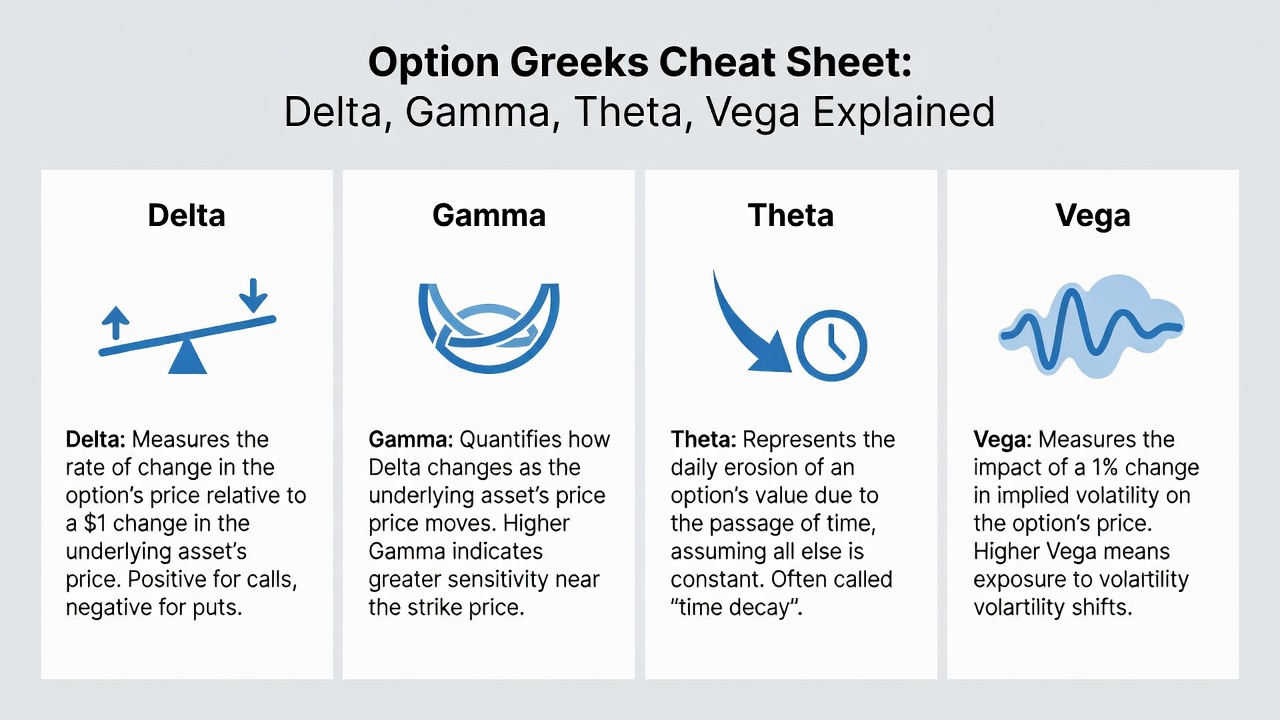
We covered Delta in detail in Part 16, but here is the essential job it performs for your portfolio. Delta tells you exactly how much an option’s price will move for every $1.00 change in the underlying stock.
If you buy a call option with a Delta of 0.50, your option contract gains $0.50 in value when the stock rises by $1.00. Conversely, if the stock drops by $1.00, your option loses $0.50.
Let’s run a quick numeric example to make this concrete. Imagine XYZ stock is trading at $100, and you buy a $100 call option for $4.00 with a Delta of 0.60.
If XYZ stock rises from $100 to $101, your call option increases by $0.60, bringing its new price to $4.60. Delta also doubles as a rough proxy for the probability that your option finishes in the money at expiration.
Remember that call options always have positive Delta between 0.00 and 1.00, while put options have negative Delta between 0.00 and -1.00. That negative sign simply means put prices move in the opposite direction of the stock.
Free For Traders
Know What To Trade BEFORE The Opening Bell
The Big Dipper Dashboard hands you curated high-probability setups every single morning — free.

Gamma: The Accelerator That Changes Delta’s Speed
In Part 17, we explained why Delta isn’t a static number. Delta changes constantly as the stock price moves, and Gamma is the exact measure of that change.
Think of Gamma as the gas pedal attached to your Delta speedometer. Gamma tells you how much your Delta will increase or decrease for every $1.00 move in the underlying stock price.
If your option has a Delta of 0.50 and a Gamma of 0.10, a $1.00 increase in the stock pushes your Delta up to 0.60. On the next $1.00 move upward, your option price will gain $0.60 instead of $0.50.
At-the-money options have the highest Gamma because they sit right on the edge of profitability. As options move deep into the money or far out of the money, Gamma shrinks back toward zero.
Buyers love high Gamma because it accelerates profits when the trade goes in their favor. Sellers fear high Gamma because a sudden stock move can blow up their positions rapidly.

Theta: The Clock Ticking Against Your Option’s Value
We introduced Theta in Part 15 as the universal force of time decay. Theta measures how much dollar value your option contract loses each day, assuming stock price and volatility stay unchanged.
Unlike Delta or Gamma, Theta works on a predictable schedule because time only moves in one direction. Every single calendar day that passes chips away at the extrinsic value of your contract.
If you purchase a call option for $3.00 with a Theta of -0.05, your option will lose $0.05 in value by tomorrow if nothing else changes. Its new price will sit at $2.95.
Theta decay is not linear; it accelerates dramatically during the final 30 to 45 days before expiration. The closer you get to expiration day, the faster that timer burns down your option’s extrinsic premium.
Option buyers pay Theta every single day they hold a position. Option sellers collect Theta, turning time decay from a penalty into their primary source of income.
Vega: The Thermometer Measuring Volatility Swings
In Part 18, we examined Vega and how market expectations shape option pricing. Vega tells you how much an option’s price changes for every 1 percentage point change in implied volatility.
When market uncertainty spikes, demand for options rises, and implied volatility increases. Vega measures how much extra cash buyers are willing to throw at options when fear enters the market.
Suppose you own an option trading at $5.00 with a Vega of 0.15, while implied volatility sits at 25%. If implied volatility climbs to 26%, your option’s price jumps by $0.15 to $5.15 without the stock price moving an inch.
Options with longer time remaining until expiration have the highest Vega because there is more time for wild market swings to occur. Shorter-term options have low Vega because their expiration outcome is nearly settled.
Understanding Vega prevents you from overpaying for options right before earnings announcements or major news events. When implied volatility crushes after the event, Vega takes a massive bite out of your premium.
From Find Better Trades
Three Signals Align. Your Phone Buzzes. That’s It.
Trisignal only fires when all three confluence conditions line up — high-probability alerts sent straight to Telegram.


Putting It All Together: A Multi-Greek Side-by-Side Comparison
To master options, you must see how these four Greeks interact simultaneously on the exact same contract. No single Greek operates in a vacuum when live trading begins.
When you hold a position overnight, stock price movement (Delta), rate of Delta change (Gamma), passing days (Theta), and volatility shifts (Vega) all adjust your option’s price together.
Here is a side-by-side quick reference table showing what each Greek measures, who benefits from it, and when its impact is highest:
| Greek | What It Measures | Who Benefits? | When Impact Is Highest |
|---|---|---|---|
| Delta | Price change per $1 stock move | Buyers when directional | Deep In-the-Money |
| Gamma | Delta change per $1 stock move | Option Buyers | At-the-Money, Near Expiration |
| Theta | Price loss per 1 day passing | Option Sellers | At-the-Money, Near Expiration |
| Vega | Price change per 1% IV shift | Long-term Buyers | At-the-Money, Far Expiration |
Notice how option buyers generally benefit from Delta, Gamma, and Vega, while sacrificing Theta. Option sellers reverse this relationship entirely: they give up Vega and Gamma protection to earn daily Theta decay.
Balancing these four forces is the core skill of options risk management. Once you can read all four at a glance, you can select contracts that fit your exact market outlook.
A Real-World Step-by-Step Trade Walkthrough Using All Four Greeks
Let’s walk through a realistic numerical example combining all four Greeks on a single trade. Suppose stock ABC is trading at $50.00, and you buy a 30-day $50 call option for $2.50.
Your option has the following Greek profile: Delta is 0.50, Gamma is 0.08, Theta is -0.04, and Vega is 0.10. Implied volatility currently sits at 20%.
Now let me show you what happens overnight if stock ABC moves up $1.00 to $51.00, 1 calendar day passes, and implied volatility increases by 2% (from 20% to 22%).
First, Delta adds $0.50 from the $1 stock gain. Second, Gamma increases your Delta from 0.50 to 0.58 for the next dollar move. Third, Theta subtracts $0.04 for the 1 day elapsed. Fourth, Vega adds $0.20 ($0.10 x 2%) from the volatility rise.
Combining all three price changes ($0.50 gain from Delta – $0.04 loss from Theta + $0.20 gain from Vega), your option gain equals $0.66. Your $2.50 contract is now worth $3.16, and your new Delta for tomorrow is 0.58.
This exact multi-step calculation happens automatically every second in the market. Knowing how each Greek contributes lets you troubleshoot why a trade made or lost money.
Common Mistakes Beginners Make With This
Ignoring Theta when buying short-dated contracts: Beginners buy options expiring in 3 days expecting a move, but Theta decay eats all their gains even if the stock moves slightly in their favor.
Buying high-Vega options right before earnings: Beginners buy calls into high implied volatility, and even if the stock jumps, volatility crush collapses Vega and destroys the option’s premium.
Confusing Delta with exact win probability: Delta is a useful mathematical proxy for probability, but assuming a 0.70 Delta call guarantees a 70% win rate ignores changing market conditions.
Treating Gamma as a harmless stat: Beginners holding short options near expiration underestimate Gamma acceleration, leading to sudden massive losses on tiny stock moves.
Looking at Greeks in isolation: Beginners evaluate Delta without checking Vega or Theta, resulting in trades that lose money due to hidden volatility drops or time decay.
Frequently Asked Questions About Option Greeks
Which option Greek is the most important for beginners to track?
Delta is the most critical starting point because it directly connects option price changes to stock price movement. Once you understand Delta, monitoring Theta comes next so time decay never catches you off guard.
Do option Greeks stay the same throughout the life of a contract?
No, Greeks are dynamic metrics that recalculate continuously with every stock tick, IV change, and passing second. You must re-evaluate your contract’s Greeks regularly as market conditions evolve.
Why does Theta decay speed up as expiration approaches?
As expiration nears, the remaining extrinsic value in an option must decay down to zero if it expires out of the money. Since there are fewer days left to erase that value, the daily decay rate accelerates rapidly.
Can an option have positive Delta and negative Vega at the same time?
Yes, your overall portfolio position can combine positive Delta and negative Vega depending on whether you are buying or selling contracts. For instance, short put positions gain value when stock prices rise (positive Delta) but lose value when volatility rises (negative Vega).
Next up in Part 20, we are tackling exercise and assignment—what actually happens behind the scenes when an option reaches the end of the line and gets converted into real shares.
📈 Want More? Join Our Free Trading Community
- Trading Strategy Guides Telegram — daily strategy tips and market insights
- Find Better Trades Telegram — free trade signals delivered to your phone
- Find Better Trades on YouTube — live trade breakdowns and tutorials