Vega Explained: How Volatility Changes Option Prices

📚 Beginner’s Guide to Options — Part 18 of 51
- Part 1: What Is an Option? The Absolute Basics Explained
- Part 2: Calls vs. Puts: The Two Types of Options You Need to Know
- Part 3: Strike Price Explained: What It Actually Means for Your Trade
- Part 4: Expiration Date Explained: Why It Changes Everything
- Part 5: Premium Explained: What You’re Really Paying For
- Part 6: In the Money vs. Out of the Money: A Beginner’s Breakdown
- Part 7: Intrinsic Value vs. Extrinsic Value: What Makes Up an Option’s Price
- Part 8: How Buying a Call Option Works, Step by Step
- Part 9: How Buying a Put Option Works, Step by Step
- Part 10: What Happens When an Option Expires? Every Outcome Explained
- Part 11: Options Contracts 101: What One Contract Actually Represents
- Part 12: How to Read an Options Chain Without Getting Overwhelmed
- Part 13: Bid, Ask, and Spread: What They Mean When You’re Trading Options
- Part 14: What Is Implied Volatility? A Beginner’s Plain-English Guide
- Part 15: Why Options Lose Value Over Time: Theta Explained Simply
- Part 16: Delta Explained: What It Really Tells You About Your Option
- Part 17: Gamma Explained: Why Delta Doesn’t Stay the Same
- Part 18: Vega Explained: How Volatility Changes Your Option’s Price (you are here)
⚡ Key Takeaways
- Vega measures how much an option price changes when implied volatility moves by one percentage point.
- Both call options and put options gain value when market implied volatility rises.
- Understanding Vega helps you avoid buying overpriced options before implied volatility collapses.
— Ben, Find Better Trades
When I first started trading options, I could not understand why my trade lost money even though the stock price moved exactly where I wanted it to go. That frustrating scenario usually happens because traders ignore the fourth major Greek that governs option pricing.
Welcome to Part 18 of my beginner series, where we are tackling Vega and learning how volatility directly dictates contract prices.
What Is Vega? The Missing Piece of the Greeks
In earlier parts of this series, we talked about Delta, Gamma, and Theta. Those Greeks showed us how stock price moves and time decay affect contract pricing.
But option prices do not just move because of stock price changes or calendar days passing. They also shift dramatically when market expectations about future price swings change.
Vega is the Greek that measures this exact relationship. Specifically, Vega tells you how much an option’s price will rise or fall for every one percentage point change in implied volatility.
If you recall Part 14 where we covered implied volatility, IV represents the market’s forecast of a stock’s potential movement. Vega translates that forecast directly into hard dollars and cents.
Unlike Delta or Theta, Vega is not named after a real Greek letter. However, in the trading world, it holds just as much power over your account balance as any official Greek concept.
When you buy an option, you are naturally long Vega, meaning you want market volatility to expand. When you sell an option, you are short Vega, meaning you profit when market volatility shrinks.
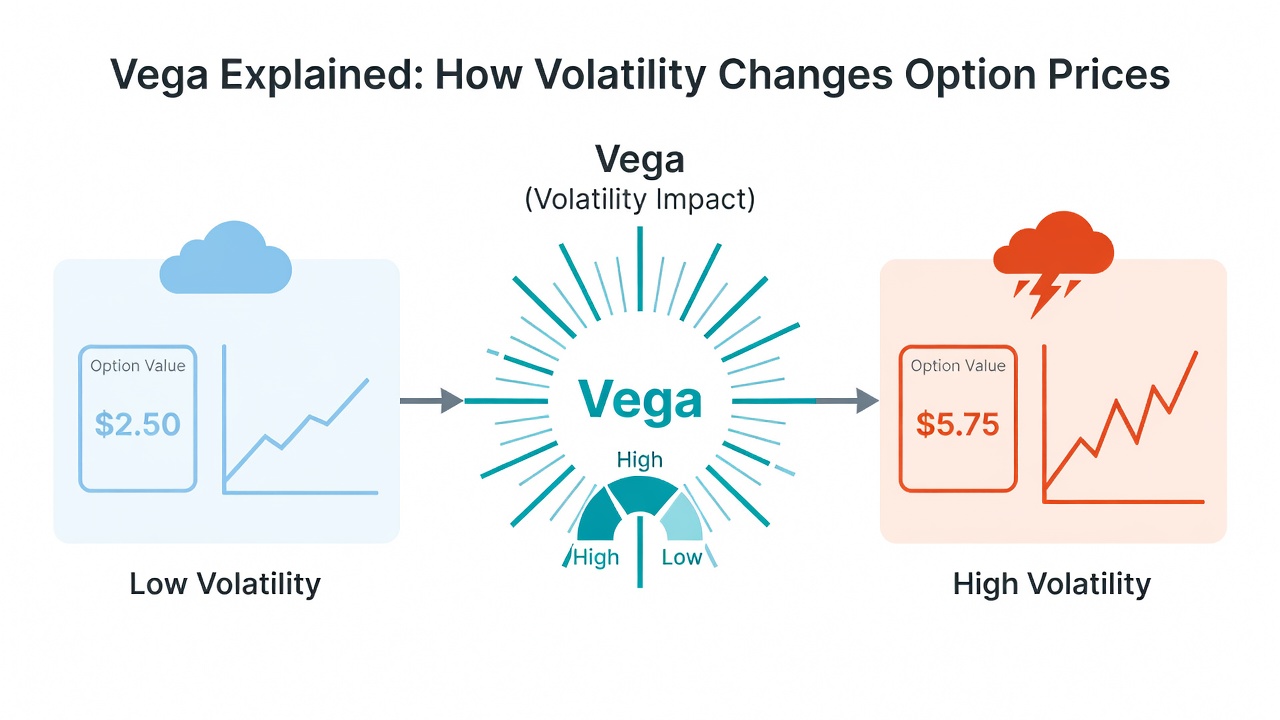
How Implied Volatility Drives Vega
To get comfortable with Vega, you first need to understand why buyers pay extra when uncertainty fills the market.
Options give you rights without obligations, meaning your maximum downside is capped while your upside potential can be substantial.
When a stock becomes wild and unpredictable, the chances of that stock making a massive move into the money increase.
Because of this increased opportunity for huge moves, option sellers demand higher compensation to take on that uncertain risk.
That extra compensation inflates the extrinsic value of the option contract, which we broke down back in Part 7.
Vega simply measures how sensitive that extrinsic price tag is to every single point shift in implied volatility.
Free For Traders
Know What To Trade BEFORE The Opening Bell
The Big Dipper Dashboard hands you curated high-probability setups every single morning — free.

Understanding the Numbers: What Does a Vega Value Actually Mean?
Let’s look at a concrete numeric example so you can see Vega in action on a real trading desk.
Imagine stock XYZ is trading at $100 per share, and you are eyeing a call option with a strike price of $100.
Suppose this option currently trades at a total price of $4.00, and its current implied volatility is 30 percent.
You look at your platform’s Greek display and see that this specific option has a Vega reading of 0.15.
If market anxiety increases and implied volatility rises by one point from 30 percent to 31 percent, your option price gains $0.15, rising to $4.15 without the stock price moving an inch.
Conversely, if implied volatility drops from 30 percent down to 29 percent, your option price drops by $0.15 to $3.85.
Since one standard contract controls 100 shares, as we covered in Part 11, a 0.15 Vega represents a $15 total dollar shift in contract value per percentage point of IV movement.

Call Options vs Put Options: Does Vega Treat Them Differently?
Beginners often assume that Vega works differently for call options than it does for put options.
Because calls profit on upward moves and puts profit on downward moves, it is easy to assume their Greeks invert completely.
But Vega is identical in direction for both long calls and long puts.
Rising implied volatility increases the extrinsic value of calls and puts simultaneously because both benefit from wider expected stock swings.
Whether you hold a bullish call or a bearish put, higher volatility inflates your contract’s total cost.
Here is a quick breakdown comparison showing how Vega impacts long and short options positions across calls and puts.
| Position Type | Vega Exposure | Impact of Rising IV | Impact of Falling IV |
|---|---|---|---|
| Long Call | Positive Vega | Option Premium Increases | Option Premium Decreases |
| Long Put | Positive Vega | Option Premium Increases | Option Premium Decreases |
| Short Call | Negative Vega | Position Loss Increases | Position Profit Increases |
| Short Put | Negative Vega | Position Loss Increases | Position Profit Increases |
As shown in the table, your position direction determines whether rising Vega helps your trade or hurts your trade balance.
High Vega vs Low Vega: Expiration and Strike Price Impact
Not all option contracts carry the exact same Vega reading on an options chain.
Two major factors dictate how high or low an option’s Vega will be: time until expiration and distance from the strike price.
Longer-dated options carry significantly higher Vega than short-dated options that expire in a few days.
That happens because long-term contracts have months of extrinsic value exposed to shifting market expectations.
Furthermore, at-the-money options possess the highest Vega values compared to deep in-the-money or far out-of-the-money options.
If you purchase a LEAP option with six months to expiration, a sudden shift in implied volatility will impact your trade far more than a stock price tick.
From Find Better Trades
The Pullback Isn’t A Warning. It’s Your Entry.
Slingshot catches the exact moment a trend pause is ready to rip back in your favor — built for explosive pullback continuations.

The Hurricane Insurance Analogy: Why Volatility Demands Higher Premiums
I find that insurance analogies work best when trying to make Vega feel completely intuitive.
Think of buying an option contract like buying a home insurance policy against severe weather damage.
If blue skies and calm sunny weather are forecasted for the next month, home insurance policies remain cheap because risk is low.
But if the weather service announces a Category 5 hurricane heading straight for your coastline, insurance companies instantly hike policy premiums.
The physical house has not changed, but the probability of severe damage has skyrocketed overnight.
In this setup, Vega represents how much insurance companies raise that monthly premium for every step up in storm danger level.
How Vega Changes as Market Volatility Shifts
Now let’s walk through our second numeric example to see how Vega impacts a multi-week swing trade.
Let’s say company ABC is heading into an upcoming quarterly earnings report with its stock trading at $50.
You purchase a 30-day call option for $3.00 with an implied volatility reading of 40 percent and a Vega of 0.10.
Over the next week, anticipation builds around earnings, pushing implied volatility up from 40 percent to 50 percent.
That 10-percentage-point surge in implied volatility multiplied by your 0.10 Vega adds $1.00 of extrinsic value to your contract.
Your $3.00 option is now worth $4.00, giving you a $100 profit per contract even if company ABC’s stock price did not move at all.
Understanding this dynamic allows you to capture gains from volatility expansions without needing massive stock direction moves.
Common Mistakes Beginners Make With This
1. Buying options right before major earnings announcements. Beginners often buy high-IV options expecting stock moves, only to get crushed by IV crush immediately after earnings release. When earnings pass, implied volatility plunges, destroying contract value even if the stock moves in their favor.
2. Confusing Vega with Delta. New traders mistake Vega’s impact for stock movement, forgetting that Vega tracks volatility shifts rather than stock price ticks. You can lose money on a call option while the stock goes up if implied volatility drops sharply enough.
3. Ignoring Vega on long-term contracts. Many buyers pick long-dated options assuming volatility will not affect them, but long-term contracts carry the highest Vega exposure on the chain. A broad market drop in implied volatility can drag down LEAP options significantly.
4. Holding short options during expanding volatility. Option sellers frequently forget that exploding IV inflates option prices, turning winning short trades into rapid losses. If you sell options, an unexpected surge in volatility forces you to buy them back at much higher prices.
Frequently Asked Questions About Vega and Volatility
Does Vega affect options that are deep in the money?
Deep in-the-money options have very little extrinsic value, which means their Vega is relatively low. Most of their pricing is driven by Delta and intrinsic value rather than volatility changes.
Is Vega positive or negative for call options?
Vega itself is expressed as a positive number for both call and put contracts. However, if you sell an option, your net Vega exposure becomes negative because rising volatility hurts your trade balance.
What is IV crush and how is Vega related to it?
IV crush happens when implied volatility collapses rapidly after an event like an earnings announcement passes. Because Vega dictates contract value per point of IV, a sharp drop in IV destroys contract price fast.
Which options have the highest Vega value on an option chain?
At-the-money options with long expiration dates carry the highest Vega values across the board. If you want maximum sensitivity to market volatility shifts, look at long-dated at-the-money options.
In Part 19 of our series, we are putting all four core Greeks together in The Greeks Cheat Sheet: Delta, Gamma, Theta, Vega in Plain English so you can analyze any trade setup in seconds.
📈 Want More? Join Our Free Trading Community
- Trading Strategy Guides Telegram — daily strategy tips and market insights
- Find Better Trades Telegram — free trade signals delivered to your phone
- Find Better Trades on YouTube — live trade breakdowns and tutorials