Gamma Explained: Why Delta Doesn’t Stay the Same in Options

📚 Beginner’s Guide to Options — Part 17 of 51
- Part 1: What Is an Option? The Absolute Basics Explained
- Part 2: Calls vs. Puts: The Two Types of Options You Need to Know
- Part 3: Strike Price Explained: What It Actually Means for Your Trade
- Part 4: Expiration Date Explained: Why It Changes Everything
- Part 5: Premium Explained: What You’re Really Paying For
- Part 6: In the Money vs. Out of the Money: A Beginner’s Breakdown
- Part 7: Intrinsic Value vs. Extrinsic Value: What Makes Up an Option’s Price
- Part 8: How Buying a Call Option Works, Step by Step
- Part 9: How Buying a Put Option Works, Step by Step
- Part 10: What Happens When an Option Expires? Every Outcome Explained
- Part 11: Options Contracts 101: What One Contract Actually Represents
- Part 12: How to Read an Options Chain Without Getting Overwhelmed
- Part 13: Bid, Ask, and Spread: What They Mean When You’re Trading Options
- Part 14: What Is Implied Volatility? A Beginner’s Plain-English Guide
- Part 15: Why Options Lose Value Over Time: Theta Explained Simply
- Part 16: Delta Explained: What It Really Tells You About Your Option
- Part 17: Gamma Explained: Why Delta Doesn’t Stay the Same (you are here)
⚡ Key Takeaways
- Gamma measures how much your Delta changes every time the stock price moves by one dollar.
- Gamma acts like an accelerator pedal, making options gain or lose value faster as the stock price shifts.
- Gamma is highest for at-the-money options near expiration, creating extreme profit potential for buyers and major risk for sellers.
— Ben, Find Better Trades
When I first started trading options, I thought Delta was a static number that told me exactly how much money I would make for every dollar move in a stock. Then I watched a trade gain value far faster than my initial Delta predicted, leaving me completely confused about what just happened.
Welcome to Part 17 of my beginner series, where we are tackling Gamma—the hidden engine that causes your Delta to constantly shift as stock prices move.
What Is Gamma? The Acceleration of Your Option
In Part 16 of this series, we learned that Delta measures how much an option’s price changes when the underlying stock moves by one dollar.
However, Delta is not a fixed number carved into stone.
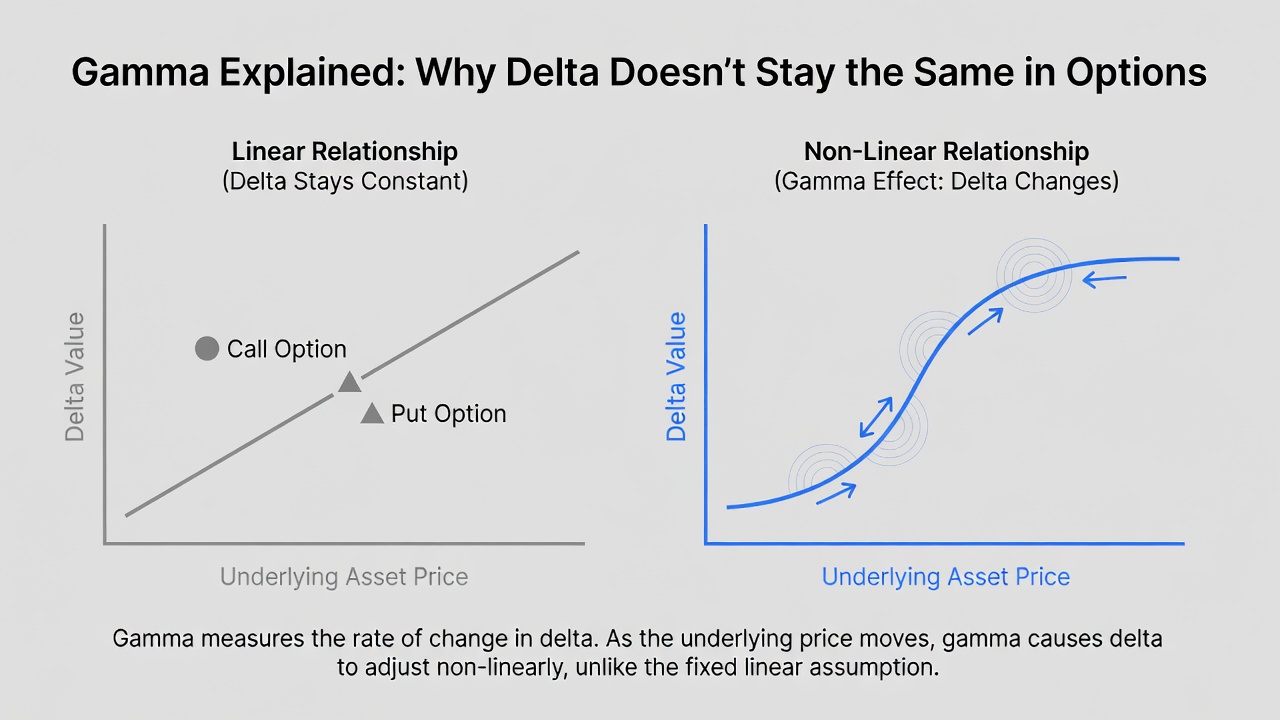
As the stock price moves up or down, Delta itself constantly shifts, and Gamma is the exact measurement of that shift.
Think of Delta as the speed of your car, while Gamma is the gas pedal that accelerates your speed.
If your car is cruising at 50 miles per hour, speed tells you how far you travel in an hour.
If you press down on the gas pedal, your speed increases to 60 or 70 miles per hour, and Gamma represents that pedal pressure.
Without Gamma, options trading would be completely linear and predictable.
Because Gamma exists, option prices can gain rapid momentum as a trade moves in your favor.
Why Delta Doesn’t Stay Static (And How Gamma Changes It)
Options contracts do not gain or lose value at a constant rate throughout their entire lifespan.
When a stock starts moving toward your strike price, your option becomes much more likely to finish in the money.
Because the probability of success rises, the option’s sensitivity to stock price movements increases dramatically.
Gamma tells you precisely how many points Delta will gain or lose for every one-dollar shift in the stock price.
If your option has a Delta of 0.30 and a Gamma of 0.05, a one-dollar rise in the stock increases your Delta to 0.35.
If the stock climbs another dollar, your Delta increases again, moving up to 0.40.
This compounding effect means your profits can accelerate as the stock continues to push in your direction.
Conversely, if the stock moves against you, Gamma works in reverse by shrinking your Delta and slowing down further losses.
Free For Traders
This Free Indicator Finds Overbought & Oversold Levels For You
Add the Red & Green Zone indicator to TradingView at zero cost. It does the level-hunting automatically on any chart.

A Step-by-Step Numeric Example of Gamma in Action
Let’s walk through a concrete math example to see how Gamma works in a real trade setup.
Suppose hypothetical stock XYZ is trading at $100 per share, and you buy a call option with a strike price of $105.
At the time of purchase, your call option has a Delta of 0.35 and a Gamma of 0.08.
If XYZ stock moves up from $100 to $101, your option contract gains $0.35 in value based on its initial Delta.
At the exact same time, Gamma adds 0.08 to your Delta, bringing your new Delta up to 0.43 for the next dollar move.
Now suppose XYZ stock climbs another dollar, moving from $101 to $102.
Because your Delta is now 0.43, this second dollar move adds $0.43 to your option contract price instead of just $0.35.
Gamma also updates your Delta again, adding another 0.08 to bring your Delta to 0.51 for any future upward move.
Over a two-dollar stock move, you did not just gain $0.70; you gained $0.78 total because Gamma increased your rate of profit along the way.

At the Money vs. Out of the Money: Where Gamma Lives
Gamma is not equal across all strike prices on an options chain table.
Gamma reaches its absolute highest peak when an option is At the Money (ATM), right where the stock price currently sits.
When an option is far Out of the Money (OTM), Gamma is extremely small because the option is unlikely to expire in the money.
When an option is deep In the Money (ITM), Gamma is also very small because Delta is already near 1.00 and cannot go higher.
At-the-money options sit on a razor’s edge where every dollar move drastically changes the odds of finishing in the money.
Because those odds shift dramatically around the strike price, Gamma must be high to adjust Delta rapidly.
Understanding this concept helps you pick strike prices based on how fast you want your Delta to change.
How Expiration Date Controls Gamma (The Risk Zone)
The expiration date acts as a giant amplifier for Gamma risk and reward.
Options with months left before expiration have low, smooth Gamma levels because time allows stock prices to fluctuate without immediate crisis.
As expiration day approaches, Gamma for at-the-money options skyrockets upward like a steep mountain peak.
Traders call the final week before expiration the high-Gamma risk zone.
During this final window, a tiny 50-cent move in the stock can swing an option’s Delta from 0.20 to 0.80 in minutes.
This rapid shift can create massive quick profits for option buyers, but devastating losses for unprepared traders.
If you prefer calmer trades with predictable price movements, sticking to longer expiration dates keeps Gamma manageable.
From Find Better Trades
Catch The Reversal Before It Wrecks Your Gains
Pattern-recognition scanner that spots bearish reversals early — protect your profits or time short entries with confidence.


Long Gamma vs. Short Gamma: Buyer vs. Seller Reality
Every options trade has two sides, and Gamma affects buyers and sellers in completely opposite ways.
When you buy a call or put option, you are Long Gamma, meaning Gamma works as your ally.
As an option buyer, when the trade moves in your favor, Gamma increases your Delta so you make money faster.
When the trade moves against you, Gamma decreases your Delta so your losses slow down as the option drops toward zero.
However, when you sell an option contract, you are Short Gamma, which creates a serious structural risk.
As an option seller, if the stock moves against your position, Gamma increases your losses at an accelerating rate.
For example, if you short a call option with a 0.20 Delta and a 0.10 Gamma, a stock rally pushes your Delta to 0.30, then 0.40, speeding up your losses every step of the way.
How to Read Gamma on an Option Chain Table
Most modern broker platforms display Gamma right alongside Delta, Theta, and Vega on their options chain display.
When looking at the table, you will notice Gamma is always expressed as a positive decimal number for both calls and puts.
Here is how Gamma looks across different strike prices for a hypothetical $100 stock:
| Strike Price | Moneyness | Initial Delta | Gamma | New Delta After +$1 Move |
|---|---|---|---|---|
| $90.00 | Deep ITM | 0.88 | 0.02 | 0.90 |
| $95.00 | Slightly ITM | 0.68 | 0.05 | 0.73 |
| $100.00 | At the Money (ATM) | 0.50 | 0.09 | 0.59 |
| $105.00 | Slightly OTM | 0.32 | 0.06 | 0.38 |
| $110.00 | Deep OTM | 0.14 | 0.03 | 0.17 |
Notice how Gamma peaks right at the $100 strike price where the stock is currently trading.
Notice also how Gamma tapers off significantly as you look higher at the $110 strike or lower at the $90 strike.
When evaluating contracts on your broker screen, compare Gamma values to see how aggressively Delta will shift on a price move.
If you want fast Delta growth, choose strike prices where Gamma is highest; if you want stability, choose strikes with lower Gamma.
Common Mistakes Beginners Make With This
The most frequent error beginners make is assuming Delta stays constant throughout the entire trade. They calculate potential gains using the entry Delta, only to be surprised when their position moves much faster or slower than planned.
Another major mistake is holding short option contracts into expiration week without realizing the high-Gamma danger. A small price move against a short contract near expiration can turn a winning credit trade into a massive loss in minutes.
New traders also frequently buy cheap, out-of-the-money options near expiration expecting high Gamma to save them. While Gamma is high, Theta time decay is decaying the contract far faster than Gamma can build Delta, leading to total loss.
Finally, beginners often ignore Gamma when sizing their trades. They take oversized positions on high-Gamma contracts, leading to extreme portfolio volatility that triggers emotional decisions and panic selling.
Gamma Options FAQs: Plain English Answers
Is high Gamma good or bad for option buyers?
High Gamma is generally positive for option buyers because it speeds up profit accumulation when the stock moves in your favor. However, high Gamma also means faster Delta drops if the stock moves against you, making the trade much more volatile overall.
Why is Gamma highest for at-the-money options?
At-the-money options sit right on the border between being profitable and worthless. Because a small stock move changes the outcome dramatically, the probability shifts fast, causing Delta to adjust at its maximum speed.
Can Gamma ever be a negative number?
Gamma is listed as a positive number on option chains for both calls and puts. However, when you sell an option contract (short position), you have negative Gamma exposure, meaning price moves against you will accelerate your losses.
How does Gamma relate to Theta time decay?
Gamma and Theta are closely connected opposites in options trading. Options with high Gamma near expiration also experience the fastest rate of Theta time decay, creating a race between price movement and time loss.
Next up in Part 18, we’ll conquer Vega—the Greek that shows you exactly how sudden swings in market volatility can send your option’s price soaring or crashing, even if the stock price doesn’t move a single cent.
📈 Want More? Join Our Free Trading Community
- Trading Strategy Guides Telegram — daily strategy tips and market insights
- Find Better Trades Telegram — free trade signals delivered to your phone
- Find Better Trades on YouTube — live trade breakdowns and tutorials