Options Theta Explained Simply: Why Options Lose Value Over Time

📚 Beginner’s Guide to Options — Part 15 of 51
- Part 1: What Is an Option? The Absolute Basics Explained
- Part 2: Calls vs. Puts: The Two Types of Options You Need to Know
- Part 3: Strike Price Explained: What It Actually Means for Your Trade
- Part 4: Expiration Date Explained: Why It Changes Everything
- Part 5: Premium Explained: What You’re Really Paying For
- Part 6: In the Money vs. Out of the Money: A Beginner’s Breakdown
- Part 7: Intrinsic Value vs. Extrinsic Value: What Makes Up an Option’s Price
- Part 8: How Buying a Call Option Works, Step by Step
- Part 9: How Buying a Put Option Works, Step by Step
- Part 10: What Happens When an Option Expires? Every Outcome Explained
- Part 11: Options Contracts 101: What One Contract Actually Represents
- Part 12: How to Read an Options Chain Without Getting Overwhelmed
- Part 13: Bid, Ask, and Spread: What They Mean When You’re Trading Options
- Part 14: What Is Implied Volatility? A Beginner’s Plain-English Guide
- Part 15: Why Options Lose Value Over Time: Theta Explained Simply (you are here)
⚡ Key Takeaways
- Theta measures how much money an option contract loses every single day purely because time is passing.
- Time decay is non-linear and accelerates rapidly during the final 30 to 45 days before expiration.
- Option buyers pay theta decay every day, while option sellers capture theta decay as potential profit.
— Ben, Find Better Trades
When I bought my first call option years ago, I watched the stock price stay completely flat for three days straight while my contract lost money every single afternoon. It felt like someone was reaching into my account and taking five dollars out while I slept.
Welcome to Part 15 of our beginner’s guide, where we are tackling options theta—the clock that eats away at your option’s price every calendar day.
What Is Theta and Why Does Your Option Lose Value?
In options trading, theta is one of the risk measures known as the Greeks, and it represents the daily rate of time decay.
Every option contract comes with a built-in expiration date, which we covered earlier in Part 4 of this series.
As calendar days pass, there is less time left for the stock to move in a direction that makes your contract profitable.
Because time represents opportunity, a contract with less time remaining is worth less money to potential buyers.
Theta measures this loss of value in dollar terms per share for every calendar day that elapses.
When you look at an options pricing chart, theta is typically displayed as a negative number for long options, such as -0.05.
A theta reading of -0.05 means your option contract will lose five cents of price value per share—or $5.00 total for a standard 100-share contract—every single day, assuming stock price and volatility stay unchanged.
Extrinsic Value: The Engine Behind Time Decay
To understand why theta exists, you must remember how an option contract is priced from the ground up.
In Part 7, we broke down how an option’s premium consists of two distinct components: intrinsic value and extrinsic value.
Intrinsic value is the real-world profit built into the contract based on where the stock is currently trading relative to your strike price.
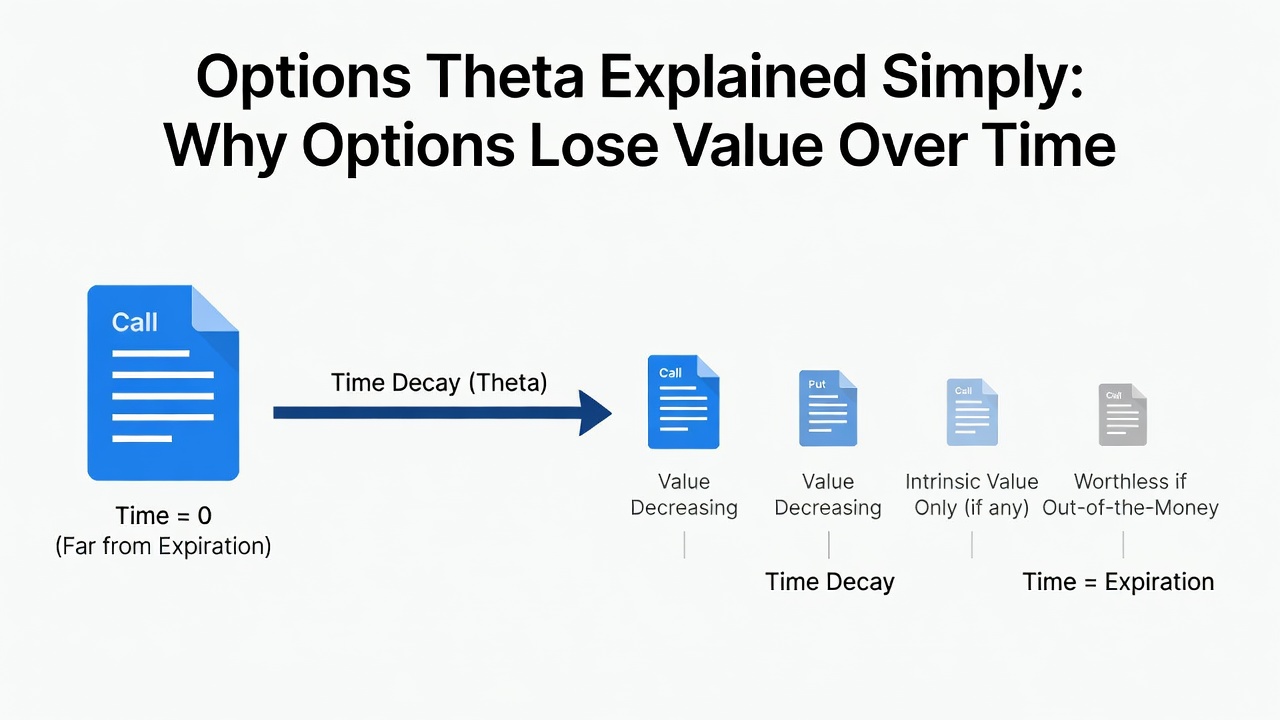
Extrinsic value, which traders often call time value, is the extra premium buyers pay for remaining time and potential future price movement.
Theta attacks extrinsic value exclusively.
Theta can never erode intrinsic value because intrinsic value is calculated purely from simple stock price mathematics.
If an option contract sits out of the money and consists of 100% extrinsic value, theta will eventually drag that option’s price all the way to zero on expiration day.
Free For Traders
Get Free Weekly Trade Ideas Sent Straight To Your Phone
Join thousands of traders who get high-probability setups delivered every week — no cost, no catch.

The Melting Ice Cube: A Plain-English Analogy for Theta
Here is the exact analogy I use when teaching brand new options traders in my trading room.
Imagine walking out of a store on a warm summer afternoon holding an ice sculpture.
When you first buy the sculpture, it is detailed, heavy, and worth top dollar.
However, as you sit on a bench with the sculpture, the ambient heat starts melting the outer edges into water.
The sun does not care whether you are paying attention or looking away; it melts a fraction of the ice every single hour.
By evening, if the sculpture has not been delivered to its final location, you are left holding a tiny puddle of water worth nothing.
In this comparison, the warmth of the sun is the passage of time, and the dripping water is theta stripping extrinsic value out of your trade.

Understanding the Theta Decay Curve: Why Speed Matters
A common beginner mistake is assuming that an option loses value in a straight, even line from day one until expiration.
In reality, theta decay behaves more like a boulder rolling down a steep hill.
When an option contract has ninety days remaining until expiration, daily time decay is extremely small and barely noticeable on your account balance.
Between ninety days and sixty days out, the option loses extrinsic value at a slow, predictable trickle.
However, once the clock ticks past forty-five days, the slope of time decay steepens dramatically.
The rate of loss accelerates aggressively during the final thirty days of the contract’s life.
By the final week before expiration, theta decay operates at maximum speed, burning through remaining extrinsic value rapidly.
Here is a detailed breakdown showing how an out-of-the-money option contract loses value over a ninety-day timeline:
| Days to Expiration | Contract Extrinsic Value | Daily Theta Loss | Decay Speed Description |
|---|---|---|---|
| 90 Days Out | $4.00 ($400 total) | -$0.02 (-$2/day) | Very Slow |
| 60 Days Out | $3.30 ($330 total) | -$0.03 (-$3/day) | Moderate |
| 30 Days Out | $2.10 ($210 total) | -$0.06 (-$6/day) | Fast Acceleration |
| 7 Days Out | $0.70 ($70 total) | -$0.10 (-$10/day) | Maximum Velocity |
A Step-by-Step Numerical Example of Theta Decay
Let’s run through a step-by-step example so you can see the daily math working on a real position.
Suppose hypothetical stock XYZ is trading at $100.00 per share on May 1st.
You buy a $105 call option expiring on June 15th, which gives you exactly forty-five days until expiration.
The premium for this call contract is $3.00 per share, meaning you pay $300 total for one contract as we covered in Part 11.
Because the current stock price ($100) is lower than your strike price ($105), this contract is out of the money and has zero intrinsic value.
That means the entire $3.00 price ($300 total) consists strictly of extrinsic time value.
Looking at your broker’s options chain, you see that the contract’s theta reading is -0.04.
Over the next five calendar days, stock XYZ stays completely stationary at $100.00 per share.
Each day, theta subtracts $0.04 per share from your option’s price, totaling $0.20 per share over five days.
On May 6th, with forty days remaining until expiration, your call option is now worth $2.80 per share ($280 total).
Even though the stock did not drop a single penny, your trade lost $20.00 in value simply because five calendar days passed.
From Find Better Trades
Know EXACTLY What To Trade At 9:30 AM
Morning Opening Range Breakout setups delivered before the bell. While everyone else is scrambling, you already have your plan.


Buying vs. Selling Options: Who Benefits From Theta?
Every options transaction involves two opposing traders: a buyer and a seller.
Understanding theta highlights why these two parties experience the passage of time in opposite ways.
When you purchase a call or a put option, you are net long options premium.
Long options positions carry negative theta, meaning time decay acts as a daily tax working against your account balance.
On the flip side, when you sell an option contract to open a trade, you are net short options premium.
Short option positions carry positive theta, meaning time decay works in your favor as daily profit.
For option sellers, every calendar day that passes without a major stock move reduces the value of the contract sold.
The seller can later buy back that same contract at a lower price, locking in the decay as net profit.
How to Use Theta to Choose Better Expiration Dates
Understanding how theta behaves will directly improve how you pick expiration dates for your trades.
When I buy call or put options for directional swing trades, I generally prefer buying contracts with 60 to 90 days remaining before expiration.
By purchasing longer-dated contracts, I position my trade on the flat, slow portion of the theta decay curve.
This decision gives my stock thesis room to develop without aggressive daily time decay destroying my capital.
If my timing on the stock entry is off by a few days, the mild theta loss buys me grace and flexibility.
In contrast, beginners who buy short-term weekly options with three days left face brutal theta rates that demand immediate stock moves just to break even.
Common Mistakes Beginners Make With This
Buying ultra-cheap options expiring in a few days expecting massive gains. Beginners often buy cheap options expiring in two or three days because the upfront price looks small. However, these contracts sit directly at the steepest point of the theta decay curve, meaning extrinsic value evaporates almost instantly if the stock does not make an immediate explosive move.
Forgetting that theta ticks down over weekends and market holidays. Options time decay is calculated using calendar days rather than trading days. Theta continues to drain value on Saturday and Sunday while markets are closed, which option pricing models adjust for when trading resumes Monday morning.
Holding losing long positions past the 30-day mark hoping for a miracle. Many new traders hold onto losing call or put options inside thirty days to expiration, hoping the stock turns around. As theta acceleration takes over, time decay drains the remaining extrinsic value far faster than most beginners realize.
Confusing intrinsic value decay with extrinsic value decay. New traders sometimes fear that deep in-the-money options will lose all their value to theta. Deep in-the-money contracts consist primarily of intrinsic value, which is completely immune to theta decay over time.
Selling options solely for positive theta without managing directional risk. Beginners who learn about positive theta often sell options recklessly to collect daily decay. While theta works in a seller’s favor, a sharp adverse stock move can generate losses that far exceed any daily theta income collected.
Options Time Decay FAQs
Do options lose value on weekends when the stock market is closed? Yes, options lose value over weekends because theta is calculated using 365 calendar days a year. Options pricing models account for Saturday and Sunday time decay, which is reflected in contract pricing when markets reopen on Monday morning.
Does theta affect in-the-money options the same way as out-of-the-money options? No, theta impacts out-of-the-money and at-the-money options much more severely relative to total price because their value is composed mostly or entirely of extrinsic value. In-the-money options carry intrinsic value, which never decays over time.
Can an option’s price rise even when theta is decaying it daily? Yes, an option’s price will rise if the underlying stock moves in your favorable direction fast enough to overcome daily theta losses. If price gains generated by stock movement exceed daily time decay costs, your contract total value increases.
Is theta decay constant throughout the entire life of an option contract? No, theta is dynamic and changes every day based on stock movement and time remaining until expiration. Theta decay remains slow when expiration is far away and accelerates sharply during the final 30 to 45 days before expiration.
Next up in Part 16 of our series, we will look at Delta—the Greek that shows you exactly how much your option price changes for every dollar move in the underlying stock.
📈 Want More? Join Our Free Trading Community
- Trading Strategy Guides Telegram — daily strategy tips and market insights
- Find Better Trades Telegram — free trade signals delivered to your phone
- Find Better Trades on YouTube — live trade breakdowns and tutorials