Risk Reversal Options Strategy: Low-Cost Directional Guide

📚 Options Strategies, Step by Step — Part 19 of 30
- Part 1: The Bull Call Spread: A Cheaper Way to Bet on a Rise
- Part 2: The Bear Put Spread: Profiting From a Drop With Defined Risk
- Part 3: Bull Put Credit Spreads: Getting Paid to Be Right on Direction
- Part 4: Bear Call Credit Spreads: Selling Premium Above Resistance
- Part 5: Managing Credit Spreads: Closing Early at 50% Profit
- Part 6: The Iron Butterfly: When You Expect a Stock to Pin a Price
- Part 7: The Reverse Iron Condor: Profiting From a Breakout
- Part 8: Short Straddles and Strangles: The Risk Nobody Explains
- Part 9: Calendar Spreads: Trading Time Decay Between Two Expirations
- Part 10: Diagonal Spreads: A Calendar Spread With a Directional Lean
- Part 11: The Double Diagonal: Income From a Range With Room to Breathe
- Part 12: Butterfly Spreads: Cheap Trades Aimed at a Target Price
- Part 13: Broken Wing Butterflies: Taking the Risk Off One Side
- Part 14: Christmas Tree Spreads: A Directional Butterfly Variation
- Part 15: Front Ratio Spreads: Extra Premium, Extra Risk
- Part 16: The Put Ratio Backspread: Cheap Crash Protection
- Part 17: The Jade Lizard: Premium With No Upside Risk
- Part 18: Synthetic Long Stock: Owning the Move With Options
- Part 19: Risk Reversals: A Directional Trade Funded by the Other Side (you are here)
⚡ Key Takeaways
- A risk reversal combines buying an out-of-the-money option in your target direction with selling an out-of-the-money option on the opposite side to pay for it.
- The trade drastically reduces or completely eliminates your upfront cash outlay, but it exposes you to real capital risk if the stock crashes through your short strike.
- Only enter a bullish risk reversal on a stock you are completely comfortable purchasing and owning at the short put strike price.
— Ben, Find Better Trades
A risk reversal is an options strategy where a trader buys an out-of-the-money option to bet on a stock’s direction while simultaneously selling an opposite out-of-the-money option to fund the purchase. Welcome to Part 19 of our series, where we take our directional trading up a level by getting the market to subsidize our upside bets.
The tool I use for this: Gravity Zone Indicator. Gravity Zone detects hidden institutional accumulation on TradingView — so you’re in the breakout while retail is still waiting for confirmation. See Gravity Zone In Action →
A lot of traders hesitate to buy long calls because premium decay burns cash every day the stock stays flat. The risk reversal solves that problem by making another trader pay for your ticket, but that discount comes with an obligation you need to understand clearly.
What Is a Risk Reversal in Options Trading?
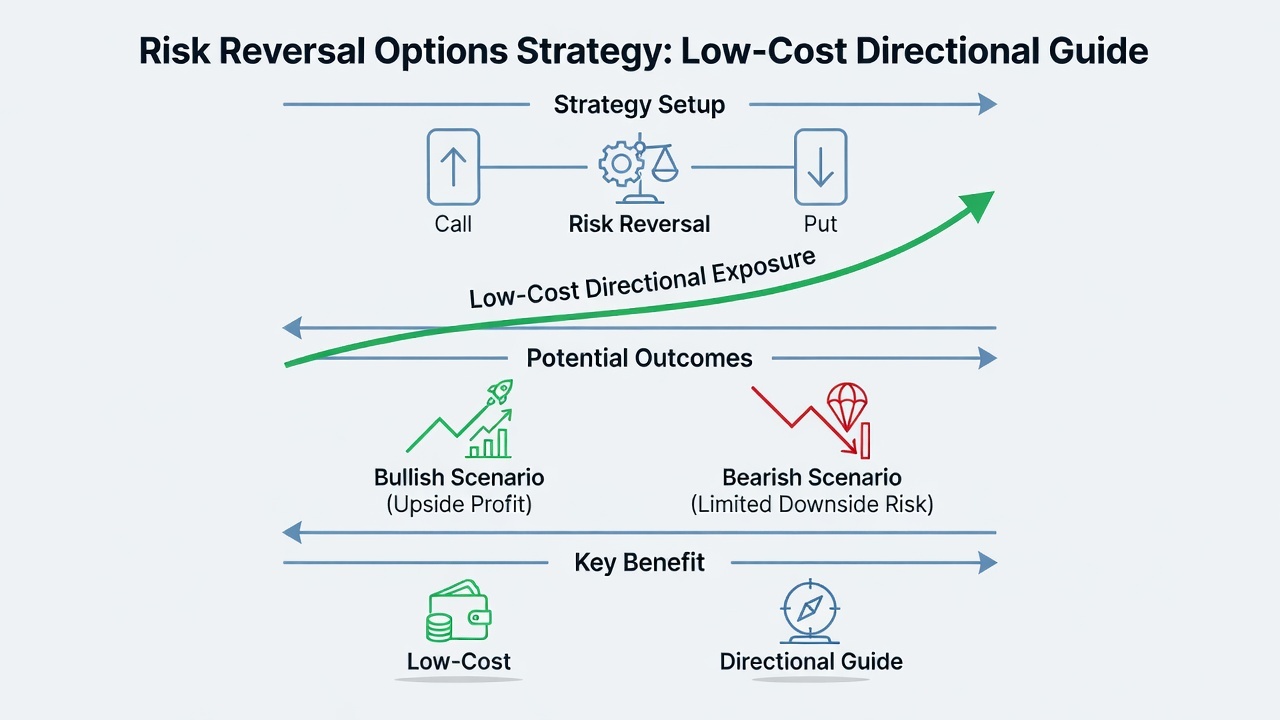
A risk reversal is an options strategy designed to give you strong directional exposure for little or no upfront cash. You construct it by purchasing an out-of-the-money option in the direction you expect the stock to move, while selling an out-of-the-money option on the opposite side.
In a standard bullish setup, you buy an out-of-the-money call and sell an out-of-the-money put with the same expiration date. The cash you collect from selling the put offsets the premium you pay for the call.
Traders often call this trade a collar in reverse or a synthetic trade with a gap in the middle. We covered synthetic long stock earlier in the series, where you bought an at-the-money call and sold an at-the-money put at the exact same strike.
With a risk reversal, the strikes are separated. This separation creates a dead zone between the two strikes where nothing happens to your account if the stock drifts sideways.
The goal is simple: capture pure upside participation without letting daily time decay eat away at your account balance while you wait for the move.
How a Bullish Risk Reversal Actually Works
A bullish risk reversal works by turning another trader’s downside fear into your upside fuel. When you want a stock to rise, you usually have to pay full market price for a call option.
By selling an out-of-the-money put simultaneously, you collect immediate cash upfront. That credit pays off most or all of the cost of the call you just bought.
If the cash from the short put matches the price of the long call dollar for dollar, you enter the trade for a net zero debit. When you enter for zero cost, you cannot lose a single penny simply from time passing if the stock stays between the strikes.
If the stock climbs above your long call strike, your call gains value just like any normal long call trade. You participate in the rally with unlimited upside potential.
However, if the stock plunges, your short put gets tested. You are legally obligated to buy 100 shares of the stock at that short strike price no matter how far the shares drop.
The Plain-English Analogy: A Real Estate Trade-Off
Think of a bullish risk reversal like making a unique deal with your neighbor down the street. You want to buy a voucher that lets you purchase a prime piece of commercial land nearby if its value booms next year.
That voucher costs $5,000, and you do not want to pull that cash out of your savings account today. To pay for the voucher, you offer your neighbor an agreement on their house down the street.
You tell them that if the housing market drops drastically, you promise to buy their house for $300,000 cash. Because you are taking on that crash risk for them, your neighbor hands you $5,000 cash today as an insurance premium.
You take that exact $5,000 payment from your neighbor and use it to buy your commercial land voucher. You spent zero net dollars out of your pocket to secure your upside bet.
If the commercial land booms, you make a handsome profit on your voucher while your neighbor’s house stays fine. But if the entire neighborhood values collapse, you are still forced to buy your neighbor’s house for $300,000.

Worked Example: Setting Up a Low-Cost Bullish Risk Reversal
Let us look at a concrete example using a hypothetical stock trading at $100 per share. You believe the company is poised for an earnings run over the next 45 days, but call options look expensive.
You decide to set up a bullish risk reversal instead of paying outright for a call. You look at options expiring in 45 days and locate the $110 strike call trading for $2.50 per share.
At the same time, you look down at the $90 strike put and see that it also trades for $2.50 per share. You buy the $110 call for $250 and sell the $90 put for $250, resulting in an exact $0 net cost, excluding broker fees.
Here is how the numbers shake out across three distinct outcomes at expiration:
| Stock Price at Expiration | $90 Put Value | $110 Call Value | Net Profit / Loss |
|---|---|---|---|
| $125.00 | Expires Worthless ($0) | Worth $15.00 ($1,500) | +$1,500 Profit |
| $100.00 | Expires Worthless ($0) | Expires Worthless ($0) | $0 (Break-Even) |
| $75.00 | In the Money by $15 ($1,500 loss) | Expires Worthless ($0) | -$1,500 Loss |
Notice what happens if the stock finishes anywhere between $90 and $110 at expiration. Both contracts expire completely worthless, and because you paid zero dollars to enter, you walk away without losing any cash.
If the stock climbs to $125, your $110 call is worth $15 per share, putting $1,500 of pure profit in your pocket. But if the stock drops to $75, you are assigned 100 shares at $90 each, sitting on an unrealized loss of $1,500.
The Bearish Risk Reversal: Playing the Downside on the House’s Dime
You can flip this entire mechanic upside down whenever you hold a strongly bearish conviction on an overextended stock. A bearish risk reversal allows you to buy downside put protection or speculation funded by an upside call sale.
In a bearish risk reversal, you purchase an out-of-the-money put below the current stock price. Simultaneously, you sell an out-of-the-money call above the current stock price to fund the position.
Let us say a stock trades at $50 per share, and you anticipate a sharp breakdown following an analyst downgrade. You buy a 45-day $45 strike put for $1.20 and sell a 45-day $55 strike call for $1.20.
Your net out-of-pocket entry cost is exactly zero dollars. If the stock falls to $35, your $45 put is worth $10 per share, yielding a $1,000 gain on a trade you entered for free.
The catch here is severe on the upside. If the stock surges past $55 on unexpected buyout rumors, you hold a naked short call with uncapped upside loss potential.
From Find Better Trades
Consistent Income. Any Market Direction.
A low-risk debit spread every Thursday, built to make steady returns whether the market runs up, down, or sideways.

Risk Reversal vs. Synthetic Long Stock: What Is the Real Difference?
Traders often confuse the risk reversal with synthetic long stock, which we explored in Part 18. Both trades create directional leverage by pairing a long option with a short option, but their strike selection changes your daily experience completely.
In a synthetic long stock position, both the call and the put share the exact same strike price, usually right at the money. That structure mimics 100 shares of real stock immediately, giving you 100 deltas from day one.
A risk reversal deliberately separates the two strikes, creating an out-of-the-money cushion. That cushion forms an inactive middle zone where small moves against you do not hurt your account balance.
| Trade Feature | Synthetic Long Stock | Bullish Risk Reversal |
|---|---|---|
| Strike Placement | Identical strikes (At the money) | Split strikes (OTM call and OTM put) |
| Delta at Open | Approximately 100 Delta | Usually 25 to 40 Delta |
| Flat Market Result | Zero loss, tracks stock dollar for dollar | Zero loss if stock stays between strikes |
| Margin Requirement | Full equity margin equivalent | Requires naked put or cash-secured margin |
The synthetic long gives you immediate speed, capturing gains on the very first cent the stock moves higher. In contrast, the risk reversal demands patience because the stock must travel beyond your out-of-the-money call strike before rapid profits kick in.
The advantage of the risk reversal is peace of mind during sideways churn. If the underlying stock chops around your entry price for three weeks, a risk reversal sits comfortably without suffering daily losses.
How to Manage and Exit a Risk Reversal
Managing a risk reversal requires strict capital rules because the short side of your trade carries significant exposure. You should never treat a zero-cost trade as a zero-risk trade.
When I trade a bullish risk reversal, my first rule is establishing my ownership plan for the short put. I only open the trade if I have the cash sitting in my account to buy the shares at the short put strike.
If the stock climbs toward your target and your long call gains substantial value, take profits proactively. A reliable exit guideline is closing the entire spread once your long call hits a 100% gain, or rolling the call strike up to lock in profit.
If the stock drops and threatens your short put strike, do not ignore it. I set a firm defensive stop: if the stock touches the short put strike, I close the short put to cap my downside risk.
Another effective management move is rolling the tested short put out in time for a credit. Rolling to a future expiration gives the underlying stock more runway to recover while keeping your upside call trade alive.
Common Mistakes Beginners Make With This
The most dangerous mistake beginners make is treating a risk reversal like free money because the net debit is zero. A zero-dollar entry does not mean zero risk, and a sharp drop will immediately trigger heavy margin calls if you are unprepared.
Another common blunder is choosing strikes that are too close to the current price. When you squeeze the strikes too close together, you eliminate the cushion that protects you from ordinary daily market noise.
Traders also frequently execute bearish risk reversals without holding the required margin level or understanding naked call risk. Selling an unhedged upside call exposes your portfolio to unlimited losses if the stock gaps up on news.
Finally, beginners often forget to plan for assignment on the short put contract. If the stock drops below your put strike near expiration, your broker will assign you 100 shares per contract, which requires sufficient cash or buying power.
Risk Reversal Options Strategy FAQs
Can you trade a risk reversal for a net credit?
Yes, you can easily set up a risk reversal for a net credit by selling an option that carries more premium than the option you buy. For example, selling a put closer to the current stock price while buying a call further out of the money puts cash into your account upfront. This provides a small profit cushion even if the stock goes nowhere.
What is the difference between a risk reversal and an options collar?
A collar is a protective strategy used by traders who already own 100 shares of the underlying stock, where they buy a protective put and sell a covered call. A risk reversal is typically opened without owning the underlying shares as a pure directional bet on future price movement. While the options used are similar, the capital requirements and profit profiles are completely different.
What happens if the stock finishes between both strikes at expiration?
If the stock price finishes between your short put strike and your long call strike at expiration, both options expire completely worthless. If you opened the trade for an even $0 net debit, you exit the position with no profit and no loss. You simply release your reserved margin and look for the next trade setup.
Why do institutional traders use risk reversals?
Institutional traders use risk reversals to express large directional opinions without spending millions of dollars in cash premium. It also allows them to take advantage of implied volatility skew, often selling puts where volatility is richly priced to buy relatively cheaper calls. This skew advantage lets them build asymmetrical reward-to-risk profiles on massive positions.
Now that you know how to use one side of the market to fund the other, get ready for Part 20, where we break down box spreads to show you why they exist on paper and why you should never trade them in real life.
📈 Want More? Join Our Free Trading Community
- Trading Strategy Guides Telegram — daily strategy tips and market insights
- Find Better Trades Telegram — free trade signals delivered to your phone
- Find Better Trades on YouTube — live trade breakdowns and tutorials