Jade Lizard Options Strategy: Complete Step-by-Step Guide


📚 Options Strategies, Step by Step — Part 17 of 30
- Part 1: The Bull Call Spread: A Cheaper Way to Bet on a Rise
- Part 2: The Bear Put Spread: Profiting From a Drop With Defined Risk
- Part 3: Bull Put Credit Spreads: Getting Paid to Be Right on Direction
- Part 4: Bear Call Credit Spreads: Selling Premium Above Resistance
- Part 5: Managing Credit Spreads: Closing Early at 50% Profit
- Part 6: The Iron Butterfly: When You Expect a Stock to Pin a Price
- Part 7: The Reverse Iron Condor: Profiting From a Breakout
- Part 8: Short Straddles and Strangles: The Risk Nobody Explains
- Part 9: Calendar Spreads: Trading Time Decay Between Two Expirations
- Part 10: Diagonal Spreads: A Calendar Spread With a Directional Lean
- Part 11: The Double Diagonal: Income From a Range With Room to Breathe
- Part 12: Butterfly Spreads: Cheap Trades Aimed at a Target Price
- Part 13: Broken Wing Butterflies: Taking the Risk Off One Side
- Part 14: Christmas Tree Spreads: A Directional Butterfly Variation
- Part 15: Front Ratio Spreads: Extra Premium, Extra Risk
- Part 16: The Put Ratio Backspread: Cheap Crash Protection
- Part 17: The Jade Lizard: Premium With No Upside Risk (you are here)
⚡ Key Takeaways
- A jade lizard is an options strategy combining an out-of-the-money bear call credit spread with a short out-of-the-money put.
- By collecting total premium greater than the width of the call spread, you completely eliminate upside risk.
- The entire risk of the trade sits on the downside, functioning exactly like a naked put if the underlying stock drops hard.
— Ben, Find Better Trades
The jade lizard options strategy is a net credit options position designed to collect income while completely eliminating upside loss. Welcome to Part 17 of our 30-part options series, where we bridge the gap between intermediate income structures and real trade management.
The tool I use for this: Gravity Zone Indicator. Gravity Zone detects hidden institutional accumulation on TradingView — so you’re in the breakout while retail is still waiting for confirmation. See Gravity Zone In Action →
Traders love selling premium, but getting blown out on a sudden gap higher ruins an otherwise steady strategy. The jade lizard fixes that specific problem through simple strike selection math.
What Is a Jade Lizard Options Strategy?
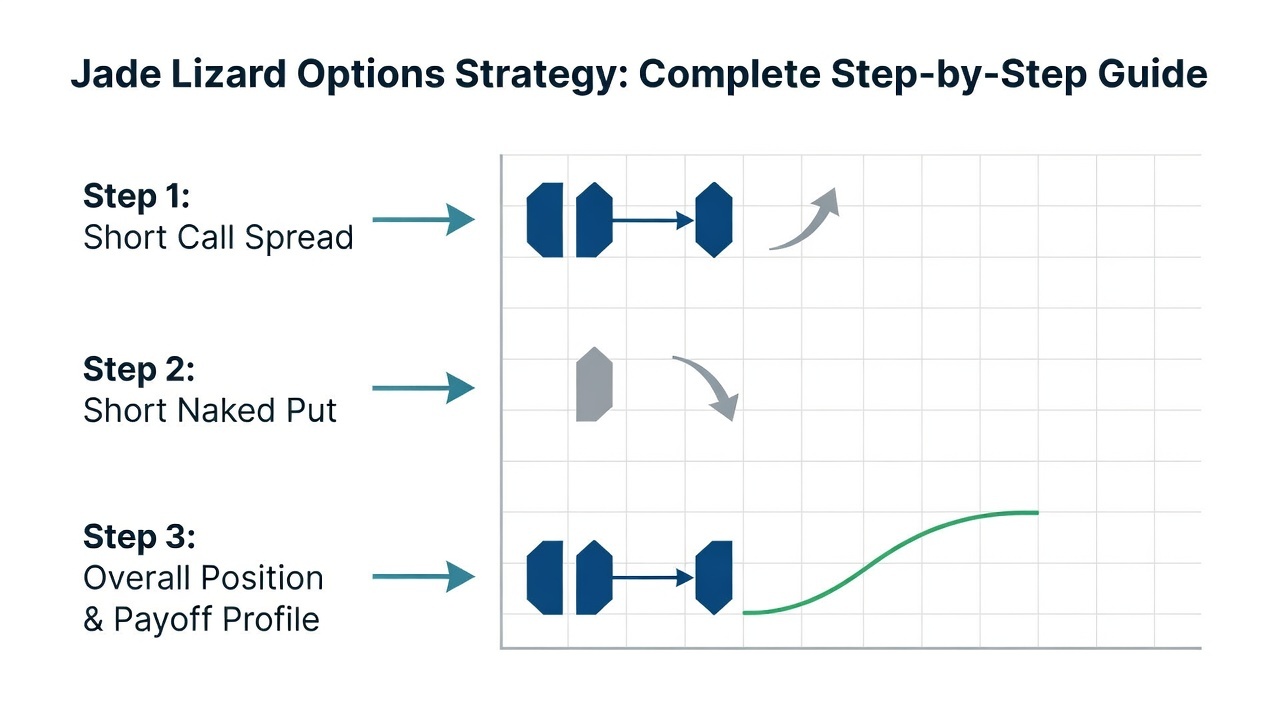
A jade lizard options strategy is a three-legged option trade created by selling an out-of-the-money put and simultaneously selling an out-of-the-money bear call credit spread. The strategy generates an upfront cash credit deposited directly into your brokerage account.
When you construct a jade lizard, your goal is to collect a total credit that is larger than the width of your call spread strikes. That mathematical condition is the secret sauce of the entire trade.
If the stock skyrockets past your call strikes, the call spread will lose money. However, the total credit you collected at entry is larger than that spread’s maximum loss, ensuring you still walk away with a net gain.
Think of it like putting up a flood barrier on a riverbank. You build the wall just high enough so that even if the highest spring tide washes right over the call spread, you still pocket a profit.
The trade does have real risk, but it sits exclusively beneath the market. If the stock collapses, you face the exact same downside risk as someone who sold a cash-secured put.
How to Construct the Jade Lizard Step by Step
Constructing a jade lizard requires opening three distinct contract legs within the same expiration cycle. We covered bear call spreads in Part 4, and here we pair one with an extra short put.
First, identify a stock that is trading sideways or carrying a slightly bullish bias. You also want elevated implied volatility, which juices option premiums and makes our mathematical requirement easier to hit.
Second, sell an out-of-the-money call at your chosen resistance level. Then, buy a call with a higher strike price to form a standard bear call credit spread.
Third, sell an out-of-the-money put well below the current stock price. This extra short put provides the additional cash credit needed to erase all upside risk.
Check your net credit immediately before submitting the trade order. Your total collected premium across all three legs must exceed the difference between your two call strikes.
The Math Behind Eliminating Upside Risk
Eliminating upside risk comes down to pure arithmetic rather than market forecasting. You do not need to guess where the stock will stop climbing if the math protects you automatically.
Let us say stock XYZ is trading at $100 per share. You decide to set up a jade lizard with 45 days until expiration.
You sell a 105 strike call and buy a 107 strike call, creating a call spread that is $2.00 wide. At the same time, you sell a 95 strike put.
Suppose the 105/107 call spread brings in a net credit of $0.80. Meanwhile, the 95 put brings in a credit of $1.50.
Your total credit received is $2.30 ($0.80 + $1.50). Because your call spread width is only $2.00, your maximum possible loss on that spread is $2.00.
If XYZ stock rockets to $150, your call spread loses $2.00. But since you kept $2.30 upfront, you still keep $0.30 per share ($30 per contract) in pure profit.
| Stock Price at Expiration | Call Spread Result ($105/$107) | Short Put Result ($95 Put) | Total Net Profit / Loss |
|---|---|---|---|
| Above $107 (e.g., $120.00) | -$2.00 Max Loss | Expires Worthless ($0) | +$0.30 Profit ($30) |
| Between $95 and $105 | Expires Worthless ($0) | Expires Worthless ($0) | +$2.30 Max Profit ($230) |
| At Breakeven ($92.70) | Expires Worthless ($0) | -$2.30 Loss | $0.00 Even |
| Below Breakeven (e.g., $85.00) | Expires Worthless ($0) | -$10.00 Loss | -$7.70 Loss (-$770) |

Downside Risk and Finding Your Breakeven
Downside risk is the primary hazard of running any jade lizard position. Because the short put is completely uncovered by a long put, your downside exposure is substantial.
Your breakeven price on the downside equals the short put strike minus the total net credit collected. Any drop below that calculated line represents a dollar-for-dollar loss.
Using our previous XYZ example, your short put strike is $95 and your total credit is $2.30. That places your downside breakeven price at exactly $92.70 per share.
If the stock drops to $90, your short put is in the money by $5.00. After subtracting your initial $2.30 credit, your net loss comes out to $2.70 per share ($270 per contract).
If the company goes to zero, your loss can be devastating without proper capital reserves. Never sell a jade lizard on a stock you are not completely comfortable owning at the short put strike price.
Jade Lizard vs. Iron Condor: What Is the Difference?
The difference between a jade lizard and an iron condor comes down to asymmetric risk allocation. An iron condor uses four legs to cap risk on both sides of the market.
In an iron condor, you buy a protective long put beneath your short put. That protection limits your downside loss, but buying that put reduces the total net credit you collect.
A jade lizard ditches that protective put entirely. By avoiding the purchase of an expensive long put, you pocket substantially more cash premium.
This extra credit allows you to cancel the upside risk completely, something an iron condor cannot do. An iron condor always leaves you exposed to a defined loss if the stock rallies hard.
Choose an iron condor when you want hard boundaries against a market crash. Choose a jade lizard when you want higher income, fear an upside breakout, and have the account margin to take assignment on the shares.
From Find Better Trades
Know Exactly Where The Big Money Steps In
Auto-plots institutional support & resistance zones from pure price action — no more guessing at levels.
 → See Magnizone

Ideal Market Conditions for Trading the Jade Lizard
The jade lizard thrives best in environments of elevated implied volatility. High volatility inflates option premiums across the board, making our credit requirement far easier to secure.
Look for stocks displaying an Implied Volatility Rank (IV Rank) above 40. When IV Rank is low, put premiums shrivel, and you will struggle to collect a credit larger than your call spread width.
I personally target stocks that have established strong, reliable technical support levels. Placing your short put strike below a multi-month support level gives your trade an extra layer of statistical defense.
Earnings announcements can provide great IV expansion, but beware of binary earnings surprises. If you trade through earnings, make sure your downside breakeven sits far outside the market’s expected move.
Avoid trading jade lizards in high-beta tech momentum names that can easily drop 30% in a week. Boring, mature dividend-paying stocks or broad index ETFs make much safer candidates for this trade structure.
How to Manage and Exit a Jade Lizard Trade
Managing a jade lizard requires discipline rather than sitting passively until expiration day. I aim to close the trade early whenever I can capture 50% of the total initial credit.
We discussed taking early profits at 50% back in Part 5, and that rule applies directly here. If you collected $2.30, place a good-till-canceled order to buy the entire package back for $1.15.
Closing early frees up your buying power and removes tail risk from unexpected late-cycle news. Time decay works rapidly in your favor between 45 and 21 days to expiration.
If the stock climbs hard, you do not need to do anything at all. You can let the position expire, absorb the call spread loss, and keep the residual net profit without lifting a finger.
If the stock drops aggressively toward your short put strike, you must take action. You can close the trade to take a controlled loss, or roll the untested call spread down closer to the money to collect extra defensive credit.
Common Mistakes Beginners Make With This
Beginners frequently fail to collect enough credit to cover the call spread width. If you collect $1.80 on a $2.00 call spread, you still carry $0.20 of upside risk, defeating the entire purpose of the trade structure.
Another frequent mistake is treating the jade lizard like a defined-risk trade on both sides. Many new traders forget that the short put has naked-style risk, leaving them blindsided when a sell-off triggers massive margin expansion.
Traders also run into trouble by choosing stocks with poor liquidity and wide bid-ask spreads. When an underlying option chain has twenty-cent spreads on every leg, slippage eats away your upside credit advantage instantly.
Finally, beginners often freeze when the underlying price breaks below their short put strike. Without a pre-planned exit point or assignment plan, an unhedged drop can wipe out several months of small credit gains.
Frequently Asked Questions About the Jade Lizard
What is a reverse jade lizard?
A reverse jade lizard is the mirror image of this trade, built using a bull put spread and an uncovered short call. It is designed to eliminate downside risk entirely while taking short call risk on the upside.
Can you lose money on a jade lizard if the stock goes up?
No, you cannot lose money on the upside if the trade was set up correctly. As long as your total credit collected exceeds the strike width of your call spread, your upside return will always remain positive.
What happens if my short put gets assigned?
If the stock finishes below your short put strike at expiration, you will be assigned 100 shares per contract at the strike price. Your actual cost basis on those shares will be discounted by the total initial credit collected across all three legs.
How much buying power does a jade lizard require?
A jade lizard requires margin equivalent to a naked short put or a cash-secured put. Because the call spread side is fully defined and covered by its own credit, brokerages do not double-charge margin for both sides simultaneously.
Next up, we are diving into synthetic long stock, showing you how to duplicate 100 shares of stock using pure options leverage.
📈 Want More? Join Our Free Trading Community
- Trading Strategy Guides Telegram — daily strategy tips and market insights
- Find Better Trades Telegram — free trade signals delivered to your phone
- Find Better Trades on YouTube — live trade breakdowns and tutorials
Lesson 74 of 75 in the free Options Trading Course.
← Previous: You Can Be Right on NVDA Tonight and Still Lose Money
Next: Synthetic Long Stock: Replicate 100 Shares With Options →