Put Ratio Backspread: How to Trade Cheap Crash Protection

📚 Options Strategies, Step by Step — Part 16 of 30
- Part 1: The Bull Call Spread: A Cheaper Way to Bet on a Rise
- Part 2: The Bear Put Spread: Profiting From a Drop With Defined Risk
- Part 3: Bull Put Credit Spreads: Getting Paid to Be Right on Direction
- Part 4: Bear Call Credit Spreads: Selling Premium Above Resistance
- Part 5: Managing Credit Spreads: Closing Early at 50% Profit
- Part 6: The Iron Butterfly: When You Expect a Stock to Pin a Price
- Part 7: The Reverse Iron Condor: Profiting From a Breakout
- Part 8: Short Straddles and Strangles: The Risk Nobody Explains
- Part 9: Calendar Spreads: Trading Time Decay Between Two Expirations
- Part 10: Diagonal Spreads: A Calendar Spread With a Directional Lean
- Part 11: The Double Diagonal: Income From a Range With Room to Breathe
- Part 12: Butterfly Spreads: Cheap Trades Aimed at a Target Price
- Part 13: Broken Wing Butterflies: Taking the Risk Off One Side
- Part 14: Christmas Tree Spreads: A Directional Butterfly Variation
- Part 15: Front Ratio Spreads: Extra Premium, Extra Risk
- Part 16: The Put Ratio Backspread: Cheap Crash Protection (you are here)
⚡ Key Takeaways
- A put ratio backspread sells fewer higher-strike puts to finance buying a larger number of lower-strike puts, often for a net credit.
- The strategy gives you uncapped profit potential during severe market drops while removing all risk to the upside if the stock rallies.
- Your primary danger is the valley of death, which produces maximum loss if the underlying stock settles directly on your long strike at expiration.
— Ben, Find Better Trades
A put ratio backspread is an options strategy where you sell one higher-strike put and buy two or more lower-strike puts, typically entered for a net credit or for zero cost. In Part 16 of our series, we are flipping ratio spreads on their head to build downside disaster insurance that pays you if the market crashes or completely ignores your hedge and runs higher.
Most traders waste thousands of dollars buying expensive straight puts that bleed to death from time decay when the market moves sideways. I prefer structures that eliminate upside risk while giving me violent gains if a real panic occurs.
What Is a Put Ratio Backspread?
A put ratio backspread is an asymmetric bearish options strategy designed to capitalize on severe downward price shocks without paying heavy upfront premiums. You construct it by selling fewer puts closer to the current stock price and buying more puts further away out of the money.
In Part 15, we looked at front ratio spreads where you sold extra contracts to collect huge cash upfront. Backspreads do the exact opposite by purchasing more contracts than you sell.
Think of this trade like buying disaster insurance funded by a minor fender-bender policy. You agree to take on the small repair risk near the current price so an insurer hands you catastrophic flood coverage for little to no out-of-pocket cash.
Because you buy more options than you write, you end up net long options contracts overall. This means you do not face the unlimited naked margin exposure that makes front ratios dangerous for retail accounts.
If the stock collapses, your multiple long puts explode in value far faster than the single short put can harm you. If the stock unexpectedly rallies to new all-time highs, the entire position simply expires worthless and you keep any initial credit collected.
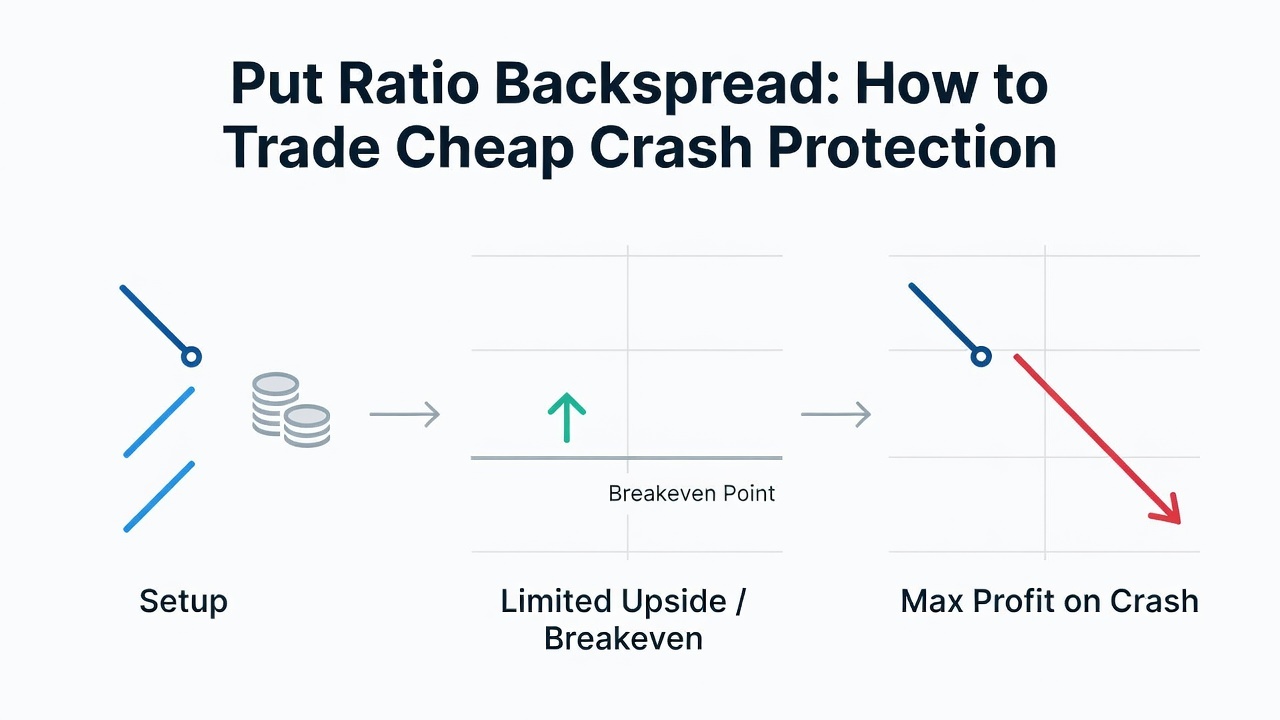
How the 1×2 Ratio Put Backspread Is Structured
The standard structure for a put ratio backspread is the 1×2 ratio, meaning you sell one higher-strike put for every two lower-strike puts you purchase. Both legs share the exact same expiration date and target the same underlying asset.
Here is how the anatomy of a standard 1×2 put ratio backspread looks on paper:
- Sell 1 Put: At-the-money or slightly out-of-the-money (higher strike).
- Buy 2 Puts: Out-of-the-money (lower strike).
- Target Entry Cost: Even money or a small net credit.
The premium collected from the single short put is used directly to finance the purchase of the two cheaper long puts. In an ideal setup, the income from the short put completely covers the cost of both long puts.
When you structure the trade for a net credit, you create a zero-risk scenario to the upside. If the stock takes off like a rocket, every option expires worthless, leaving that initial credit safely in your pocket.
However, this strategy is not a simple free lunch. The trade-off for getting free downside leverage lives squarely in the price gap between your strikes.
The Valley of Death: Understanding Maximum Risk
The valley of death is the price zone around your lower long strike where the put ratio backspread suffers its maximum possible loss. It is the single most important structural feature to understand before placing this trade.
Your maximum loss occurs if the underlying stock pins exactly at your long put strike at expiration. At that specific price, your two long puts expire completely worthless, while your short put is fully in the money against you.
The math for maximum loss is calculated as the distance between the two strikes minus any net credit collected at trade entry. If you entered for a net debit, that debit is added to the strike width instead.
Let us say you trade a 5-point wide spread and collect a $0.50 credit. If the stock lands right on your long strike at expiration, you lose $4.50 per share, or $450 per spread.
This risk profile makes the strategy poorly suited for stocks expected to grind slowly downward. You need the market to either rip higher or fall off a cliff to escape the valley alive.

Worked Example 1: Protecting an Index with a Net Credit
Let us walk through a concrete example using an index exchange-traded fund trading at $100 per share. You want downside crash insurance for the next 45 days, but you refuse to pay a hefty debit for standard long puts.
You sell one $100 put for $4.00 to fund your insurance purchase. Simultaneously, you buy two $95 puts for $1.80 each, costing you $3.60 total.
Because you brought in $4.00 and spent $3.60, you establish the entire position for a net credit of $0.40, which translates to $40 in cash. Let us review the payoff table across several expiration prices:
| Stock Price at Expiration | Short 100 Put Value | Two Long 95 Puts Value | Net Profit / Loss |
|---|---|---|---|
| $110.00 (Big Rally) | $0.00 | $0.00 | +$40 (Net Credit Kept) |
| $100.00 (Unchanged) | $0.00 | $0.00 | +$40 (Net Credit Kept) |
| $95.00 (Max Loss Pin) | -$500 | $0.00 | -$460 (Max Loss) |
| $90.40 (Breakeven) | -$960 | +$920 | $0 (Breakeven) |
| $80.00 (Severe Crash) | -$2,000 | +$3,000 | +$1,040 (Profit) |
Notice what happened at $80.00: while your short put lost $2,000, your pair of long puts gained $3,000, creating a handsome $1,040 profit. Meanwhile, anywhere above $100 leaves you with a safe $40 gain without requiring a dime of defense.
The lower breakeven point sits at $90.40, which is calculated as the lower strike minus the maximum loss per share ($95 – $4.60). Every dollar the stock drops below $90.40 adds another $100 of pure profit to your account.
Greeks and the Volatility Advantage of Long Vega
A put ratio backspread carries positive vega because you own two long contracts while selling only one short contract. This gives you a powerful structural edge during market routs that beginners regularly overlook.
When stock prices plummet, implied volatility almost always surges higher. Because you are net long options, expanding volatility pumps extrinsic value into your two long puts far faster than it inflates your single short put.
This dynamic means a backspread can become profitable days or weeks before the stock actually crosses your lower expiration breakeven. An aggressive spike in volatility can rescue a trade that is technically sitting inside the danger zone.
The trade-off comes in the form of negative theta, or time decay. While your short put decays in your favor, your two long puts lose value at twice that pace each day the market stands still.
If the stock slowly slips toward your long strike while volatility stays muted, time decay will quickly chew into your position. You want violent price action, not a gentle drift.
From Find Better Trades
Consistent Income. Any Market Direction.
A low-risk debit spread every Thursday, built to make steady returns whether the market runs up, down, or sideways.
 → See Layered Options

Worked Example 2: Individual Stock Earnings Collapse
Let us look at a single stock setup where XYZ is trading at $200 before an unpredictable product launch. You anticipate either a massive selloff or an indifferent rally, but you want zero risk if the stock pops.
You sell one $195 put for $9.00 and buy two $185 puts for $4.00 each. You take in $9.00 and spend $8.00, generating an upfront net credit of $1.00, or $100 cash.
The strike spread is $10.00 wide, which means your maximum loss inside the valley of death is $900 ($10 spread minus the $1 credit). Your downside breakeven price sits at $176.00 ($185 long strike minus $9 max loss).
| XYZ Stock Price | Short 195 Put Result | Two Long 185 Puts Result | Overall P&L |
|---|---|---|---|
| $220.00 | Expires Worthless | Expire Worthless | +$100 (Credit) |
| $185.00 | -$1,000 Loss | $0.00 Value | -$900 (Max Loss) |
| $160.00 | -$3,500 Loss | +$5,000 Gain | +$1,600 Profit |
If XYZ releases disastrous news and craters to $160, you walk away with a $1,600 profit on a trade that cost you nothing out of pocket to establish. If the launch goes well and the stock pushes to $220, you keep your initial $100 credit.
The only real failure occurs if XYZ drifts down lazily and parks near $185 as expiration arrives. In that scenario, your long puts offer no intrinsic protection to offset the short put obligation.
How to Enter, Manage, and Exit the Trade
When entering a put ratio backspread, aim for an expiration cycle between 45 and 60 days out. This gives the underlying asset sufficient time to make a massive directional run while buffering you against aggressive near-term time decay.
Always negotiate your strikes to ensure you collect a small net credit or at worst establish the trade at dead even money. Paying a sizable debit ruins the beauty of the trade because it creates downside loss potential if the stock rallies.
I set an automatic profit target whenever the trade gains 50% of the strike width after a crash, or whenever implied volatility doubles. When volatility spikes violently, close the position early rather than waiting around for expiration settlement.
If the stock slides downward slowly and hovers near your higher short strike with 21 days remaining, close the trade immediately. Do not sit passively in a trade that is drifting toward the valley of death as time decay accelerates.
Treat this strategy as an aggressive crash hedge or earnings collapse play rather than a core monthly income generator. It is designed to turn sudden panic into sudden capital.
Common Mistakes Beginners Make With Put Ratio Backspreads
Paying a large debit to open the trade: Many beginners choose strikes too far apart and pay an expensive debit to get into the position. If you pay a debit, you lose money when the stock rallies, ruining the primary benefit of the structure.
Holding contracts all the way to expiration: New traders frequently freeze when the stock drops toward the long strike, hoping it will crash further before the closing bell. Holding an expiring backspread near the long strike guarantees you absorb the maximum theoretical loss.
Deploying the strategy on slow, low-beta stocks: Using a put backspread on a utility stock or slow consumer staple is usually a mistake. This strategy requires rapid, volatile momentum to leap over the valley of death and generate real profits.
Sizing the position too large: Traders look at the upside credit and think the trade is completely risk-free, so they trade 10 or 20 contracts. When the underlying drops straight into the valley of death, the resulting loss can severely damage a small account.
Ignoring post-earnings volatility crush: If you trade this through an earnings report and the stock moves down only modestly, the collapse in implied volatility will destroy your two long puts. You need an enormous move to counteract the loss of extrinsic value after scheduled binary announcements.
Frequently Asked Questions About Put Ratio Backspreads
Can you lose money on a put ratio backspread if the stock goes up? If you establish the trade for a net credit or zero cost, you cannot lose money if the stock goes up. Every option expires worthless, and you retain the original credit you collected at the start.
Why use a put ratio backspread instead of buying a simple put? A standard long put suffers constant time decay and requires you to pay upfront capital that is lost if the stock rises. The put ratio backspread eliminates that cost by funding your long puts with a short put contract.
What is the best strike width for a 1×2 put backspread? Most traders look for a strike width that allows the trade to be placed for a small net credit while keeping the long strikes within realistic reach. For a $100 stock, a 5-point width usually offers an optimal balance between cost and probability.
When should I exit a put ratio backspread that goes wrong? You should exit the trade if the stock drops slowly toward your long strike and reaches 21 days to expiration. Getting out early preserves your capital and prevents terminal decay inside the maximum loss zone.
In Part 17, we will look at an income structure with a unique safety net: the Jade Lizard, and how it lets you collect rich option premium with zero risk to the upside.
📈 Want More? Join Our Free Trading Community
- Trading Strategy Guides Telegram — daily strategy tips and market insights
- Find Better Trades Telegram — free trade signals delivered to your phone
- Find Better Trades on YouTube — live trade breakdowns and tutorials
Lesson 72 of 75 in the free Options Trading Course.
← Previous: Front Ratio Spreads: How to Trade Call and Put Ratios
Next: You Can Be Right on NVDA Tonight and Still Lose Money →